
 by
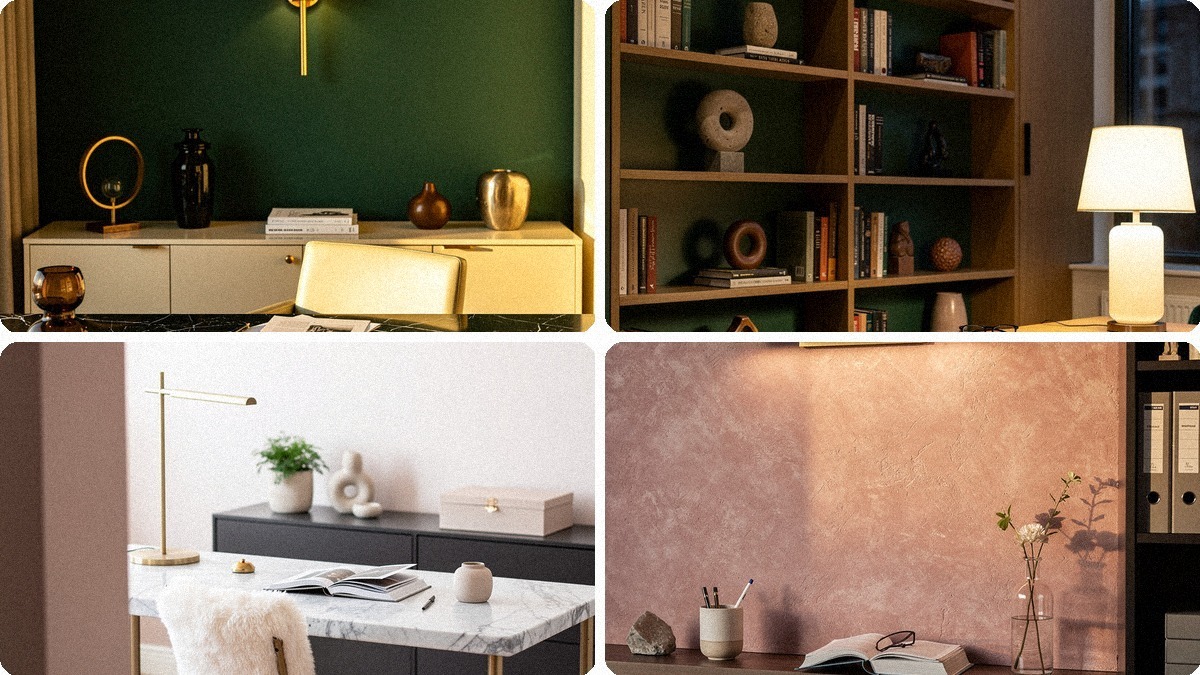
by I've built a lot of home offices, and the ones that feel luxurious have almost nothing to do with square footage. My first attempt was a disaster: a $2,000 desk crammed into a windowless alcove with a task light that gave me headaches by 2pm. The room looked expensive and felt like a waiting area. The shift came when I stopped buying "luxury" and started thinking about how the corner itself could work. These 17 ideas are what I use now, from the paint color that changes the whole day to the one light swap that costs less than dinner out!
Is a Luxury Corner Office Worth It?
Yes, more than almost any other home office change. A corner gives you two walls of support, a natural focal point, and a sense of enclosure that a single wall can't provide.
The desk is just the surface. The corner is the room.
I've set up offices in spare bedrooms, converted closets, and once in a hallway that was technically a fire code violation. The ones that worked had one thing in common: they used a corner as a container. The mistake I see most often is treating a corner office as a smaller version of a full room. It's not.
A corner office is a different species. The light comes from one direction, the walls meet at an angle, and the space behind you is usually open to the rest of the house. That openness is both the challenge and the opportunity. The challenge is noise and distraction.
The opportunity is that the corner can feel like a retreat within a larger space, not a punishment for lacking a dedicated room.
Where the Budget Actually Goes
The most expensive part of a corner office project is almost always the desk. A solid oak top runs $300 to $1,200, while a custom built-in can double that. The second-biggest line item is storage: custom millwork runs $2,000 to $8,000, while IKEA BILLY units painted to match can get you 80 percent of the look for under $400.
The good news is that the two cheapest moves, paint and lighting, deliver the most impact. A gallon of Farrow & Ball Green Smoke and a weekend of work changes the whole mood of the room.
A $200 pendant from CB2 Primitivo creates a pool of light that defines the workspace and leaves the rest of the room in softer shadow. The contrast is what makes a room feel luxurious, not the brightness.
If you're planning the whole room, our home office layout guide covers traffic flow and clearance rules.
What Adds the Most Value
A clean, current corner with real materials you can style. Rough ranges I've seen: a budget refresh (paint, shelves, task lighting, organization) runs about $200 to $800; a mid-range redo with a solid oak desk and built-in bookcase feel lands around $1,500 to $5,000; a full custom millwork rebuild starts near $7,000 and climbs. Start at the bottom, you'll be surprised how far it goes.
The paint color is the first decision because everything else responds to it. A dark green corner against light walls creates a visual room within a room.
The eye reads the green as a boundary, and that boundary is what lets you focus. I've worked in corners painted white, gray, and blue, and the dark green is the only one that made me forget I was in a corner of a larger space. The color does the work of walls that aren't there.
- paint the corner in a deep, warm green
- float a thick oak desk across the angle
- add a single statement sconce above the desk
- build a vertical bookshelf wall in the dead space
- layer a sheepskin over a simple task chair
- install a floating shelf at eye level for the objects you actually touch
- swap the overhead light for a pendant that pools
- add a small rug to anchor the corner zone
- use a brass desk lamp with a heavy base
- add one living thing that doesn't need coddling
- hide the cables in a single raceway painted to match
- add a small tray for the daily essentials
- use a linen pinboard instead of a whiteboard
- add a small side table for coffee and nothing else
- install a picture light above the pinboard or shelf
- use a single sculptural object as a paperweight
- add a throw blanket in mohair or cashmere for the reading breaks
1paint the corner in a deep, warm green
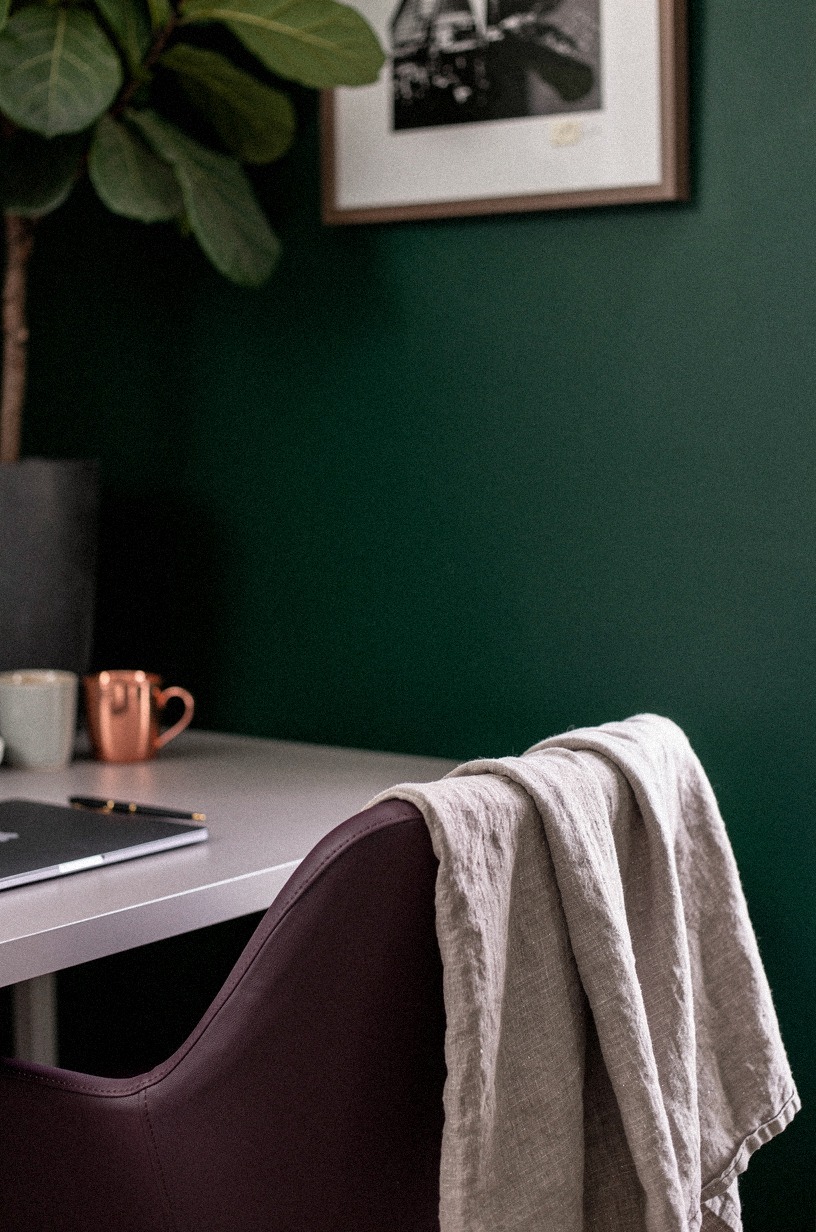
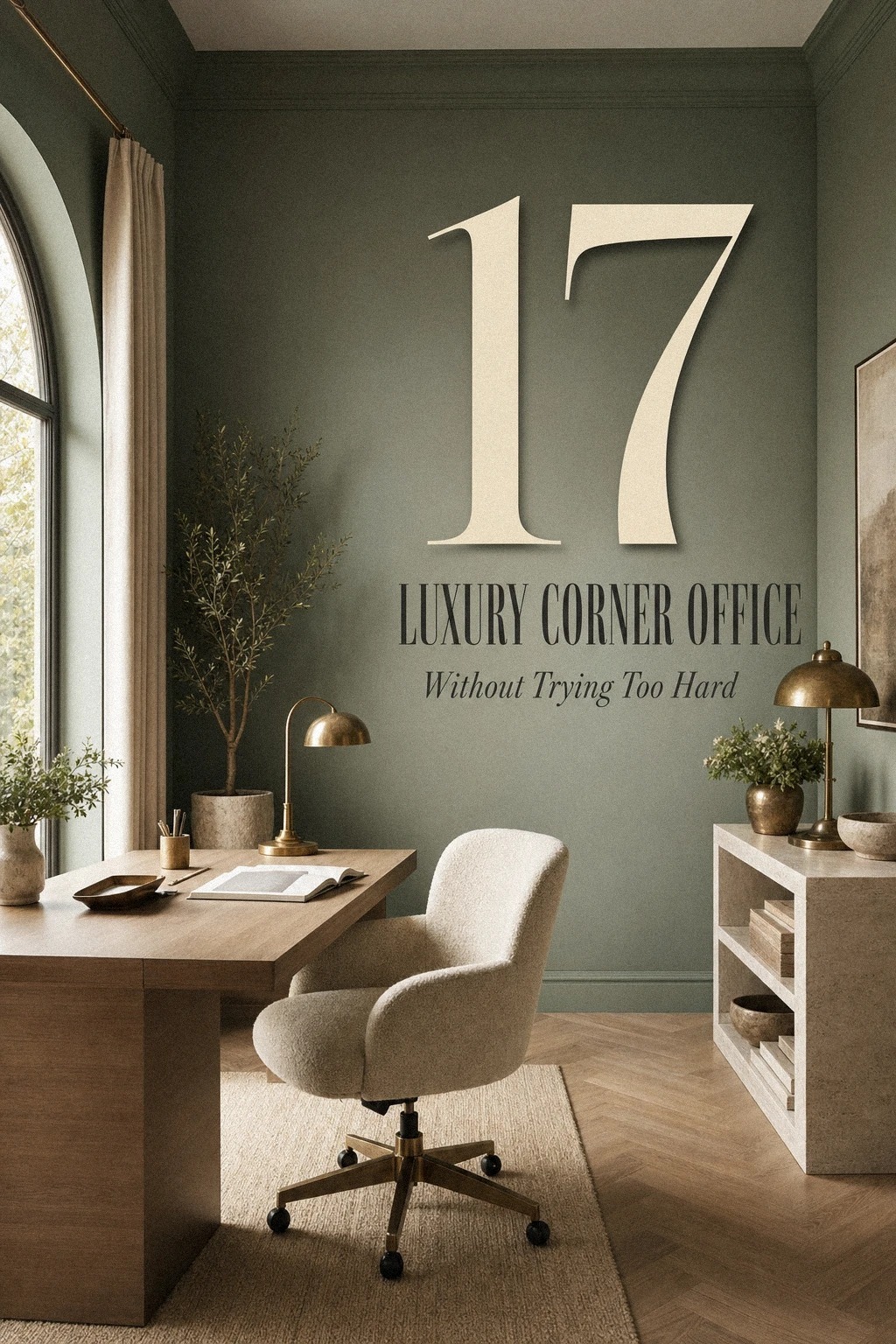
A dark corner sounds wrong until you see it. Farrow & Ball Green Smoke (No. 47) wraps a corner office in something that feels like a library without the dust. The color changes with the light: warm and olive in the morning, moody and almost black by evening.
I've tried lighter greens and they read as minty or sickly against screens. This one absorbs glare and gives your eye a place to rest when you look up from the monitor.
The move is keeping the ceiling and the wall outside the corner light. Benjamin Moore White Dove OC-17 on the surrounding walls makes the corner feel intentional, not accidental. Two coats, a good brush on the edges, and you're done in a weekend.
If you're worried about the dark closing in, add a mirror on the adjacent wall. It bounces the window light back into the corner and doubles the sense of space.
2float a thick oak desk across the angle
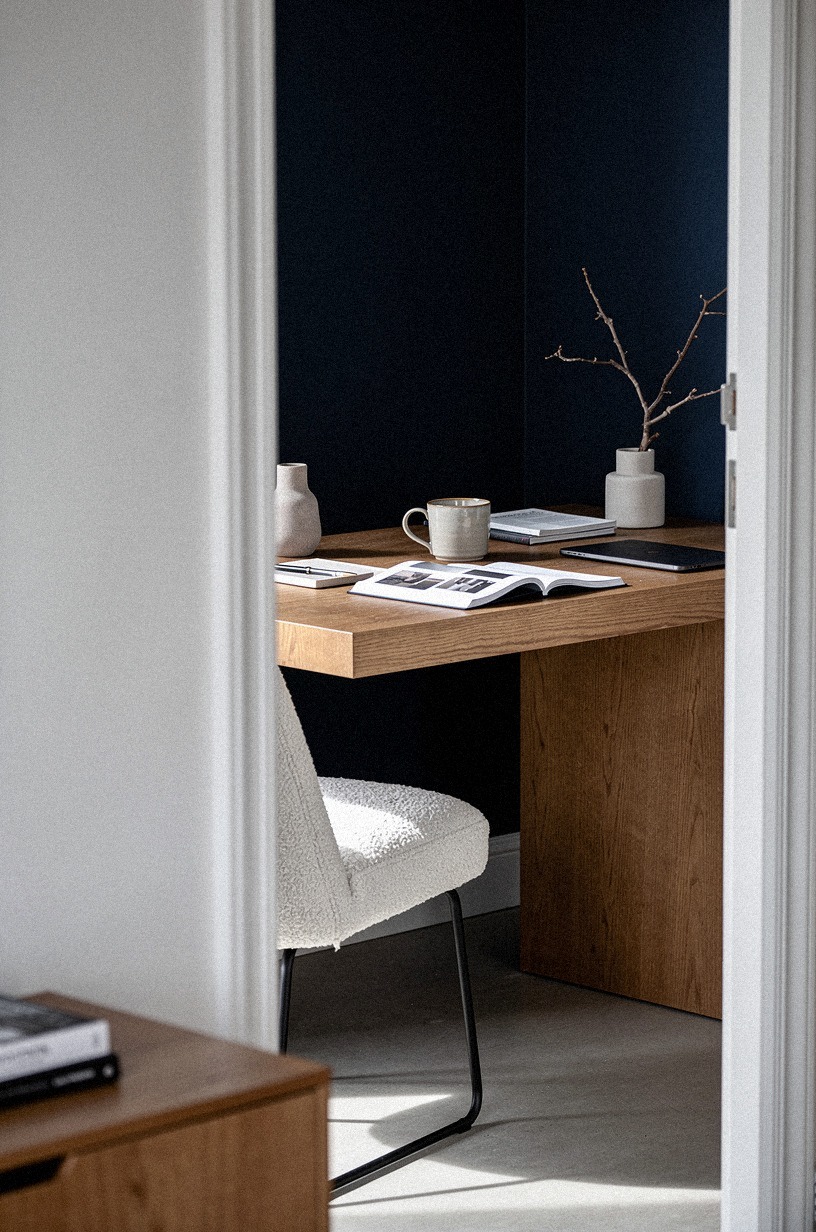
The worst corner offices put the desk against one wall and waste the angle. A floating desk that spans the corner uses every inch and creates a wrap-around workspace that feels like a cockpit. I built mine from 3/4-inch solid white oak, 30 inches deep at the center, tapering to 24 at the sides.
The grain runs continuous across the joint, and that detail is what makes it look built-in rather than plopped down.
You'll need a steel bracket system hidden underneath, or a cantilevered frame bolted to studs. The desk height should sit at 29 to 30 inches (74-76 cm), standard for typing.
Go deeper than 30 inches and you lose knee clearance; shallower than 24 and there's no room for a laptop plus a notebook. I learned that the hard way with my first build, which was 22 inches deep and felt like a shelf.
If you're planning the whole room, our home office layout guide covers traffic flow and clearance rules.
3add a single statement sconce above the desk
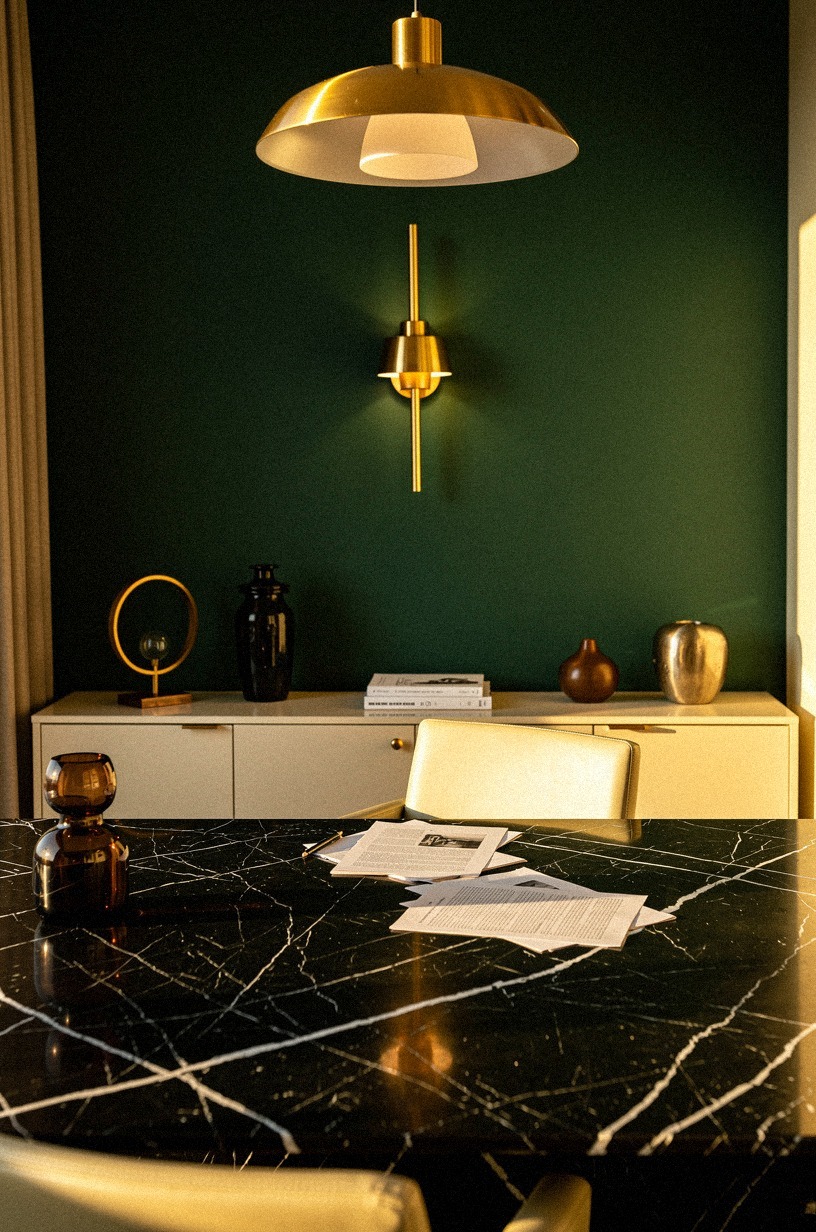
Overhead lights kill the mood of a corner office. A single statement sconce mounted above the desk at eye level when seated creates a pool of warm light that defines the workspace without flooding the whole room. I've used a brass swing-arm sconce with a linen shade in three offices now, and the effect is the same every time: the corner feels like a library at 5pm, even at 10am.
The bulb matters as much as the fixture. A dimmable LED at 2700K, no higher.
Anything above 3000K reads as clinical and fights the warm tones you're building. The sconce should be hardwired if you own, or plug-in with a cord cover if you rent.
The cord cover is the detail most people skip, and it's the detail that makes the difference between a room that looks considered and one that looks temporary. If you're redoing the whole lighting plan, our lighting layout guide has switch logic and placement rules.
4build a vertical bookshelf wall in the dead space
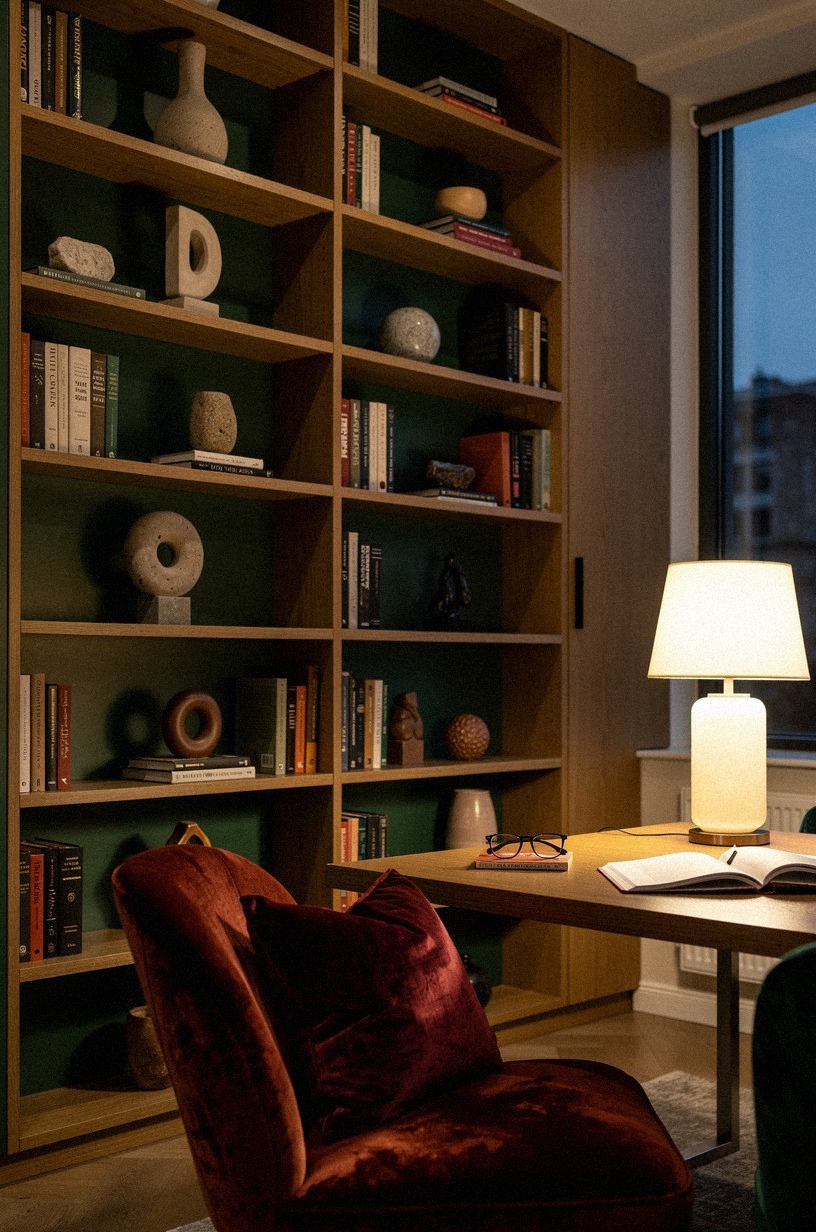
The space above a corner desk is usually empty drywall. A floor-to-ceiling bookcase turns that dead zone into the room's best feature.
I've used IKEA BILLY units painted in Benjamin Moore Cheating Heart (1617) to create a built-in look for under $400. The move is adding crown molding at the top and baseboard trim at the bottom so the units read as architecture, not furniture.
For a real investment, custom millwork runs $2,000 to $8,000 depending on height and finish. A custom bookcase in cerused white oak with integrated lighting is the kind of detail that makes a corner office feel like it belongs in a magazine. (Not that magazine look is the goal. The goal is that you want to sit down and work.)
5layer a sheepskin over a simple task chair
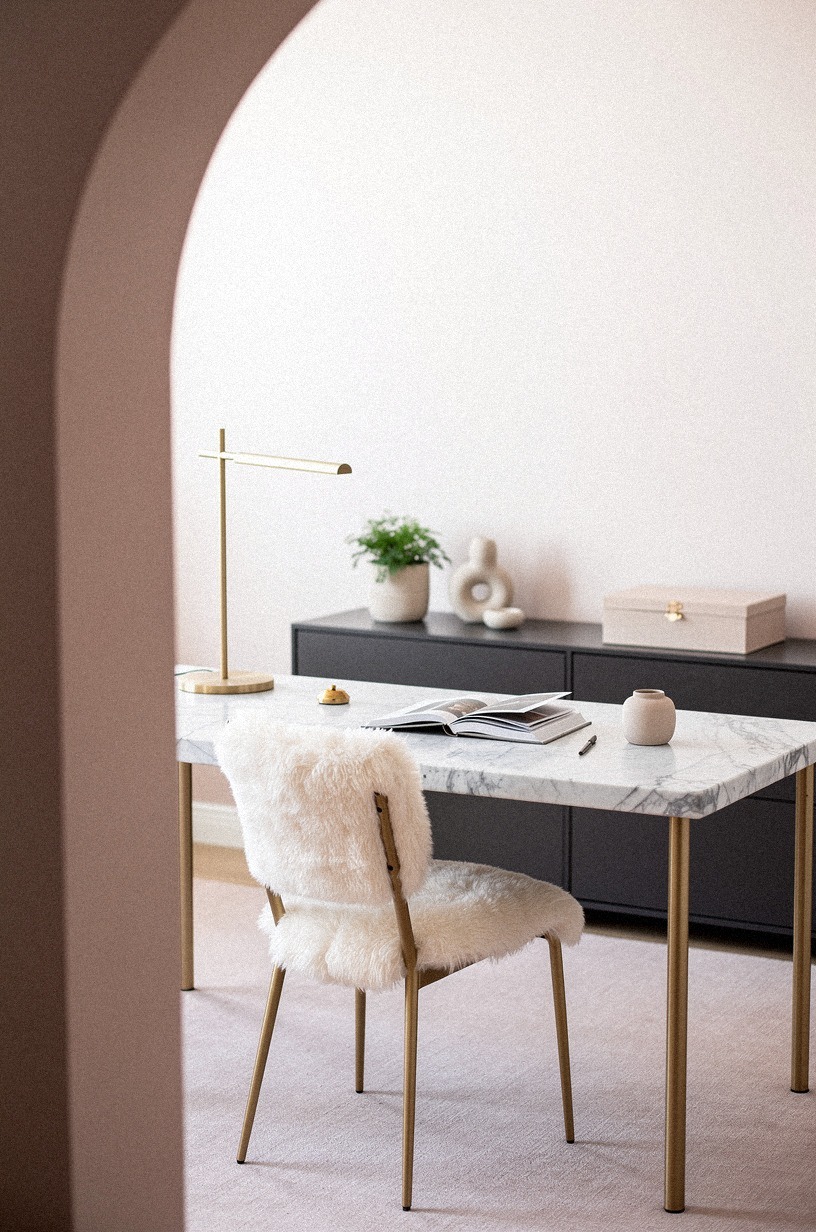
The chair is where you spend eight hours. A sheepskin throw over a basic ergonomic chair transforms it without the $1,500 price tag of designer seating. The texture breaks up the office silhouette and adds warmth that leather or mesh can't touch.
I've used this move in three offices now, and it works every single time!
The chair itself should give you 42 inches (107 cm) of clearance behind it to roll back without hitting the wall. If your corner is tight, consider a saddle stool or a kneeling chair for part of the day.
Your back will thank you. And the sheepskin?
Shake it outside once a month and it lasts for years.
6install a floating shelf at eye level for the objects you actually touch
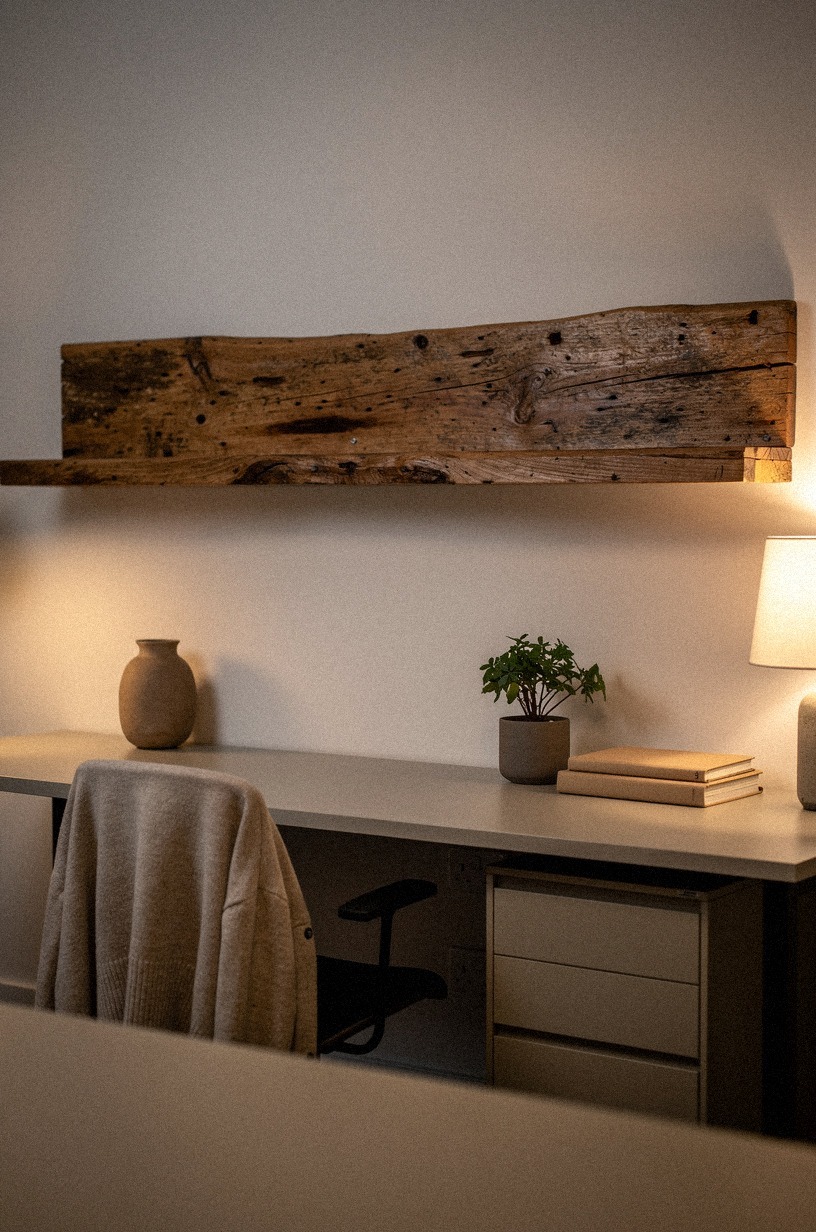
A desk surface collects clutter. A single floating shelf at eye level, 12 inches deep, holds the three things you reach for: a notebook, a good pen, a small plant.
Everything else goes in drawers. I use white oak for the shelf and brass brackets for the hardware.
The combination reads as warm and intentional.
The shelf should sit 12 to 16 inches (30-41 cm) above the desk surface. Any higher and you're reaching; any lower and it blocks your sightline.
I've tried glass shelves and they look cold. I've tried painted MDF and they look cheap.
Solid wood, oiled not varnished, is the sweet spot. The oil lets the grain show through and you can refresh it in ten minutes every year.
7swap the overhead light for a pendant that pools
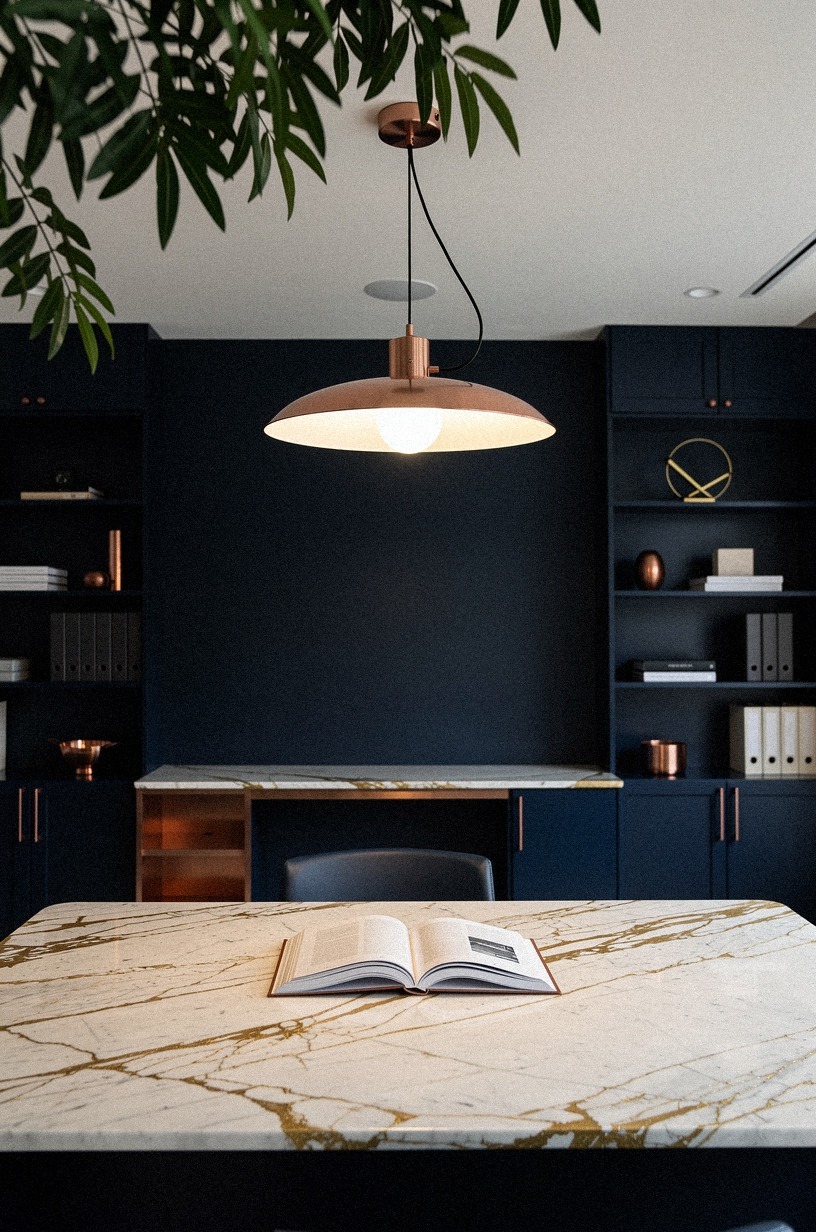
Recessed cans are the default in most offices and they're terrible for corners. A single pendant light with a wide shade, hung low over the desk, creates a pool of light that defines the workspace and leaves the rest of the room in softer shadow. The contrast is what makes a room feel luxurious, not the brightness.
Look for a shade in linen, rattan, or aged metal. The CB2 Primitivo line has pendants in natural materials that cost around $200 and look like they cost $800.
The bulb should be dimmable LED at 2700K. Install it on a separate switch from any other lights so you can control the mood without standing up.
If you're redoing the whole ceiling plan, our lighting layout guide has switch logic and placement rules.
8add a small rug to anchor the corner zone
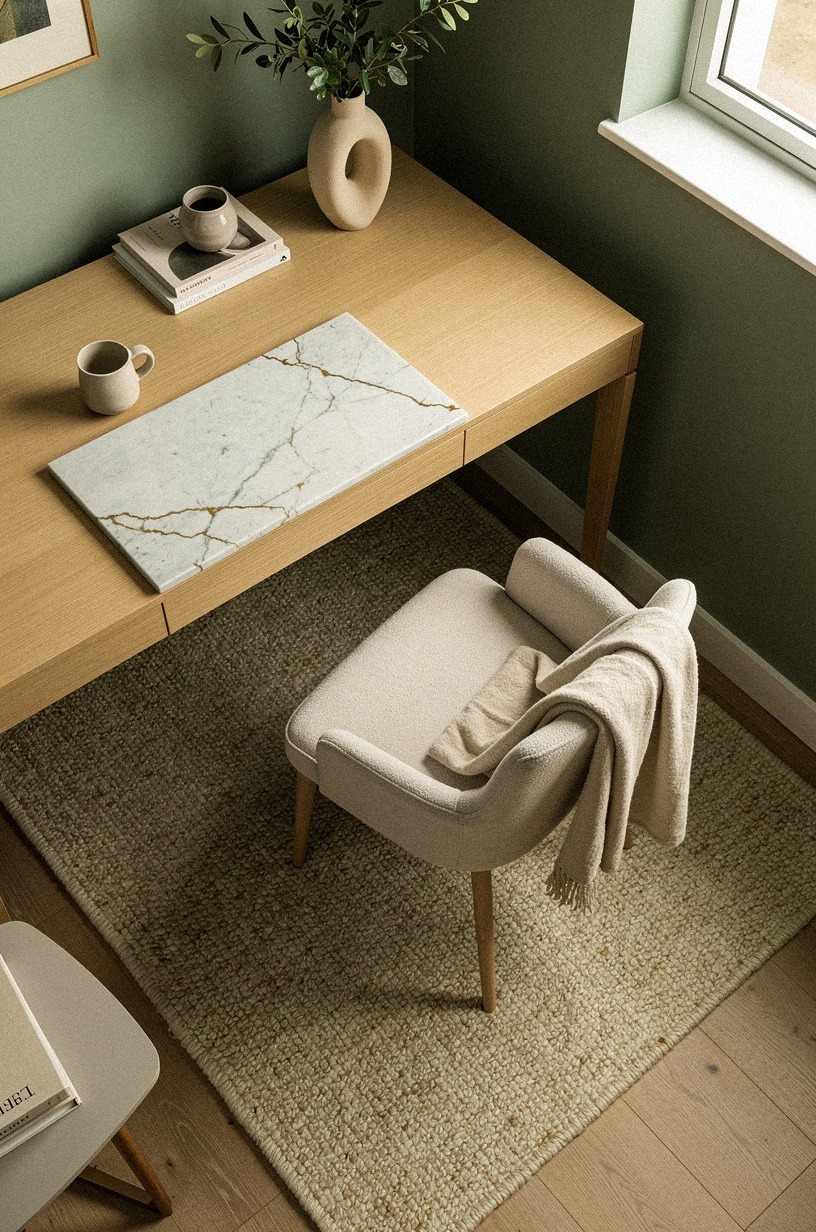
A rug in an office sounds odd until you try it. A 5×7 or 6×9 wool rug under the desk and chair defines the corner as a zone and adds warmth that hard floors can't match.
I've used a flat-weave wool rug in a warm oatmeal tone that hides coffee stains and feels good underfoot during long calls. The texture is the point.
A rug that feels like a blanket under your feet changes the whole day.
The rug should sit 6 to 12 inches beyond the desk edge on all sides. Too small and it looks like a bath mat; too large and it fights the rest of the room. The pile should be low, under 1/2 inch, so the chair rolls smoothly.
I've tried high-pile rugs and they're a nightmare with casters. The flat-weave is the sweet spot: warm, durable, and practical.
If you're choosing a rug for a small office, our small rug guide has size rules by room type.
9use a brass desk lamp with a heavy base
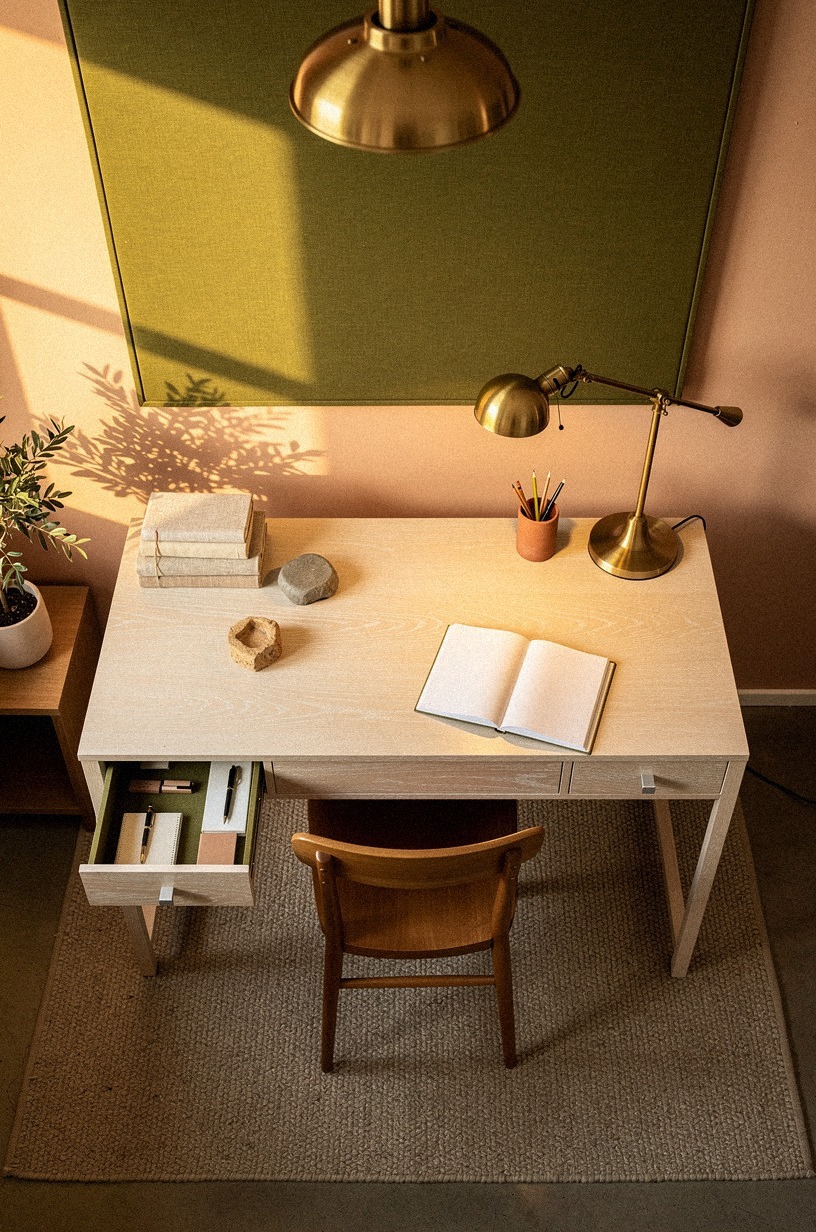
The task lamp is the most personal object in a corner office. You touch it every day, adjust it, move it.
A brass or bronze lamp with a heavy base won't tip when you reach for it. I use one with an articulating arm and a ceramic shade that focuses light downward.
The ceramic warms the beam before it hits the page.
Skip the LED ring lights and the color-changing gimmicks. A simple incandescent-style bulb at 40 watts, dimmed to 60 percent, is what your eyes want at 9pm.
The heavy base is non-negotiable. I've knocked over too many plastic lamps to count, and the crash always happens during a call!
10add one living thing that doesn't need coddling
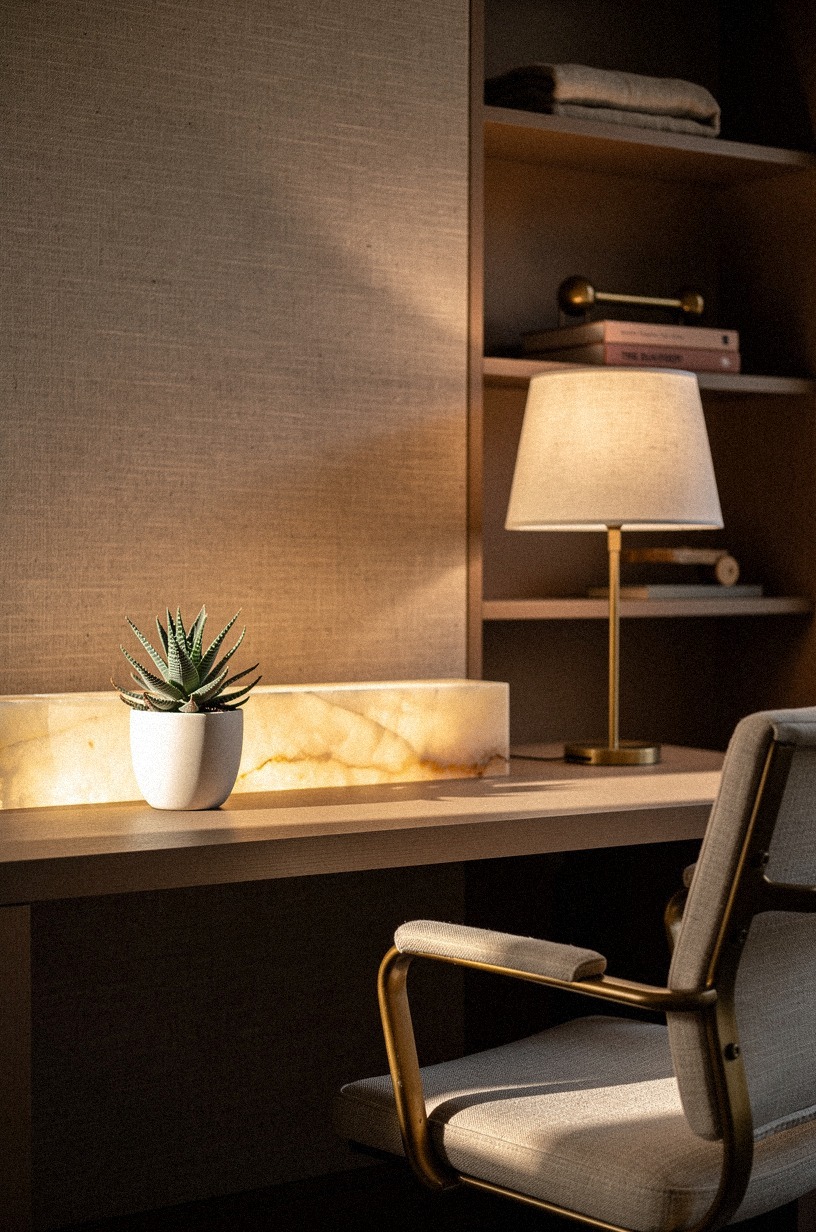
A corner office without something growing feels sterile. A snake plant or a ZZ plant in a simple terracotta pot adds life without demanding attention.
I've killed enough fiddle-leaf figs to know that the plant is not the point. The pot is.
A hand-thrown terracotta pot with a warm, uneven glaze costs $15 and looks like it came from a studio.
The plant should sit on the floating shelf or the floor beside the desk, not on the desk itself. The desk is for work.
The plant is for looking at when you need a break. The terracotta should be unglazed on the outside, so it develops a patina over time.
The glaze on the inside keeps it from leaking. This is the kind of detail that costs nothing and reads as considered.
If you're choosing plants for a low-light office, our low-light plant guide has the ones that actually survive.
11hide the cables in a single raceway painted to match
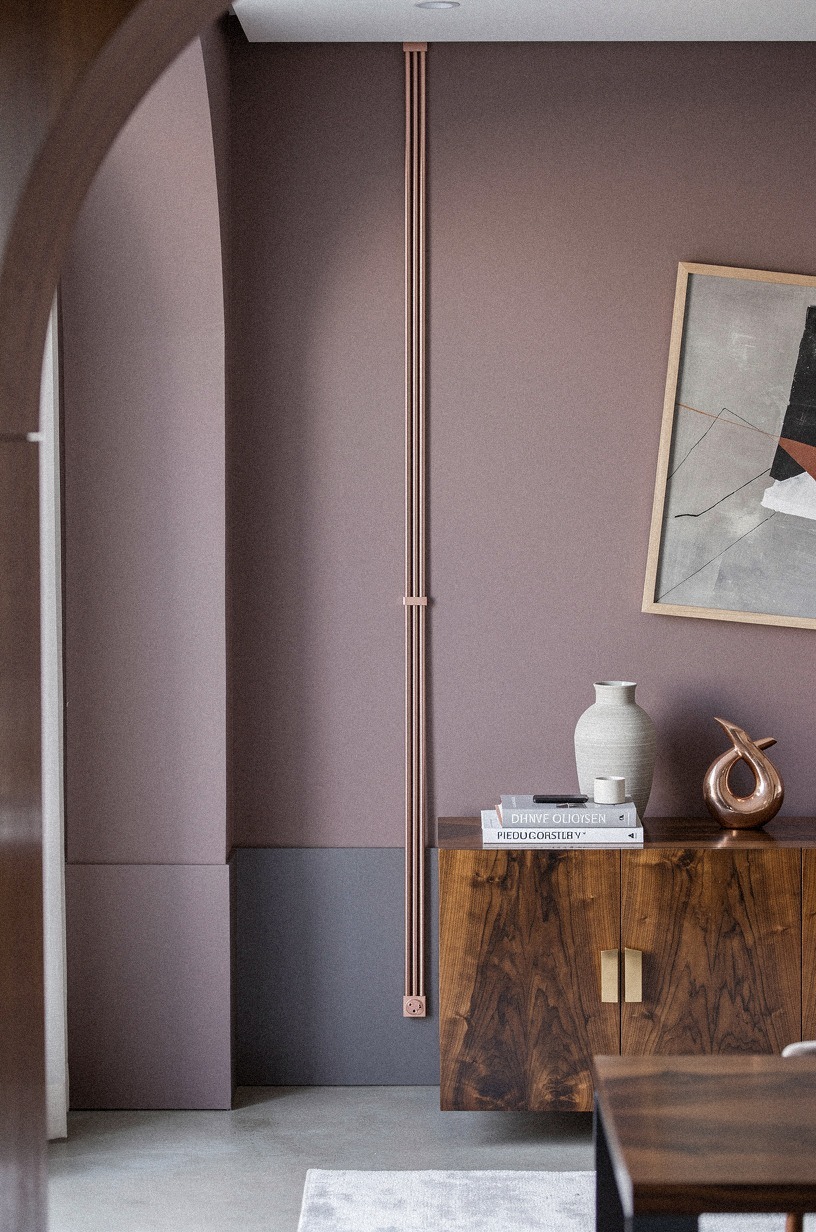
Cable management is the difference between an office that looks considered and one that looks temporary. A single raceway running from the desk to the floor, painted to match the wall, takes twenty minutes to install and changes the whole room.
I've used white plastic raceways on white walls and brass channels on dark walls. Both disappear if you paint them right.
The power strip goes in a cable box under the desk, not on the floor. The monitor cord, the laptop cord, the lamp cord: all one direction, all one channel.
The visual quiet that results is hard to describe but you feel it immediately. It's the part of the room that lets you think.
12add a small tray for the daily essentials
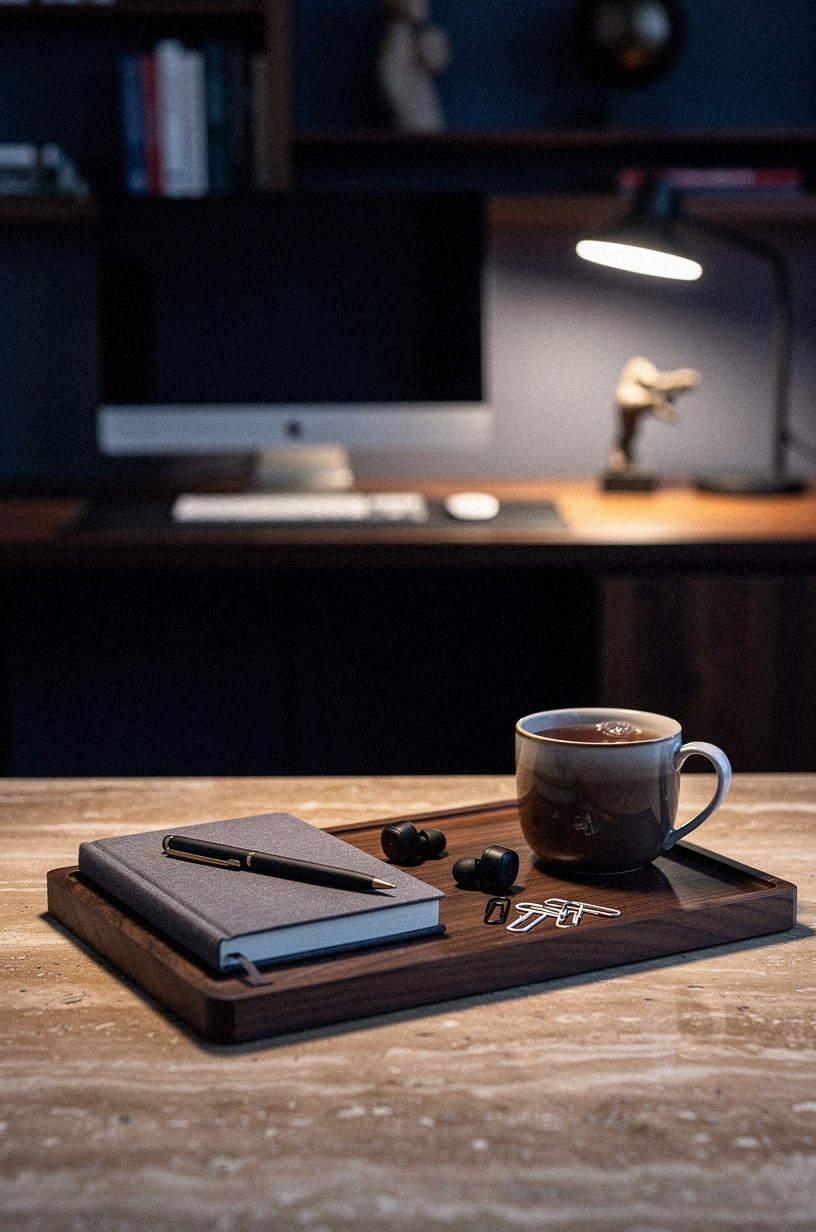
A leather valet tray or a weathered wooden tray on the desk corrals the three things you touch every morning: keys, a pen, maybe a pair of glasses. The tray itself is a signal that this corner is yours. I've used a small brass tray from a flea market for five years, and the patina is better than anything new.
The tray should be no larger than 8×10 inches. Bigger and it becomes a dumping ground.
Smaller and it's useless. The material matters: leather softens the desk, wood warms it, brass adds a note of precision.
Choose the one that matches the mood you're building. (And if you don't know the mood yet, you haven't finished the paint. Do the paint first.)
13use a linen pinboard instead of a whiteboard
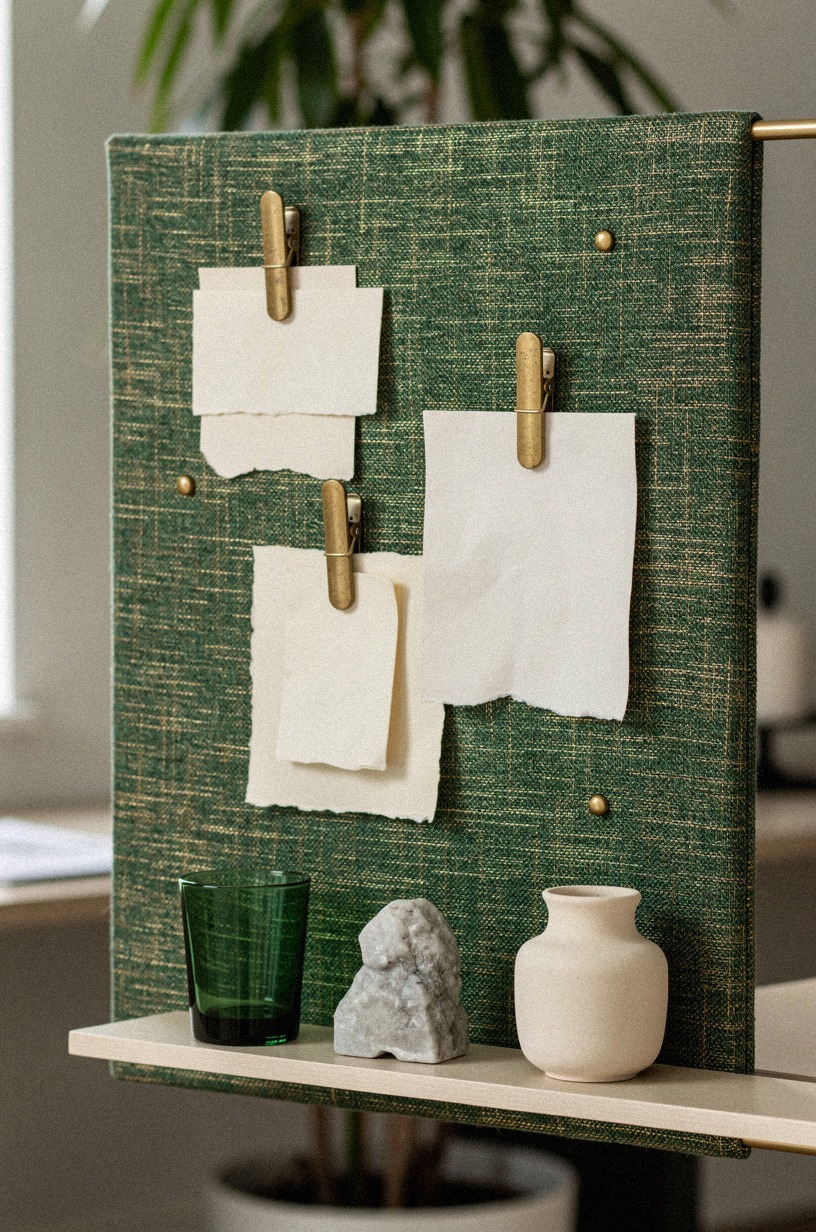
Whiteboards look like conference rooms. A linen-wrapped pinboard in a brass or oak frame looks like a studio. The texture of the linen catches light differently than felt or cork, and the pins slide in without the aggressive push of harder surfaces.
I use mine for inspiration images, a single quote, and the one project I'm actively working on.
Mount it at eye level when seated, not standing. You're pinning for yourself, not for a presentation.
The frame should be 1 to 2 inches wide; anything thinner looks like a craft project, anything thicker looks like a picture frame that lost its glass. The linen color should be warm white or natural oatmeal, never bright white.
Bright white competes with the screen.
14add a small side table for coffee and nothing else
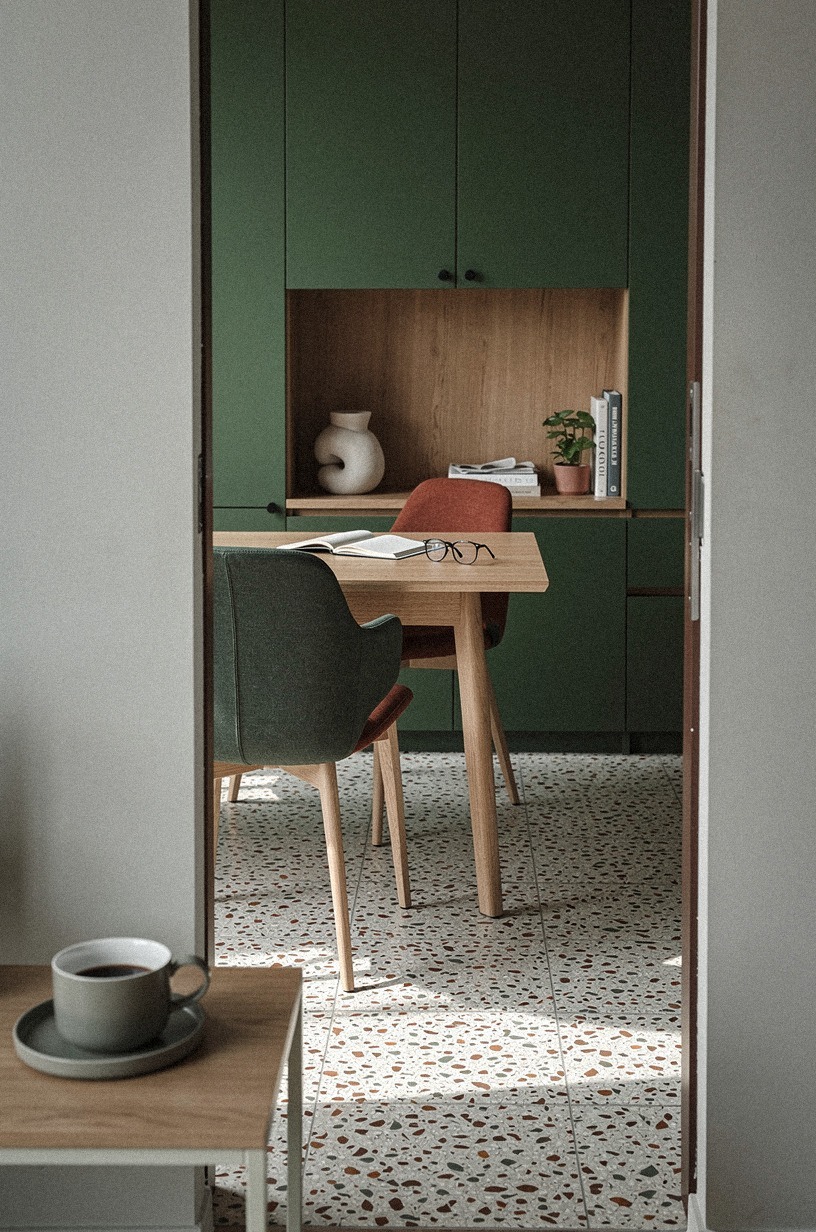
The desk is for work. A small side table, 16 to 20 inches square, holds the coffee cup, the water glass, the sandwich plate. It keeps food away from electronics and gives you a place to look when you need a break from the screen.
I use a marble-topped table with a brass base that I found secondhand. The marble is cool to the touch and the weight keeps it stable.
The table should sit within arm's reach but not so close that you bump it when you swivel. If space is tight, a C-table that slides under the desk works. The material should contrast with the desk: marble on wood, wood on metal, metal on stone.
The contrast is what makes both pieces look intentional.
15install a picture light above the pinboard or shelf
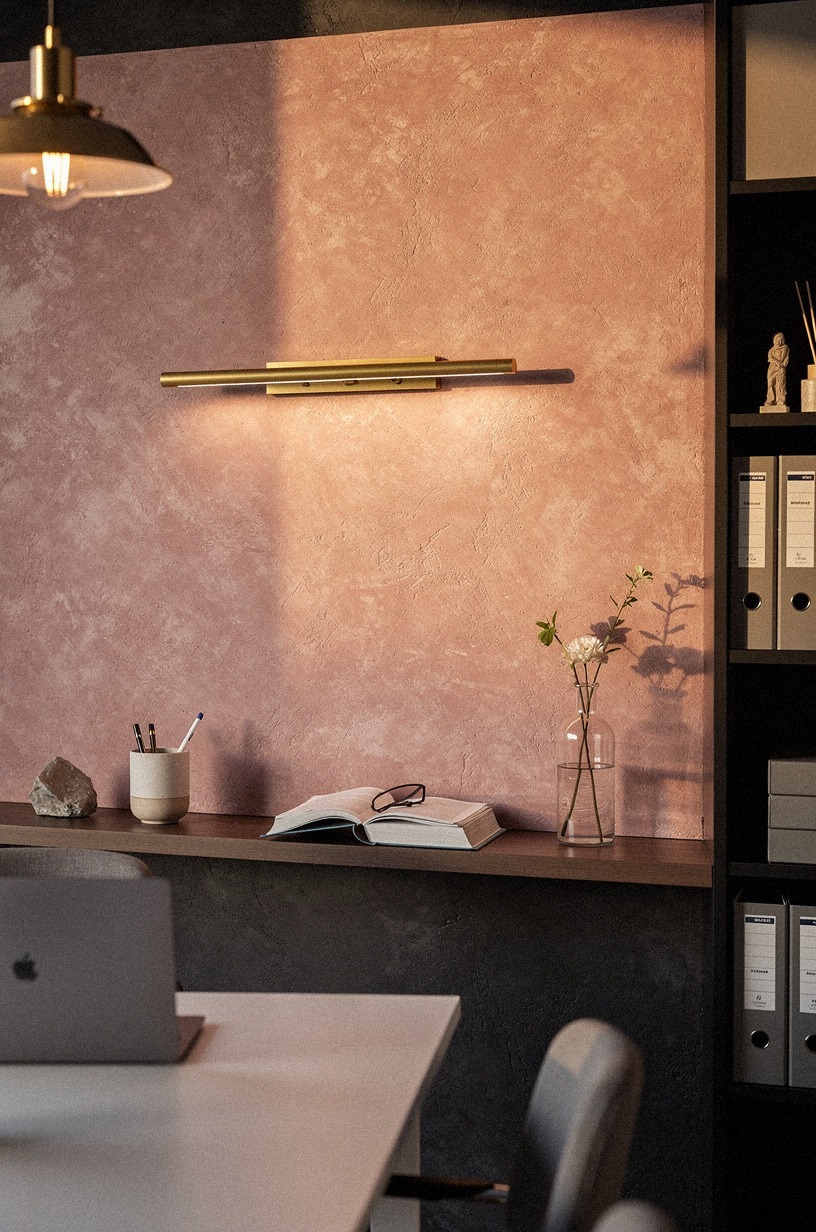
A picture light mounted above a pinboard or a single framed piece adds a layer of warmth that no overhead fixture can match. The light grazes the surface, creating soft shadows that give the wall depth. I use a brass picture light with an LED strip inside, about 18 inches wide, above a single framed photograph.
The effect is subtle. During the day you don't notice it.
At 5pm, when the natural light fades, it turns the corner into a gallery. The photograph itself doesn't matter as much as the frame: wide, simple, natural wood.
The frame is the architecture; the image is just the content.
16use a single sculptural object as a paperweight
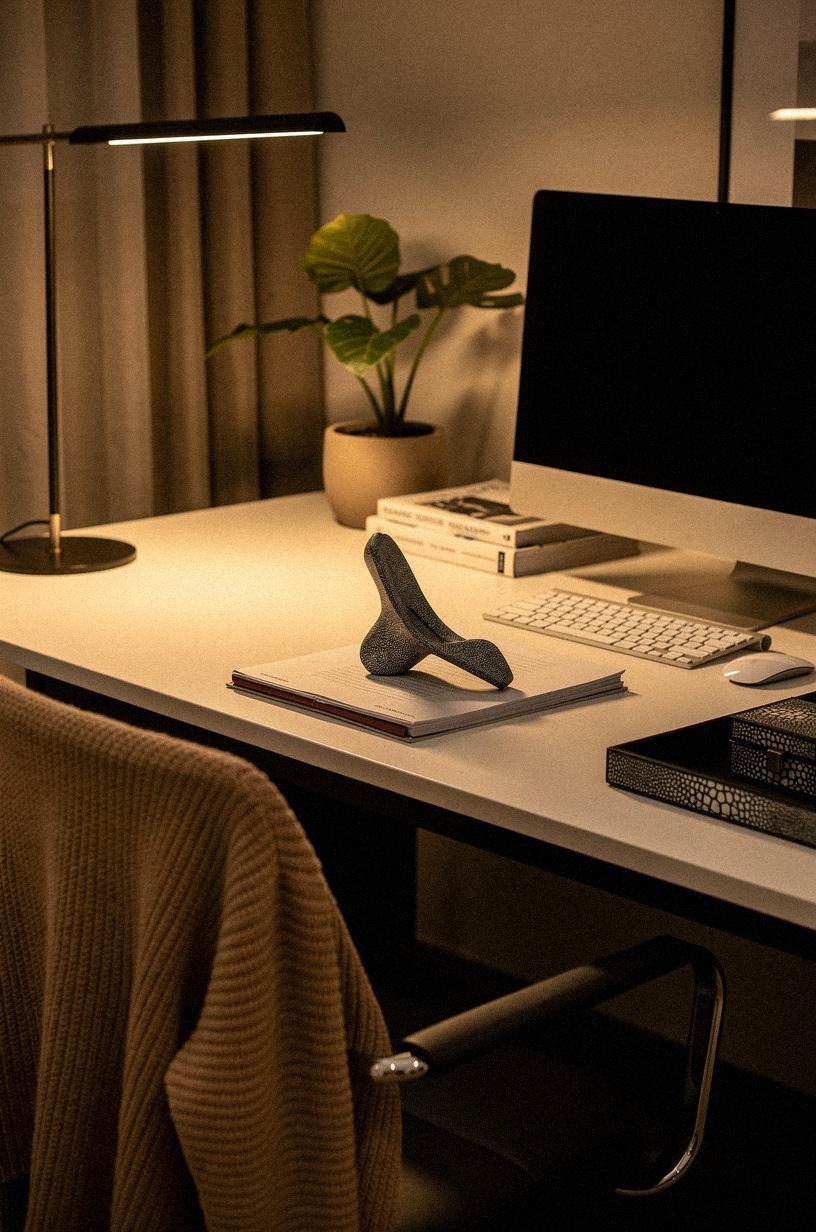
A paperweight is an excuse to own something beautiful. A geode, a heavy brass sphere, a smooth river stone: the weight in your hand is a reminder that this is a physical space, not just a screen container.
I use a brass cube that I found at a estate sale. It holds down receipts, marks the corner of a notebook, and gives my hand something to do during calls.
The object should be 2 to 3 inches in any dimension. Smaller and it's lost; larger and it's a desk ornament.
The material should be heavy: metal, stone, dense wood. The weight is the point.
A light plastic object looks like a toy. A heavy brass cube feels like a tool.
17add a throw blanket in mohair or cashmere for the reading breaks
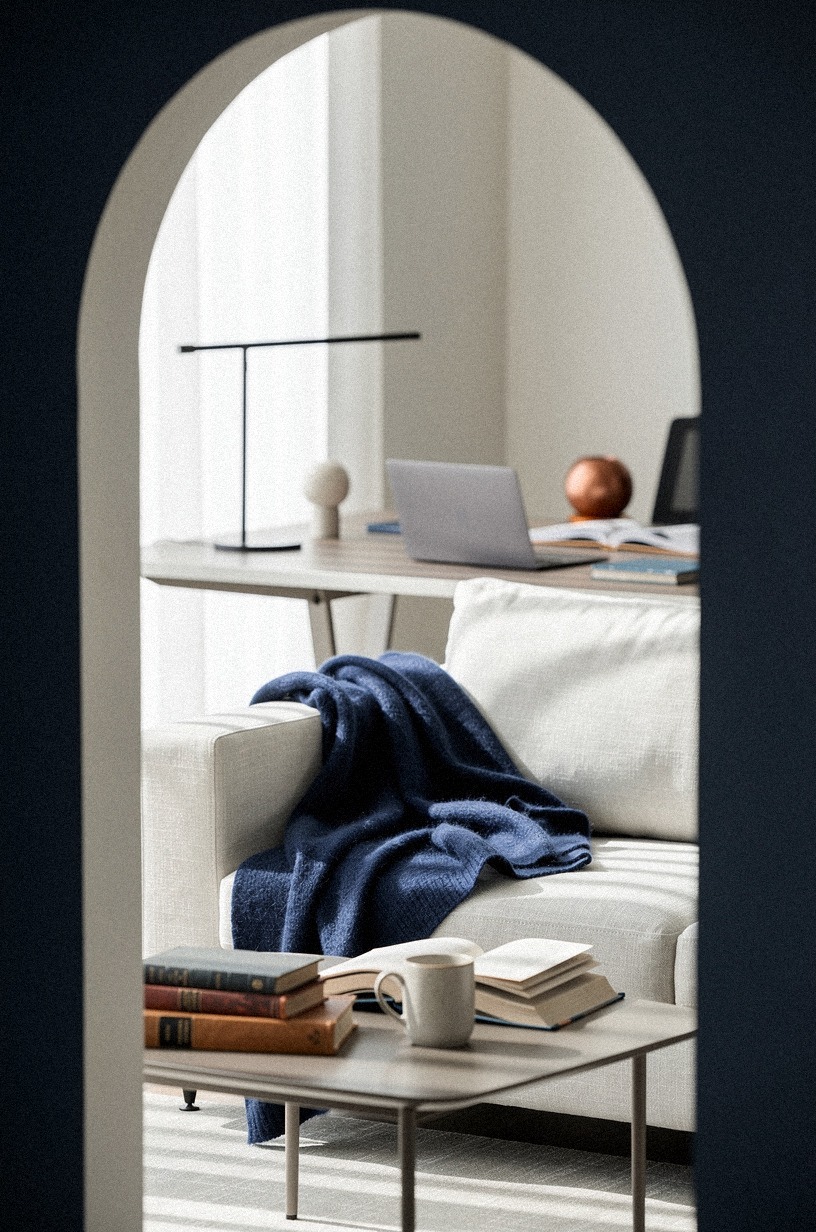
A throw blanket draped over the chair back signals that this corner is for more than email. Mohair velvet or cashmere in a warm neutral, oatmeal or sage, adds texture that makes the office feel like a room you'd choose to be in.
I use a sage mohair throw that I bought on sale five years ago. It's pilled slightly and looks better for it.
The blanket should be 50×60 inches minimum. Smaller and it's a lap blanket; larger and it drapes properly over the chair back.
The color should be one step lighter or darker than the wall. Against Green Smoke, a warm oatmeal works.
Against a light wall, a deeper olive or rust adds weight. The throw is the detail that makes you want to sit down with a book instead of closing the laptop.
Why the Corner Matters More Than the Desk
I've set up offices in spare bedrooms, converted closets, and once in a hallway that was technically a fire code violation. The ones that worked had one thing in common: they used a corner as a container.
A corner gives you two walls of support, a natural focal point, and a sense of enclosure that a single wall can't provide. The desk is just the surface.
The corner is the room.
The mistake I see most often is treating a corner office as a smaller version of a full room. It's not. A corner office is a different species.
The light comes from one direction, the walls meet at an angle, and the space behind you is usually open to the rest of the house. That openness is both the challenge and the opportunity.
The challenge is noise and distraction. The opportunity is that the corner can feel like a retreat within a larger space, not a punishment for lacking a dedicated room.
The paint color is the first decision because everything else responds to it. A dark green corner against light walls creates a visual room within a room.
The eye reads the green as a boundary, and that boundary is what lets you focus. I've worked in corners painted white, gray, and blue, and the dark green is the only one that made me forget I was in a corner of a larger space. The color does the work of walls that aren't there.
The lighting is the second decision because it defines the time of day. A single pendant, a sconce, a task lamp: these create a pool of light that feels like evening even at noon. The contrast between the lit corner and the darker surrounding room is what makes the space feel luxurious.
Luxury isn't brightness. Luxury is control. The ability to make the room darker or warmer or more focused is what separates a corner office from a desk in a corner.
The materials are the third decision, and they're where most people stop too soon. A desk is a desk until you specify the wood, the finish, the edge detail. A chair is a chair until you add the sheepskin.
A shelf is a shelf until you choose the bracket. These details don't add cost proportionally.
A $50 oak shelf with a $15 brass bracket looks more considered than a $200 shelf with a hidden bracket that tries to look floating. The visible hardware is honest.
The hidden hardware is pretending.
The objects you choose to display are the final layer, and they're the most personal. The tray, the paperweight, the plant, the throw: these are the things that make the corner feel like yours. I've been in offices with $10,000 desks that felt like showrooms, and offices with IKEA desks that felt like sanctuaries.
The difference was never the desk. It was the corner, and how someone had thought about it.
The Questions I Get Asked Most
What is the best luxury corner office for a small office?
The best small corner office uses the angle itself as architecture. A floating oak desk across the corner, a single sconce above, and a vertical bookcase in the dead space above. IKEA BILLY units painted dark green create a built-in look for under $400.
The key is keeping the surrounding walls light so the corner doesn't close in. If you only have 6 feet of wall, skip the bookcase and use a single floating shelf at eye level.
If you're working with a truly tight space, our small office layout guide has measurements that actually work.
Where can I buy luxury corner office pieces on a budget?
IKEA for desks, shelves, and storage. The TONSTAD oak desk and BILLY bookcase are solid starting points. Target Threshold and Studio McGee lines have good task lamps and textiles.
Wayfair has brass hardware and pendant lights at mid-range prices. The best move is Facebook Marketplace for solid wood desks people are offloading during moves. I've found oak desks for $100 that needed nothing but oil.
How much does a luxury corner office makeover cost?
A typical refresh runs $200 to $800 for paint, shelves, task lighting, and organization. A mid-range setup with a new desk and ergonomic chair lands around $1,500 to $5,000.
Custom millwork and a full bookcase wall start at $7,000 and climb. The biggest variable is the desk: a solid oak top is $300 to $1,200, while a custom built-in can double that.
Start with paint and lighting. You'll be surprised how far it goes.
Can I create a luxury corner office on a budget?
Yes, and the corner actually helps. Paint the corner in Farrow & Ball Green Smoke and leave the rest white.
Add a floating shelf from IKEA and a brass sconce from a hardware store. Use a sheepskin over your existing chair.
The three free moves: declutter the surface, route cables through a painted raceway, and add a plant you can't kill. Total cost: about $300 if you buy the paint and the light. The rest is decision-making, not spending.
Is a luxury corner office worth it in a small space?
Yes. A corner office uses the least desirable real estate in a room: the angle where two walls meet.
By claiming that space intentionally, you free up the center of the room for living. The small footprint forces you to edit: only the essential desk, the essential light, the essential chair. That editing is what makes a small office feel luxurious.
A large office with too much furniture feels cluttered. A corner office with exactly enough feels curated.
Is a luxury corner office a good idea for a rental?
Yes, with two constraints. Use peel-and-stick wallpaper instead of paint if your landlord is strict. Command strips and tension rods can hold lightweight shelves without drilling.
The biggest rental-friendly move is a C-table on casters instead of a built-in desk: it rolls away when you move and works in any corner. The sheepskin, the plant, the tray: these move with you.
Invest in objects, not installation.
Where I'd Start First
If I had to pick one, I'd start with the wall color. You can't layer warmth on top of a cold room.
The rug, the desk, the lamp will all fight the walls instead of building on them. Get the color right first.
Everything else lands.