
 by
by I've set up a lot of home offices, and the ones that feel commanding never come from the chair alone. It's the desk. A masculine executive desk isn't about dark wood and brass hardware anymore. It's about weight, proportion, and the kind of materials that look better at 9 PM than they do at 9 AM. The good news? You don't need a law-firm budget to get there. Most of the offices I admire were built in a weekend with one smart buy and a few deliberate choices.
> Editor's note: This guide covers the 17 moves that actually matter — from the wall color behind your desk to the one object that makes the whole surface feel finished. Start anywhere, but start with the desk.
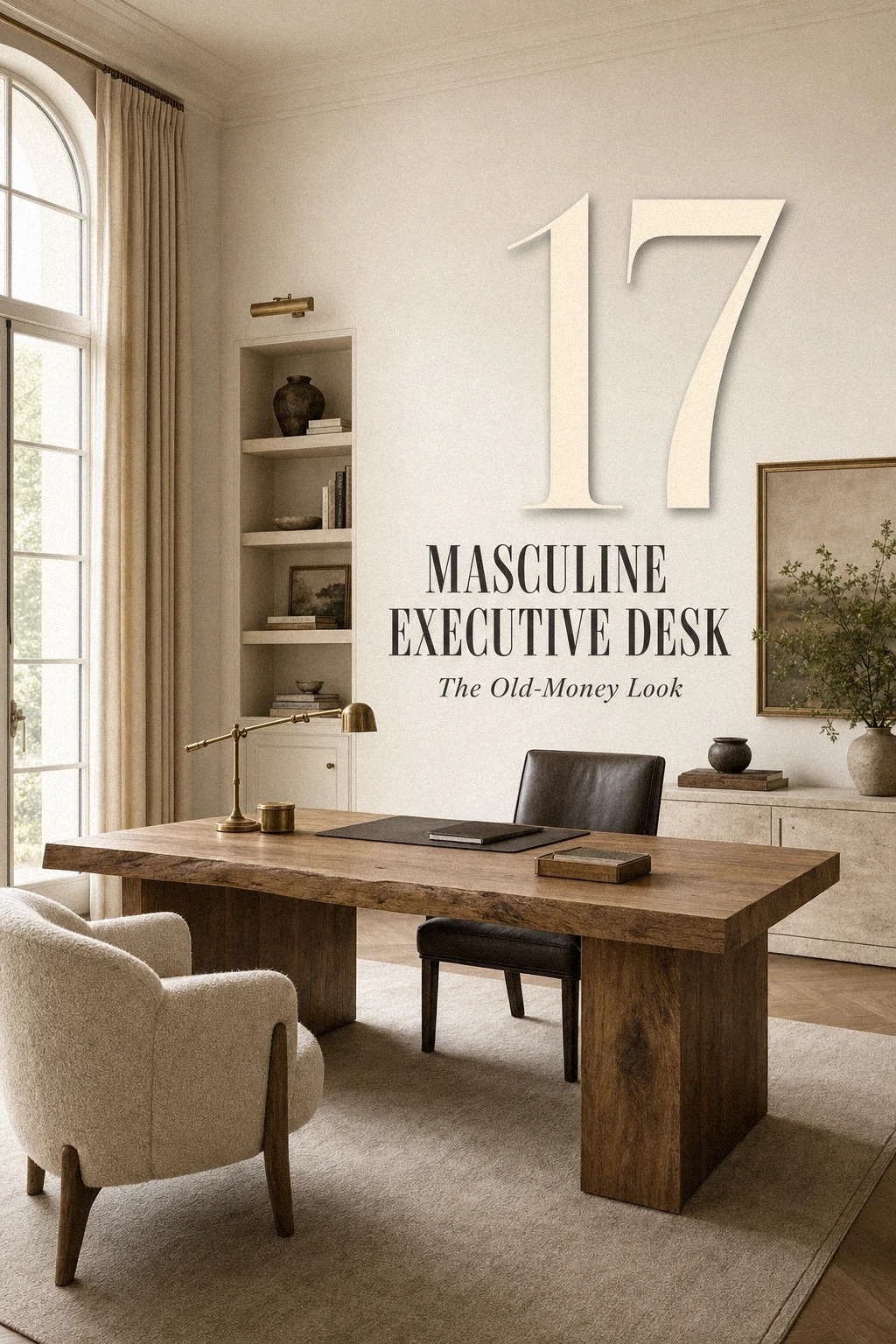
- Anchor the room with a solid oak slab
- Skip the matching set and mix two woods
- Paint the wall behind the desk in a deep, quiet green
- Layer the light at three heights
- Add a single leather accent that ages in place
- Float the desk off the wall
- Choose a desk lamp that could live in a workshop
- Build a wall of shallow storage
- Use a dark, moody paint for the desk itself
- Add one oversized piece of art, not a gallery wall
- Swap the desk chair for something with timber arms
- Run a rug under everything
- Add a brass or steel object that does nothing
- Keep the cable management invisible
- Add a small credenza with closed storage
- Choose a single metal and repeat it
- Add a plant that thrives on neglect
1Anchor the room with a solid oak slab
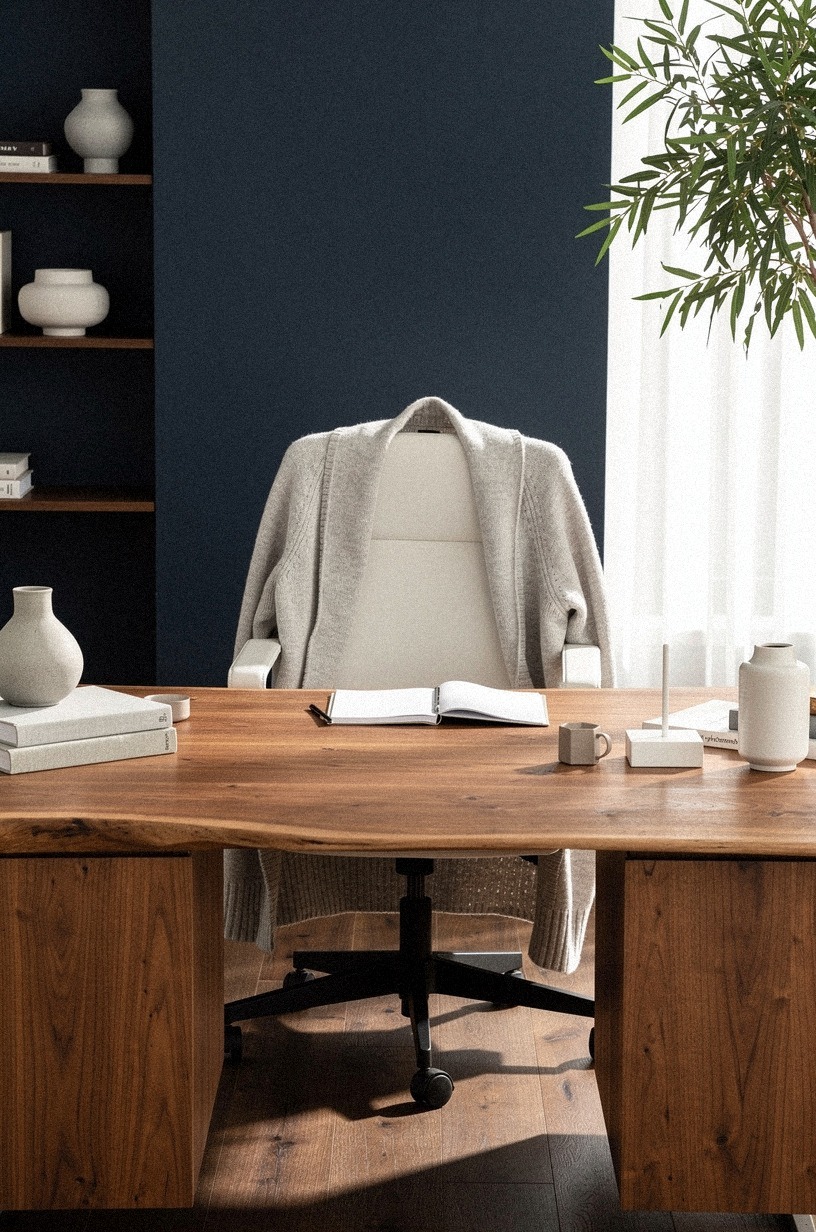
A walnut desk in a navy, white and walnut office gives the room gravity without feeling like furniture from a boardroom drama. The grain runs long, the surface is matte, and the warm tone keeps it from reading yellow.
I've seen a 72-inch slab from a local millwork shop outshine a $4,000 retail piece because the owner sanded it himself and finished it with Rubio Monocoat in Pure. The move is the legs.
Tubular steel in aged bronze keeps it from reading "rustic cabin." The washed Belgian linen draped nearby and the cardigan left over the chair back give the shot that lived-in texture. If you're building the whole office out, our desk job aesthetic guide covers the wall and lighting layer that makes this actually work.
2Skip the matching set and mix two woods
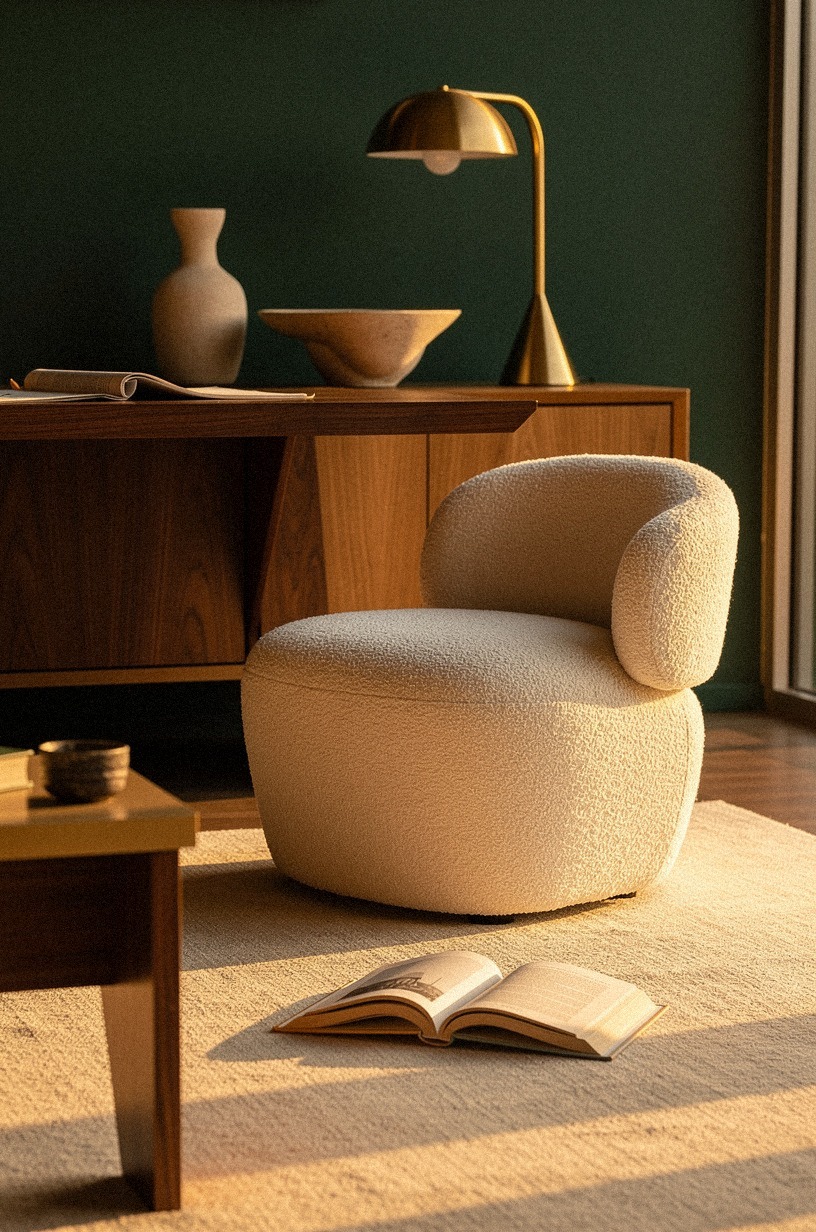
The Two-Wood Rule. One dominant timber, one accent.
Walnut desk, white oak shelving. Or ash tabletop with black-stained maple drawer faces.
The contrast reads intentional, not accidental. What kills the look is when every piece is the same stain from the same big-box collection.
It flattens the room. And honestly? A second wood gives you permission to buy that vintage piece from Facebook Marketplace without worrying if it matches.
The image here is an emerald, gold and cream space with organic boucle and a book left open face-down — warm late-afternoon golden-hour light, low floor-level perspective. If you're mixing timbers, our desk job aesthetic guide has a full breakdown on pairing woods that don't fight.
3Paint the wall behind the desk in a deep, quiet green
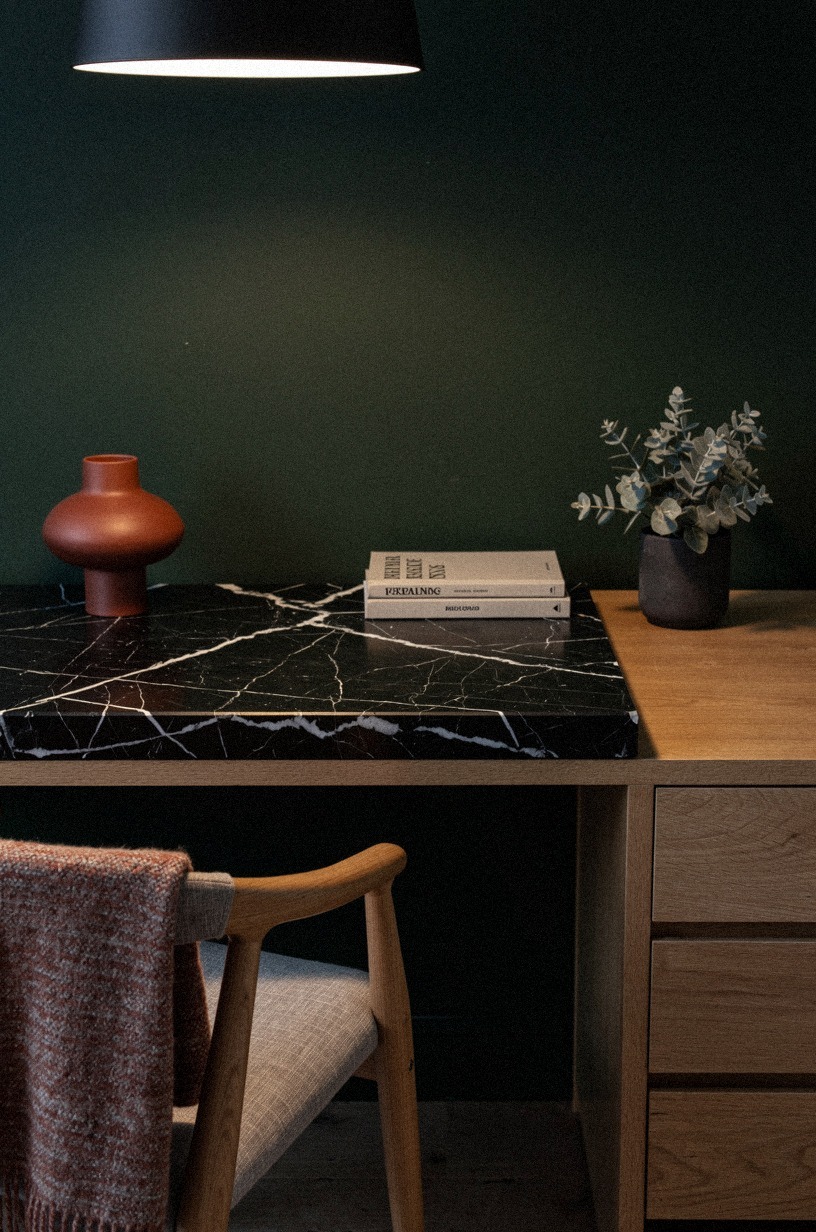
Farrow & Ball Green Smoke (No. 47) behind a warm wood desk is one of the best combinations I've seen in a home office. It's dark enough to recede, green enough to feel alive, and it makes brass or black hardware pop without trying.
The wall becomes a backdrop, not a statement. A single accent wall is all you need. The other three can stay warm white or a very quiet neutral.
The image shows a macro close-up of a forest green, rust and natural oak setting with Nero Marquina black marble with white veins, a soft throw draped loosely over the chair back, and a pendant light cut at the top frame edge — glowing lamp light at dusk. I've tried this in a north-facing room and it held its depth all day. South-facing, it turns almost olive by late afternoon.
Beautiful either way!
4Layer the light at three heights
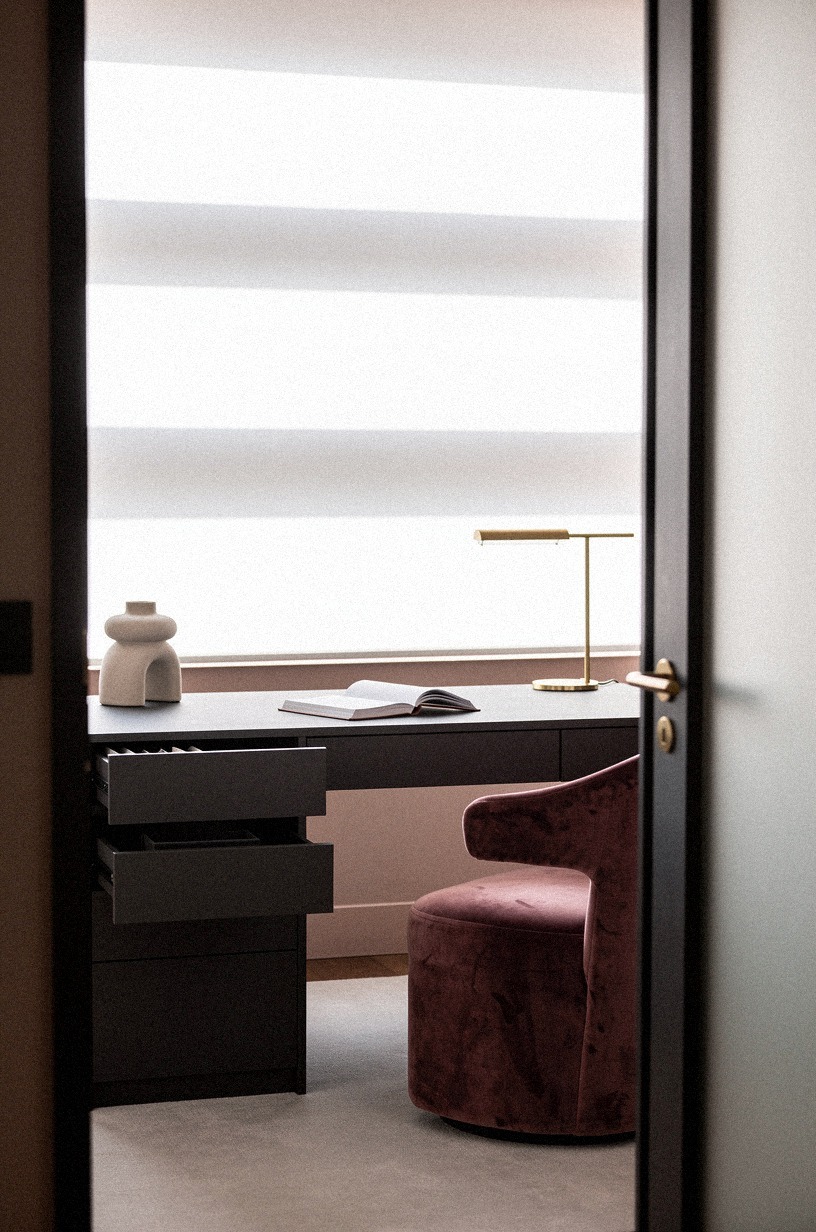
The Three-Height Light Stack. Overhead pendant or flush mount for general fill. A swing-arm sconce or architectural desk lamp at 18 to 24 inches above the work surface for task work.
And a small table lamp on a side shelf or credenza at sitting-eye level for warmth after 6 PM. All three on dimmers. The mistake is one bright ceiling fixture and nothing else. The room feels like a DMV.
Warm bulbs only, 2700K to 3000K. Nothing blue after sunset.
The image is a layered view through a doorway into a dusty rose, charcoal and brass office with deep-pile mohair velvet, one drawer left a touch ajar, one chair arm exiting the right frame edge — bright airy morning light. If you're wiring up the whole room, our warm lighting guide covers the bulb temps.
5Add a single leather accent that ages in place
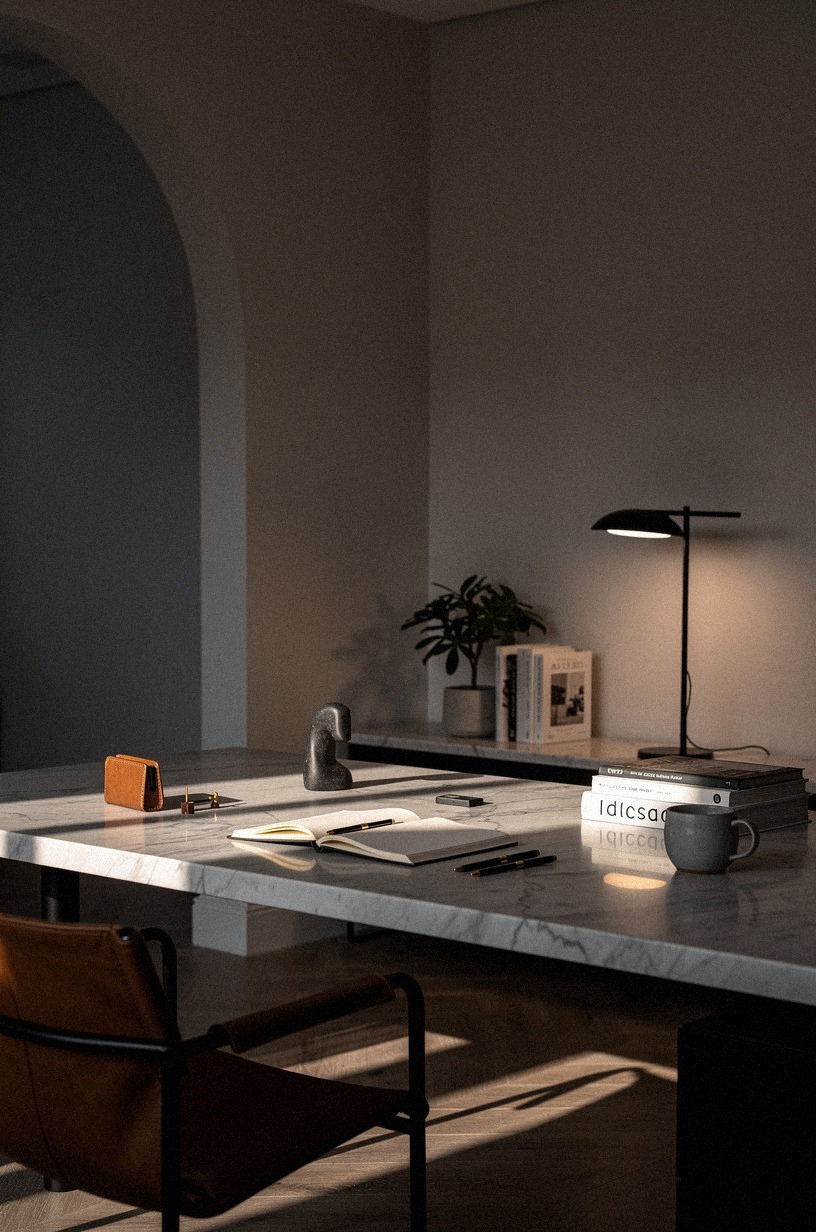
A full-grain leather desk pad in cognac or tobacco changes how the whole surface reads. It warms up black laminate, softens the formality of polished stone, and gives you a place to rest your forearms that isn't cold. The patina is the point.
Buy it new and let it scuff. Or buy it vintage and start with the character already there. The image shows a wide-angle diagonal establishing shot of a warm white, camel and black accents office with Carrara marble with subtle grey veining, warm afternoon light falling across the surface, an archway cropped at the left edge — atmospheric low evening light with one lamp on.
I've had the same Saddleback Leather pad for six years. It looks better now than the day it arrived.
You'll thank me.
6Float the desk off the wall
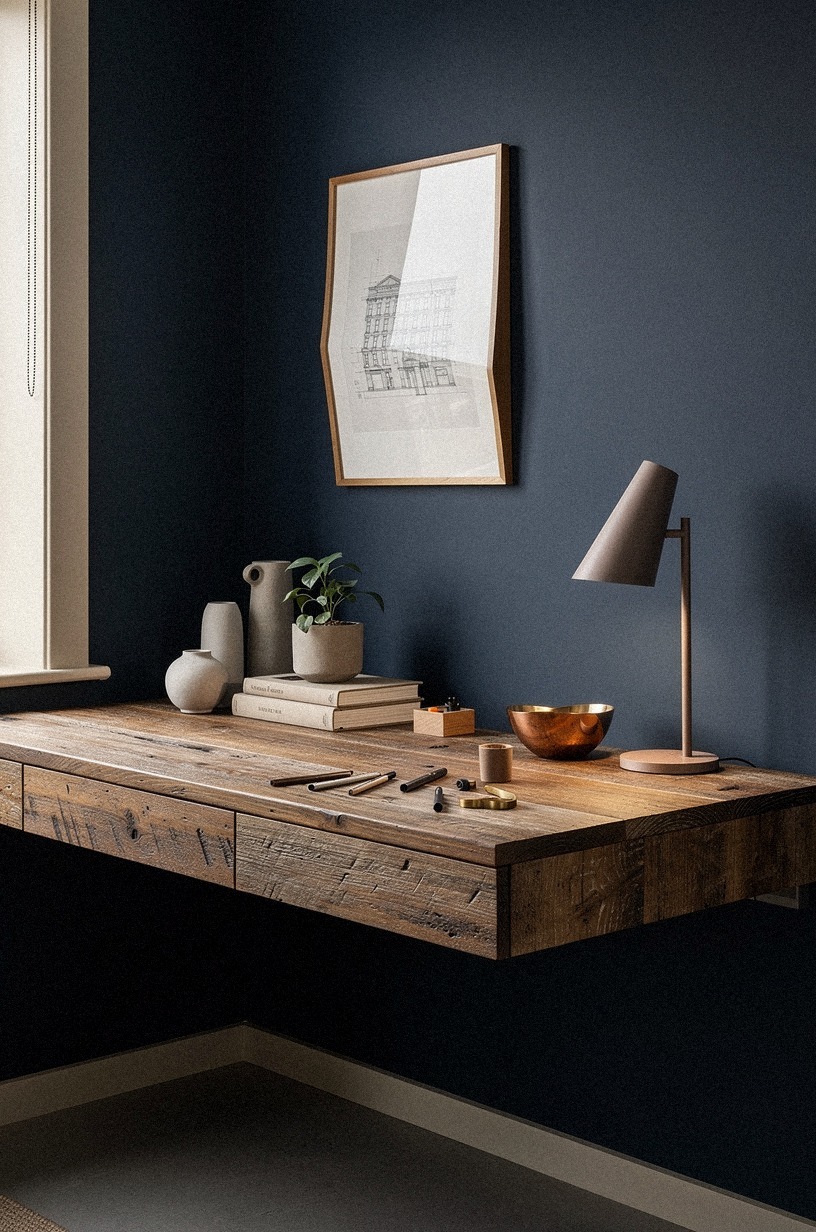
The Floating Desk Strategy. If your room has the depth, pull the desk 12 to 18 inches away from the wall and run a low credenza or narrow console behind it.
The gap becomes breathing room. You gain a surface for books, a lamp, or a plant.
And the desk stops feeling like it was shoved into a corner. This works especially well in open-plan spaces where the office shares a wall with a living area. The floating arrangement defines the zone without a partition.
The image is a wide-angle diagonal establishing shot of a midnight blue, copper and ivory office with reclaimed weathered teak, a slightly crooked frame nobody bothered to straighten, the foreground surface continuing off the bottom edge — soft overcast daylight, even and calm. If you're working with a tight footprint, our teen bedroom layout guide has tricks on carving zones in small rooms that apply here too.
7Choose a desk lamp that could live in a workshop
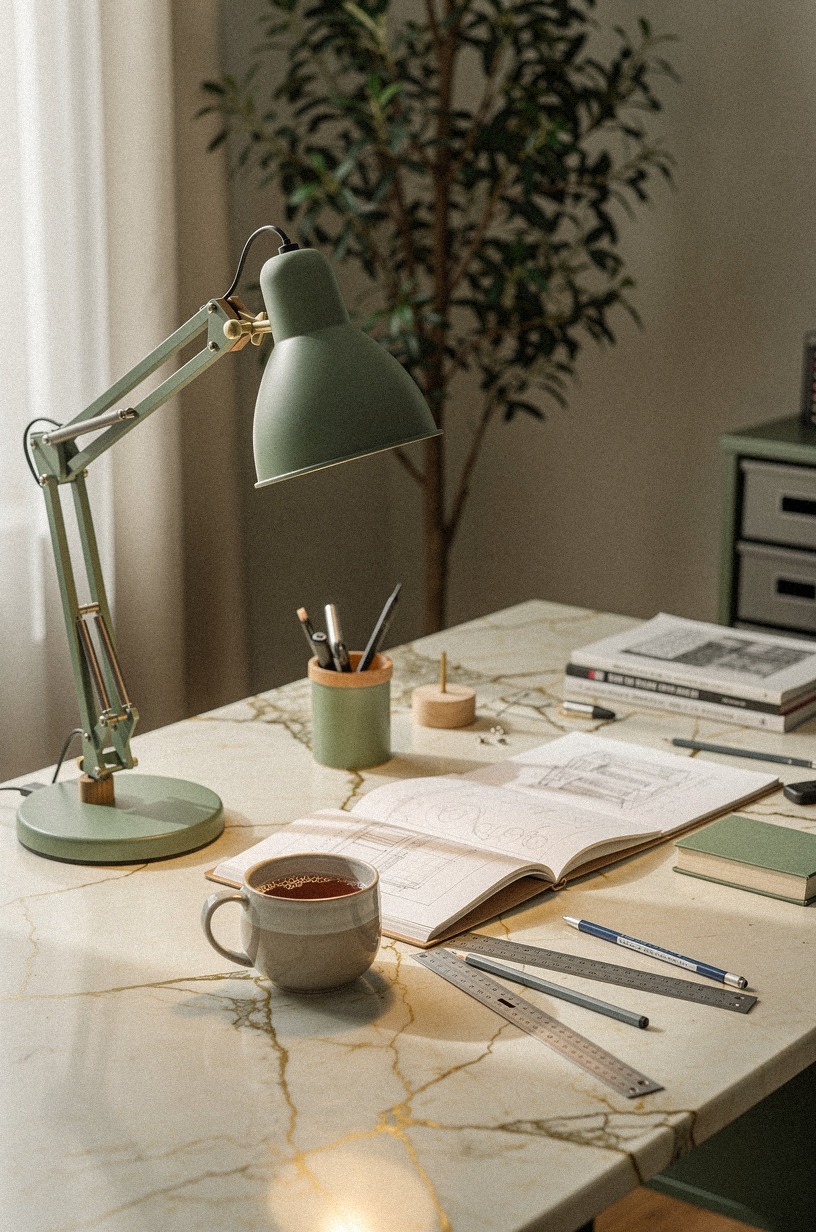
Skip the chrome gooseneck from the supply closet. What you want is a cast-iron base with a bronze shade or a swing-arm in matte black with an exposed Edison bulb behind a ribbed glass diffuser. The Schoolhouse Electric Orbit lamp in aged brass is the best I've found under $300. It throws a warm pool of light about 18 inches across, enough for a notebook and a coffee cup, not so wide it washes out your screen.
The cast-iron base keeps it from tipping when you reach for a pen. And the ribbed glass casts these thin shadows that make the whole desk feel like a workshop at 7 PM.
The image is a wide-angle diagonal establishing shot of a sage green, warm cream and natural wood office with Calacatta marble with gold veining, a mug of tea gone cold beside the work, a tall plant half out of frame at the top — soft natural window light. That's the mood. Task light, not taskmaster light.
8Build a wall of shallow storage
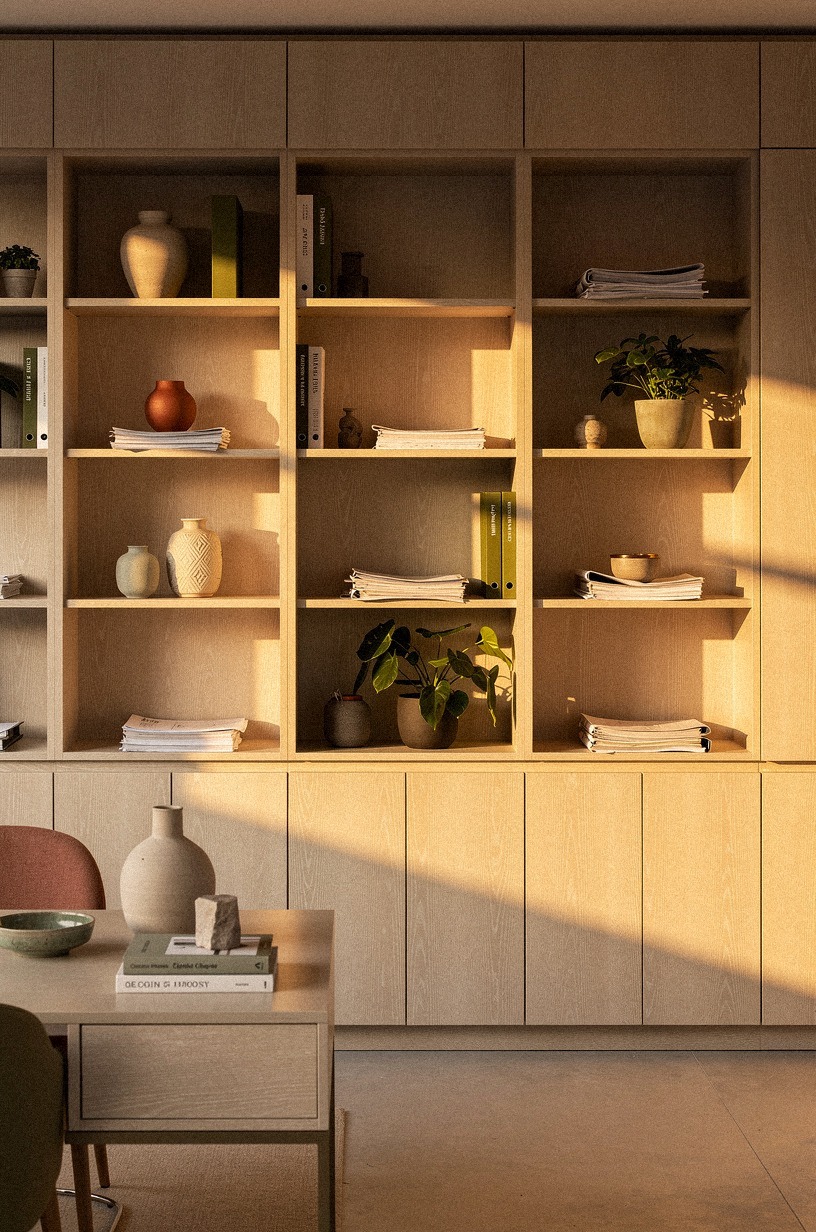
A 12-inch deep floating shelf system above the desk, run wall to wall, gives you display space without the bulk of a bookcase. Stack linen-bound notebooks, a small brass tray for loose change, and one object with personal weight. A stone paperweight.
A vintage camera. The rule is: if it doesn't mean something, it doesn't go up. The shallow depth keeps the storage from crowding your headspace. Standard height is 12 to 16 inches above the desktop.
Any lower and you'll knock it every time you stand up. The image is a first-person POV stepping into a terracotta, stone and olive office with cerused white oak, papers shuffled just slightly out of square, a side table cut at the bottom-left edge — warm late-afternoon golden-hour light.
If you're mounting shelves, our desk job aesthetic guide has the stud-spacing math that keeps them level.
9Use a dark, moody paint for the desk itself
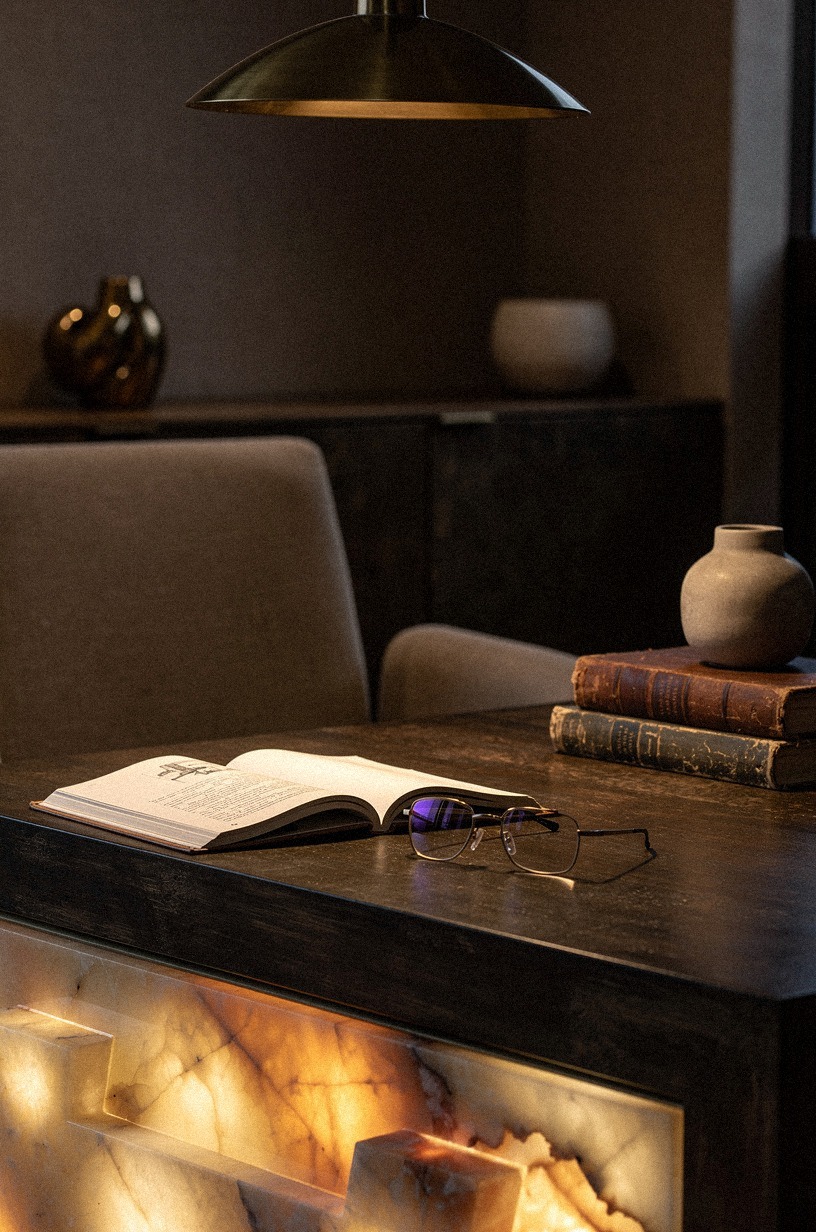
Not the wall. The desk. Benjamin Moore Cheating Heart (1617) on a pine or poplar desk, finished in satin enamel, reads as charcoal furniture with a subtle warmth.
It's less severe than pure black, and it pairs with almost any wood tone in the room. I've seen this done on an old IKEA HEMNES desk with the hardware swapped for unlacquered brass pulls.
The transformation was shocking. The desk went from dorm room to design studio for the cost of a gallon and a Saturday.
The image is a first-person POV stepping into a clay, linen and aged brass office with backlit translucent onyx, reading glasses set down beside an open notebook, a pendant light cut at the top frame edge — glowing lamp light at dusk. Total MVP for this room!
10Add one oversized piece of art, not a gallery wall
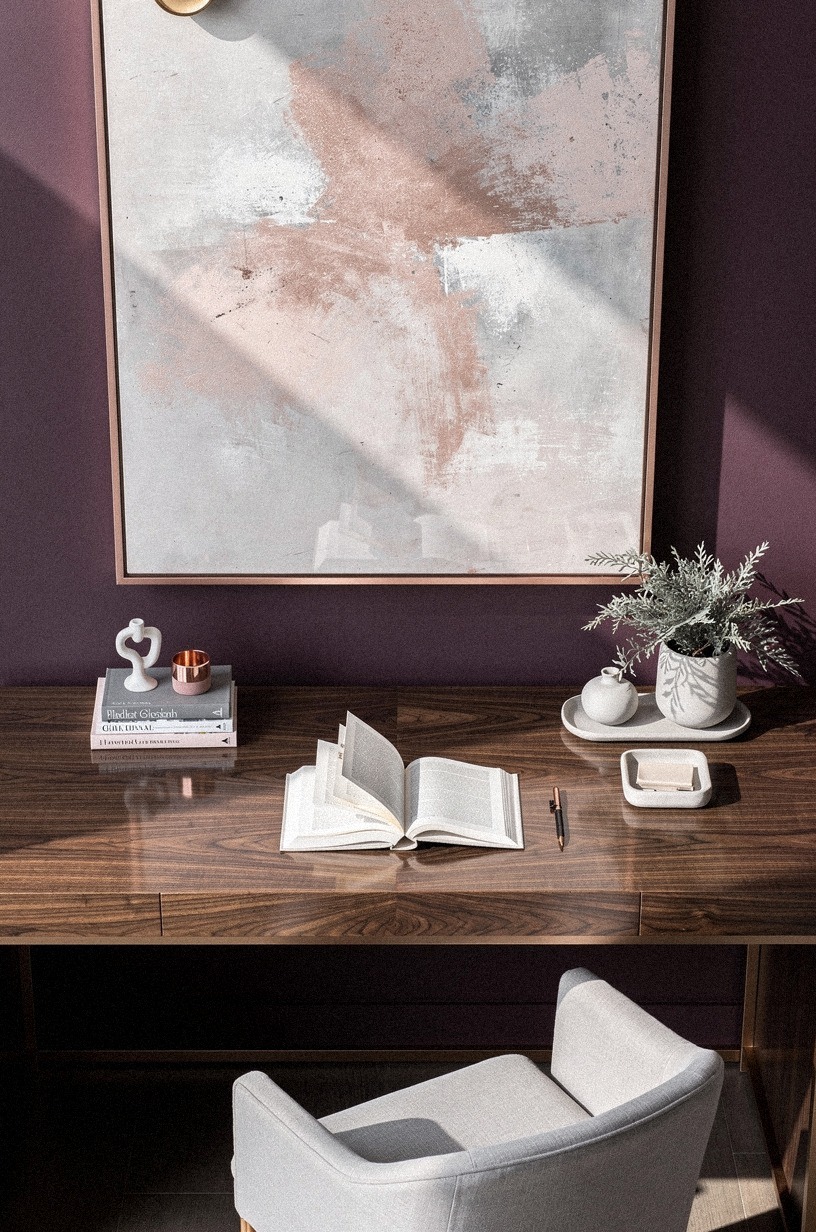
A single framed piece at 36 by 48 inches or larger, hung so the center sits at 57 to 60 inches from the floor, anchors the office better than six small frames fighting for attention. Black and white photography works.
So does a single abstract in umber, ochre, and warm gray. The frame should be simple: raw oak, matte black metal, or unframed canvas on a stretcher. The oversized scale is what makes it feel executive.
Not the subject. The image is an editorial overhead bird's-eye view of a plum, grey and rose gold office with book-matched walnut, a stack of books mid-read on the surface, one chair arm exiting the right frame edge — bright airy morning light. A giant photo of a gravel road does more for a room than a small print of a famous painting.
If you're hanging heavy, our warm lighting guide has the anchor types that won't rip out.
11Swap the desk chair for something with timber arms
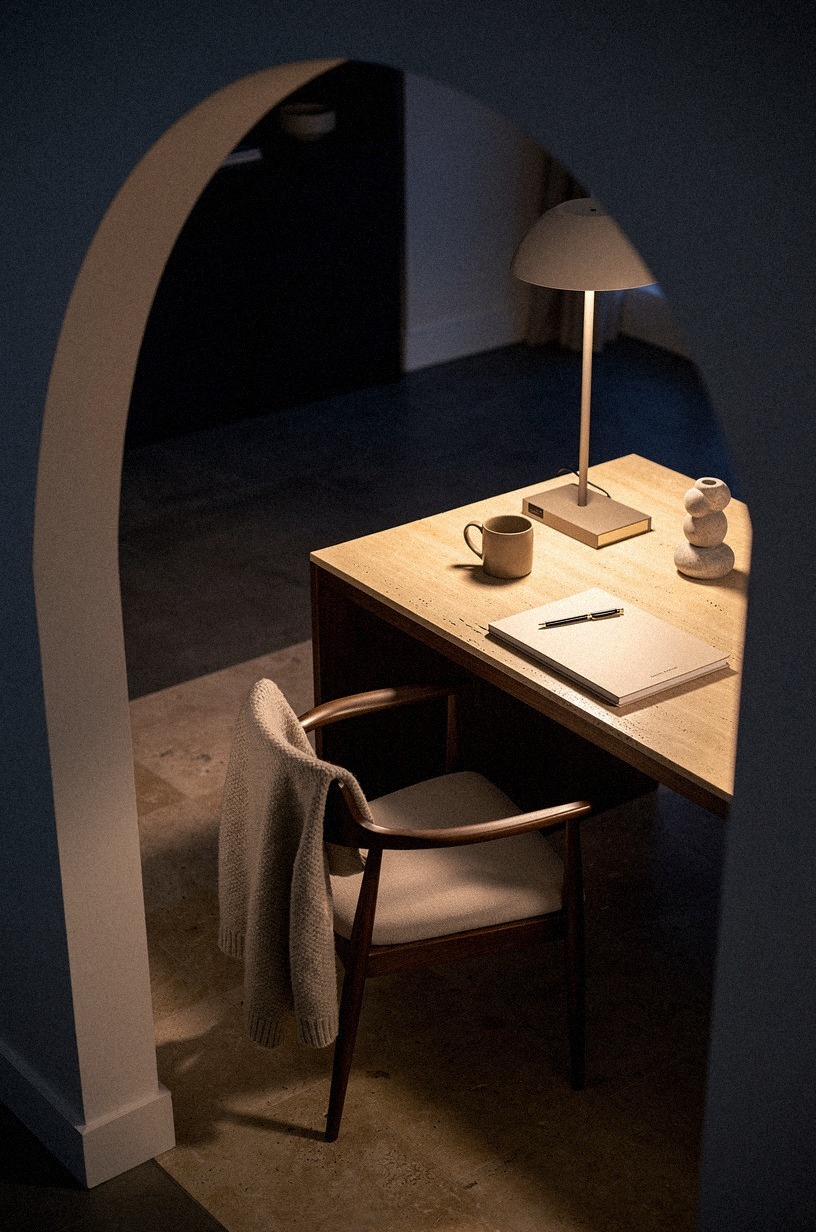
A black leather seat on a walnut or ash frame bridges the gap between office chair and dining chair. The Article Sven in tan leather on walnut is the reference here — it looks like a mid-century dining chair but rolls and swivels.
The timber arms warm up the whole desk zone in a way that all-metal or all-plastic chairs never do. I've used one for two years and the leather has softened exactly where my elbows rest. The trick is height: the seat should be 17 to 19 inches from the floor so your forearms hit the desk at a right angle. Anything higher and you'll hunch.
Anything lower and you'll reach. The image is an editorial overhead bird's-eye view of a navy, white and walnut office with warm travertine, a cardigan left over the chair back, an archway cropped at the left edge — atmospheric low evening light with one lamp on. If you're chair hunting, our desk job aesthetic guide has the ergonomic checks that keep your back happy.
12Run a rug under everything
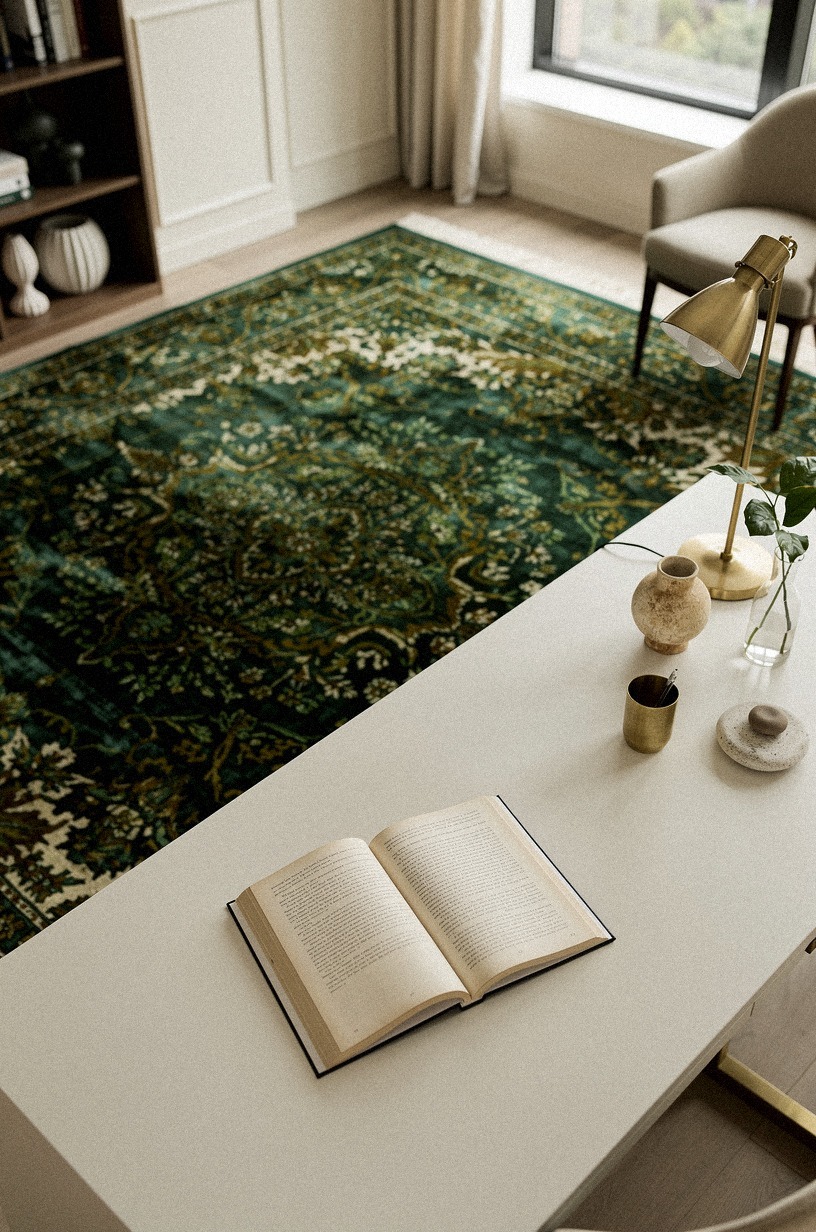
A 9 by 12 foot rug under the desk and chair defines the office zone in an open room and softens the acoustics in a closed one. Wool in a flatweave or low-loop pile is best for a chair that rolls. Vintage Persian in navy and ivory is the classic masculine move.
Beni Ourain in undyed cream works if the rest of the room is darker. The rug should extend 18 to 24 inches beyond the desk on all sides. Anything smaller looks like a bath mat that got lost.
The image is a classic 45-degree editorial magazine view of an emerald, gold and cream office with unlacquered brass developing patina, a book left open face-down, the foreground surface continuing off the bottom edge — soft overcast daylight, even and calm. If you're layering textiles, our desk job aesthetic guide has the pile-height rules that keep chairs rolling smooth.
13Add a brass or steel object that does nothing
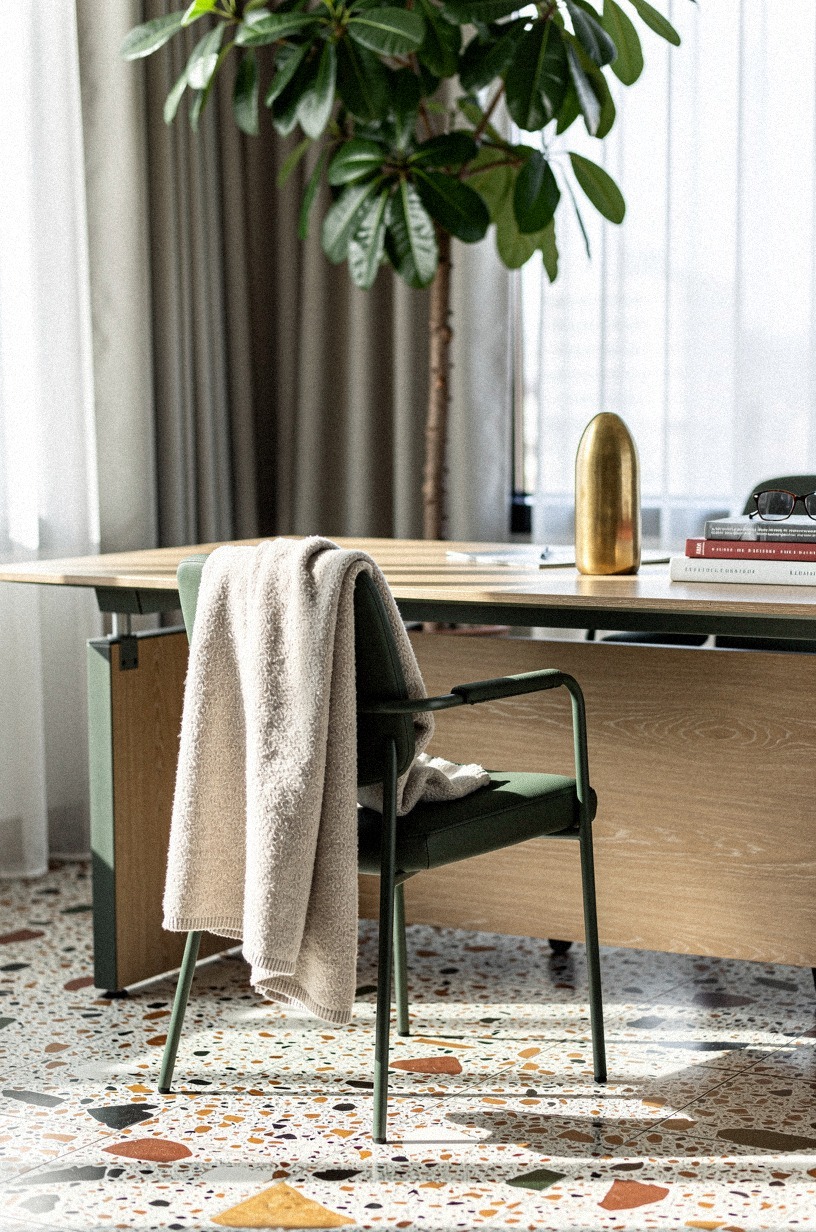
A solid brass paperweight. A cast-steel geometric sculpture. A vintage theodolite from a flea market. One object on the desk that has no function except to sit there and catch light.
It signals that the desk is styled, not just used. And it gives the eye a place to rest between the monitor, the notebook, and the coffee cup. The image is a frontal symmetric eye-level shot of a forest green, rust and natural oak office with oversized-chip terrazzo, a soft throw draped loosely over the chair back, a tall plant half out of frame at the top — soft natural window light. I've had a Noguchi AKARI paper lamp on my desk for two years.
It has never once been turned on. It doesn't matter.
It's the best thing on the surface. Chef's kiss.
14Keep the cable management invisible
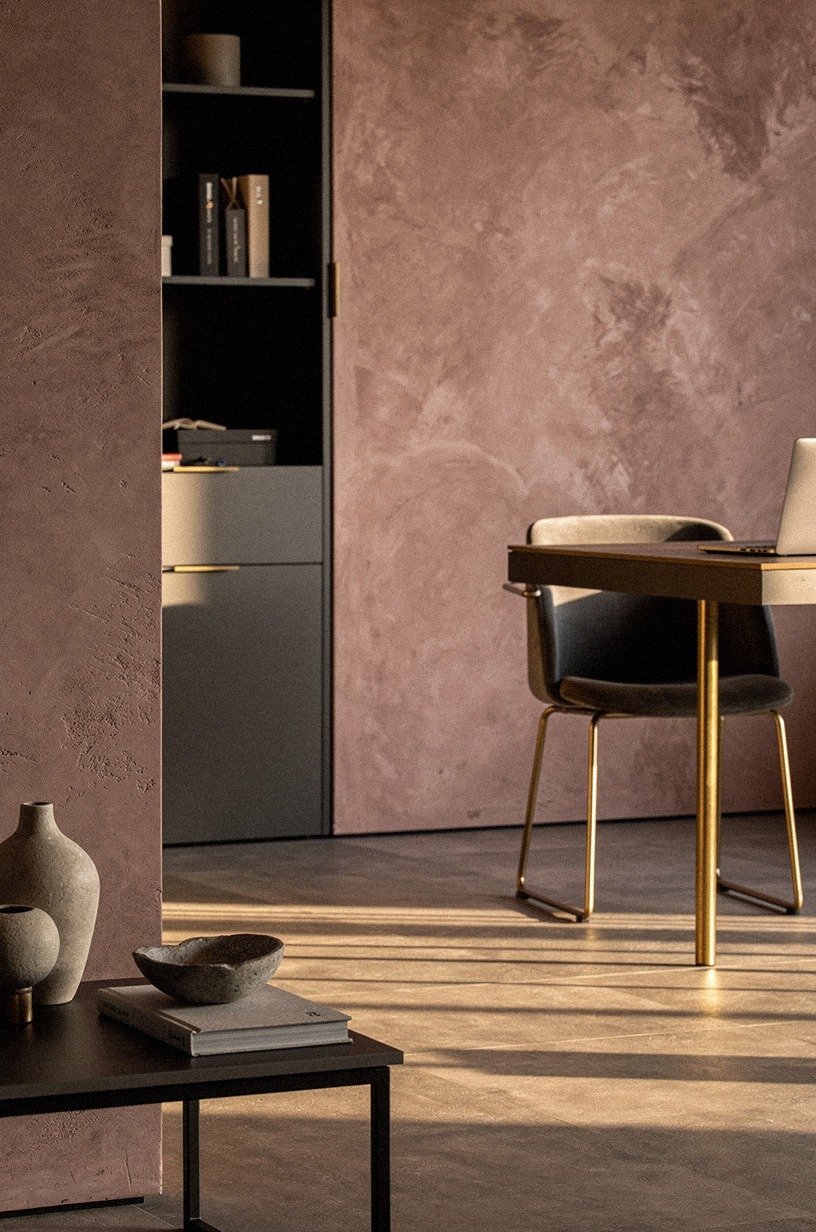
The Cable Ghost Rule. If I can see a power strip, a charger brick, or a white cable snaking down the leg, the desk isn't finished.
Under-desk trays in black steel, cable sleeves in dark gray fabric, and adhesive cable clips painted to match the desk leg are the tools. The goal isn't perfection. It's invisibility from the normal sightlines.
Sit in the chair. Look at the desk. If you don't see wires, you win.
The image is a dramatic low floor-level perspective of a dusty rose, charcoal and brass office with hand-applied Venetian plaster, one drawer left a touch ajar, a side table cut at the bottom-left edge — warm late-afternoon golden-hour light. This is the detail that separates a styled office from a Pinterest board. Worth it.
15Add a small credenza with closed storage
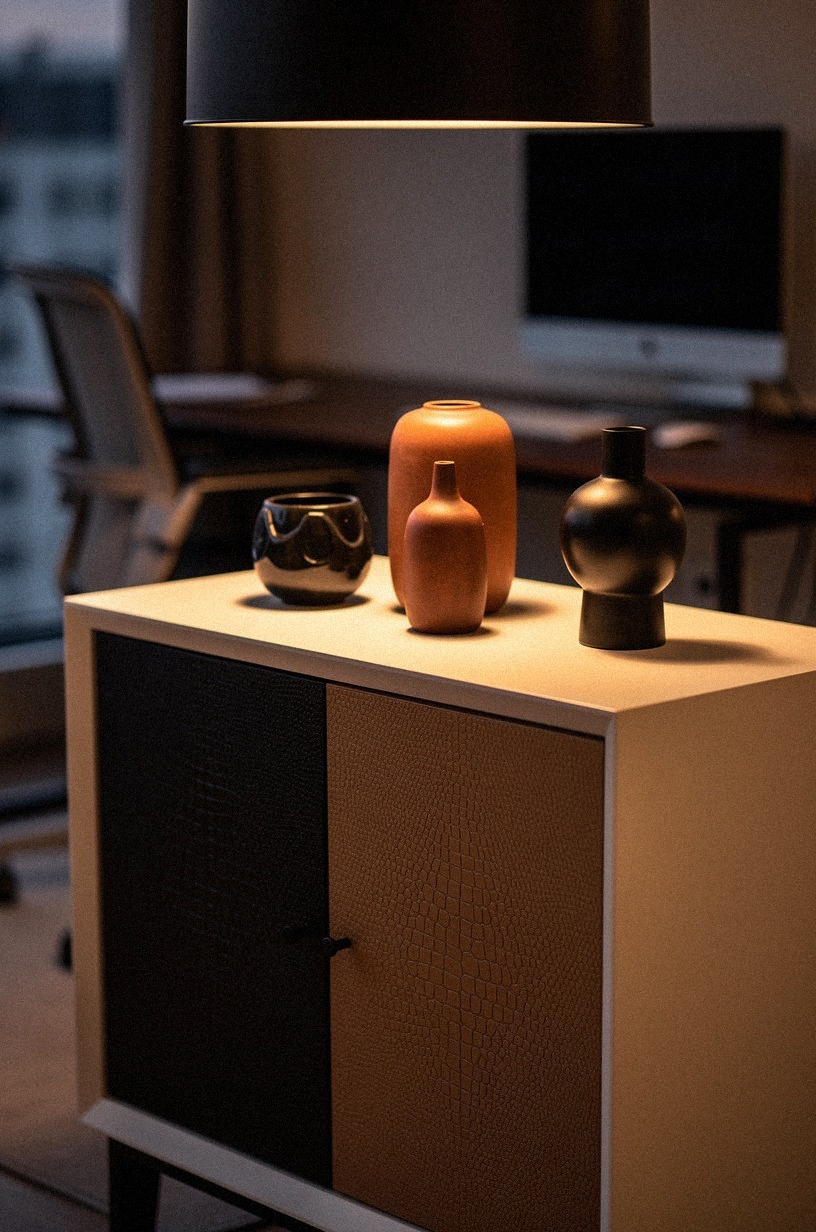
A 48 to 60 inch low cabinet in walnut or black-stained oak, with push-latch doors and no visible hardware, gives you a place to hide the printer, the files, and the backup hard drive. The top becomes a bar or a coffee station.
A marble remnant slab on top elevates it further. CB2 has a Forte line in charcoal that works here. IKEA TONSTAD in dark oak is the budget play. The closed front is the point.
Open shelving is for display. Office life requires hiding. The image is a macro close-up hero shot of a warm white, camel and black accents office with shagreen accents, warm afternoon light falling across the surface, a pendant light cut at the top frame edge — glowing lamp light at dusk.
If you're building storage, our teen bedroom layout guide has the depth rules that keep cabinets from crowding your chair swing.
16Choose a single metal and repeat it
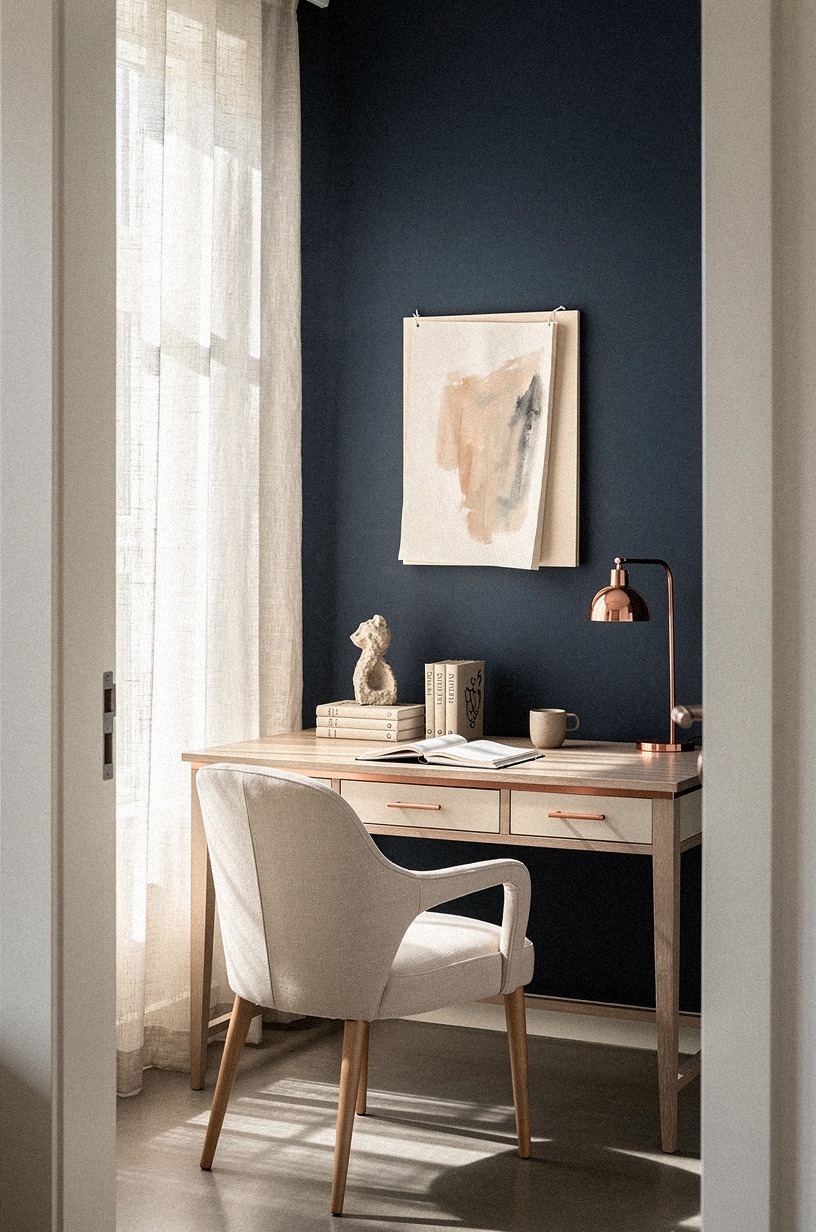
The One-Metal Rule. Pick brass, blackened steel, or aged bronze. Use it for the desk legs, the lamp base, the drawer pulls, the picture frame, and the shelf brackets. The repetition ties the room together without a theme.
The mistake is mixing chrome, brass, and matte black in the same sightline. It looks like you bought what was on sale.
I've done it. I replaced three chrome pieces with brass equivalents and the room felt finished overnight.
Cost about $80. Impact was ridiculous.
The image is a layered view through a doorway into a midnight blue, copper and ivory office with washed Belgian linen, lived-in texture, a slightly crooked frame nobody bothered to straighten, one chair arm exiting the right frame edge — bright airy morning light. 10/10 recommend.
17Add a plant that thrives on neglect
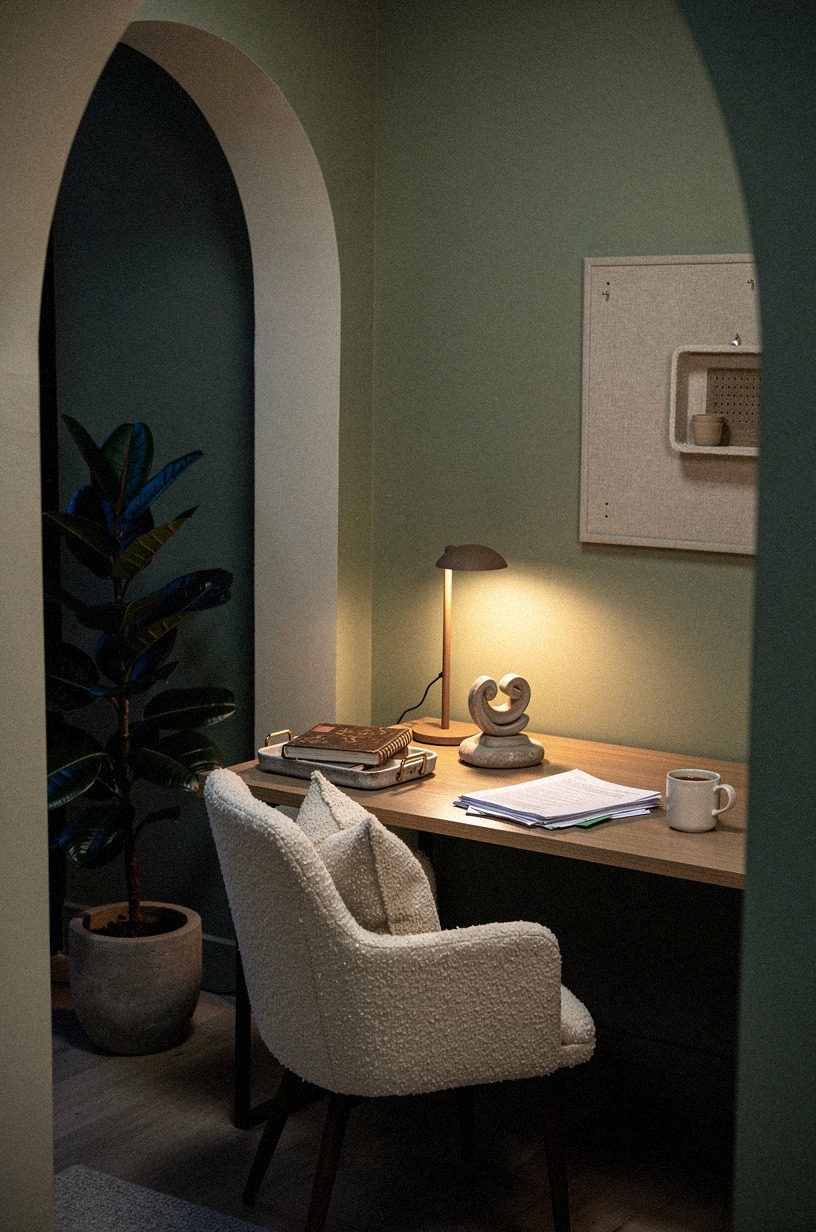
A ZZ plant in a unglazed terracotta pot. A snake plant in a raw concrete planter.
One living thing that doesn't need your attention and doesn't look decorative. The terracotta warms the desk.
The concrete cools it. Both work.
Both are cheap. The plant is there to prove the office is inhabited, not staged.
And honestly? It's the one thing on the desk that changes a little every week. Everything else stays the same. The plant grows.
The image is a wide-angle diagonal establishing shot of a sage green, warm cream and natural wood office with organic boucle, a mug of tea gone cold beside the work, an archway cropped at the left edge — atmospheric low evening light with one lamp on. That's the point.
What does a masculine executive desk actually cost?
Most people land in the budget tier and still build something that feels permanent. The desk is the one place where spending a little more pays off. A $600 solid oak desk with a $250 chair and a $100 lamp is a mid-range setup that outperforms a $2,000 matching set from a big-box store.
The matching set looks like you bought a room in a box. The mixed build looks like you thought about it. I've tried both.
The mixed build wins every time.
The word gets misused. It doesn't mean dark leather and whiskey decanters. It means materials with gravity, lines with confidence, and a palette that doesn't apologize. A bleached oak desk with linen and brass can feel more commanding than a mahogany monster with carved lions.
The difference is restraint. One bold choice per surface. One strong material per piece. No clutter, no performance.
The offices I remember are the quiet ones. A single Noguchi lamp on a walnut slab.
A Green Smoke wall behind a steel frame. Nothing shouting. Everything speaking.
This is the shift that's happened in the last three years. The old executive look was about signaling power. The new one is about signaling judgment.
And judgment is harder to fake. It shows in the one vintage piece mixed with the new build. In the paint color that took three samples to find. In the desk lamp that was hunted down instead of clicked through.
That's the look worth copying. Not because it's masculine.
Because it's considered.
I learned this the hard way. Three years ago I built an office with a dark walnut desk, a black leather chair, and a brass lamp. Looked great in photos. Felt like a stage set when I sat in it.
The leather squeaked. The brass reflected my monitor into my eyes at 4 PM.
The desk was too deep — I kept losing pens in the back corner. I sold the chair, moved the lamp to a side table, and kept the desk. The replacement chair was ash with a wool seat. The new lamp was matte black with a linen shade.
The desk stayed. And suddenly the room felt like mine, not a photograph of someone else's idea of success.
That's the difference between masculine as aesthetic and masculine as weight. One performs.
The other holds.
A Few Things Worth Answering
What is the best masculine executive desk for a small office?
A wall-mounted floating desk in white oak or a 48-inch writing desk with slim legs. The IKEA TONSTAD in dark oak works well at 47 inches wide and leaves room for a narrow credenza.
The key is keeping the visual weight low. If you're tight on space, check our executive sleep habits guide for tips on winding down in a room that serves double duty.
Where can you buy masculine executive desk pieces on a budget?
IKEA for desks and storage. Wayfair for chairs with timber frames. Target Threshold for lamps and accessories.
Facebook Marketplace for vintage brass objects and solid wood pieces that need nothing but a wipe down. The best find I ever made was a 1960s tanker desk for $80 that just needed new feet.
Hunt on Sunday evenings. That's when the good stuff gets listed.
How much does a masculine executive desk makeover cost?
About $200 to $800 for a budget refresh. Paint the wall, add a leather pad, swap the lamp, and organize the cables. A mid-range build with a new desk and chair runs $1,500 to $5,000.
The high end, with custom millwork and built-ins, starts at $7,000. Most of the impact comes from the first $500 spent on the right paint, one good light, and a surface that feels solid under your hands.
Can you create a masculine executive desk on a budget?
Yes, and the budget constraints actually help. Paint the desk or wall in Cheating Heart or Green Smoke. Add a leather pad instead of buying a new desk.
Swap the hardware for unlacquered brass. Hide the cables with a $20 tray. Buy one vintage object that has weight.
These five moves cost under $300 total and transform a generic setup into something that looks deliberate. The limitation forces the choice.
Is a masculine executive desk worth it in a small space?
Worth it. A small office benefits from the visual weight of a real desk more than a large one.
In a big room, a flimsy desk gets lost. In a small room, it's the only thing you see. A solid surface, a good lamp, and a dark wall behind it make the space feel intentional rather than cramped.
The move is scale. A 60-inch desk in a 10 by 10 foot room is too much.
A 48-inch piece with floating shelves above is exactly right.
Where I'd Start First
If I had to pick one, I'd start with the wall color. You can't layer warmth on top of a cold room. The desk, the chair, the lamp will all fight it.
Get the paint right first. Everything else lands.
Farrow & Ball Green Smoke on a single wall behind a white oak desk is the combination I'd build from every time. Pin the paint swatch for later and start with the surface that holds the whole room together.