
 by
by Our first mattress recommendation for osteoarthritis is the Amerisleep AS5. Its soft feel and Bio-Pur memory foam make it an option for sleepers who want more cushioning around sensitive shoulders and hips. Softness is not right for everyone: check support, ease of turning and getting out of bed, particularly if joint pain limits movement.
Amerisleep AS5
The AS5 is Amerisleep's soft-feel option, with Bio-Pur memory foam. Consider it when you want more cushioning than a firmer mattress provides. Softness is not suitable for every sleeping position, so check that your hips remain comfortably supported.
Why mattress choice matters for osteoarthritis
Osteoarthritis wears down cartilage in the hip, knee, spine, and shoulder joints. These are exactly the contact points between a sleeper and a mattress. Spend seven hours on a surface that is too firm and the hip joint is compressed inward all night. Spend seven hours on a surface that is too soft and the lumbar sags, pulling the sacroiliac joint into extension. Either failure creates the classic OA morning: ten minutes of stiffness before the joint warms up and lets you move.
The engineering target is a mattress that cushions each joint to its natural resting position without allowing the spine to bow. Medium-firm beds with zoned support layers consistently perform best in this regard, because the zones are calibrated by body region rather than by a single blanket firmness rating.
What specs to look for
| Spec | Recommended | Why it matters for OA |
|---|---|---|
| Firmness | Medium to medium-firm (5-6/10) | Joints settle in neutral without sag |
| Zoned support | 5-zone or lumbar-reinforced | Each joint cushioned independently |
| Comfort layer | 2-3 in. foam or latex | Absorbs contact pressure without deep sinkage |
| Edge support | Reinforced perimeter | Safer sit-to-stand with sore hips and knees |
| Adjustable base compatible | Yes | Head/knee elevation can reduce morning stiffness |
| Delivery | White glove | No heavy lifting when joints are painful |
| Trial window | 100+ nights | Covers seasonal OA variation |
Best mattresses for osteoarthritis compared
| Mattress | Type | Firmness | Joint relief | Trial | Queen from |
|---|---|---|---|---|---|
| Amerisleep AS5 | All-foam | Soft | Excellent, HIVE 5-zone | 100 nights | Check current price |
| Saatva Classic | Dual-coil hybrid | Luxury Firm 6/10 | Excellent, zoned lumbar pad + coils | 365 nights | ~$1,879 |
| Helix Midnight | Hybrid | Medium-firm 6/10 | Very good, pressure relief 9/10 (NapLab) | 120 nights | $1,099 |
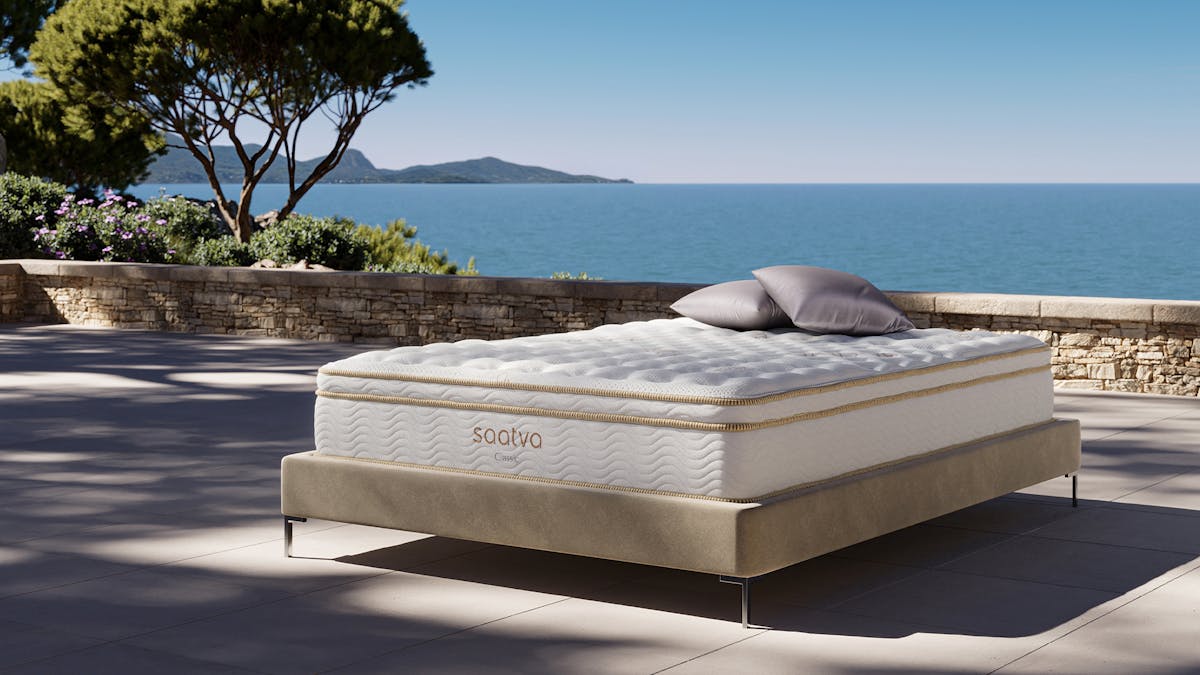
Saatva Classic
9/10
- Dual-coil construction with a dedicated lumbar zone reinforcement pad keeps the lower back supported while hips and shoulders settle in
- Outstanding edge support (10/10 NapLab) makes sit-to-stand safer when hips and knees are painful
- Free white-glove delivery and old-mattress removal, no heavy lifting required with sore joints
- 365-night trial covers a full year of seasonal OA fluctuation
- Luxury Firm option hits the medium-firm sweet spot consistently recommended for arthritic joints
- Higher motion transfer than all-foam, less ideal if a partner is a very light sleeper
- $99 return fee if the mattress is returned during the trial period
Osteoarthritis demands joint cushioning, lumbar support, and safe edge exit. The Saatva Classic in Luxury Firm delivers all three: the dual coils respond zone by zone to hip and shoulder weight, the lumbar pad prevents lower-back sag, and white-glove delivery means no lifting when joints are inflamed.
Sleep position and osteoarthritis
Position matters as much as the mattress surface for OA joint relief:
- Side sleeping (most common with OA): a medium mattress with enough give at the hip and shoulder keeps joints decompressed. A pillow between the knees takes rotational load off the hip and sacroiliac joints.
- Back sleeping: pair with a medium-firm surface and a pillow under the knees to preserve natural lumbar lordosis without strain.
- Stomach sleeping: compresses the lumbar spine and increases hip pressure, making OA symptoms worse for most people. A pillow under the pelvis can reduce the arc if the position cannot be changed.
An adjustable base paired with any of the picks above adds head and knee elevation modes that can reduce morning joint stiffness in the spine, hip, and knee positions most affected by osteoarthritis.
How long until a mattress helps OA pain?
Most people with osteoarthritis report reduced morning stiffness within 2 to 4 weeks of switching to a better-fitted surface. Full adaptation, when the body has stopped bracing against the new support profile, typically takes 6 to 8 weeks. This is why 100-plus night trials matter for OA sufferers more than for anyone else: the first month often shows early improvement, but the real picture comes later.
If pain is unchanged after 8 weeks on an appropriate mattress, the cause is likely clinical rather than mechanical, and a rheumatologist or physiotherapist evaluation is appropriate. A mattress addresses positional comfort, not cartilage degeneration.
Our first recommendation in this guide is the Amerisleep AS5. The AS5 is Amerisleep's soft-feel option, with Bio-Pur memory foam. Consider it when you want more cushioning than a firmer mattress provides. Softness is not suitable for every sleeping position, so check that your hips remain comfortably supported.
Frequently asked questions
Is a firm or soft mattress better for osteoarthritis?
Neither extreme. Extra-firm surfaces press directly on arthritic joints; very soft surfaces let the hip and spine sag into misalignment. Medium to medium-firm (5-6 out of 10) consistently produces the best results by cushioning joints without allowing structural collapse.
Does a hybrid mattress help with arthritis?
A coil hybrid combines responsive zone-by-zone support from the pocketed coils with pressure absorption from the comfort layer above. For OA, this combination works well because the coils support body weight independently in each zone while the foam or pillow top cushions the actual contact points. A strong edge support coil perimeter also makes sitting on the side of the bed and standing up safer, which matters when hips and knees are painful.
Is white-glove delivery worth it for someone with joint pain?
Yes. Moving and setting up a mattress requires bending, lifting, and carrying weight that is genuinely dangerous for inflamed joints. The delivery team handles all of it, including old-mattress removal. For Saatva this service is included at no extra cost.
Can an adjustable base reduce osteoarthritis morning stiffness?
Many OA patients report that a gentle head incline and slight knee bend position overnight reduces the degree of morning stiffness in the lumbar spine and hip. The base does not treat the disease but it can reduce the time and discomfort of the waking-up phase.
This guide is part of our Best Mattress for Pain Relief hub, where we compare all top picks by condition.