
 by
by The best mattress for overweight back sleepers is one built specifically to handle higher body loads without bottoming out or losing lumbar alignment. Our top pick is the Saatva HD: engineered for sleepers up to 500 lb per side, its reinforced dual-coil base and zoned lumbar support hold the natural lordotic curve under sustained higher-weight pressure. Sleepers in the 150-250 lb range who prefer all-foam can also consider the Amerisleep AS3 as a strong alternative.
Saatva HD
9.4/10
- Engineered for sleepers up to 500 lb per side, with 25% more steel coil support than the Saatva Classic
- Zoned lumbar foam reinforcement targets the L4-L5 region directly, preventing pelvic drop under heavier loads
- Exceptional edge support with reinforced perimeter coils, making getting in and out of bed easier for heavier frames
- Free white-glove delivery, in-room setup, and old mattress removal included
- 365-night trial and lifetime warranty, the longest coverage in its category
- Higher-end price point compared to boxed mattresses
- Ships flat, not roll-packed, so setup requires the white-glove team
The Saatva HD is the clearest engineering answer to the overweight back sleeper problem. Its reinforced coil stack resists the pelvic sinkage that flattens the lumbar curve under higher body loads, while the zoned lumbar pad keeps the L4-L5 region supported throughout the night. No other mattress in this category offers a 365-night trial with lifetime warranty at comparable structural specs.
Why body weight changes the mattress equation for back sleepers
Back sleeping concentrates load on three zones: the upper back, the lumbar spine, and the pelvis. At average weight these zones are roughly equal. At higher weights the pelvis becomes the dominant load point, carrying roughly 40 percent of total body weight in the supine position. If the mattress under the pelvis compresses faster than the mattress under the lumbar, the pelvis drops relative to the spine, inverting the natural lordotic curve into a flexed position. This is the mechanical origin of most morning lower back pain in heavier back sleepers.
The research supports a specific range. A 2015 Sleep Health study (Jacobson et al.) found medium-firm mattresses reduced chronic non-specific lower back pain significantly over 12 weeks. At higher body weights, medium-firm means a bed that resists pelvic sinkage while still allowing the shoulder blades to settle, which calls for zoned construction rather than uniform firmness. A uniform soft bed lets the pelvis drop; a uniform firm bed leaves the lumbar unsupported. Zoned firmness is the engineering answer, and a mattress rated for the actual body weight is the structural foundation that makes zoning effective.
Specifications that matter at higher body weight
| Spec | Target for heavy back sleepers | Why it matters |
|---|---|---|
| Per-side weight rating | 400 lb+ per side | A mattress rated below your weight compresses past its design point |
| Lumbar zone firmness | Firmer than shoulder zone | Holds lordotic curve under higher load |
| Comfort layer density | 4 PCF+ for foam | Prevents premature sag under sustained pressure |
| Edge support | Reinforced perimeter | Easier exit for heavier frames |
| Trial window | 100 nights minimum | Long enough to separate adaptation from mismatch |
| Warranty | 15-20 years, covers 1"+ impression | Protects against sag under heavier use |
Top picks compared
| Mattress | Type | Firmness | Weight rating | Trial | Queen |
|---|---|---|---|---|---|
| Saatva HD | Dual-coil hybrid | Medium-firm 6/10 | 500 lb/side | 365 nights | From $1,995 |
| Saatva Classic (Firm) | Dual-coil innerspring | Firm 8/10 | 300 lb/side | 365 nights | ~$1,395 |
| Amerisleep AS3 | All-foam (Bio-Pur) | Medium 5/10 | 250 lb/side | 100 nights | From $1,049 |
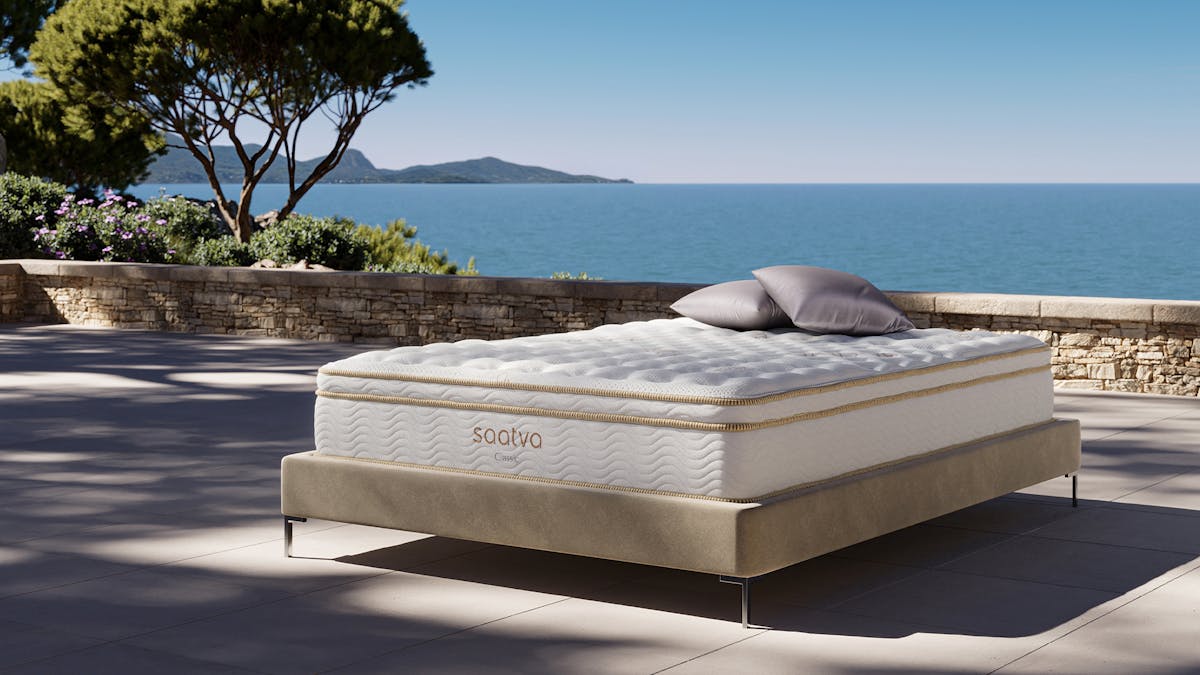
Saatva Classic
8.9/10
- Dual-coil construction (884 pocketed + 416 support coils queen) delivers deep structural support for heavier frames
- Zoned lumbar foam reinforcement pad targets the lower back directly
- Outstanding edge support, 2.25" sitting sinkage in lab tests, critical for getting in and out of bed
- Free white-glove delivery, setup, and old mattress removal included
- 365-night trial, lifetime warranty
- Weight rating lower than the HD model, best suited for sleepers up to 300 lb
- $99 return fee applies during the trial window
Back sleepers in the 200-300 lb range who want a responsive, hotel-style coil feel get solid structural support from the Saatva Classic in Firm. The dual-coil stack and perimeter reinforcement hold heavier bodies without bottoming out, though sleepers above 300 lb should step up to the HD.
Firmness guide by weight range
Firmness needs shift with body weight because heavier loads compress comfort layers further, making a mattress feel softer than its rating suggests:
- 150-200 lb: Medium (5-6/10) works for most back sleepers. The Amerisleep AS3 or Saatva Classic in Luxury Firm are solid fits in this range.
- 200-250 lb: Medium-firm (6-7/10). The Saatva Classic in Luxury Firm is the primary recommendation; the Saatva HD is also a strong choice for long-term durability.
- 250-300 lb: Firm (7-8/10) or a purpose-built heavy-duty hybrid. Saatva HD and Saatva Classic in Firm are the right choices here.
- 300 lb+: The Saatva HD is the clear recommendation, with its 500 lb per side engineering rating and reinforced coil stack. Standard mattresses compress past their design point at this weight range.
Sleep position mechanics for heavy back sleepers
In the supine position, a pillow under the knees, not under the lumbar, helps the spine settle into natural lordosis. The knee pillow reduces tension on the hip flexors and lets the lumbar curve decompress rather than flatten against the mattress. Combined with a medium-firm zoned mattress, this gives the best overnight lumbar alignment outcomes for heavier sleepers.
An adjustable base with zero-gravity mode elevates the legs slightly and further reduces lumbar disc pressure, worth considering for back sleepers with persistent morning pain even on a good mattress.
Amerisleep AS3
8.7/10
- HIVE 5-zone support fires firmer under the lumbar (zone 3 of 5), preventing the pelvic drop that causes back pain
- Plant-based Bio-Pur open-cell foam resists heat buildup that extra body mass amplifies
- CertiPUR-US certified, made in the USA, free shipping
- 20-year warranty covers impressions over 1.5 inches
- All-foam edge support softer than a coil hybrid
- Best suited for back sleepers up to 250 lb; heavier sleepers should opt for the Saatva HD
For back sleepers in the 150-250 lb range who prefer the pressure-conforming feel of foam over coils, the AS3 hits the medium sweet spot while actively reinforcing the lumbar zone. Above 250 lb, the Saatva HD is the better structural fit.
How long before a new mattress relieves back pain?
Most people report improvement within 2 to 4 weeks of switching to a properly-fitted mattress, with full adaptation closer to 8-12 weeks in the Jacobson study. Heavier sleepers sometimes take longer because the body has developed compensatory patterns around a previous poor sleep position. This is why a 100-night minimum trial matters, with 365 nights being the gold standard for confirming a genuine fit.
For overweight back sleepers, the Saatva HD is the structurally correct choice, engineered for up to 500 lb per side with a zoned lumbar system and 365-night trial. The Saatva Classic (Firm) covers the 200-300 lb range. The Amerisleep AS3 is a solid all-foam alternative for sleepers up to 250 lb.
Frequently asked questions
What mattress firmness is best for overweight back sleepers?
Medium-firm (6-7 out of 10) is the most consistent recommendation for back sleepers in the 150-250 lb range. Above 250 lb, a firm hybrid with reinforced coils usually performs better because heavier loads compress comfort layers past the medium feel into too-soft territory. Above 300 lb, a purpose-built mattress like the Saatva HD with a 500 lb per side weight rating is the right starting point.
Is memory foam good for heavy back sleepers?
High-density memory foam (4 PCF+) with a zoned support layer works well up to around 250 lb. Above that, a hybrid with pocketed coils provides more durable support and better prevents the pelvic sinkage that flattens the lumbar curve. The Saatva HD's reinforced coil base is the structural upgrade that matters most for heavier sleepers.
Does a heavier person need a firmer mattress?
Generally yes, but the key is zoning, not uniform firmness. A uniform extra-firm bed leaves the lumbar unsupported above the surface. A medium-firm zoned mattress holds the pelvis up while still allowing the lumbar curve to settle, which is the correct mechanical outcome. A high weight rating combined with zoned construction is the combination to look for.
What weight does a mattress start failing for back sleepers?
Most mainstream mattresses start showing accelerated wear and alignment issues around 230-250 lb for back sleepers. The Saatva HD is purpose-built with a 500 lb per side rating and extends reliable performance well above that threshold.
This guide is part of our Best Mattress by Body Type hub, compare all the top picks and narrow down your choice there.