
 by
by Natural latex (NR) lasts 15 to 25 years, off-gases almost nothing, and earns the top eco certifications (GOLS, OEKO-TEX). Synthetic latex (SBR) is petroleum-derived, lasts 8 to 12 years, and costs 30% to 50% less. Blended latex sits between both. For most shoppers, a Talalay-blend latex hybrid captures most of the durability and breathability of natural rubber at a more accessible price, which is why the Saatva Latex Hybrid is our top pick. For maximum natural rubber content, the PlushBeds Botanical Bliss is the GOLS-certified standard.
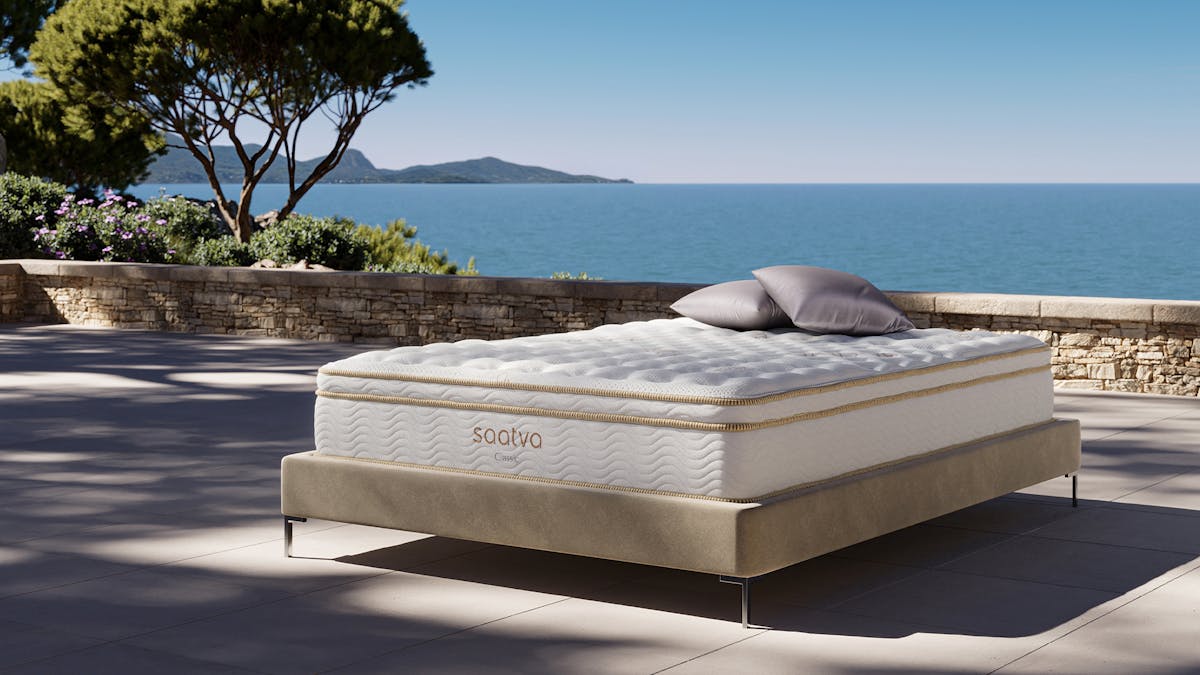
Saatva Latex Hybrid
9.0/10
- Talalay-process blended latex (30% NR / 70% SBR) over zoned pocketed coils, bouncy and breathable
- eco-INSTITUT and GREENGUARD Gold certified, organic cotton cover, New Zealand wool fire barrier
- 365-night trial, the longest in the latex category, plus a lifetime warranty and free old-mattress removal
- Best entry point to Talalay latex for shoppers moving from memory foam or innerspring
- Talalay blend is 70% SBR, so it is not a 100% natural latex mattress
- Heavier than foam-only mattresses, standard delivery requires two people to position
The Saatva Latex Hybrid is the cleanest middle option in the DTC latex market. The Talalay process produces a bouncy, aerated foam that sleeps cooler than memory foam; the pocketed coil base adds edge support and spinal alignment. The 365-night trial removes the most common barrier to buying latex: uncertainty about whether you will like the feel.
What latex actually is: NR, SBR, and blended
Latex as a mattress material is one of three distinct things, and the distinction drives every decision about price, durability, and certifications.
Natural latex (NR) is harvested from the Hevea brasiliensis rubber tree, grown across Sri Lanka, Thailand, Malaysia, and Indonesia. The raw sap is roughly 30% rubber polymer and 70% water, plus small amounts of proteins and lipids. In mattress production, the water is driven off and vulcanizing agents (sulfur and zinc oxide) crosslink the long cis-1,4-polyisoprene chains into an elastic, breathable foam. Those long, disordered polymer chains are the source of natural rubber's exceptional fatigue resistance and long lifespan.
Synthetic latex (SBR), technically styrene-butadiene rubber, was developed in the 1930s as a wartime substitute for imported natural rubber. SBR uses shorter, more uniform polymer chains than natural rubber. The shorter chain length produces a foam that is slightly denser, slightly firmer, and less buoyant than NR at the same ILD (Indentation Load Deflection) rating. SBR is cheaper to produce because petroleum is cheaper than rubber tree latex, and the consistency is easier to control batch-to-batch.
Blended latex combines NR and SBR before processing. The most common Talalay blend is 30% natural rubber and 70% SBR, the ratio Saatva discloses for its Latex Hybrid. The most common Dunlop blend is the inverse, 70% NR and 30% SBR. The blend ratio is driven by cost, chemistry, and the target feel of the finished foam.
Dunlop and Talalay: the two manufacturing processes
The manufacturing process shapes the feel as much as the NR/SBR ratio does. Dunlop and Talalay convert liquid latex into mattress foam by different routes, and the results feel different even at the same blend.
Dunlop is the older method, invented in 1929. Liquid latex is whipped with air, poured into a mold, and vulcanized in a single pass. Heavier rubber particles settle toward the bottom during the pour, which creates a slight density gradient: the bottom of a Dunlop core is firmer than the top. The finished foam is denser, more supportive, slightly firmer at equal ILD, and generally less expensive to produce. Avocado Green, PlushBeds Botanical Bliss, and Latex for Less all use Dunlop-process natural latex.
Talalay was developed in the 1950s as a more controlled alternative. The whipped latex is poured into a sealed mold under vacuum, which distributes the rubber particles evenly before the foam is flash-frozen and then vulcanized. The vacuum and freeze steps eliminate the density gradient and produce a more uniform, softer, bouncier, and more aerated foam. Talalay costs 30% to 50% more to produce. Saatva uses Talalay-process blended latex in the Latex Hybrid.
The practical feel difference: at the same nominal firmness, Dunlop is denser and more supportive, with a "lifted" quality. Talalay is more pillowy and bouncy, with a softer initial compression before the support kicks in. Neither is objectively better. Side sleepers and combination sleepers tend to prefer Talalay; back sleepers and heavier sleepers often prefer Dunlop's firmer support character.
Performance: lifespan, heat, off-gassing, cost
| Metric | Natural latex (NR) | Synthetic latex (SBR) | Blended (30/70 Talalay) |
|---|---|---|---|
| Lifespan | 15–25 years | 8–12 years | 12–18 years |
| Heat retention | Low (slightly lower than SBR) | Low (1–3°F cooler than memory foam) | Low |
| Off-gassing | Near-zero | Mild (dissipates in 1–2 weeks) | Very low |
| Queen price range | $1,800–$4,000+ | Rare in premium DTC; $1,000–$1,500 | $1,395–$1,895 (sale) |
| Eco certifications | GOLS, eco-INSTITUT, OEKO-TEX, GOTS | None applicable | eco-INSTITUT, GREENGUARD Gold |
Lifespan is where natural latex earns its premium most clearly. Natural rubber's long, disordered polymer chains create more crosslink points during vulcanization, which translates to better fatigue resistance under repeated compression. A 100% natural latex mattress core lasts 15 to 25 years versus 8 to 12 for synthetic latex. Sleep Like the Dead's longitudinal owner surveys consistently place latex mattresses at the top of the durability ranking, ahead of memory foam (7 to 10 years) and innerspring (6 to 8 years).
Heat is where both latex types outperform memory foam. Latex foam's open cellular structure, with pinhole channels through the core visible on any cut face, allows vertical airflow that most memory foam blocks. Independent testing by NapLab and Sleepopolis places latex mattresses 1 to 3 degrees Fahrenheit cooler in skin-contact temperature than memory foam. Talalay is slightly cooler than Dunlop due to its more aerated structure.
Off-gassing is nearly a non-issue for natural latex. The harvested rubber sap, once vulcanized, releases trace organic compounds well below the thresholds set by eco-INSTITUT and GREENGUARD Gold. Synthetic latex off-gases more, primarily styrene and residual butadiene, both at low ppm levels and both dissipating within one to two weeks. A 100% natural latex mattress is often described as odorless from day one.
Eco-impact and certifications
Latex is one of the few mattress materials with a credible environmental story, but the category also contains significant greenwashing. The certifications are the only reliable signal.
GOLS (Global Organic Latex Standard) certifies foam containing at least 95% certified organic raw material with processing inputs meeting strict environmental and social criteria. GOLS-certified latex is unambiguously high natural rubber content. PlushBeds Botanical Bliss, Avocado Green Natural, and Latex for Less hold GOLS certification on their latex foam.
eco-INSTITUT is a German testing body that certifies finished products for VOC emissions, formaldehyde, heavy metals, and other indoor-air pollutants. The Saatva Latex Hybrid and PlushBeds Botanical Bliss both hold eco-INSTITUT certification. This is the broadest emissions certification in the category and applies to both natural and blended latex products.
GOTS (Global Organic Textile Standard) applies to fabrics and yarns, not foam. A GOTS label on a mattress certifies the cotton or wool cover, not the latex core.
OEKO-TEX Standard 100 tests for harmful substances in textiles. Like GOTS, it certifies the cover fabric rather than the latex core.
GREENGUARD Gold certifies low chemical emissions appropriate for sensitive populations (children, elderly, healthcare environments). Saatva, Amerisleep, Helix, and most major DTC brands hold this for their mattresses.
The practical rule: if a mattress claims "natural latex" without showing a GOLS certificate or publishing the exact NR/SBR ratio, assume it is a blended or mostly-synthetic product.
Brand map: which latex goes into which mattress
Saatva Latex Hybrid. Talalay-process blended latex, approximately 30% NR and 70% SBR, over zoned pocketed coils. Organic cotton cover, New Zealand wool fire barrier. eco-INSTITUT and GREENGUARD Gold certified. Queen $1,895 on sale, $2,395 MSRP. 365-night trial, lifetime warranty, free white-glove delivery. The entry point to Talalay latex in the DTC market, and the most forgiving trial window for first-time latex buyers.
PlushBeds Botanical Bliss. 100% natural Dunlop-process latex sourced from Sri Lankan plantations. ARPICO and GOLS certified. Three latex layers in configurable firmness combinations, rearrangeable after delivery. Organic cotton cover, organic New Zealand wool fire barrier. Queen $2,499 on sale. 100-night trial, 25-year warranty. The strongest 100% natural latex option in the DTC market.
Avocado Green Mattress. 100% natural Dunlop latex layers (GOLS certified) over individually pocketed coils. Organic cotton cover, organic New Zealand wool. GOLS, GOTS, eco-INSTITUT, and Made Safe certified, plus Climate Neutral company certification. Queen $1,899 on sale. 365-night trial, 25-year warranty. The most-certified natural latex hybrid in the DTC market.
Birch Natural (Helix). Talalay-process natural latex, approximately 95% NR and 5% SBR, over pocketed coils. GOLS certified, GOTS certified cotton cover, OEKO-TEX certified wool. Queen $1,749 on sale. 100-night trial, 25-year warranty. Sits between Saatva Latex Hybrid and Avocado in price and natural rubber content.
Latex for Less. 100% natural Dunlop latex in a flippable two-firmness construction (one side soft, one side firm). GOLS certified. Queen $1,399 on sale. 120-night trial, 20-year warranty. The most accessible entry to 100% natural latex.
Latex mattress comparison 2026
| Mattress | Latex type | Process | Key certifications | Queen price | Trial |
|---|---|---|---|---|---|
| Saatva Latex Hybrid | Blended (~30% NR / 70% SBR) | Talalay | eco-INSTITUT, GREENGUARD Gold | $1,895 sale | 365 nights |
| PlushBeds Botanical Bliss | 100% natural | Dunlop | GOLS, GOTS, ARPICO | $2,499 sale | 100 nights |
| Avocado Green | 100% natural | Dunlop | GOLS, GOTS, eco-INSTITUT, Made Safe | $1,899 sale | 365 nights |
| Birch Natural | ~95% NR / 5% SBR | Talalay | GOLS, GOTS, OEKO-TEX | $1,749 sale | 100 nights |
| Latex for Less | 100% natural | Dunlop | GOLS | $1,399 sale | 120 nights |
PlushBeds Botanical Bliss
8.7/10
- 100% GOLS-certified natural Dunlop latex, the gold standard for natural rubber content
- Three-layer construction is rearrangeable after delivery, so you can adjust firmness without returning the mattress
- ARPICO and GOLS certifications, plus eco-INSTITUT, organic cotton cover and wool fire barrier
- 25-year warranty, one of the longest in the category
- Higher upfront cost than blended latex options
- Dunlop foam is denser and feels less "plush" than Talalay at the same nominal firmness
- 100-night trial is shorter than Saatva's 365 nights
If you want to know exactly what is in your mattress, PlushBeds Botanical Bliss is the right answer. Every latex layer is GOLS-certified, the NR/SBR ratio is unambiguously 100% natural rubber, and the rearrangeable firmness system means you are not stuck with a feel that does not work.
Five buyer profiles: which latex to choose
You want the longest trial to confirm latex is right for you. Saatva Latex Hybrid. 365 nights to test the Talalay bounce-over-coils feel before you commit. The blended ratio keeps the price below 100% natural while preserving most of the durability and breathability benefits.
You want the highest certified natural rubber content. PlushBeds Botanical Bliss. Three layers of GOLS-certified Dunlop latex, rearrangeable after delivery to get the firmness right. The 25-year warranty matches the expected lifespan of the material.
You want the most third-party certifications on a hybrid. Avocado Green. GOLS, GOTS, eco-INSTITUT, Made Safe, and Climate Neutral certification, plus pocketed coil support under the Dunlop latex layer.
You want 100% natural latex at the lowest price. Latex for Less. The flippable two-firmness design (soft on one side, firm on the other) gives you a second chance to get firmness right without a return.
You want to test the latex feel before committing to a full mattress. A 3-inch natural latex topper from Sleep On Latex ($399 queen) lets you evaluate the material for 30 days over your existing mattress.
Latex allergy: what you actually need to know
Type I latex allergy, the IgE-mediated reaction to proteins in natural rubber, affects roughly 1% of the general population. Reactions can range from contact dermatitis to anaphylaxis. For mattress shoppers, the risk is much lower than the headline suggests.
Latex mattress cores are encased in cotton and wool covers. Direct skin contact with raw latex foam does not occur during normal use. The proteins responsible for allergic reactions are also substantially denatured during vulcanization. The American Latex Allergy Association and the ACAAI both conclude that the risk of triggering a Type I reaction through a properly constructed latex mattress is negligible for most allergic individuals.
If you have documented severe Type I latex allergy with an anaphylaxis history, consult your allergist before purchasing. Synthetic latex (SBR) contains no natural rubber proteins and presents zero Type I latex allergy risk. The Saatva Latex Hybrid's 70% SBR composition reduces the natural rubber protein load proportionally, making it a more conservative choice for shoppers with mild sensitivity.
Frequently asked questions
Is natural latex always better than synthetic latex?
Better for lifespan, off-gassing, and eco-impact, yes. Better for feel preference and budget, not always. Natural latex lasts 15 to 25 years versus 8 to 12 for synthetic, and produces near-zero off-gassing. But natural latex is denser and bouncier. Some sleepers prefer the slightly firmer, less buoyant character of synthetic or blended latex. The Saatva Latex Hybrid's Talalay blend is a deliberately tuned middle ground.
What does "Talalay blend" mean on a mattress label?
Talalay blend means the latex was processed using the Talalay vacuum-freeze method and the rubber input is a mix of natural and synthetic rubber. The most common ratio is 30% NR and 70% SBR. This is cheaper than 100% natural Talalay and feels nearly identical, with a slightly shorter lifespan. Saatva and Brooklyn Bedding use Talalay blend.
Is Dunlop or Talalay latex better?
Neither is objectively better. Dunlop is denser, slightly firmer at equal ILD, and feels more supportive. Talalay is more aerated, bouncier, and softer-feeling at equal ILD. Dunlop is generally cheaper to produce. PlushBeds Botanical Bliss and Avocado use Dunlop; Saatva Latex Hybrid uses Talalay.
How long does a latex mattress last?
100% natural latex mattresses last 15 to 25 years with regular rotation. Blended latex (30% NR / 70% SBR Talalay) lasts 12 to 18 years. Synthetic-heavy latex lasts 8 to 12 years. All three outperform memory foam (7 to 10 years) and innerspring (6 to 8 years) by a wide margin.
Do latex mattresses sleep hot?
No. Latex foam has an open cellular structure with pinhole channels that allow vertical airflow. Independent testing by Sleepopolis and NapLab places latex 1 to 3 degrees Fahrenheit cooler in skin-contact temperature than memory foam. Talalay is slightly cooler than Dunlop due to its more aerated pour.
Why does latex cost so much more than memory foam?
Raw natural rubber latex costs 3 to 5 times more per pound than the petrochemicals used to make polyurethane memory foam. Latex manufacturing is also slower and more complex (pour, mold, and vulcanize cycles in either Dunlop or Talalay process). The cost differential flows directly into retail prices. The trade-off is a 2 to 3 times longer lifespan.
For first-time latex buyers, the Saatva Latex Hybrid is the lowest-risk entry: Talalay bounce and breathability, 365-night trial, and a lifetime warranty at a blended-latex price. For 100% natural rubber content and the longest-lasting mattress in the category, the PlushBeds Botanical Bliss is the GOLS-certified gold standard. Avoid any mattress claiming "natural latex" without a published NR/SBR ratio or GOLS certification number.