
 by
by Our Recommended Pick
Saatva Classic pairs a PCM-enhanced Euro pillow top with coil-on-coil construction for multi-layer temperature management.
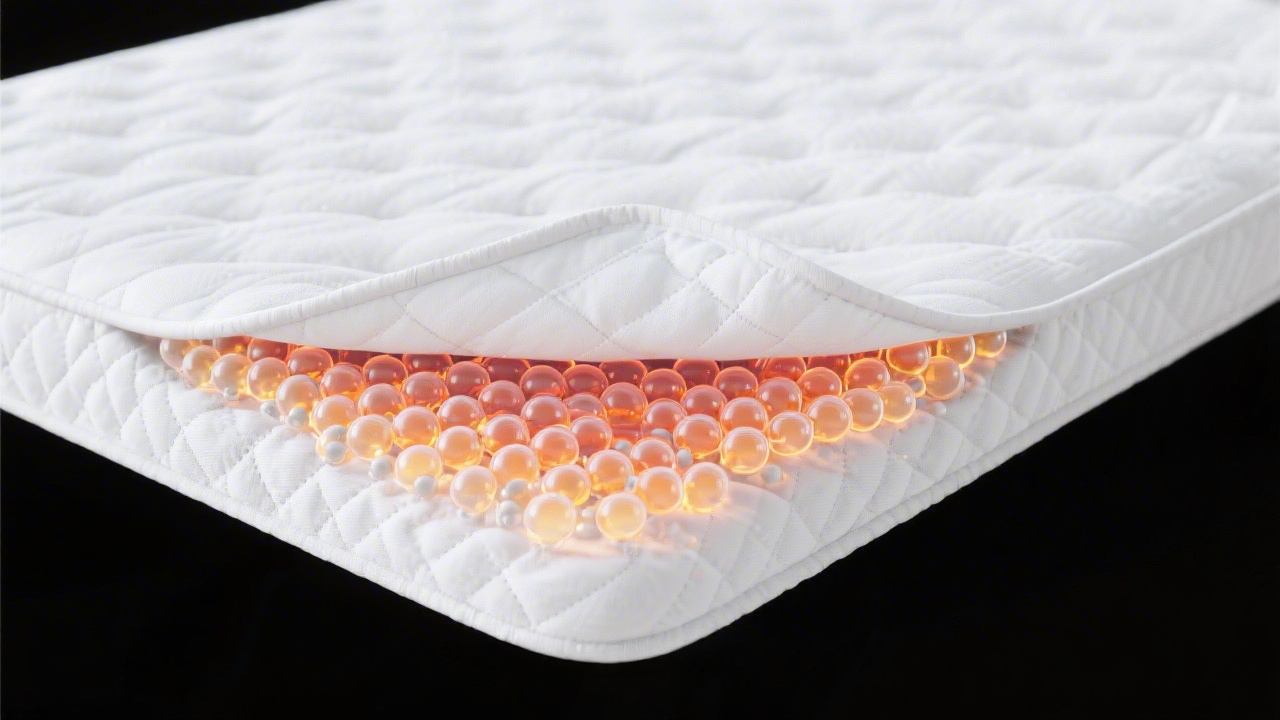
Phase change materials (PCMs) represent the most scientifically sophisticated passive cooling technology used in consumer mattresses today. Unlike gel or graphite, which conduct heat away, PCMs absorb heat by changing physical state — from solid to liquid — at a precisely calibrated temperature. This is the same physical principle used in cold packs and spacecraft thermal regulation.
The Physics of Phase Change Cooling
When a material changes state — from solid to liquid, or liquid to gas — it absorbs large amounts of energy (latent heat) without increasing in temperature. PCMs used in bedding are engineered to transition at temperatures just below the normal skin surface temperature of a sleeping person (approximately 33–36°C / 91–97°F).
As body heat warms the PCM-infused surface, the material begins to melt, absorbing heat in the process. The sleep surface temperature remains stable — closer to the PCM's transition temperature — rather than rising with body heat. When the body cools (or the room temperature drops), the PCM re-solidifies, releasing stored heat back. This creates a regulation loop rather than a one-way heat transfer.
Where PCMs Are Used in Mattresses
- Mattress covers and quilted panels: The most common application — PCM microcapsules are embedded in the cover fabric fibers. This is what most "cooling cover" claims refer to.
- Foam infusion: PCM beads can be incorporated into memory foam, creating gel-bead PCM combinations (what higher-end "cooling gel" mattresses actually use — see our gel mattress guide).
- Topper covers: Standalone toppers with PCM-infused quilted covers are one of the more accessible ways to add phase change technology to an existing sleep setup.
PCM Temperature Limits: The Key Constraint
PCMs have a latent heat capacity — a maximum amount of energy they can absorb before becoming fully liquid. Once they are fully liquid, they no longer provide phase-change cooling. They are now simply a liquid layer with modest thermal conductivity.
In practice: a well-engineered PCM mattress cover may provide effective temperature regulation for 4–8 hours for a normal-weight sleeper in a temperature-controlled room. Heavier sleepers or those in warm rooms may exhaust the PCM's capacity faster.
Re-solidification (resetting the PCM) occurs during the time the sleeper is out of bed — typically overnight cooling of the bedroom allows full reset by morning.
PCM vs Gel vs Graphite vs Coils
| Technology | Mechanism | Sustained All Night? | Resets Automatically? |
|---|---|---|---|
| PCM cover/foam | Latent heat absorption | Partial (capacity-limited) | Yes (overnight) |
| Gel swirl | Conductivity | No (initial only) | Yes (passive) |
| Graphite foam | Conduction channeling | Yes (continuous) | N/A (no capacity) |
| Pocketed coils | Active airflow | Yes (continuous) | N/A (passive airflow) |
What Determines PCM Quality?
- Transition temperature: Should be calibrated to ~33–35°C for sleeping use. Generic PCMs calibrated for industrial applications may not perform at body temperature.
- Latent heat capacity: Measured in J/g. Higher capacity = longer effective cooling. Premium brands publish this; budget brands rarely do.
- Encapsulation durability: PCM microcapsules in fabric must withstand repeated washing. Poor encapsulation leads to leakage and performance loss within months.
- Distribution density: A thin strip of PCM in the center panel performs very differently from full-surface coverage.
Related Technologies to Read Alongside This Guide
PCM technology is most effective when combined with other thermal management: graphite foam for continuous conduction, and hybrid coil construction for passive airflow. Many premium mattresses now use all three layers in combination.
Our Recommended Pick
Saatva Classic pairs a PCM-enhanced Euro pillow top with coil-on-coil construction for multi-layer temperature management.
Frequently Asked Questions
What is a phase change material mattress?
A mattress (or mattress cover) that contains phase change materials — compounds engineered to absorb body heat by melting at the temperature of the sleep surface, keeping the sleeper cooler without active cooling systems.
Do phase change mattresses really work?
Yes, with caveats. Quality PCMs provide measurable temperature reduction (2–6°F surface difference in controlled tests) for 4–8 hours. Performance depends on PCM quality, encapsulation, and transition temperature calibration.
How long does PCM cooling last in a mattress?
For most sleepers in a temperature-controlled room: 4–8 hours per sleep cycle. The PCM resets (re-solidifies) during the day when out of bed. Heavier sleepers or warm rooms reduce effective duration.
Is PCM cooling better than gel cooling?
For sustained cooling: PCM significantly outperforms gel swirl, which provides only initial cool touch. High-quality gel bead mattresses use PCM-grade beads — making "gel bead" and "PCM" overlapping categories at the premium end.
Are PCM materials safe?
PCMs used in bedding are typically paraffin-based waxes or bio-based fatty acids, micro-encapsulated in polymer shells. They are non-toxic and stable. Look for OEKO-TEX certification on the fabric to confirm the encapsulation material is safe for skin contact.