
 by
by Your renter-friendly headboard can cost $0 to $300 and still make the bedroom feel finished today. I’ve used folded quilts, tension rods, removable panels, and layered pillows when drilling wasn’t an option. The difference comes from scale and texture, not a permanent frame. Short version: choose your bed width, build upward, and keep every move reversible.
What You’ll Need Before You Start
Measure the bed first. A queen mattress is 60x80 inches, while a king is 76x80 inches. Your headboard idea should reach at least the mattress width, though a slightly wider arrangement can make your room feel calmer and more grounded.
If you’re working with a narrow rental bedroom, keep the side edges close to the mattress so the wall doesn’t feel crowded.
Gather what you already have before buying anything: a quilt, two large pillows, removable hooks, a tension rod, fabric, painter’s tape, or a lightweight folding screen. You don’t need a drill.
You’ll want scissors, a measuring tape, and a clean wall, but even those can be borrowed. And if your bedroom feels noisy or visually busy, start with this renter-friendly non-toxic bedroom guide for a quieter base.
For color, Farrow & Ball Setting Plaster No. 231 gives a warm blush-beige backdrop, while Benjamin Moore Pale Oak OC-20 stays quieter in changing daylight. I’d skip a stark blue-white wall here. It can make linen and wood look gray by evening, especially under a cool ceiling bulb.
- Start With a Folded Quilt Headboard Alternative
- Build the Three-Height Headboard Rule
- Hang a Tension-Rod Headboard Cover
- Layer Oversized Pillows Instead of Buying a Frame
- Paint a Soft Arch Behind the Bed
- Frame a Folding Screen as a Bed Headboard
- Swap a Curtain Panel for a Headboard Cover
- Mix Two Woods With the Two-Wood Rule
- Anchor a Removable Wall Panel
- Float a Low Bench Behind the Mattress
- Frame the Bed With the Three-Source Light Stack
- Finish With a Layered Headboard Ideas Aesthetic
1Start With a Folded Quilt Headboard Alternative
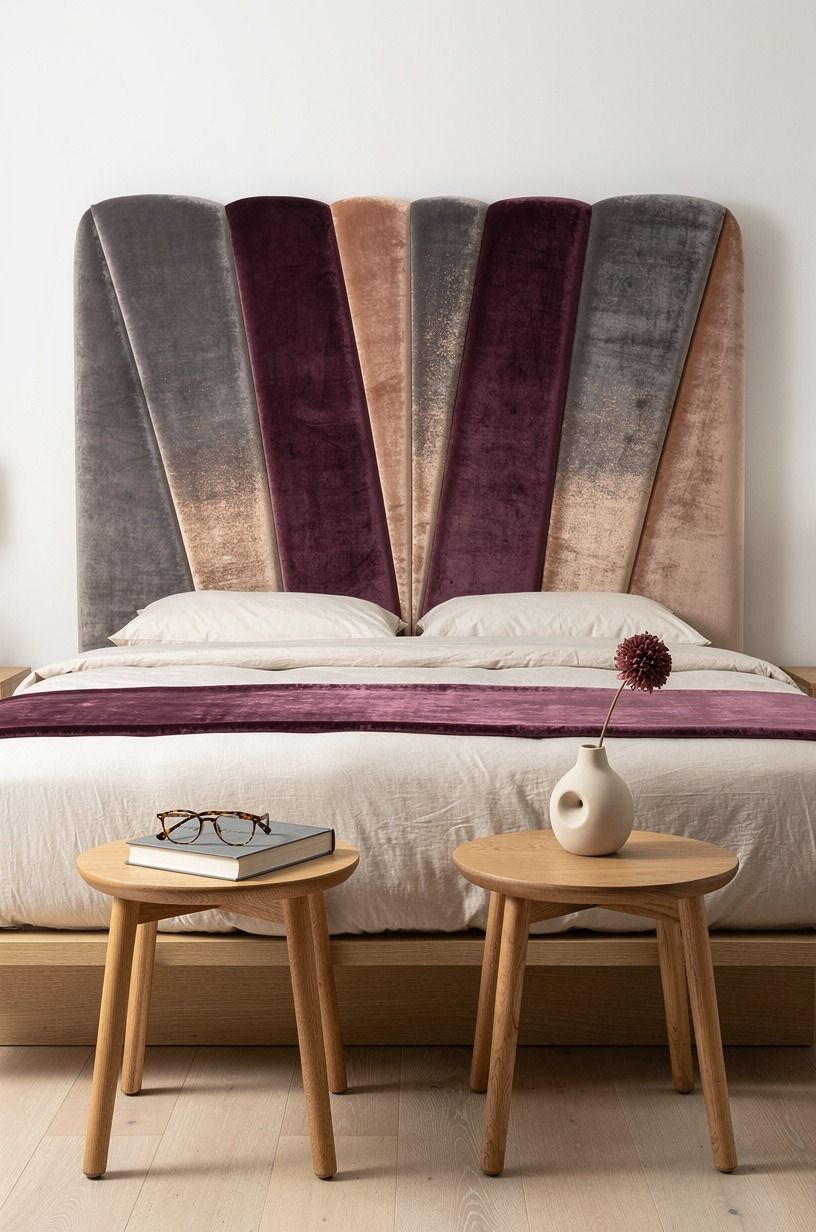
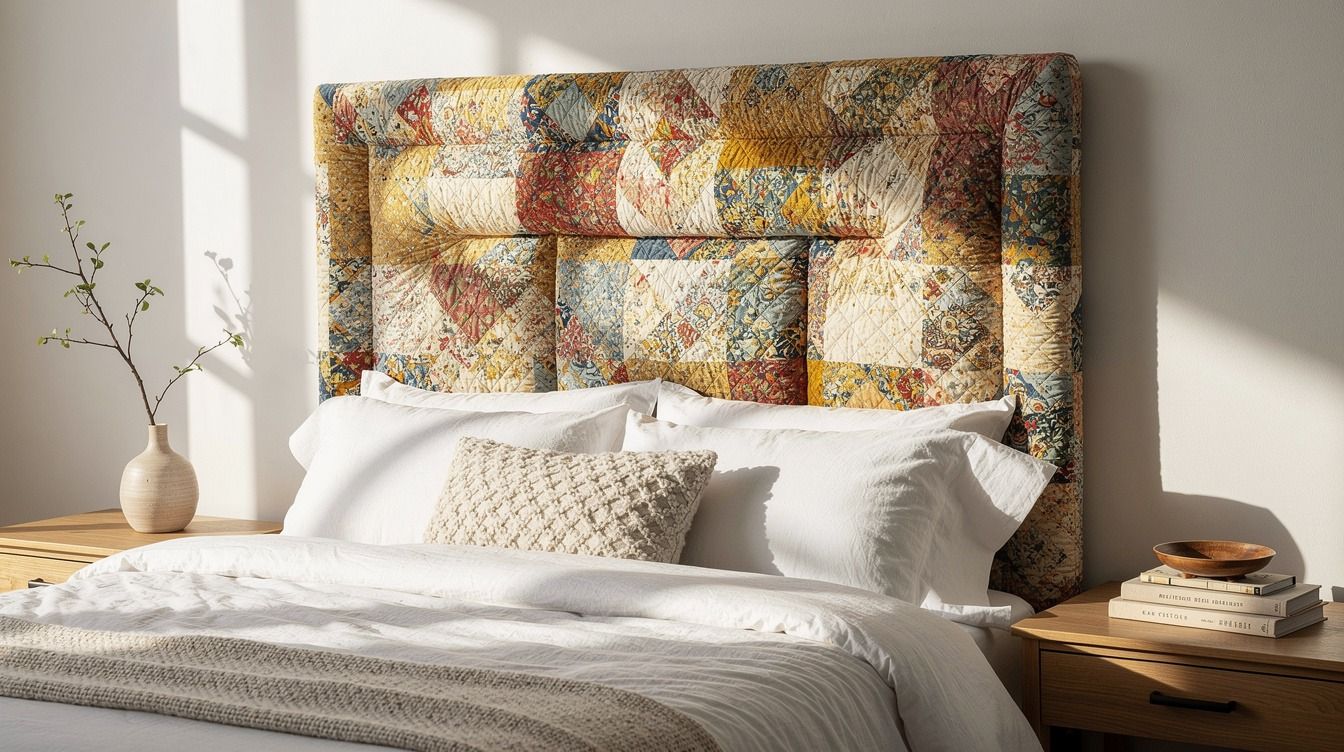
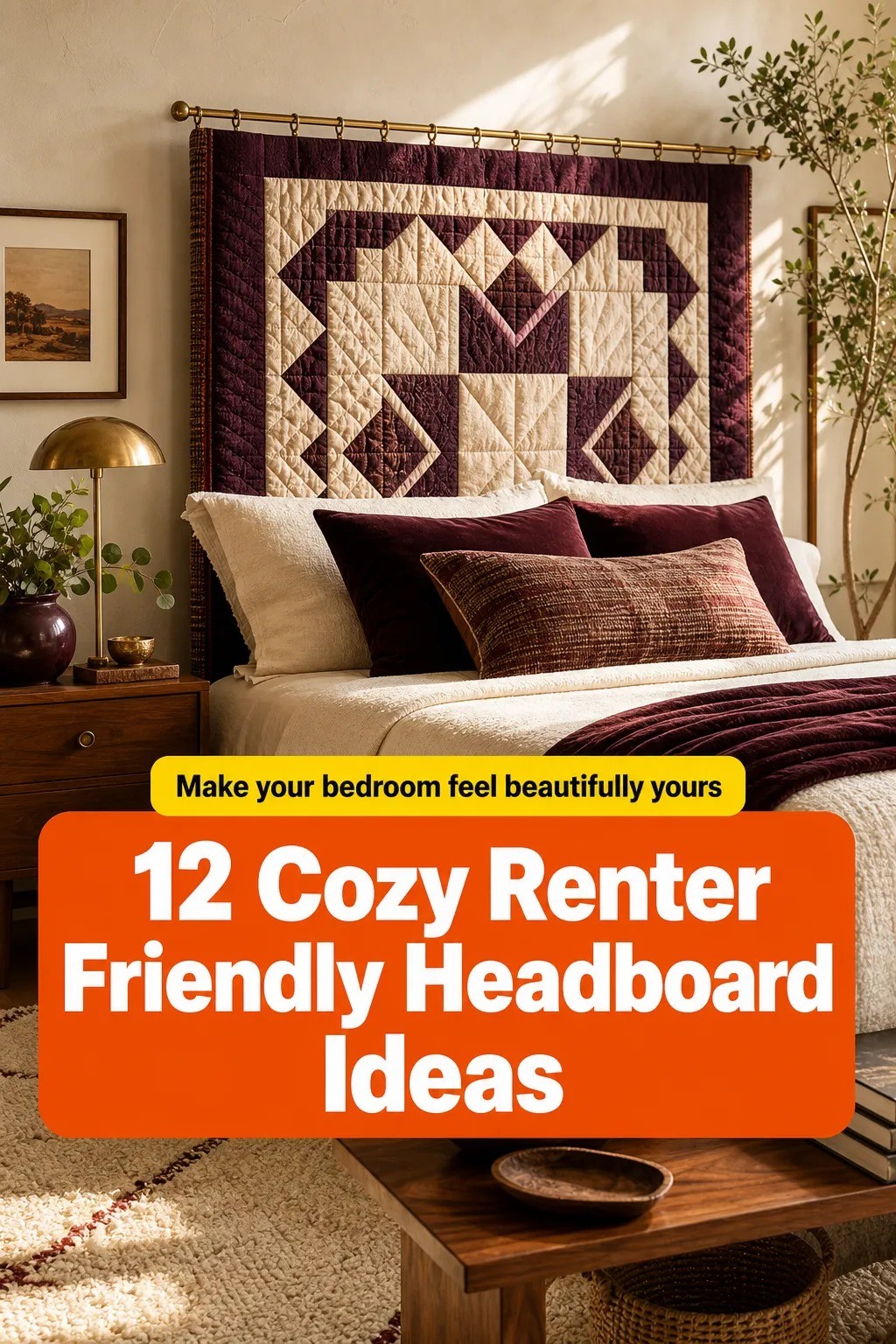
Fold a substantial quilt lengthwise and drape it over a curtain rod, tension rod, or the top edge of the bed. The quilt should begin slightly above your pillows and fall behind the mattress, creating a soft vertical panel without a rigid frame. You can tuck the lower edge behind the mattress so it stays tidy when you move around.
A deep-pile mohair velvet quilt in plum or grey with a touch of rose gold works better than a slippery satin cover because its weight gives the shape some authority. You’ll notice the room feels softer when the fabric catches the afternoon light instead of reflecting it.
I’ve tried thin coverlets for this, and they looked apologetic. Choose a quilt with visible stitching, gentle texture, and enough width to cover your queen or king bed.
If you’re renting, use a tension rod only when the walls and side surfaces can support it safely. You don’t want the rod pressing against delicate paint. For more removable decorating ideas, pair this with peel-off renter-friendly backsplash ideas, especially if your bedroom wall needs a little more color without commitment.
2Build the Three-Height Headboard Rule
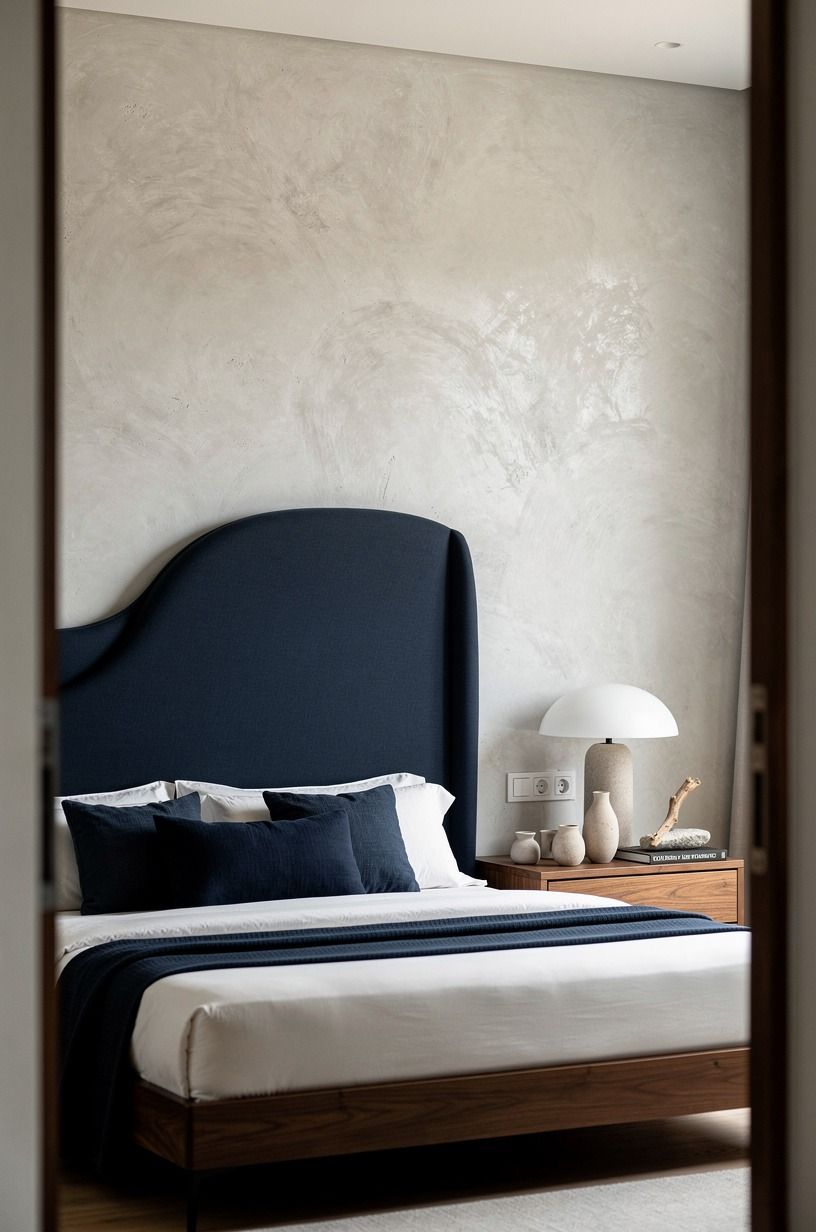
Create three distinct heights behind the bed: pillows at mattress level, a textile or panel above them, and one taller object near the ceiling line. This three-height headboard rule keeps a renter-friendly arrangement from looking like bedding stopped halfway up the wall.
You don’t need a matching set. You need a clear rise from low to high.
For the middle layer, try a lightweight screen against a wall with hand-applied Venetian plaster. For the highest layer, use a removable wall decal, a slim framed textile, or a hanging branch with soft leaves. You’ll want the tallest point centered on the bed, not centered on the whole wall if the room has a door or window nearby.
But don’t make every layer the same color. I’d choose warm white at the pillow line, muted navy in the middle, and natural walnut behind everything.
The contrast is subtle, but your eye will understand the arrangement immediately. If your room still feels unsettled at bedtime, you might also enjoy this piece on why rain makes you sleepy, which has a similar quiet-room feeling.
3Hang a Tension-Rod Headboard Cover
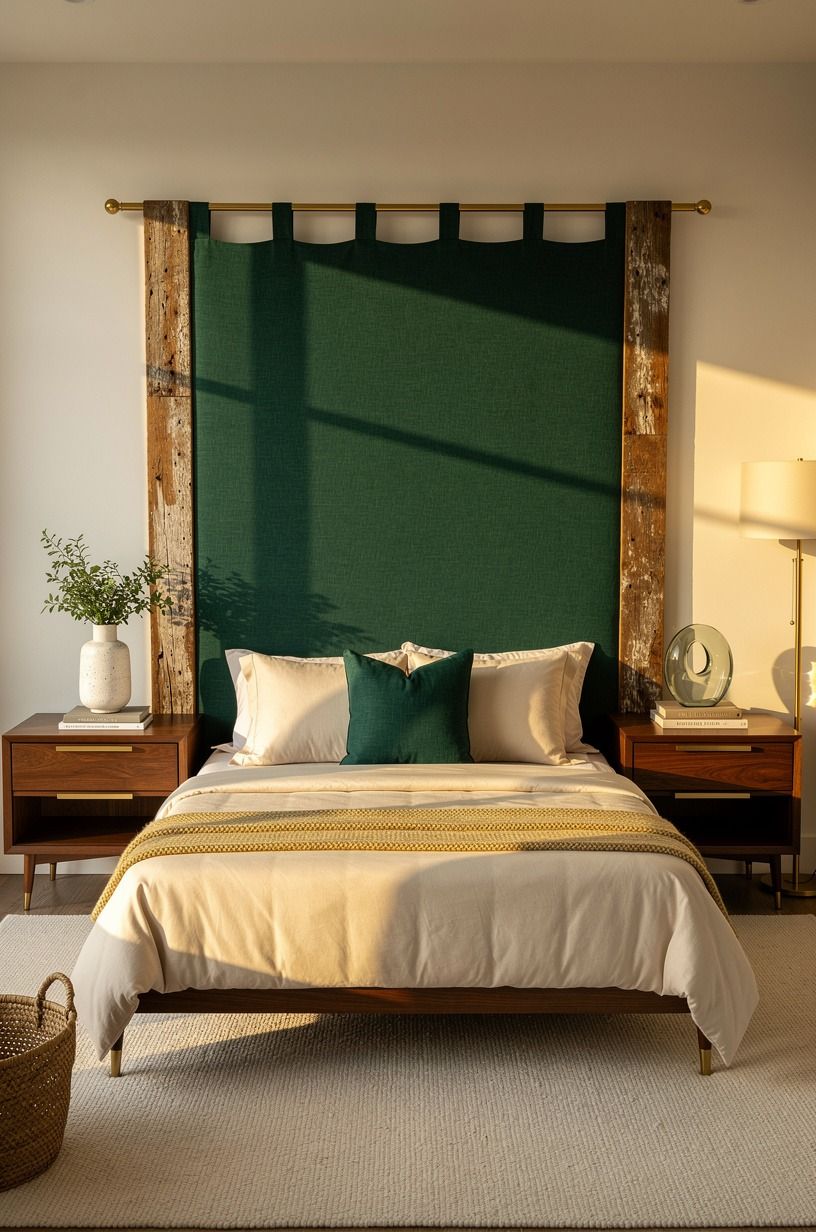
Slide a wide emerald, gold, and cream fabric panel onto a tension rod and pair it with reclaimed weathered teak just above the mattress.
4Layer Oversized Pillows Instead of Buying a Frame
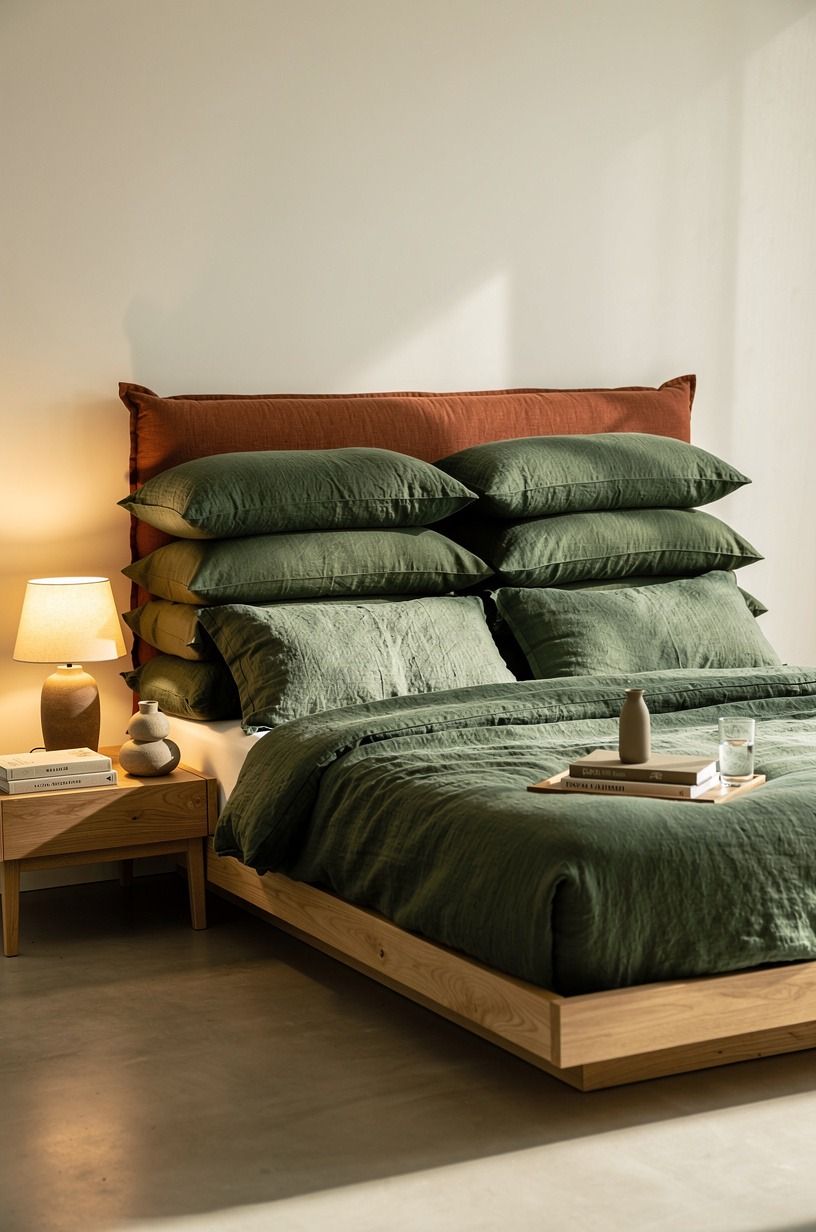
Arrange oversized sleeping pillows behind smaller lumbar pillows so the bed itself becomes the headboard. This works best when the pillow arrangement is tall enough to support your back and wide enough to create a visual rectangle across the mattress. You’re building a soft wall that can change whenever your bedding changes.
Start with two washed Belgian linen shams or large square pillows in forest green or rust, then add standard pillows and one long lumbar cushion. I’d choose a solid color for the largest pieces and save pattern for the front layer. A busy print at every level makes a small bedroom feel restless, while one faded stripe or block print gives your eye somewhere to pause.
The practical part matters, too. You’ll want washable covers and inserts that don’t collapse by midnight.
I made the mistake of using feather-light inserts once, and the pillows slid apart every time I leaned back. A firmer insert fixed the problem without adding furniture.
If your bed doubles as a reading spot, keep renter-friendly non-toxic bedroom ideas nearby for other low-commitment comfort upgrades.
5Paint a Soft Arch Behind the Bed
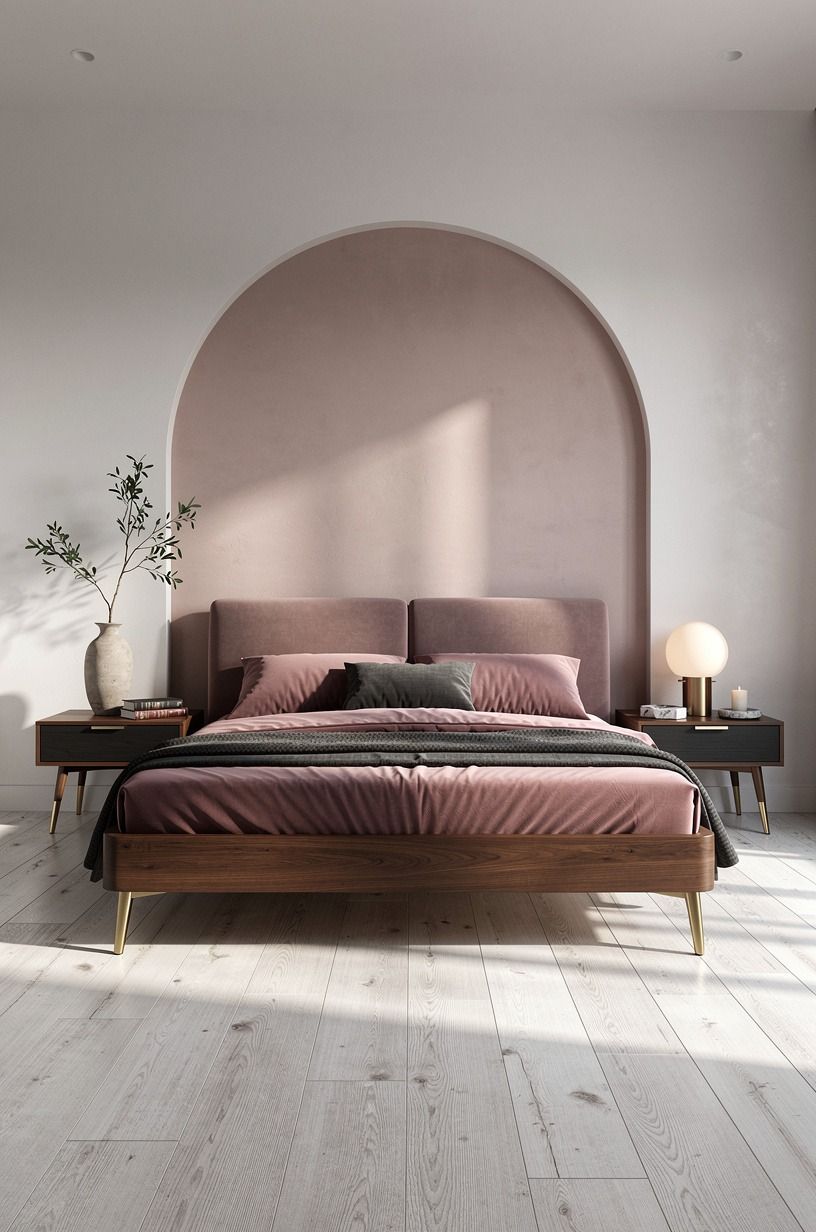
Use painter’s tape to outline a broad arch behind the bed, then fill it with a single wall color. The painted shape becomes a headboard alternative without adding depth, which is useful when your nightstands are already close to the bed. You can paint over it later, so the idea stays renter-friendly when the finish is done carefully.
Farrow & Ball Setting Plaster No. 231 is a strong choice for a quiet dusty-rose arch because it shifts gently with daylight. If you want more contrast, use charcoal nearby with cerused white oak and aged brass accents. I’d skip a tiny arch.
It makes the bed look larger than the wall treatment, and that imbalance feels accidental.
Keep the arch wider than the mattress by a small amount, but don’t let it run behind the nightstands unless your room is very large. You’ll want the curve to frame your pillows and stop where your eye naturally lands.
But if painting is prohibited, use a removable fabric panel cut into an arch shape instead. That version takes longer to trim, though it leaves no paint line behind.
6Frame a Folding Screen as a Bed Headboard
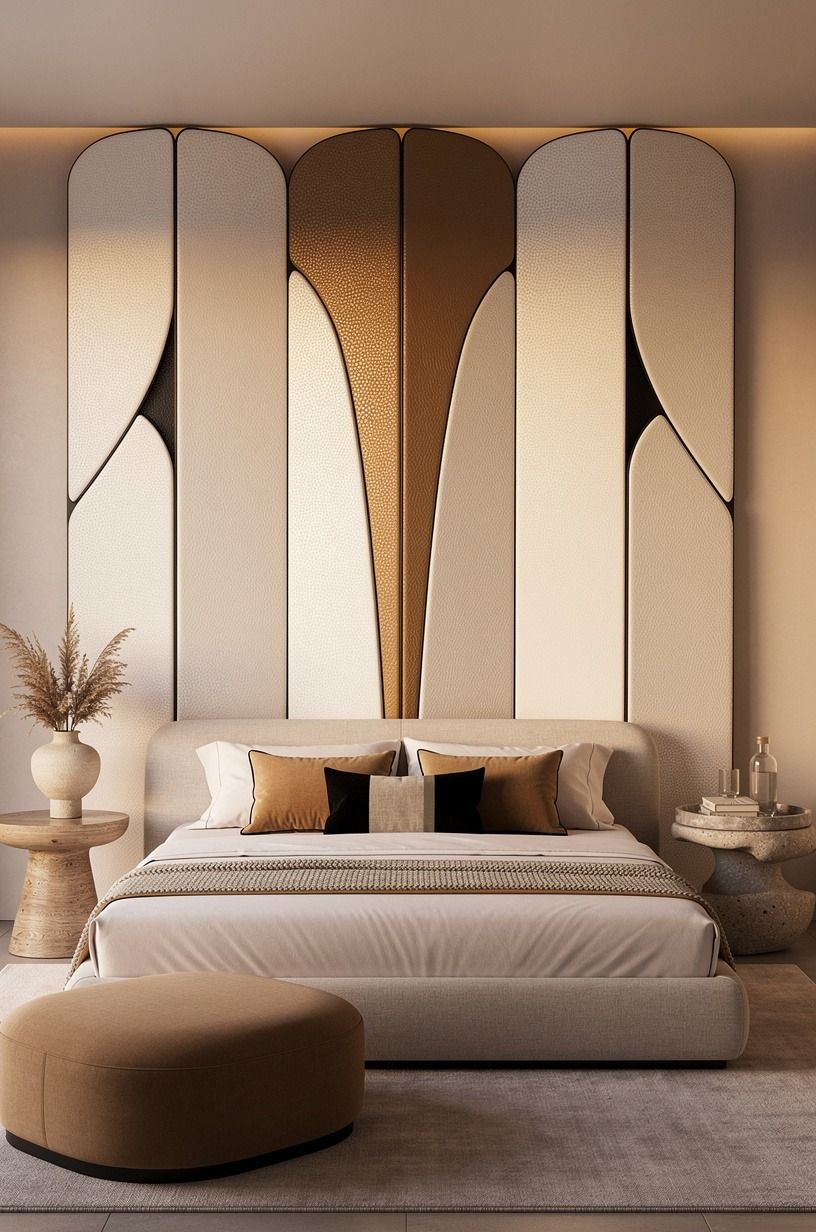
Open a lightweight folding screen behind the bed and let it act as a freestanding headboard. A screen with shagreen accents brings height and texture without attaching anything to the wall. It’s also useful if your rental bedroom has an unattractive wall, because the screen hides the problem rather than asking you to repair it.
Look for a folding screen with shagreen accents and narrow panels instead of a broad opaque one. A warm white or camel finish keeps the arrangement light, while small black details give it structure. You’ll want the screen to extend a little beyond the mattress on both sides, but not so far that it catches on your bedding when you make the bed.
I’d avoid a glossy black screen throughout the room. It tends to read like office furniture, especially under overhead light.
A warm white or camel finish with restrained black accents is more forgiving. If you’re choosing between a screen and a bulky upholstered frame, I’d choose the screen for a rental because you can move it, fold it, and use it elsewhere later.
7Swap a Curtain Panel for a Headboard Cover
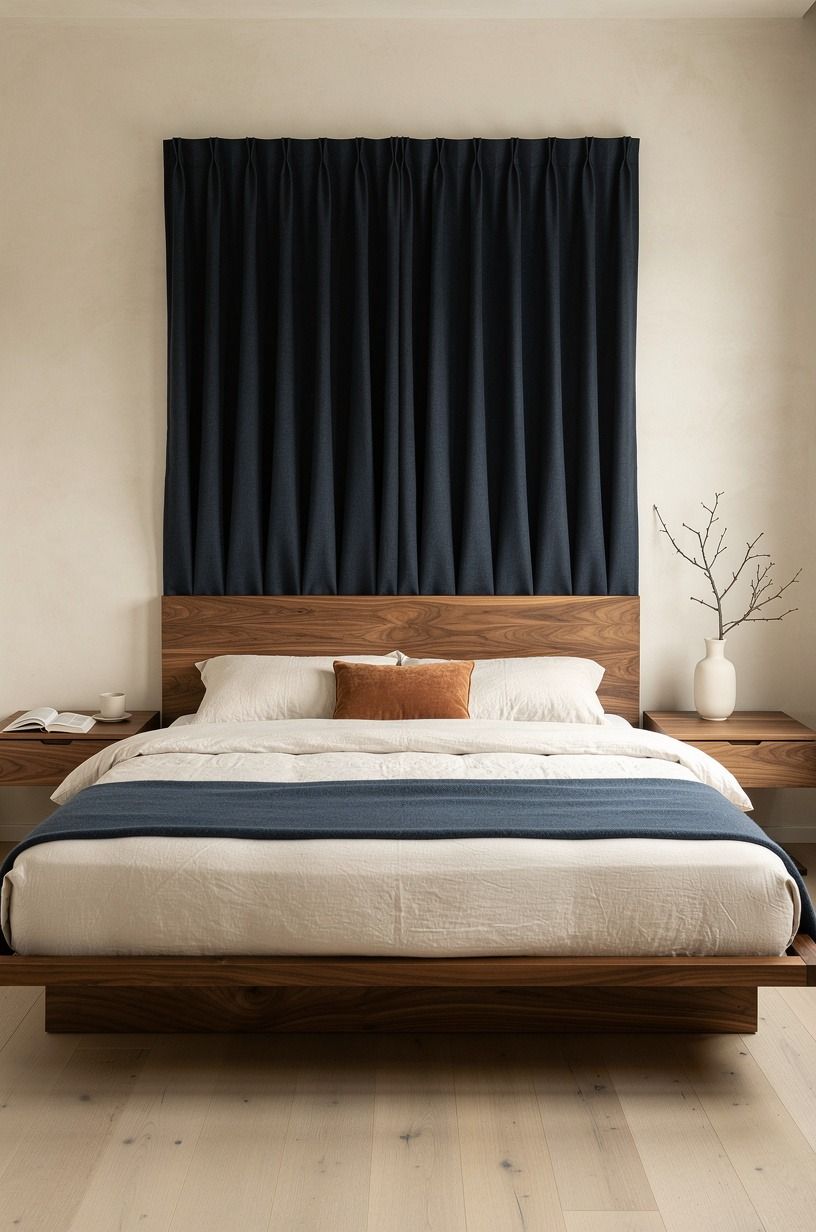
Hang one wide midnight-blue curtain panel behind the bed and let it fall from near the ceiling to the floor. Add copper and ivory accents, with book-matched walnut nearby, to give the soft backdrop a more grounded finish. This headboard cover works especially well when the bed sits beneath a window or when the room needs help feeling taller.
Choose midnight-blue fabric with enough weight to fall in a clean line, then repeat the ivory and copper in the bedding or lighting. You’ll want the panel to be wider than the mattress, with enough fullness to create soft folds rather than a flat sheet pulled tight.
A single panel is better than two narrow ones if your bed is centered against the wall. The split can create a dark line right behind your head, and I find that distracting.
Use a tension rod or removable curtain hardware where allowed. For a similar removable approach in another part of the home, see these cheap renter-friendly kitchen upgrades.
8Mix Two Woods With the Two-Wood Rule
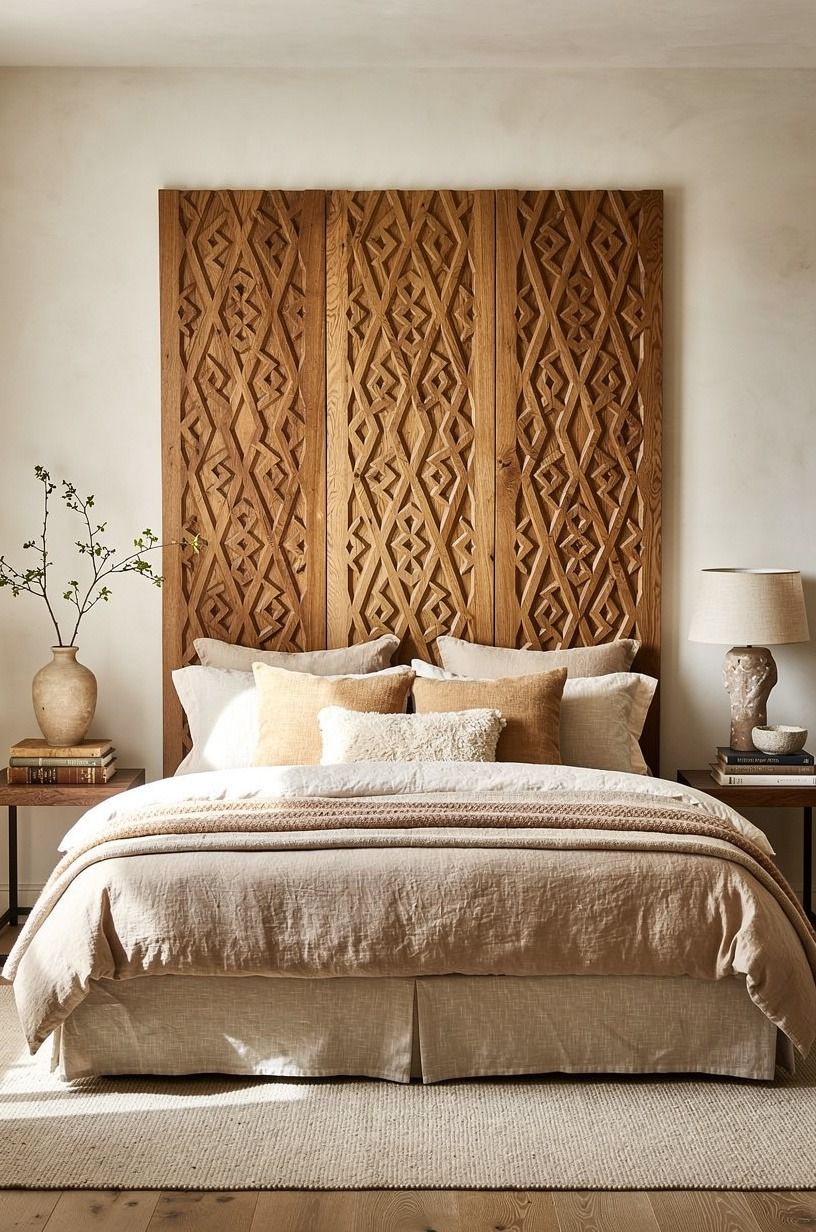
Use two wood tones behind the bed, one as the main surface and one as a small natural-wood accent, then soften the arrangement with organic bouclé in sage green and warm cream.
9Anchor a Removable Wall Panel
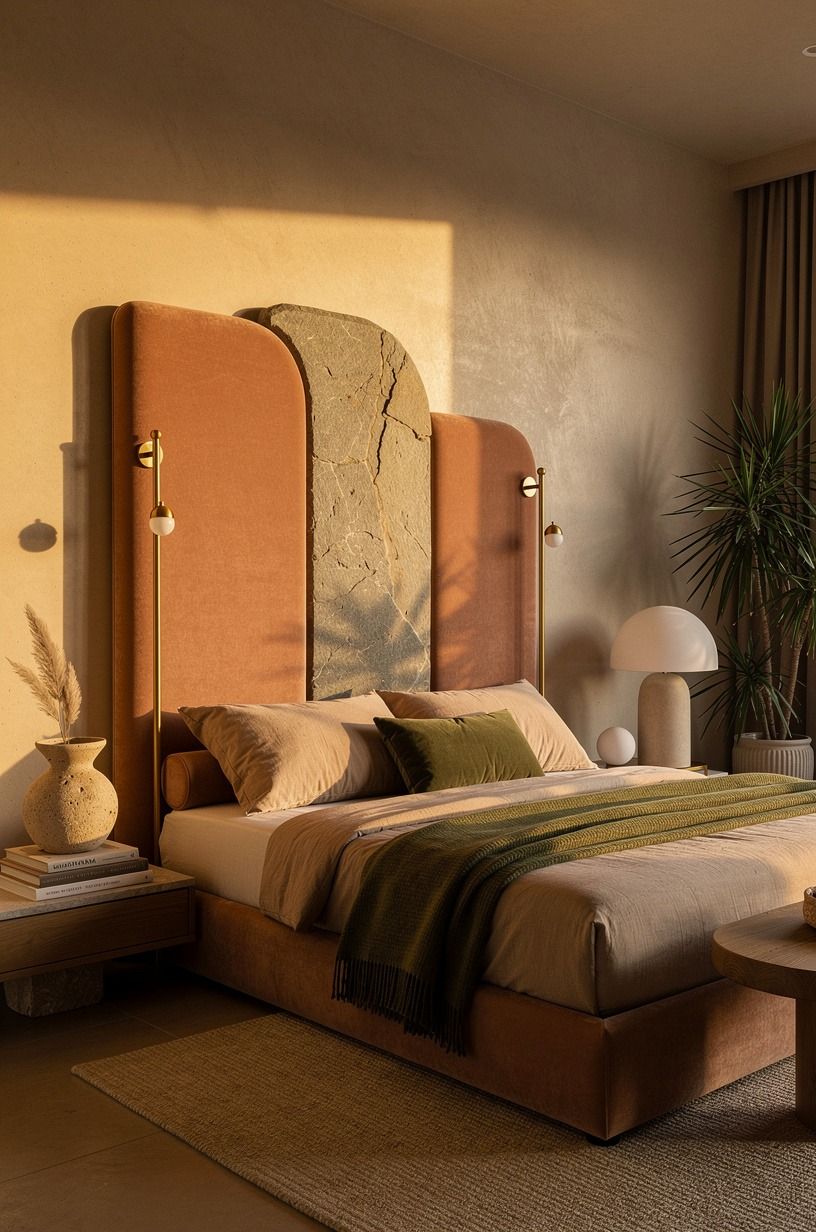
Lean two lightweight wall panels behind the bed and secure them with removable strips where appropriate. The panels can be painted, wrapped in fabric, or covered with peel-and-stick wallpaper. Together, they create the impression of architectural depth without drilling into studs or adding a heavy frame.
Try a terracotta, stone, and olive palette with an unlacquered brass trim or small hardware detail developing patina if you want an earthy, collected look. You’ll want the pattern to remain visible above the pillows, so position the panels before you press down any adhesive. If you’re unsure about the finish, test it behind a nightstand first.
I’d rather see two generous panels than six tiny ones. Small pieces make the wall look busy and create too many edges around the bed.
Make sure you follow the removable product’s instructions and protect the paint underneath. This renter-friendly backsplash guide is useful when you’re comparing temporary adhesive surfaces and deciding how much wall you want to cover.
10Float a Low Bench Behind the Mattress
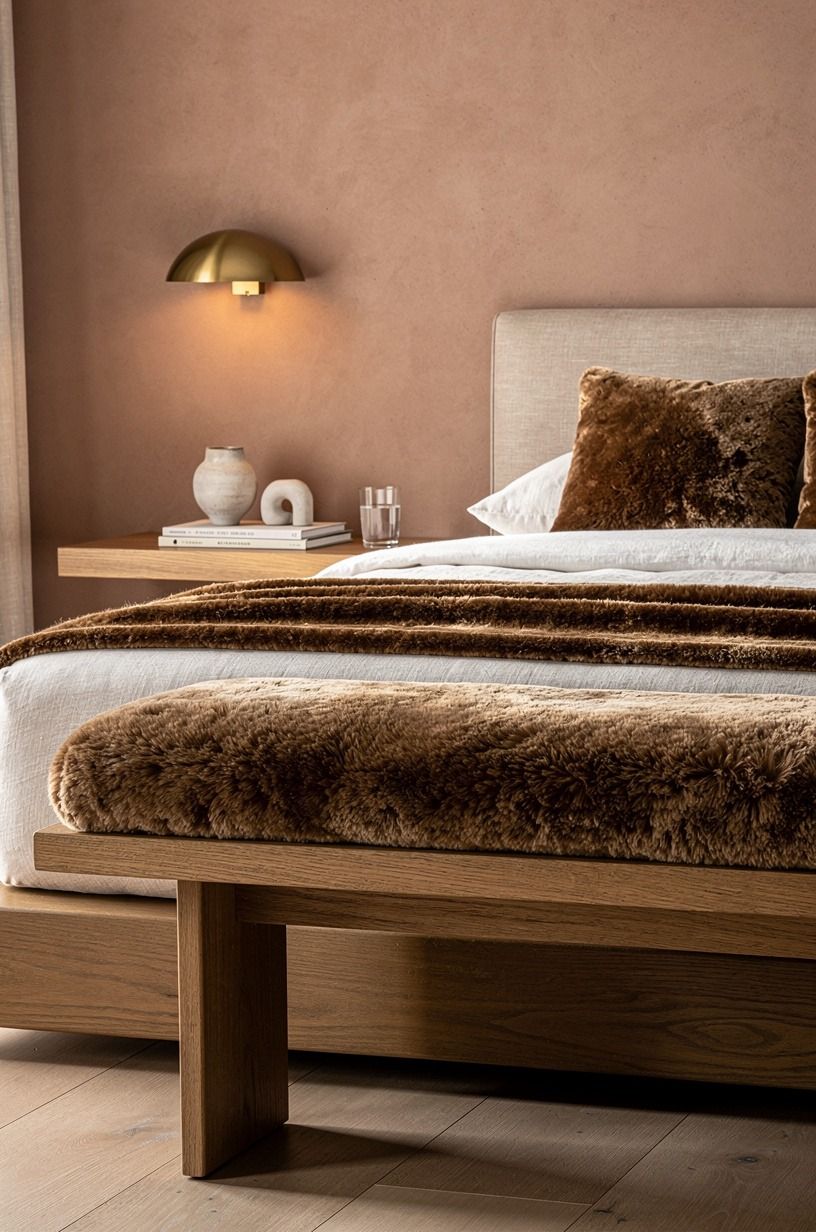
Place a narrow bench behind the bed and use its back edge as the base for a soft headboard arrangement. The bench doesn’t need to touch the wall, so you can shift it during cleaning or take it with you later. It also gives you a practical place for folded blankets, books, or tomorrow’s clothes.
A 24-inch-high bench upholstered in deep-pile mohair velvet can sit close to the mattress height, though you’ll want to compare it with your own bed before buying. Nightstands are often 24 to 28 inches tall, so the bench should relate to that range rather than tower behind your pillows. You’ll want the top surface clear enough that you can reach anything you place there.
I’d skip a bench with a deep seat if your bedroom is narrow. It steals walking space and turns a simple headboard idea into a daily obstacle.
Choose a slim profile in clay-toned velvet or linen with aged brass details instead. If you’re tempted to fill it with baskets, keep one section empty so the bench still reads as furniture, not storage overflow.
11Frame the Bed With the Three-Source Light Stack
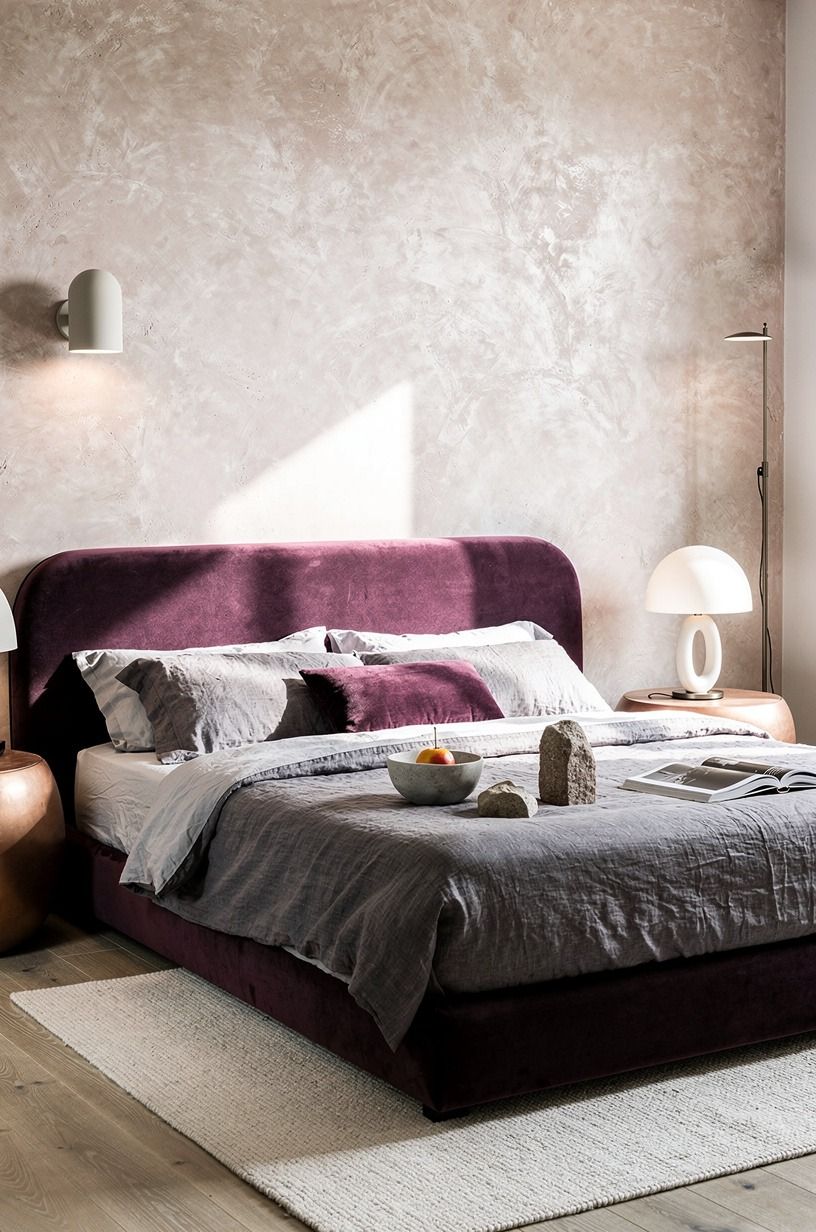
Build a warm light arrangement against hand-applied Venetian plaster, using plum, grey, and rose-gold accents across three sources at different heights: a low lamp, a middle wall or clip light, and a small glow above the bed.
12Finish With a Layered Headboard Ideas Aesthetic
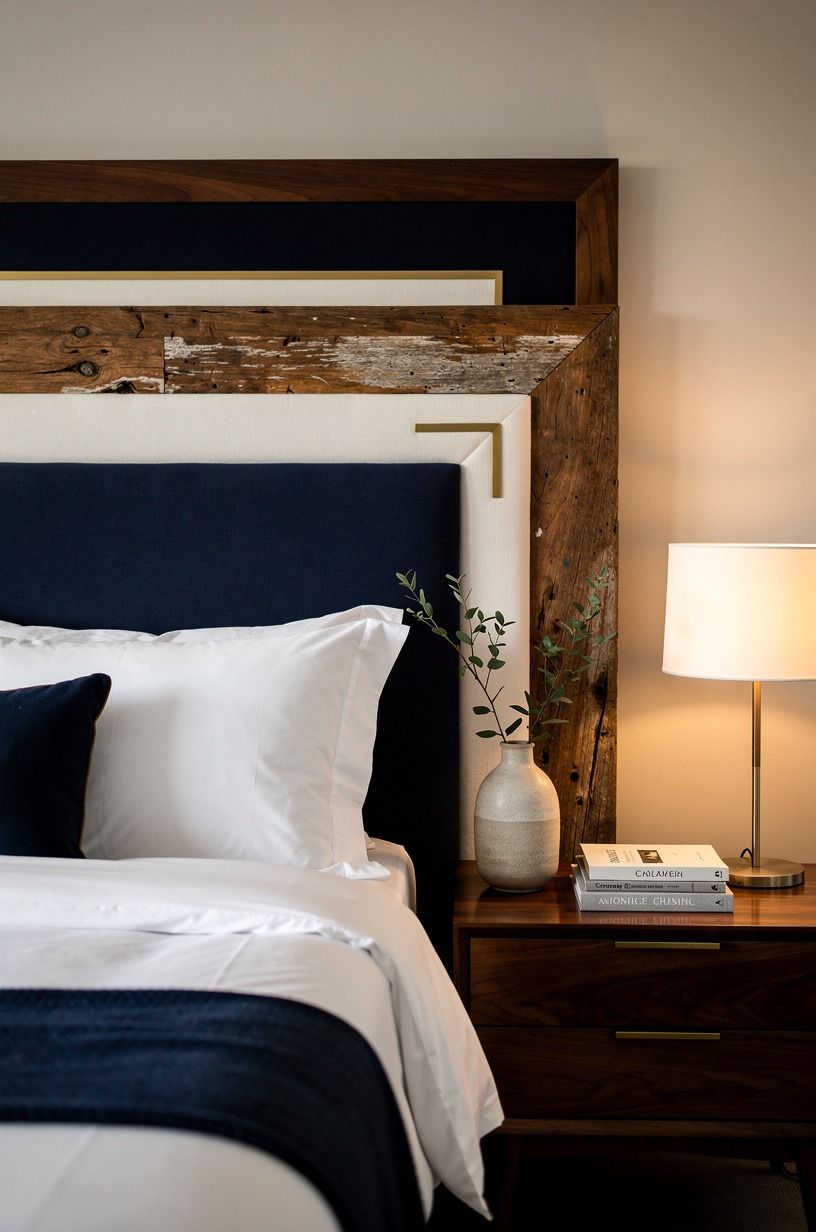
Finish the bed by combining one tall textile, one grounded object, and one small personal detail. This is where your headboard ideas aesthetic becomes specific to you instead of looking copied from a showroom. The textile can be a quilt, the grounded object can be a bench or screen, and the personal detail might be a framed postcard or a small ceramic piece.
Try a navy linen lumbar pillow, a white quilt behind it, and a narrow walnut stool with a reclaimed weathered teak finish at the side. You’ll want the colors to repeat somewhere else, but they don’t need to match exactly. A soft green in the pillow can echo a plant leaf, while the walnut can connect with a picture frame across the room.
I’d stop before the bed becomes a display wall. Your headboard should support sleep, reading, and ordinary mornings, not require constant arranging.
And if you’re styling a very small room, extend the rug 18 to 24 inches beyond the bed so the whole arrangement feels anchored. A rug that stops at the mattress edge makes the bed look stranded.
How Much Should a Renter-Friendly Headboard Cost?
The headboard itself can be free if you use bedding, pillows, or furniture you already own. If you buy fabric, a screen, or removable panels, your project can stay near the low end of a typical bedroom refresh. The broader US cost ranges below are useful context, though you don’t need a full-room renovation to make the bed feel finished.
For the headboard alone, I’d spend first on the material you’ll touch most often. Washed-linen bedding can change the whole bed, while a cheap rigid panel may still feel cold and temporary. You’ll want to protect your budget for the part that affects comfort every night.
What I’d Do Differently After Living With These Ideas
I used to think a headboard had to be a single object. A frame, an upholstered rectangle, a clear beginning and end.
Then I lived with a quilt hung behind the bed, and I realized the softer arrangement worked harder. It absorbed sound, hid an uneven wall, and could be washed when life got messy.
That mattered more than having one impressive piece.
The option I’d skip is a very narrow wall panel behind a wide bed. It makes the mattress look oversized and leaves the sides visually unsupported.
If you’re choosing between a narrow panel and a wider curtain, choose the curtain. Your eye follows its height, and the folds make the whole wall feel less rigid.
I also learned that color needs to be tested at night. Farrow & Ball Setting Plaster No. 231 looked gentle in the morning but picked up more pink under a warm lamp.
That wasn’t a problem, but I needed to know before wrapping the entire wall. You’ll want to place a sample behind the bed and look at it after sunset, because your room has two personalities.
A renter-friendly headboard is worth making when it solves a real issue: a hard wall, a low bed, poor acoustics, or a room that feels unfinished. It isn’t worth buying random decor just to fill the wall.
Give your money to texture, scale, and comfort. The room will feel more intentional because every piece has a job.
What People Always Want to Know
What is the best renter-friendly headboard idea for a small bedroom?
A folded quilt on a tension rod is the easiest choice because it adds height without taking floor space. Soft texture also reduces the hard, echoing feeling many small bedrooms have. A lightweight IKEA screen works when you want more structure and can spare a few inches behind the bed.
Where can I buy renter-friendly headboard pieces on a budget?
Look at IKEA, Target, Wayfair, Facebook Marketplace, and local thrift stores. Secondhand fabric can save the most money, especially when you’re searching for quilts, curtain panels, or folding screens. You can also reuse bedding you already own instead of buying a dedicated headboard cover.
How much does a renter-friendly headboard makeover cost?
A renter-friendly headboard can cost nothing if you use pillows, bedding, or furniture you own. A broader bedroom refresh typically falls within the $200-$800 budget range, while an upholstered headboard commonly sits around $250-$900. Your wall treatment is where the budget can stay low.
Can I create a renter-friendly headboard on a budget?
Yes, and you can start with three low-cost moves: fold a quilt behind the bed, rearrange oversized pillows, and lean a screen or bench against the wall. A free rearrangement may solve the scale problem before you buy anything. You’ll want to spend only after living with the layout.
Is a renter-friendly headboard worth it in a small space?
Yes, because a soft or painted backdrop gives the bed a clear visual center without adding much depth. Vertical height can make your room feel more settled. Keep the headboard close to the mattress width and let the rug extend 18 to 24 inches beyond the bed.
Is a renter-friendly headboard a good idea for a rental?
Yes, especially when you use tension rods, removable fabric, freestanding screens, or carefully tested adhesive panels. No-damage flexibility lets you change the room without leaving a large repair job. You’ll still want to check your lease and test every adhesive method in a hidden area.
How long does it take to make a renter-friendly headboard?
Most fabric, pillow, bench, and folding-screen arrangements can be completed in an afternoon. A no-tool setup is fastest when you’ve measured the bed first and gathered the materials nearby. You’ll spend more time adjusting height and spacing than assembling anything.
Where I’d Start First
If I had to pick one step, I’d start with the folded quilt on a tension rod. It adds softness, height, and sound control without stealing floor space, and you can wash or move it when your rental changes. Pin this idea for later, then try it with the bedding you already own.