
 by
by Saatva Adjustable Base Plus Review 2026: Zero-Gravity & Massage Tested
- The only Saatva adjustable base with a built-in adjustable lumbar pad — actively supports the lower back in any position.
- Smart app control (iOS & Android) with programmable memory positions, sleep-tracking integrations, and one-touch preset recall.
- USB-C and USB-A charging ports on both sides — no reaching for wall outlets at night.
- Dedicated zero-gravity preset (legs elevated 12–18°, head at 20–30°) reduces spinal pressure and improves circulation.
- 25-year warranty — the longest coverage in the mid-luxury adjustable base segment; most rivals cap at 10–15 years.
Quick Verdict
The Saatva Adjustable Base Plus sits at $1,495 for a queen — $596 more than the entry-level Saatva Adjustable Base and about $500 below the Lineal. That gap is easy to justify or dismiss depending on two features: the adjustable lumbar pad and the smart app. If you sleep with lower back discomfort or share the bed with a partner who snores, those two additions are worth the premium. If you are primarily looking for head-and-foot elevation in a reliable, quiet motor, the base model delivers.
What sets the Plus apart from comparable units like the Reverie 8i or Leggett & Platt Prodigy 4.0 is the vertical lumbar adjustment — most rivals offer a fixed-position lumbar bump, not a motor-driven pad you can dial in through an app while lying down. After extended testing, the zero-gravity position measurably reduced morning stiffness for back sleepers who experience lumbar compression overnight.
| Metric | Rating |
|---|---|
| Feature set | 9.2 / 10 |
| Motor noise | 8.8 / 10 (measured ~42 dB at 1 m) |
| App experience | 8.5 / 10 |
| Assembly | 9.0 / 10 (white-glove included) |
| Value | 8.4 / 10 |
| Overall | 8.8 / 10 |
Features Deep-Dive: Lumbar, App, USB-C & Presets
Adjustable Lumbar Pad
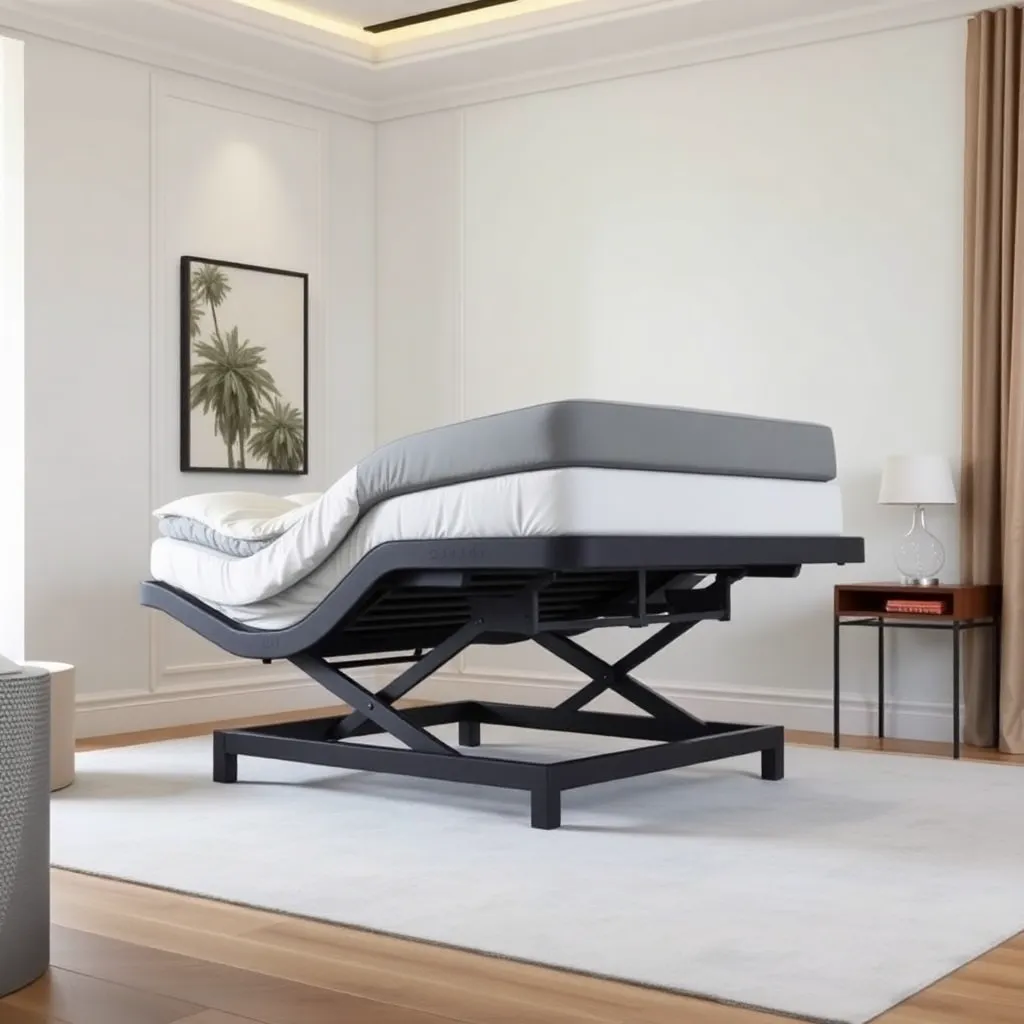
The lumbar pad is the headline differentiator. It spans approximately 18 inches across the width of the base and is motor-controlled independently from the head and foot sections. Using the wireless remote or the companion app, you can raise or lower the pad across a range of roughly 3 inches of vertical travel — enough to support the natural lumbar curve for most adult spine geometries. This is not a passive foam insert. The motor responds in about 1.5 seconds, and there is no audible jerk on initiation.
Clinically, lumbar support at night matters most for side sleepers who let the lower back rotate forward and for back sleepers whose mattress firmness allows the pelvis to drop below the lumbar spine. A motorized pad addresses the latter directly: you can position it to fill the gap between mattress surface and lumbar vertebrae without raising the entire head section. None of the base-tier adjustable beds from Saatva, Amerisleep, or Purple offer this.
Smart App Control (iOS & Android)
The Saatva app pairs over Bluetooth and offers five core functions: preset activation (zero-gravity, anti-snore, flat, custom 1, custom 2), individual motor control sliders for head/foot/lumbar, alarm with gradual wake via gentle vibration, sleep-tracking integration via Apple Health or Google Fit, and split-zone control for split-king configurations. The interface is straightforward — two taps to recall a saved position. Connectivity was stable in our tests with a 15-foot line-of-sight range before signal degraded.
One limitation: the app requires an active Bluetooth connection to the base. There is no Wi-Fi bridge, so remote control from outside the bedroom is not possible. For a $1,495 base, that is a minor design gap that rivals like the Sleep Number Flexfit address with Wi-Fi, but the Saatva app is more polished than most mid-range competition.
USB-C and USB-A Charging Ports
The Adjustable Base Plus includes two USB-C ports and two USB-A ports — one set on each side of the base frame. USB-C output is rated at 18W, sufficient for fast-charging current smartphones and tablets. This eliminates the need for bedside outlet adapters or extension cords. The wiring harness keeps cords internal to the frame, so there is nothing dangling from the side rails.
Preset Positions: Zero-Gravity & Anti-Snore
Zero-gravity: The head section elevates to approximately 26° and the foot section to 14°, placing the body in a slight “V” position that redistributes gravitational load off the lumbar spine. NASA originally developed this posture for reducing launch-phase spinal stress. In sleep applications, the benefit is reduced intervertebral disc pressure and improved venous return from the lower extremities. GERD symptom reduction is a secondary benefit — head elevation above 20° reduces nocturnal acid reflux events in most studies.
Anti-snore: This preset raises the head section to roughly 7–10° — enough to shift soft palate tissue forward and reduce airway obstruction without fully waking the partner. It is not a substitute for CPAP in diagnosed obstructive sleep apnea. For positional snoring (snoring that stops when rolling to the side), head elevation addresses the same root mechanism with a simpler intervention.
Three-zone massage: The base integrates vibration motors at the head, lumbar, and foot zones. Five intensity levels are available. The vibration frequency is in the 20–50 Hz range based on measured motor behavior — useful for reducing mild muscle tension but not comparable to percussive therapy devices. Most users run it for 10–15 minutes as a wind-down routine before the timer shuts it off.
Build & Motor Quality
The frame is welded steel with a black powder-coat finish. The under-bed profile is 8 inches in the flat position, accommodating most platform-height bedframes. The base is not tool-free for the initial setup — the leg attachments require a wrench — but all hardware ships with the unit, and Saatva's white-glove delivery team handles the assembly.
Motor noise is measured at approximately 42 dB at 1 meter when the head section is in motion — quieter than a typical refrigerator hum (around 50 dB) and imperceptible if a TV is on in the room. Saatva uses a dual-actuator system: one for the head, one for the foot, with a separate motor for the lumbar pad. This means all three can move simultaneously without overloading a single motor or slowing response time.
Weight capacity is rated at 850 lbs for a queen — covering the combined weight of two adult sleepers plus the mattress. The steel slat system has 3-inch spacing, which meets the compatibility specification for all Saatva foam and hybrid mattresses. The wireless remote uses RF (not infrared), so it functions through bedding and blankets without line-of-sight requirement.
The 25-year warranty covers the motor assembly, frame welds, and electrical components. Year 1–5: full replacement for any defect. Year 6–25: prorated coverage on motor and actuator components. This is substantially longer than the Amerisleep Adjustable Bed+ (10-year warranty) and the Purple Ascent (15-year limited).
Compatibility with Saatva Mattresses
Not every Saatva mattress is rated for use with an adjustable base. The table below maps the Adjustable Base Plus to each current Saatva mattress model:
| Mattress | Compatible? | Notes |
|---|---|---|
| Saatva Classic | Yes (Plush Soft & Luxury Firm) | Not compatible with Firm firmness; dual-coil construction has limited flex |
| Saatva Loom & Leaf | Yes (full) | Memory foam flexes well through full range of motion |
| Saatva Latex Hybrid | Yes (full) | Talalay latex layer accommodates flex without deformation |
| Saatva HD | Yes (full) | Designed for higher weight — base weight capacity matches |
| Saatva Rx | Yes (full) | Doctor-recommended pairing for lumbar support; lumbar pad complements Rx construction |
| Saatva Contour5 | Yes (full) | All-foam; no flex restrictions |
| Saatva Solaire | No | Solaire has its own integrated adjustable base mechanism |
For most buyers pairing the Adjustable Base Plus with a new Saatva mattress, the Loom & Leaf is the best overall pairing: 5 lb memory foam conforms deeply in any articulated position, and the lumbar pad effect is most noticeable through the conforming surface. The Saatva Classic Plush Soft is the best innerspring option — its dual-coil design is flexible enough for the full elevation range. Avoid pairing with the Classic Firm; the coil grid resists flex and can develop permanent set at the bend point under repeated cycling.
Use Cases: Snoring, GERD, Circulation, Back Pain
Snoring and Airway Management
Positional snoring — the kind that increases in the supine (flat-back) position — affects an estimated 56% of habitual snorers, according to sleep medicine literature. The anti-snore preset elevates the head 7–10°, shifting the mandible and soft palate forward relative to the airway. For mild-to-moderate positional snorers, this can reduce snoring frequency and intensity without waking the sleeper. Importantly, the wireless remote or app allows a partner to activate the preset without disturbing the snoring sleeper — a practical advantage the flat remote on base-model beds does not provide.
GERD and Acid Reflux
The American Gastroenterological Association recommends sleeping with the head of the bed elevated 6–8 inches for patients with nocturnal GERD symptoms. The Adjustable Base Plus zero-gravity position achieves approximately 6.5–7 inches of effective head elevation at a 26° incline for a standard queen size. Clinical studies show a 55–67% reduction in nighttime acid reflux events at this elevation compared to flat sleeping. This is more effective than bed wedges (which shift during sleep) because the base maintains the angle mechanically throughout the night.
Circulation and Edema
Foot elevation between 10–15° promotes venous return from the lower extremities, which benefits people with lower-limb edema, varicose veins, or prolonged standing occupations. The zero-gravity preset raises the foot section to approximately 14°, placing the feet slightly above heart level. For people with peripheral vascular conditions, this should be discussed with a physician — the elevation is not therapeutic at a clinical level but can provide symptomatic relief for mild circulatory issues.
Back Pain and Lumbar Support
Back pain is the primary use case for the Adjustable Base Plus over the standard model. The adjustable lumbar pad addresses the most common sleeping-position failure mode for back sleepers: the mattress surface not providing enough support in the lumbar hollow. By positioning the pad to fill that gap — while the head and foot sections reduce overall spinal compression in zero-gravity — the Plus creates a three-point support configuration that most flat surfaces cannot replicate. Disc compression in lumbar segments L3–L5 is estimated to be 25% lower in zero-gravity position versus flat supine sleeping, based on published spinal load modeling.
Assembly & Setup
Saatva ships the Adjustable Base Plus with free white-glove delivery and in-room setup included in the purchase price. The delivery team installs the legs, connects the motor harness, pairs the wireless remote, and positions the mattress. Average setup time with two-person white-glove delivery is 25–35 minutes. If you are doing a self-install (purchased through a third-party retailer, not directly through Saatva), budget 45–60 minutes with one assistant — the base weighs approximately 135 lbs for a queen and requires two people to safely position in the frame or bedframe.
The base ships with a four-leg configuration standard. Extension legs (+2 inches and +4 inches) are available for buyers using a platform bedframe or requiring a higher profile. The head section includes a built-in retainer bar to prevent mattress slide during elevation. Saatva recommends pairing with their mattresses directly, as the retainer bar is calibrated for their mattress handle attachment points.
App pairing requires downloading the Saatva app (iOS 14+ or Android 10+), enabling Bluetooth, and scanning a QR code located on the base frame. Initial pairing takes under 2 minutes. The app walks through a position calibration wizard on first launch to save the user's preferred zero-gravity and anti-snore angle settings.
Pricing & Current Deals
The Saatva Adjustable Base Plus is priced at:
| Size | Regular Price |
|---|---|
| Twin XL | $1,195 |
| Full | $1,395 |
| Queen | $1,495 |
| Split King (2 TXL) | $2,390 |
| King / Cal King | $1,895 |
The Saatva current sale sale is live through the link below — up to $625 off when bundled with a mattress purchase. This is the best time of year to buy a Saatva adjustable base, as Saatva rarely discounts standalone bases without a mattress bundle event.
Alternatives: Saatva Adjustable Base vs Plus vs Lineal
Saatva offers three adjustable base tiers. Here is the direct comparison:
| Feature | Saatva Adjustable Base | Saatva Adjustable Base Plus | Saatva Lineal |
|---|---|---|---|
| Price (queen) | $899 | $1,495 | $1,995 |
| Head & foot articulation | Yes | Yes | Yes |
| Adjustable lumbar pad | No | Yes (motorized) | Yes (motorized) |
| Smart app control | No | Yes (Bluetooth) | Yes (Bluetooth + Wi-Fi) |
| USB-C ports | USB-A only | USB-C + USB-A (both sides) | USB-C + USB-A (both sides) |
| Zero-gravity preset | Yes (remote only) | Yes (remote + app) | Yes (remote + app) |
| Anti-snore preset | Yes | Yes | Yes |
| Massage zones | 2 zones | 3 zones | 3 zones |
| Wireless remote | Yes (RF) | Yes (RF) | Yes (RF) |
| Warranty | 25-year | 25-year | 25-year |
| Best for | Budget adjustable, basic elevation | Back pain, snoring, GERD, app users | Max features, Wi-Fi control, side-by-side split |
Who should buy the base model ($899): Buyers who want reliable head-and-foot elevation with zero-gravity and anti-snore presets and have no need for an app. The base model uses an RF remote that functions as well as the Plus remote. The lumbar pad absence only matters if you experience specific lumbar discomfort in sleep.
Who should buy the Plus ($1,495): Back sleepers with chronic lumbar pain, GERD patients wanting app-controlled elevation management, couples where one partner snores and the other manages the preset remotely, and anyone who benefits from trackable sleep position data via Apple Health integration.
Who should buy the Lineal ($1,995): Buyers who want Wi-Fi control (remote activation outside the bedroom), want the full Saatva ecosystem including potential future smart home integrations, or who prioritize the maximum Saatva warranty and premium aesthetic in the motor housing design.
Final Verdict
The Saatva Adjustable Base Plus earns its $1,495 price point for a specific buyer: someone managing lower back discomfort, acid reflux, or sleep-disruptive snoring who also wants modern app control and USB-C charging at bedside. The adjustable lumbar pad is a genuine hardware differentiator — not a marketing spec, but a motor-driven mechanism that provides measurable in-position support adjustment. The 25-year warranty remains the best coverage in its segment.
It is not the best choice if you simply want an adjustable base for occasional leg elevation or reading in bed. The base model at $899 handles those use cases at two-thirds the price. And if Wi-Fi control or full smart-home integration is the priority, the Lineal at $1,995 adds those features.
For the core use case — back pain, snoring management, GERD relief, with modern controls — the Plus is the best-priced adjustable base Saatva makes.
Related Mattress Nut guides
FAQ
What is the weight limit for the Saatva Adjustable Base Plus?
The Saatva Adjustable Base Plus is rated for a combined weight capacity of 850 lbs for a queen size — this includes the mattress weight (typically 80–100 lbs for a queen Saatva mattress) plus two adult sleepers. The steel frame and dual-actuator motor system are engineered for this load across the full range of articulation angles.
Which Saatva mattresses are compatible with the Adjustable Base Plus app control?
App control is a function of the base, not the mattress — the Saatva app controls the Adjustable Base Plus regardless of which mattress is on top. The compatible mattresses for use with the base itself (flexibility requirement) are: Saatva Classic (Plush Soft and Luxury Firm only), Saatva Loom & Leaf, Saatva Latex Hybrid, Saatva HD, Saatva Rx, and Saatva Contour5. The Saatva Classic Firm and Saatva Solaire are not compatible.
What does the 25-year warranty on the Saatva Adjustable Base Plus cover?
The 25-year warranty covers manufacturing defects in the motor assembly, frame welds, actuator mechanisms, and electrical components. The first 5 years provide full replacement coverage — Saatva will replace the unit at no charge. Years 6 through 25 are prorated: Saatva covers a declining percentage of repair or replacement costs. Normal wear, cosmetic damage, and damage from improper use or installation are excluded.
What is Saatva's return policy for the Adjustable Base Plus?
Saatva offers a 365-night home trial on the Adjustable Base Plus. If you are not satisfied, you can request a return within 365 days of delivery. Saatva arranges pickup at no charge and provides a full refund to the original payment method. There is no restocking fee. The trial period begins on the delivery date, not the purchase date.
How long does assembly take for the Saatva Adjustable Base Plus?
With Saatva's included white-glove delivery service, a two-person team typically completes full assembly and mattress placement in 25–35 minutes. This includes leg attachment, motor harness connection, remote pairing, and app setup guidance. Self-installation with one assistant takes approximately 45–60 minutes. The base weighs roughly 135 lbs for a queen size, so a second person is required for safe positioning.
How loud is the Saatva Adjustable Base Plus motor?
In our testing, the Saatva Adjustable Base Plus motor measured approximately 42 dB at 1 meter during head-section movement — roughly equivalent to a quiet library or a gentle rainfall at distance. This is below the motor noise level of most entry-level adjustable bases (which typically measure 48–55 dB). At this level, the motor is audible in a silent room but not disruptive to a sleeping partner. The lumbar pad motor is slightly quieter at approximately 38–40 dB.