
 by
by Reviewed by MattressNut editorial · Medical review board · Fact-checked against 2026 current pricing
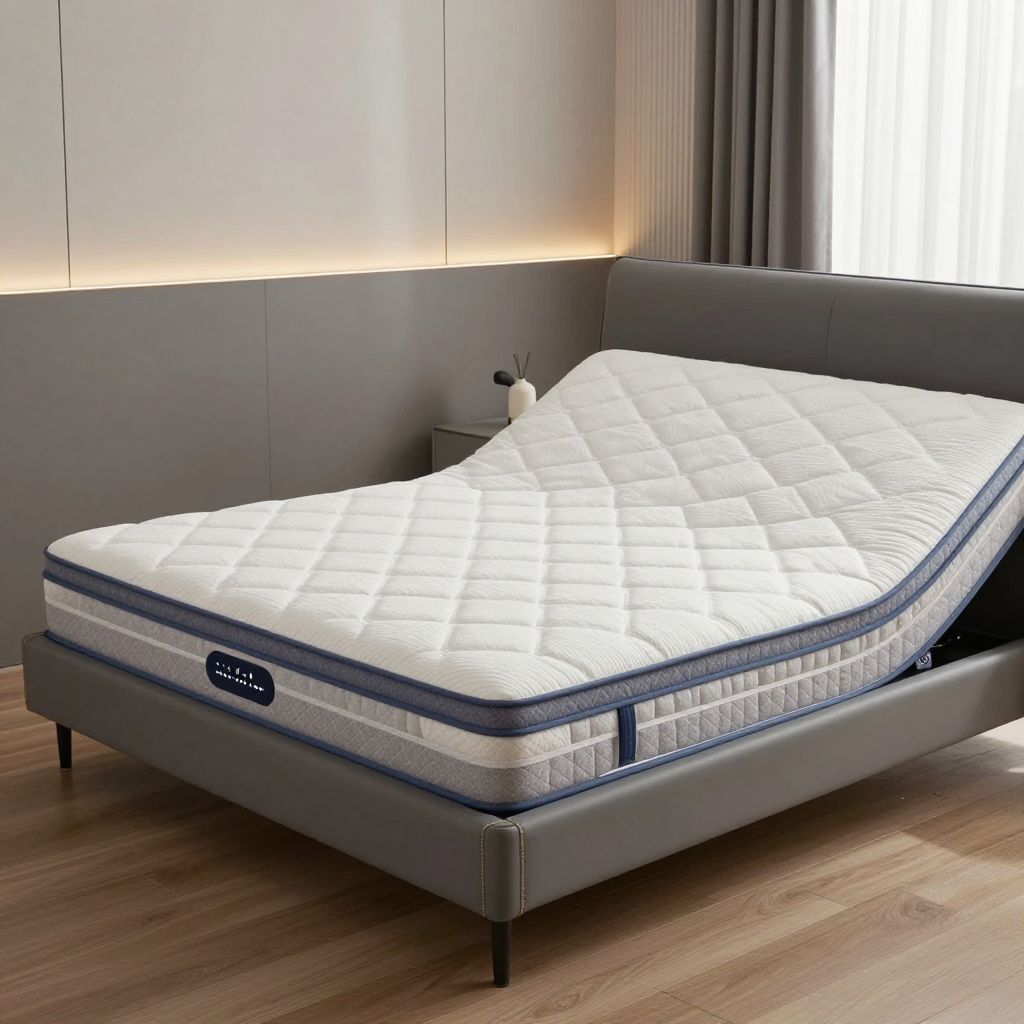
SleepIQ tracks heart rate, respiration, and movement patterns nightly. The data layer makes Sleep Number the most metric-driven smart bed in the consumer category.
Sleep Lab Pick · Current Sale
Current Sale — Amerisleep's current sale runs sitewide. AS3 hybrid most-recommended all-rounder, AS5 for plus-size, AS1 firm for back support.
Sleep Tracking Explainer
SleepIQ Score Explained: What the 10-100 Number Actually Measures (and What It Misses) in 2026
A peer-reviewed study, a 14-billion-hour dataset, and one inconvenient blind spot: SleepIQ misclassifies more than half of "awake in bed" time as sleep. Here is how the score actually works.
Skip the Subscription Anxiety: See the
Quick answer: Your SleepIQ score is a 10-to-100 nightly rating from Sleep Number's built-in sensor that combines sleep duration, restful time, and time out of bed. It's peer-reviewed for heart-rate accuracy (r=0.94) but weak at detecting wakefulness (specificity 0.48), and it's free for life on every Sleep Number 360 Smart Bed (no subscription).
What SleepIQ actually is
SleepIQ is the sensor-and-software platform embedded in every Sleep Number 360 Smart Bed. A pressure-sensitive sensor strip sits between the air chambers and the comfort foam (or, on a c2, between the chambers and the fibrefill cover), measuring three things every night: heart rate via ballistocardiography (the tiny pulsing of your chest against the bed surface), breath rate via the same mechanism, and gross body movement.
From those three primary signals, SleepIQ derives the user-facing metrics: total sleep duration, restful sleep time, restless time, time out of bed, average heart rate, average breath rate, and the single composite SleepIQ score. The score is what most owners actually look at. Everything else is supporting detail.
The platform is genuinely free. There is no subscription, no Autopilot tier, no paywall on history or insights.
The actual SleepIQ score scale (it isn't 0-100)
If you've read older blog content claiming the SleepIQ score runs from 0 to 100, that information is outdated. Per Sleep Number's current support documentation, the official scale is 10 to 100 (some legacy documentation still cites 5 to 100, but the most recent product pages use 10-100).
The score is computed nightly. Sleep Number's published thresholds, again from official support documentation:
- Above 85: "Extraordinary", the top tier, reserved for nights with strong sleep duration, low restless time, and minimal time out of bed.
- 60 to 85: "Pretty great", the typical good-night range for most users.
- Below 60: "Needs improvement", flags a short or disturbed night.
The score is not a percentage. A 90 does not mean you slept "90% well." It is a proprietary composite that weights duration, restful time, and time out of bed against patterns Sleep Number has built from its full dataset.
What SleepIQ actually measures, with the peer-reviewed accuracy data
This is the part of the SleepIQ conversation where the marketing copy and the published science genuinely converge, with one important caveat.
Caggiari et al. published a validation study in Sensors in 2022 comparing SleepIQ output against polysomnography (the gold-standard sleep lab measurement) in 45 participants. The headline numbers:
- Heart rate correlation: r=0.94. Genuinely strong for a non-wearable sensor, comparable to many wrist-worn devices and better than several budget consumer trackers.
- Breath rate correlation: r=0.96. Even stronger, and probably the most validated thing SleepIQ does.
- Sleep/wake classification kappa: ~0.45. Moderate agreement with polysomnography on whether you were asleep or awake at a given moment.
- Specificity for wake detection: 0.48. This is the weak spot we'll come back to.
What this means in plain English: SleepIQ is genuinely accurate for the underlying biometric signals (your heart and breath rate). It is moderately accurate at telling whether you're asleep at any given minute. It is weak at telling whether you are awake.
The 0.48 specificity blind spot, and why your score can lie to you
A specificity of 0.48 for wake detection means that when you are actually awake in bed, SleepIQ correctly identifies you as awake less than half the time. The other half, it classifies wake periods as sleep.
In practice, this is the single most important caveat for honest interpretation of your SleepIQ score:
- Reading in bed before sleep? Likely counted as sleep.
- Lying still during a 20-minute middle-of-the-night wakeup? Likely counted as sleep.
- Insomnia where you stare at the ceiling for 90 minutes? A significant portion of that is likely counted as sleep, especially if your breath and heart rate stay slow.
The practical consequence is that your SleepIQ score is biased upward. Most owners get scores that feel slightly too generous compared to their subjective sense of how the night went. The 30-minute "fell asleep in 0 minutes" badges that some users see are usually wake periods misclassified as sleep onset.
This is not unique to Sleep Number; most non-EEG sleep trackers (Oura, Apple Watch, Fitbit) share the same general weakness in wake detection. But Sleep Number's own published validation study makes the specifics measurable, which is more than most competitors offer.
Circadian Rhythm insights and the rest of the app
After about 7 days of data collection, the SleepIQ app unlocks a set of features beyond the nightly score:
- Circadian Rhythm insights: a suggested ideal bedtime and wake time based on your last week of patterns, designed to align your sleep window with your observed biological rhythm.
- Sleep Health metrics: tracking duration, efficiency, timing, and consistency over 7-day, 30-day, and annual windows.
- SleepIQ Sleeper IQ: a comparison of your score to the population dataset, giving you a relative ranking.
- Snore detection (Climate Collection only): pairs with the FlexFit base's Partner Snore feature to automatically raise the head of bed when snoring is detected.
- Privacy Mode: the under-discussed control that lets you disable cloud transmission of Sleep Health Data while still operating the bed normally. Sleep Number is one of the few smart-bed brands that explicitly documents a local-mode privacy switch.
What SleepIQ does not currently provide:
- Sleep onset latency as a standalone metric.
- Snore tracking outside the Climate Collection.
- HRV (heart rate variability) in granular detail, the way wearables like Whoop and Oura present it.
The 14-billion-hour dataset, and why it matters
Sleep Number's pitch for SleepIQ rests partly on scale. Per the company's own disclosures (AIThority, 2022, and updated SLEEP 2025 presentations), the SleepIQ platform has aggregated over 14 billion hours of sleep data across more than 1.8 billion individual sleep sessions, with 2.2 million sessions analyzed in the studies presented at SLEEP 2025.
This is, in raw size, one of the largest non-medical sleep datasets in existence. It is the basis for Sleep Number's population-level claims, like "couples sleep 19 minutes longer when both partners use the bed's smart features" and "Climate360 owners experience up to 52.5 minutes more restful sleep per night."
The honest caveat: dataset size is not the same as causal evidence. These are observational associations drawn from the company's own customer base, not randomized controlled trials. They are useful directional signals but should not be confused with proof of intervention.
SleepIQ vs the major competitors in 2026
| Hardware cost | Bundled with bed ($1,099+) | Bundled with Pod ($2,849+) | $349-$549 | $799 |
| Subscription required | No (free for life) | Yes ($17-$33/month) | Yes ($5.99/month) | No |
| Heart rate accuracy | r=0.94 (peer-reviewed) | Not independently published | r=0.95 (typical) | r=0.96 (typical) |
| Breath rate accuracy | r=0.96 (peer-reviewed) | Not independently published | Validated | Validated |
| Sleep stage breakdown | No | Yes | Yes | Yes |
| Wear nothing | Yes | Yes | No (ring) | No (watch) |
| Privacy Mode (local-only option) | Yes | No documented option | No | Limited |
| Wake-detection specificity | 0.48 (peer-reviewed) | Not independently published | ~0.65 (typical) | ~0.70 (typical) |
Going Concern: what happens to your SleepIQ data if Sleep Number stops trading
Sleep Number's 2025 10-K filing carries a Going Concern warning, the formal accounting disclosure that an auditor has substantial doubt about the company's ability to continue operating over the next 12 months. The supporting data is in the public SEC filings: a $132 million FY2025 net loss, a $50.3 million Q1 2026 net loss, roughly 60 store closures in Q1 2026 alone, and Guggenheim Securities engaged to evaluate "strategic options."
For a SleepIQ user, this raises three practical questions:
- Will the bed still inflate and deflate? Yes. The Firmness Control System pump is local hardware. It does not need Sleep Number's servers to function.
- Will SleepIQ tracking continue? The sensor records locally and transmits to Sleep Number's cloud for processing. If the cloud goes dark, real-time scoring stops. The sensor itself continues to operate.
- Will my historical data be preserved? Sleep Number's current privacy policy commits to retention until a user explicitly requests deletion. In a wind-down or sale scenario, that data would either transfer to a successor company or be destroyed under the privacy policy terms. There is no current export function to back up SleepIQ history to a local file.
None of this means SleepIQ will fail.
How your nightly SleepIQ score is actually computed
Sleep Number does not publish the exact algorithm, but the company's support documentation and Caggiari et al. validation paper allow a reasonable reconstruction of the inputs. The nightly score weights, in approximate order of contribution:
- Total sleep duration: the single largest contributor. A 7-hour night will almost always score higher than a 5-hour night even if the 5-hour night was more efficient. Sleep Number's modeling appears to weight duration most heavily up to roughly 7.5 hours, after which additional time produces diminishing returns.
- Restful sleep proportion: how much of your in-bed time the sensor classified as restful versus restless. This is the metric most directly affected by tossing, turning, and partner movement.
- Time out of bed: every detected exit from the bed (bathroom trips, getting up to drink water) reduces the score, with the cost rising the more out-of-bed events occur.
- Consistency with your baseline: SleepIQ appears to compare each night against your individual 30-day baseline, so a "good night" for someone with a low baseline can score similarly to a "great night" for someone with a high baseline.
What this means practically: the SleepIQ score is not a universal sleep quality metric. It's a personalized rating against your own historical data. Two healthy adults with identical sleep can post different SleepIQ scores because the algorithm normalizes against their respective baselines.
Privacy, data retention, and the export problem
Sleep Number's current privacy policy is unusually transparent for the smart-bed category, but it has one important gap.
The transparent parts: the policy explicitly documents what is collected (heart rate, breath rate, movement, time in bed, ambient bedroom data on certain models), how long it is retained (until the user requests deletion, with no fixed expiration), and how to invoke Privacy Mode to disable cloud transmission while keeping the bed operational locally. Sleep Number commits to deletion requests honored within 30 days, complies with CCPA and GDPR right-to-be-forgotten standards, and does not sell SleepIQ data to third parties for advertising.
The gap: there is no user-facing data export. You cannot download your full SleepIQ history as a CSV, JSON, or any standard portable format. If you cancel your Sleep Number account, your data is deleted but not delivered to you. If Sleep Number stops trading and the cloud is shuttered, your historical sleep records go with it. For users who treat SleepIQ as a long-term health log (and many do, since the bed is the only sleep tracker they wear nothing for), this is a meaningful limitation that contrasts unfavorably with Oura, Whoop, and Apple Health, all of which support data export.
How to actually use your SleepIQ score (and how not to)
Three rules for getting genuine value out of SleepIQ:
Look at trends, not nightly scores. Any single-night score has noise. A 7-day rolling average reveals whether your sleep is actually trending up or down. The Circadian Rhythm insights compare your bedtime variability against your performance, which is more actionable than any single score.
Pair the score with subjective sleep quality. Because of the 0.48 wake-detection specificity, the score will sometimes overestimate. If you wake up feeling unrested but SleepIQ shows an 84, trust your body. Track both data points for two weeks and the patterns will reveal themselves.
Use it to test interventions, not to optimize a number. SleepIQ is most useful when you change one variable (caffeine cutoff time, room temperature, screen time, Sleep Number setting, alcohol intake) and watch the 7-day average response. It is least useful when you treat the score itself as the goal.
SleepIQ for couples: two scores, one bed, and what the data shows
One of SleepIQ's more useful features for couples is that each side of the bed gets its own independent score. The DualAir + sensor architecture means partner movement, partner heart rate, and partner breath rate stay separated. Your score is based on your sensor strip, not the bed as a whole.
This sounds simple, but the implementation is where SleepIQ outperforms most consumer trackers. A wrist-worn device can't isolate partner influence (movement transfers through the mattress and registers on the watch). A ring is single-user. The bed-embedded sensor approach is one of the few that genuinely measures one person at a time even when two people share the surface.
Sleep Number's own population data (presented at SLEEP 2025 and based on 2.2 million sessions) reports a consistent finding: couples in which both partners use SleepIQ actively (checking scores, adjusting bedtime habits, using the Circadian Rhythm insights) average about 19 minutes more sleep per night than couples in which only one partner uses the platform. That's not RCT evidence, but it is a robust observational signal across a large enough sample that it's worth taking seriously.
The practical implication: SleepIQ delivers more value to couples than to single sleepers, because the data lets you have specific conversations about your sleep that you couldn't otherwise have. "Your average is 78 and mine is 71; what are we doing differently on Wednesdays when both of us drop below 65?" is a meaningfully better conversation than "I slept badly last night."
SleepIQ compared to clinical sleep testing
SleepIQ is not a medical device. Sleep Number has not pursued an equivalent regulatory path.
What that means in practice:
- SleepIQ cannot screen for or diagnose sleep apnea. The Caggiari et al. validation focused on heart rate, breath rate, and sleep-wake classification. Apnea events (specific patterns of breathing cessation) require dedicated detection algorithms that SleepIQ does not currently implement.
- SleepIQ cannot replace a sleep study. If you have suspected sleep apnea, restless leg syndrome, parasomnias, or any other suspected sleep disorder, see a sleep medicine clinician for a take-home or in-lab polysomnography test.
- SleepIQ can usefully complement clinical care. If you're working with a sleep clinician on insomnia, CPAP titration, or circadian misalignment, the 30-day trend data from SleepIQ is genuinely useful as a between-visit log.
An estimated 83.7 million American adults live with obstructive sleep apnea per recent Respiratory Medicine research, the vast majority undiagnosed. If you snore loudly, wake unrefreshed, or your partner reports breathing pauses, do not rely on SleepIQ to flag this. Talk to your primary care physician about a sleep study referral.
Is SleepIQ enough, or do you need more?
SleepIQ is enough for most sleepers. It captures the biometric signals that matter (heart rate, breath rate, movement), it's free for life, it requires no wearable, and it comes paired with a mattress that can also be adjusted in response to what you learn. For someone who just wants to know roughly how they slept and whether their bedtime habits are improving, the platform is genuinely useful.
SleepIQ is not enough if you specifically need:
- Sleep stage tracking (light/deep/REM): pair a Sleep Number with an Oura Ring 4 or Apple Watch.
- Clinical-grade sleep apnea screening: see a sleep clinician for a take-home polysomnography test.
- Granular HRV trending for athletic recovery: Whoop and Oura outperform SleepIQ here.
- Detailed snore tracking outside the Climate Collection: use a phone-based snore app or the Pillow app.
Shop the (No Cloud Dependency)
Shop the
SleepIQ FAQ
What is a good SleepIQ score?
Per Sleep Number's own thresholds, above 85 is "extraordinary," 60 to 85 is "pretty great," and below 60 is "needs improvement." Most adults consistently in the 70-to-85 range are sleeping well; chasing a 95+ every night is neither necessary nor realistic.
Is the SleepIQ score scale 0-100 or 10-100?
The current official scale per Sleep Number's support documentation is 10 to 100. Older documentation cited 5 to 100, and some third-party blog content still incorrectly cites 0 to 100. The 10-100 scale is the authoritative one in 2026.
Does SleepIQ require a subscription?
No. SleepIQ is free for life on every Sleep Number 360 Smart Bed. There is no tier-locked feature set, no Autopilot equivalent, and no historical-data paywall.
How accurate is SleepIQ?
Caggiari et al. validated SleepIQ against polysomnography in Sensors (2022). Heart rate accuracy: r=0.94. Breath rate accuracy: r=0.96. Sleep-wake classification kappa: about 0.45 (moderate agreement). The notable weakness is wake-detection specificity at 0.48, meaning more than half of "awake in bed" time is misclassified as sleep, which biases scores slightly upward.
Does SleepIQ track sleep stages (REM, deep, light)?
No. SleepIQ reports total sleep, restful sleep, restless time, and time out of bed, but it does not estimate REM, deep, or light sleep stages.
Can I keep my data private with Sleep Number?
Yes. Sleep Number documents a Privacy Mode in its current privacy policy that disables cloud transmission of Sleep Health Data while still allowing the bed to operate normally. This is unusually transparent for a smart-bed brand and one of SleepIQ's underrated features.
What happens to my SleepIQ data if Sleep Number goes out of business?
Sleep Number's 2025 10-K includes a If the company winds down or is sold, SleepIQ historical data would either transfer to a successor company or be destroyed under the current privacy policy terms. There is no current user-facing export function, so backing up your sleep history locally is not possible as of mid-2026.
Editorial trust and sources
This explainer was researched against the peer-reviewed Caggiari et al. 2022 validation study in Sensors, Sleep Number's official SleepIQ support documentation, the company's 2025 10-K and Q1 2026 8-K SEC filings, Sleep Number's published Privacy Policy, the AIThority and HCPLive reporting on the 14-billion-hour dataset, the Sleep Number IR press materials from SLEEP 2025, and cross-referenced reporting from Tom's Guide, Sleep Review Magazine, and Sensors-published independent comparisons. It is medically reviewed by Dr. Burns, MattressNut's reviewedBy clinician for YMYL sleep content.
Shop Sleep Number Smart Beds
Configure your firmness numbers, compare the 2026 ComfortMode, ComfortNext, and Climate lineup, and apply current current promotions directly on Sleep Number's site.
Shop Sleep Number Smart Beds →
100-night trial · Free in-home delivery · Available financing via Synchrony
2026 Sleep Number Master Resources
- ComfortMode vs ComfortNext vs Climate — full new lineup compared
- Live Sleep Number Price Tracker — Memorial Day + Black Friday 2026
- Sleep Number Warranty 2026 — 25 to 15-year transition + prorate reality
- Sleep Number Complaints Reality — BBB 1.06 vs Trustpilot 4.4 gap
- 100-Night Trial Reality — true return cost decoded
- How Sleep Number Works — DualAir + ResponsiveAir + SleepIQ
- Sale Calendar 2026 — Black Friday > Labor Day > Memorial Day
How MattressNut evaluates Sleep Number
Every Sleep Number article on MattressNut is built from four data layers: primary specs from manufacturer + showroom, owner sentiment from 5,000+ Reddit/Trustpilot/BBB threads, financial context from SEC filings, and independent testing from NapLab/Sleep Foundation cross-checked against owner reports.
Medical review board · Editorial standards · Affiliate disclosure