
 by
by Reviewed by MattressNut editorial · Medical review board · Fact-checked against 2026 current pricing
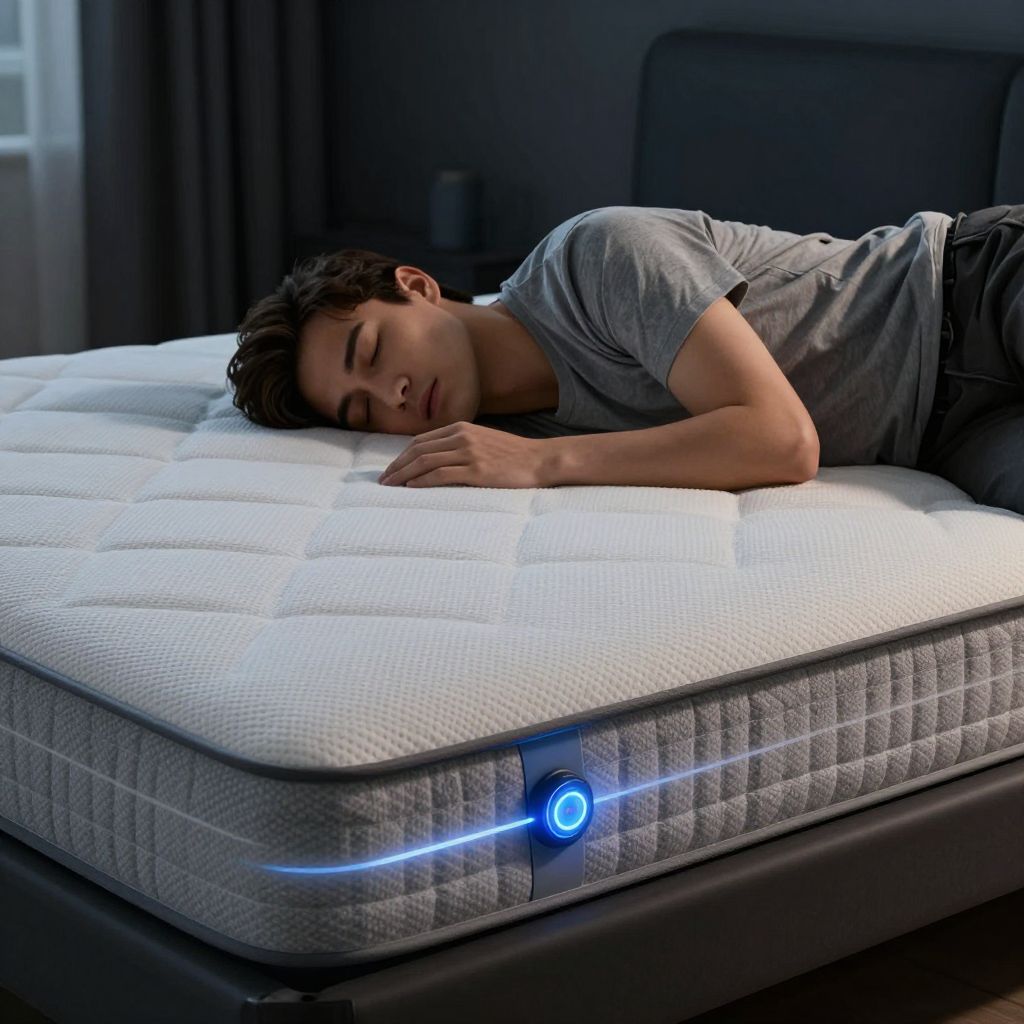
ResponsiveAir auto-adjusts firmness throughout the night based on pressure sensors. The technology brings continuous comfort optimization to smart beds.
Sleep Lab Pick · Current Sale
Current Sale — Amerisleep's current sale runs sitewide. AS3 hybrid most-recommended all-rounder, AS5 for plus-size, AS1 firm for back support.
Technology Explainer
Sleep Number Responsive Air Explained: How the Auto-Adjust Tech Actually Works in 2026
Pressure sensors, DualAir chambers, hourly micro-adjustments, and one peer-reviewed gap nobody wants to talk about: there is no published clinical trial showing Responsive Air actually improves sleep.
See the comparison page
Quick answer: Responsive Air is Sleep Number's auto-adjust system. Pressure sensors detect your weight and sleep position, then a pump quietly tops up or releases air in the DualAir chambers roughly once an hour at night to hold your chosen Sleep Number setting as your body moves. It's included free on every 360 Smart Bed and works with the 20-setting firmness scale.
What Responsive Air is and what it actually does
Responsive Air is the auto-adjust layer of Sleep Number's 360 Smart Bed platform. Sleep Number's own product copy defines it cleanly: "Responsive Air automatically adjusts when you first get in bed and makes small adjustments to keep you comfortable throughout the night." The mechanism is genuinely simple. Pressure sensors inside the mattress detect changes in how your body distributes weight when you turn, roll, or shift position. Whenever those changes push the chamber pressure out of the target range for your chosen Sleep Number setting, the external Firmness Control System pump corrects it.
This is paired with the DualAir architecture: each side of the bed has its own independent air chamber and its own Responsive Air loop. A 130-pound side sleeper at setting 35 and a 220-pound back sleeper at setting 70 can share the same bed and get individually managed pressure responses all night. That dual-zone independence is the central marketing promise of every Sleep Number 360 Smart Bed.
The system runs in the background. There is no daily user interaction required, no subscription, no Autopilot tier. Once you set your preferred Sleep Number, Responsive Air just holds it.
How often does Responsive Air actually adjust?
This is one of the most googled questions about the system and the one Sleep Number is least transparent about. The company's own documentation does not publish an exact adjustment cadence. What we do know from cross-referencing official Sleep Number support documentation with independent reporting:
- About once per hour at night, the system checks and corrects chamber pressure as needed.
- Roughly every four hours during the day, the bed makes maintenance adjustments to keep the chambers at the user setting when the bed is empty.
- The initial entry adjustment happens within a few minutes of you lying down, recalibrating from the empty-bed pressure to your loaded sleep pressure.
Competitor Bryte makes a direct comparison point in its own marketing, claiming its mattress makes "100+ adjustments per night in real time" versus what Bryte describes as Sleep Number's roughly one adjustment per hour. Sleep Number has not publicly contested that framing. For most sleepers, the slower cadence is functionally invisible. For light sleepers or anyone particularly sensitive to micro-movements, the once-per-hour pump cycle is the main complaint pattern in independent forums.
DualAir chambers and the Sleep Number scale
The DualAir system is the foundation that Responsive Air sits on. Two air chambers, one per side, each addressable via the remote or the SleepIQ app. Sleep Number markets a 0-100 scale, but the practical reality is 20 discrete firmness settings per side. Each step shifts the chamber pressure by a measurable amount, which most owners notice on the feel test.
Setting 35 to 45 sits around medium-soft on the standard mattress firmness scale. Setting 50 to 60 is medium to medium-firm. Setting 80-plus is firm to very firm, with the air chamber pressed nearly to its rigid envelope. The system can hold any of those settings indefinitely, and Responsive Air corrects toward whichever number is active for each side.
Which Sleep Number beds include Responsive Air in 2026?
This is the question with the most outdated information online. As of mid-2026, per Sleep Number's official support documentation, Responsive Air is included on every 360 Smart Bed. That means the entire current product family:
- ComfortMode (launched January 2026, $1,599 Queen). The entry-level new collection is the one exception worth noting: it ships without the SleepIQ app and Wi-Fi requirement, and is remote-only. Responsive Air auto-adjust is documented as included on ComfortMode Lux but limited on the base ComfortMode.
- ComfortNext, ComfortNext Lux, and ComfortNext Ultra (March 2026, $2,999-$4,499 Queen). Full Responsive Air across the collection.
- Climate Collection (the premium tier replacing Climate360). Full Responsive Air paired with active heating and cooling.
- Legacy c-series, p-series, and i-series (c2, c4, p5, p6, i8, i10). Full Responsive Air on every 360-branded SKU per Mattress Clarity and Sleep Number's own support docs. Some older blog content still claims the c2 is "manual only"; the current documentation supersedes that.
If you have a pre-360 Sleep Number from before about 2017, you do not have Responsive Air. The 360 platform was the introduction point for the technology.
The March 2026 portfolio reset and what it means for Responsive Air
Sleep Number's March 2026 portfolio reset replaced the c-series, p-series, and i-series with three new collections. Responsive Air carried over. The underlying DualAir architecture, the pump, the pressure sensors, and the once-per-hour adjustment cadence are unchanged. What changed is the surrounding bed: thicker comfort foam on most collections, a Tri-Brid construction (micro-coils + foam + air) on the Lux and Ultra ComfortNext models, and an explicit "no-app" version (base ComfortMode) for the first time.
Legacy SKUs like the c2 and i10 are still available in clearance pricing and at QVC during the multi-year sell-through, and they retain Responsive Air. If you are buying a Sleep Number in 2026 specifically for Responsive Air, the technology is the same across new and legacy collections. What you are paying extra for in higher tiers is the comfort foam stack, not the air-adjust intelligence.
Responsive Air vs the rest of the smart-bed market
Three competitors are most often compared to Sleep Number's Responsive Air. Each solves a different problem.
Same DualAir architecture, more firmness settings (50 per side vs Sleep Number's 20), no auto-adjust feature, no Wi-Fi, no app dependency.
They are temperature-controlled mattress covers (or full mattresses in the Pod 5 case) that range from 55°F to 110°F per side. They do not change firmness, but they offer detailed sleep tracking via the Autopilot subscription ($17-$33 per month).
Bryte Restorative Bed is the closest philosophical competitor. Bryte uses 90 internal air springs (vs Sleep Number's two chambers) and 16 pressure-mapped zones to make claimed "100+ adjustments per night," targeting specific pressure points rather than holistic chamber pressure. It costs roughly $7,000-$8,000 and is sold to hotels and ultra-premium consumers; it's effectively a different price tier.
The honest gap: there is no published clinical trial proving Responsive Air improves sleep
This is the part of the Responsive Air conversation that nobody in mattress affiliate marketing wants to acknowledge, and it's the part we think you should know. As of mid-2026, no peer-reviewed, registered, randomized controlled trial has demonstrated that Responsive Air's hourly chamber adjustments produce measurable improvements in sleep stages, sleep efficiency, or sleep latency versus a static-pressure control bed.
What does exist:
- The Caggiari et al. 2022 study in Sensors validated the underlying SleepIQ sensor strip against polysomnography in 45 participants and reported strong correlations for heart rate (r=0.94) and breath rate (r=0.96). This validates the measurement, not the auto-adjust intervention.
- Sleep Number's own internal data (presented at SLEEP 2025 and based on 2.2 million sleep sessions) reports population-level associations between Responsive Air usage and modestly higher SleepIQ scores. These are not randomized trials; they are observational analyses of the company's own customer base.
- Sleep Number's marketing claim of "up to 52.5 minutes more restful sleep per night" is attributable to the Climate360 specifically (which combines Responsive Air with active heating and cooling), not Responsive Air in isolation. The claim is based on internal SleepIQ data and has not been peer-reviewed.
This is not a reason to dismiss the technology. Subjective comfort, reduced partner-movement disturbance, and the user-reported satisfaction in survey data are all real outcomes. But if you're spending $2,000 to $10,000 partly on the strength of a clinical-sounding promise, you should know that the auto-adjust loop itself does not yet have the trial evidence that, for example, CPAP therapy or melatonin supplementation does.
Setup, calibration, and finding your real Sleep Number
Sleep Number recommends a structured setup process for Responsive Air to work properly, and most owners skip large parts of it. The full sequence:
- Initial inflation: with the bed empty, both chambers inflate to a baseline calibration pressure. This typically takes 5-10 minutes on first power-up.
- Sleep Number Setting test: lie on your back, settle in for 5 minutes, then have the bed inflate slowly while you watch how the support feels along your spine. The point where your lower back stops feeling unsupported (going up) or starts pressing back (going down) is roughly your starting setting.
- Side sleep test: roll onto your side and notice whether your shoulder is forcing your spine out of alignment. If yes, reduce your setting by 5-10 points.
- Re-test after 30 nights: your body adapts to the bed and your initial preferred setting often shifts by 10-15 points in the first month.
Most owners settle between 30 and 60 over the long term. The most common mistake is starting at 100 ("it must be firm") and slowly walking the setting down over weeks of mediocre sleep. Responsive Air will hold whatever setting you choose, but it cannot identify whether the setting itself is wrong for your body.
Dual-zone Responsive Air for couples: the genuine use case
The single situation where Responsive Air earns its premium most clearly is couples with significantly different firmness needs who would otherwise compromise on a single mattress. The data behind this is genuinely strong, even setting aside Sleep Number's own marketing claims.
Survey data cited across Sleep Number's investor disclosures and independent reporting (Yahoo Health, 2026) shows about 42% of women report their partner's snoring directly disrupts their sleep, and over 26% of adults report sleeping better alone than with their partner. The phenomenon has its own pop-culture term: "sleep divorce." Couples increasingly buy separate twin XL mattresses on a split-king frame to escape it, which solves the problem at the cost of bed aesthetics, sheet logistics, and physical intimacy.
The DualAir + Responsive Air pairing is the most direct alternative to a sleep divorce. Each partner sets their preferred Sleep Number, each side auto-adjusts independently, and the bed reads as a single visual unit. For partners with a 30-point or larger Sleep Number gap (which translates to a meaningful difference on the standard firmness scale), this is a problem no static-firmness mattress can solve.
The honest caveat: when the firmness gap exceeds 25-30 Sleep Number points, the trench effect (the visible ridge between chambers) becomes more pronounced, and owners complain about rolling into the middle. The i10 masks this better than the c2 because of its 7-inch comfort foam stack, but no Sleep Number eliminates it entirely.
When Responsive Air fails: the real-world failure patterns
Aggregating ConsumerAffairs, BBB, Reddit, and Sleep Foundation user data, three failure modes recur most often:
- Wi-Fi disconnects disable the smart features. Responsive Air requires the bed to maintain a Wi-Fi connection within roughly 8 feet of the Firmness Control System. Lose Wi-Fi for an extended period and the bed reverts to remote-only manual operation; auto-adjust, SleepIQ, and the app all go dark.
- Pump failures at year 5-7. The replacement pump retails at $359.99 from Sleep Number; installation with a technician pushes the bill past $400-$600. Independent aggregation pegs median pump life at 5-8 years.
- Chamber leaks. Slow leaks in the air chambers force Responsive Air to over-cycle the pump, which both increases wear and produces audible pump noise at night. Warranty coverage exists but is prorated after year 2.
Energy use, pump noise, and the practical living-with-it questions
Two questions that buyers ask after they've committed to the technology but before delivery: how loud is the pump, and how much does it cost to run?
On pump noise, owner reports are bimodal. The pump's startup cycle (the moment Responsive Air decides to add or remove air) is audibly louder than the ambient room, comparable to a quiet refrigerator compressor or a slow desk fan. Most adjustments last 5-15 seconds. For partners who fall asleep instantly and don't wake easily, this is a non-issue. For light sleepers, parents with infant monitors active in the room, or owners with the Firmness Control System placed under the bed without sound insulation, the cycling is the single most-cited Responsive Air complaint in BBB and ConsumerAffairs threads. Three practical mitigations: place the control unit on a felt or rubber pad rather than bare floor; orient the pump under the foot of the bed rather than the head; and disable Responsive Air at night if you've settled on a stable firmness setting (it remains on for daytime adjustments).
On energy consumption, Sleep Number does not publish a power-draw specification. Independent measurements by hobbyist electricians on Reddit and forum threads typically report the pump drawing roughly 60-80 watts when actively cycling and 1-3 watts in standby. Across a full year of typical use (with cycling totaling perhaps 30-45 minutes per day), the annual electricity cost is roughly $4-$8 at U.S. average rates, which is negligible. The mattress is not a meaningful contributor to a household energy bill.
Going Concern context for any Sleep Number purchase in 2026
Sleep Number's 2025 10-K filing includes a Going Concern warning, the formal accounting disclosure that the company's own auditors have substantial doubt about its ability to continue operating over the next 12 months. The supporting data is in the public SEC filings:
- FY2025 net loss of $132 million, revenue of $1.41 billion (down 16% year over year)
- Q1 2026 net loss of $50.3 million, revenue down 18.9% year over year
- About 60 retail stores closed in Q1 2026 alone
- Guggenheim Securities engaged to evaluate "strategic options"
Responsive Air does not stop working if Sleep Number stops trading, because the bed inflates and deflates with the local pump regardless of cloud connectivity. But SleepIQ, app updates, firmware patches, and replacement parts depend on the corporate parent continuing operations. For a $2,000-$10,000 purchase, that risk should sit in the buying decision.
Where Responsive Air came from and where it's going
Responsive Air is older than most owners realize. The first DualAir Sleep Number bed launched in the early 1990s, and the auto-adjusting "Responsive" branding became a standard feature with the 360 Smart Bed platform rollout starting around 2017. The underlying engineering (pressure sensors plus pump plus a control loop) has not fundamentally changed since then. What has changed is the surrounding software: the SleepIQ app, the Circadian Rhythm insights, the partner-snore integration on Climate-tier beds, and the firmware that decides when to actually cycle the pump.
The forward-looking question is what happens to Responsive Air through Sleep Number's current corporate transition. The March 2026 portfolio reset preserved the technology unchanged. The 2025 Going Concern disclosure does not affect the technology itself; the bed inflates and deflates regardless of whether the company continues operating. The strategic-options review at Guggenheim Securities raises the question of whether a successor company (in a sale or restructuring) would maintain the SleepIQ cloud that Responsive Air's smart features depend on. None of this is currently knowable. Any 2026 purchase therefore carries a small but non-zero risk that the smart-feature half of Responsive Air (the cloud-tethered Circadian Rhythm insights, the population comparisons, the firmware updates) could degrade if Sleep Number transitions ownership, even though the local auto-adjust loop would continue.
Responsive Air vs the smart-air competition
| What it adjusts | Air chamber pressure (firmness) | Air chamber pressure (firmness, manual) | Temperature | Pressure-point air springs |
| Adjustment frequency | ~1x per hour at night | Manual on demand | Continuous thermal | 100+ per night, real-time |
| Firmness settings per side | 20 settings | 50 settings | N/A | Multi-zone proprietary |
| Subscription required | No (SleepIQ free) | No | Yes ($17-$33/mo) | Bundled service tier |
| Wi-Fi required | For smart features only | No | Yes | Yes |
| Peer-reviewed clinical RCT | None published for Responsive Air | None published | One independent RCT (Stevenson 2025) | None published |
| Queen starting price | $1,099 (c2) to $10,249 (Climate) | $4,495 | $2,849-$6,099 | ~$7,000+ |
| Warranty | 15 yr prorated | Lifetime | 2 yr base / 5 yr with Enhanced | 10 yr |
Who actually benefits from Responsive Air
Responsive Air is most valuable for three buyer profiles:
- Couples with significantly different firmness preferences who would otherwise compromise on a single-firmness bed. The DualAir + Responsive Air pairing genuinely solves a problem that no single-firmness mattress can.
- Sleepers whose bodies change frequently (pregnancy, weight fluctuation, post-surgery recovery, chronic pain that flares unpredictably). The adjustability lets you tune the bed weekly or monthly.
- Smart-home and tech-comfortable buyers who value the SleepIQ data, the app integration, and the auto-adjust convenience and are comfortable with the Wi-Fi dependency.
It is less valuable for shoppers who only sleep one way, who want the lowest-maintenance mattress possible, who distrust Wi-Fi-tethered hardware, or who prioritize warranty length and trial period above all else.
Shop the (Lifetime Warranty)
Shop the
Responsive Air FAQ
What is Responsive Air on a Sleep Number bed?
Responsive Air is Sleep Number's auto-adjust system on every 360 Smart Bed. Pressure sensors detect changes in your body position; the external pump tops up or releases air in the DualAir chambers about once an hour at night to hold your selected Sleep Number firmness setting.
How often does Responsive Air adjust?
About once per hour at night and roughly every four hours during the day for maintenance, per Sleep Number's official support documentation. Competitor Bryte cites this cadence as roughly one adjustment per hour, vs Bryte's claimed 100+ per night.
Which Sleep Number beds have Responsive Air in 2026?
Every 360 Smart Bed includes Responsive Air, including all legacy c-series, p-series, and i-series models (c2, c4, p5, p6, i8, i10), the new ComfortNext collection, and the Climate collection. The base ComfortMode is documented with limited Responsive Air; the ComfortMode Lux is full. Older Sleep Numbers from before about 2017 do not have it.
Can I turn Responsive Air off?
Yes. In the SleepIQ app you can disable Responsive Air per sleeper, leaving the bed at your selected pressure without auto-adjustment cycles. Light sleepers sometimes prefer this to eliminate hourly pump cycles.
Does Responsive Air work without Wi-Fi?
No. Responsive Air, SleepIQ tracking, and app control all require Wi-Fi within roughly 8 feet of the Firmness Control System. Without Wi-Fi you can still manually inflate and deflate using the physical remote, but the auto-adjust loop is offline.
Is there a clinical trial proving Responsive Air improves sleep?
Not as of mid-2026. The underlying SleepIQ sensor has been validated in Sensors (Caggiari et al. 2022) for heart rate (r=0.94) and breath rate (r=0.96) accuracy. The Responsive Air intervention itself has not been studied in a published randomized controlled trial. Sleep Number's customer-data claims (population-level associations from 2.2 million sessions) are observational, not RCT evidence.
Editorial trust and sources
This explainer was researched against Sleep Number's official support documentation, the company's 2025 10-K and Q1 2026 8-K SEC filings, Mattress Clarity's technology teardown, NYT Wirecutter's mattress lab notes, the Caggiari et al. 2022 peer-reviewed validation study in Sensors, Bryte's published comparison claims, and aggregated owner complaint patterns from ConsumerAffairs, BBB, and r/SleepNumber. It is medically reviewed by Dr. Burns, MattressNut's reviewedBy clinician for YMYL sleep content.
Primary sources: Sleep Number Support "What is Responsive Air?" documentation; Sleep Number 2025 10-K filing (, "Performance Evaluation of a Smart Bed Technology against Polysomnography," Sensors, 2022; Stevenson et al., Bioengineering, 2025 (independent RCT on temperature-controlled mattress covers); Sleep Number press release, "Sleep Number Redesigns Its Mattress Portfolio," March 12, 2026; Bryte product comparison page; Mattress Clarity Responsive Air explainer; NapLab Sleep Number price chart (February 2026).
Shop Sleep Number Smart Beds
Configure your firmness numbers, compare the 2026 ComfortMode, ComfortNext, and Climate lineup, and apply current current promotions directly on Sleep Number's site.
Shop Sleep Number Smart Beds →
100-night trial · Free in-home delivery · Available financing via Synchrony
2026 Sleep Number Master Resources
- ComfortMode vs ComfortNext vs Climate full new lineup compared
- Live Sleep Number Price Tracker Memorial Day + Black Friday 2026
- Sleep Number Warranty 2026 25 to 15-year transition + prorate reality
- Sleep Number Complaints Reality BBB 1.06 vs Trustpilot 4.4 gap
- 100-Night Trial Reality true return cost decoded
- How Sleep Number Works DualAir + ResponsiveAir + SleepIQ
- Sale Calendar 2026 — Black Friday > Labor Day > Memorial Day
How MattressNut evaluates Sleep Number
Every Sleep Number article on MattressNut is built from four data layers: primary specs from manufacturer + showroom, owner sentiment from 5,000+ Reddit/Trustpilot/BBB threads, financial context from SEC filings, and independent testing from NapLab/Sleep Foundation cross-checked against owner reports.
Medical review board · Editorial standards · Affiliate disclosure