
 by
by The simplest way to raise a memory foam mattress: add a box spring (9 in high-profile or 5 in low-profile), a bunkie board, or a mattress topper. If you are also shopping for a new memory foam mattress to put on that raised setup, our top pick is the Saatva Loom & Leaf, a premium all-foam memory mattress with dense cooling foam and white-glove delivery. The Amerisleep AS3 is a solid bio-foam alternative for those who want a boxed option.
Saatva Loom & Leaf
9.3/10
- Dense premium memory foam with superior body-contouring, cooler than standard foam-in-a-box
- Organic cotton cover and natural thistle fire barrier, no harsh chemicals
- Free white-glove delivery, setup, and old-mattress removal
- 365-night trial and lifetime warranty, among the best in the industry
- Ships delivered flat, not compressed in a box, so delivery timing depends on schedule
- Higher starting price than entry-level memory foam alternatives
For a raised setup, the Loom & Leaf is the premium memory foam choice: dense enough to hold its shape on any foundation, cool enough to sleep comfortable, and backed by Saatva's white-glove service so installation on your new raised bed is handled for you.
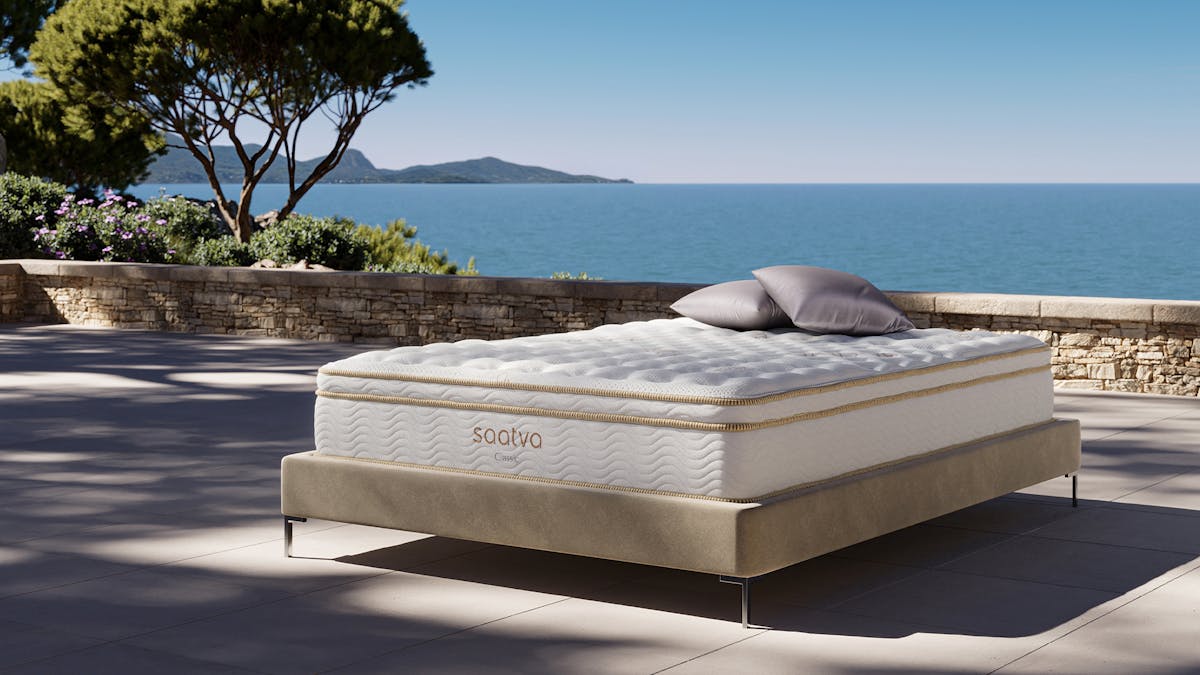
Saatva Classic
8.9/10
- Dual-coil build with a reinforced lumbar zone pad, outstanding edge support
- Free white-glove delivery, setup, and old-mattress removal
- Ships uncompressed, so zero off-gassing on arrival
- 365-night trial and lifetime warranty
- Heavy at roughly 110 lb for a queen, harder to reposition during setup
- $99 return fee applies during the trial
If you want a responsive innerspring feel rather than memory foam body-hug on your raised setup, the Saatva Classic in Luxury Firm is the most consistently recommended coil hybrid at this price point.
Amerisleep AS3
8.7/10
- HIVE 5-zone layer firms under the lumbar and relieves pressure at shoulders and hips
- Plant-based Bio-Pur open-cell foam runs cooler than standard memory foam
- CertiPUR-US certified, made in the USA
- Compatible with box springs, platforms, and adjustable bases
- Softer perimeter than a coil hybrid, so edge support is average
- Sleepers over 230 lb may do better with the firmer AS5 Hybrid
A capable foam mattress that pairs well with any box spring or raised platform. Good value for those who want a compressed-box delivery and zoned lumbar support at a lower price point than the Loom & Leaf.
Why raise a memory foam mattress?
Raising a mattress height makes getting in and out of bed easier, a practical concern for older adults, people recovering from surgery, or anyone with hip or knee pain. A 2015 study on transfer height found that bed height directly affects the effort required to stand from a lying position. Raising the mattress also keeps you further from floor-level cold air, dust, and allergens.
Memory foam mattresses present a specific consideration: because the material is dense and slow to respond, adding height through a foundation rarely changes the feel at the surface. The foam still conforms to your body the same way. What changes is the exit angle when you get up, which is the main practical benefit.
Step 1. Measure how much you want to raise the mattress
Use a measuring tape to find the current height of your mattress from floor to top surface. The clinical ideal for bed height is roughly knee-level when standing, around 20 to 23 inches for most adults. Subtract your current mattress height from that target and you have the thickness you need from your foundation.
Add 2 to 3 inches for bedding (sheets and a comforter) when calculating. Some memory foam mattresses do not fully expand immediately after unboxing, so take measurements after the mattress has had 48 hours to fully off-gas and expand.
Step 2. Choose a foundation type
| Foundation type | Height added | Best for | Approx. cost |
|---|---|---|---|
| Bunkie board | 1.5 to 2 in | Slight raise, solid base for foam | $50 to $120 |
| Low-profile box spring | 5 to 6 in | Moderate raise, traditional feel | $100 to $250 |
| High-profile box spring | 8 to 9 in | Significant raise, hotel-bed look | $150 to $350 |
| Mattress topper | 2 to 4 in | Raise + added surface comfort | $80 to $300 |
| Platform frame upgrade | 4 to 14 in | Full-bed height redesign | $200 to $800 |
Note for memory foam owners: memory foam mattresses are compatible with box springs and bunkie boards, but many manufacturers recommend a solid or closely slatted (slats no more than 3 inches apart) base. Check your warranty before adding a foundation that was not listed in the manufacturer specifications.
Step 3. Place the box spring on the bed frame
Remove your mattress and prop it against a wall. Tilt the box spring onto its side, slide it toward the frame, and lower it flat into the frame. Adjust until the corners align with the frame corners. This is easier with a second person, as box springs for queen and king sizes run 60 to 80 lb.
Step 4. Place the mattress on the box spring
Lift the mattress straight up and place it on top of the box spring. Memory foam mattresses are heavy, typically 60 to 100 lb for a queen, so get help for this step. Slide the mattress until it overhangs evenly on all sides, then re-dress the bed.
Step 5. Alternative: add a memory foam topper
A mattress topper adds 2 to 4 inches without requiring any changes to the bed frame. It also changes the surface feel, which can be useful if your current mattress is too firm. Check our guide on choosing a mattress topper thickness for body-weight and firmness guidance.
If hip pain is a concern, a softer topper on a firmer mattress can provide relief. See our mattress topper for hip pain guide for targeted picks.
Should you stack foundations?
Stacking two box springs is not recommended. Two high-profile springs would add 16 to 18 inches, making the total bed height over 30 inches for most mattresses, which is difficult to get onto safely. Stacking two bunkie boards is a better option if you want incremental extra height without spending on a new frame. Keep total foundation height under 14 inches for practical usability.
How to raise a gel foam mattress
Gel foam and memory foam mattresses raise identically. The foundation types, measurements, and installation steps are the same. The main difference is that gel foam runs slightly cooler at the surface, which a raised foundation does not change because airflow beneath the mattress affects the base, not the sleeping surface directly.
Foundation options in detail
Bunkie boards
A bunkie board is a 1 to 3 inch flat panel, usually plywood or particleboard, that sits between the mattress and an existing platform. It adds minimal height but firms the surface and prevents memory foam from sinking between open slats. If you have a platform bed with wide slat gaps, a bunkie board protects the mattress foam from sagging. Cost is around $50 to $120 for standard sizes.
Low-profile and high-profile box springs
Low-profile box springs measure 5 to 6 inches. High-profile versions measure 8 to 9 inches. Both are compatible with memory foam, though many foam manufacturers now prefer solid-base foundations. If you are using a box spring, look for one that specifies foam-compatible or no-spring interior, which is effectively a wooden platform in a fabric cover.
Platform beds
Platform beds come with a solid or slatted base built into the frame. The height off the floor varies from 6 inches for low-profile Japanese-style platforms to 14 inches for standard heights. For ventilation, use a slatted platform with slats no wider than 3 inches apart. More ventilation helps the foam breathe and extends its lifespan, a consideration backed by sleep temperature research.
Measure first, then pick a foundation by how much height you need. A bunkie board or low-profile box spring handles most situations. If you are also shopping for a new mattress, the Saatva Loom & Leaf is our top premium memory foam pick on a 365-night trial; the Amerisleep AS3 is the best bio-foam boxed alternative on a 100-night trial.
Frequently asked questions
Can I use a box spring with a memory foam mattress?
Yes. Most memory foam mattresses are compatible with box springs, but check your warranty first. Some manufacturers require a solid-base or closely slatted foundation. A no-spring box spring (a fabric-covered wooden panel) is a safe choice for any foam mattress.
How high should a memory foam mattress be off the floor?
The target is roughly 20 to 23 inches of total bed height (mattress top surface from the floor), which corresponds to knee height for most adults. Add up mattress height plus foundation height to reach that range.
Does raising a mattress change how it feels?
The sleep surface feel does not change. What changes is the angle at which you get in and out of bed, which affects ease of use rather than comfort. A topper placed on top of the mattress is the only foundation option that changes surface feel.
How do I stop my raised mattress from sliding?
Use a non-slip mat or rug pad between the mattress and the box spring or platform. Most mattress toppers also ship with an anchor system such as corner straps or an elastic skirt.
This guide is part of our Mattress Buying Guide hub. Compare all the top picks and narrow down your choice there.