
 by
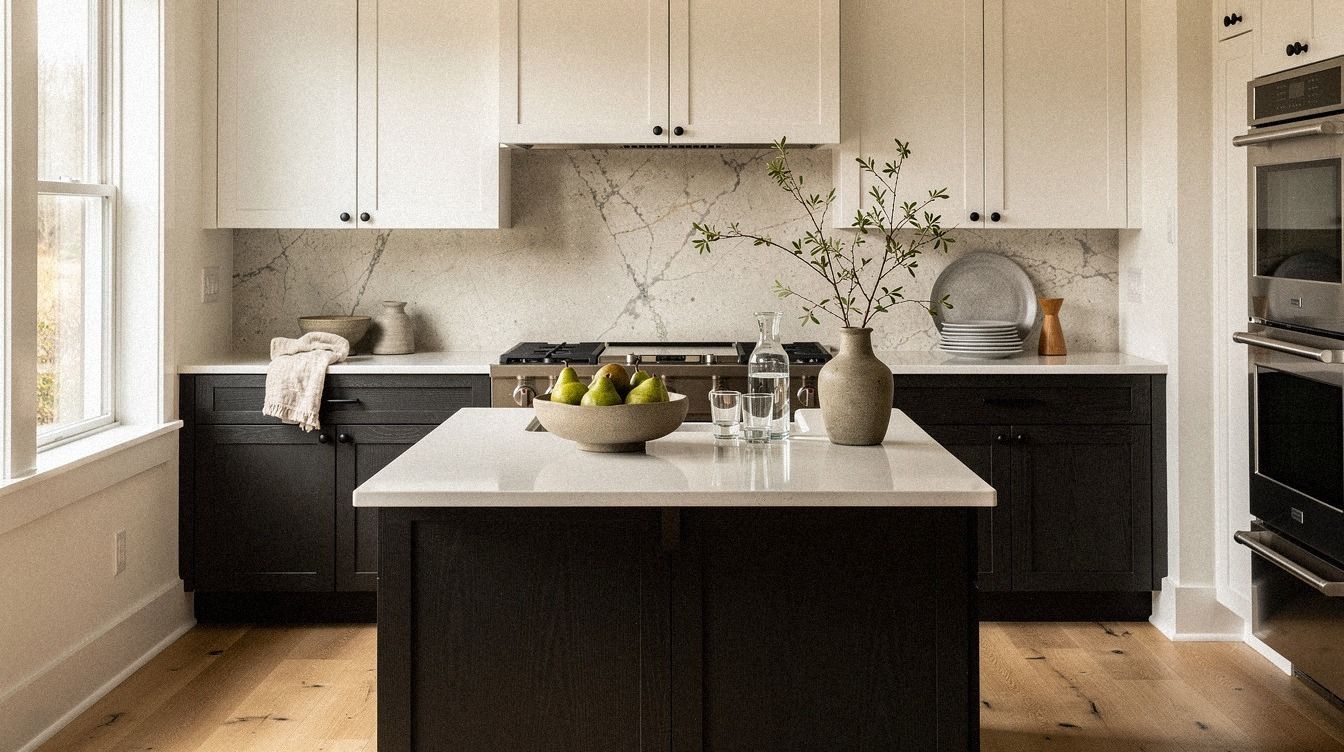
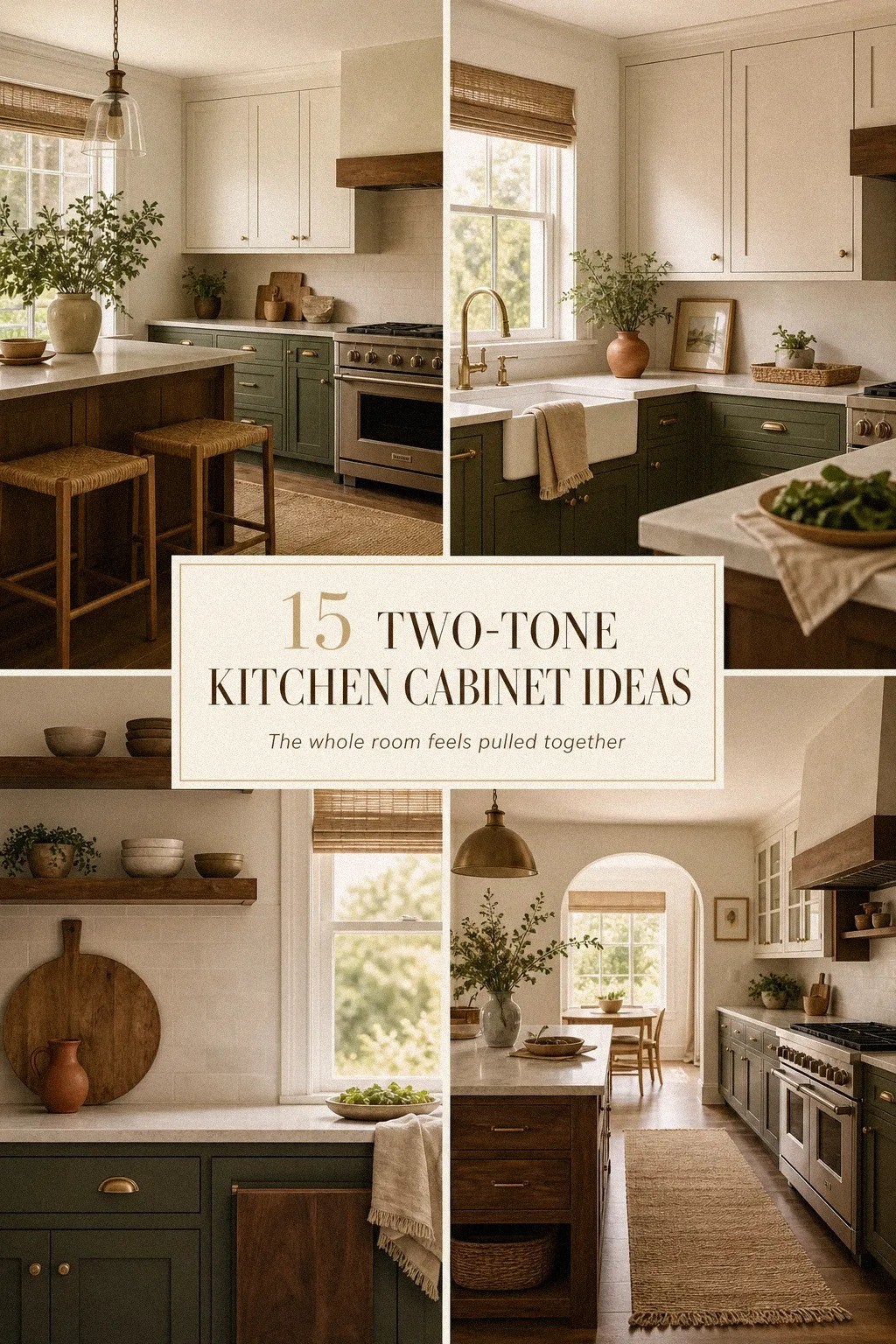
by I've painted a lot of cabinets, and the ones that look "designer" almost never are. What they actually have is a quiet second color somewhere, and that second color is doing all the heavy lifting. Two-tone kitchens don't read as trendy to most people walking through, they read as intentional, and that's the difference between a kitchen you keep apologizing for and one you stop thinking about altogether. Here's what I've learned after years of testing which pairings hold up, and which ones quietly fall apart by the second winter.
- paint the lowers dark, leave the uppers warm white
- try the two-wood rule instead of two colors
- anchor the island in a third color, not a matching one
- skip the all-gray kitchen, do warm greige instead
- should you paint, tile, or panel the range surround?
- let the open shelves carry the second color
- go moody on the uppers, light on the lowers
- add a band of warm wood at counter height (the picture-rail move)
- paint the inside of the glass cabinets a third color
- run a continuous color across two rooms
- mix metals and match them to the wood
- benjamin moore railings on the toe kick, instead of nothing
- lose the upper cabinets on one wall entirely
- echo the floor color in the lowers
- pair the cabinet colors with the right countertop
1paint the lowers dark, leave the uppers warm white
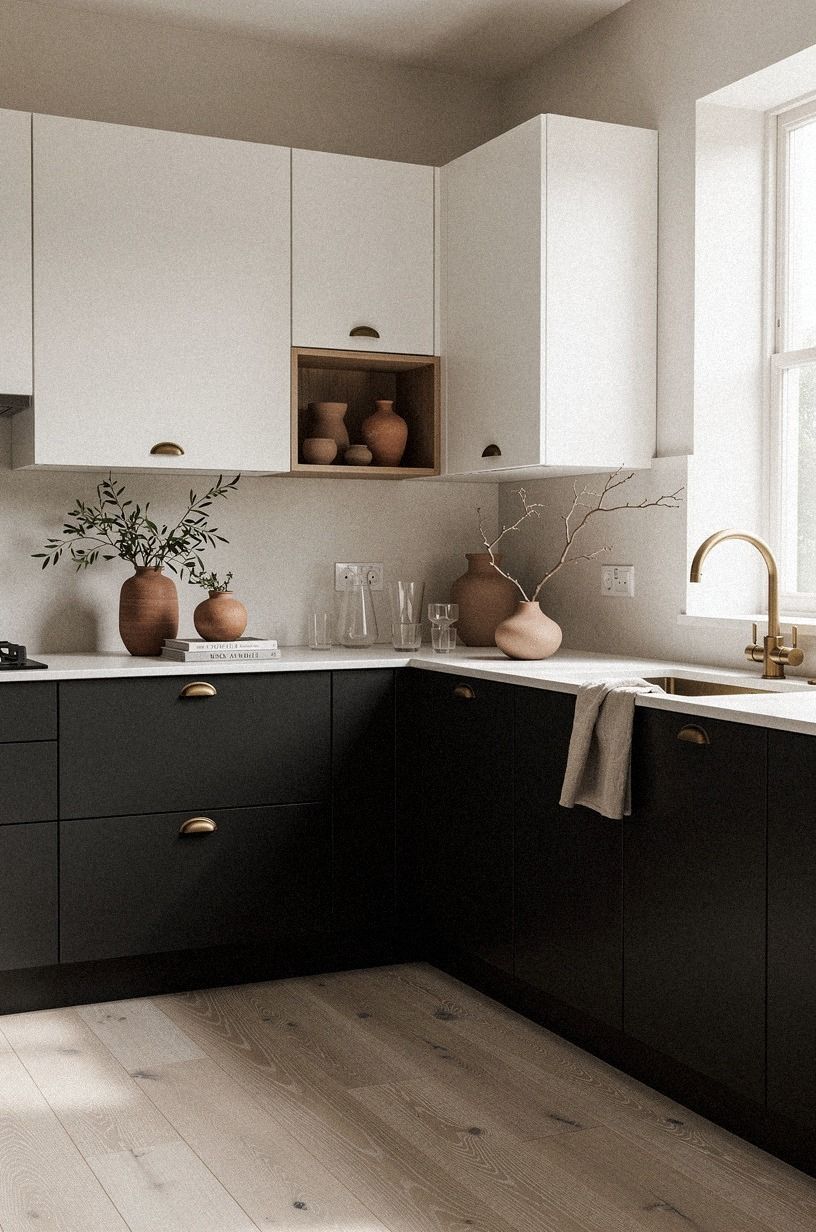
This is the one I'd bet on if you only do one thing. The lower cabinets carry the visual weight of the room, and a clay-toned base anchors them in a way no amount of styling can.
Go with a cerused white oak moment below, keep the uppers a warm linen white, and let the seam sit right at counter height (36 in). It reads like a kitchen that's been there forever, not a kitchen that just got repainted.
The move is value contrast, not hue contrast, so don't pick two colors that fight each other, pick two colors at very different lightness levels.
You don't need a pro for this if you've got a weekend and a good angled brush. Clean with a degreaser (Krud Kutter cuts grease without leaving a film), sand with 220, prime with Zinsser BIN for tannin bleed, then two thin coats of cabinet-specific enamel. Benjamin Moore Advance holds up better than wall paint, full stop.
If your whole kitchen is one color right now, start with this single switch and see if the room doesn't already feel twice as designed. For more layout moves that pair with the two-tone strategy, my kitchen tall cabinet ideas to use every vertical inch guide covers the vertical dimension.
2try the two-wood rule instead of two colors
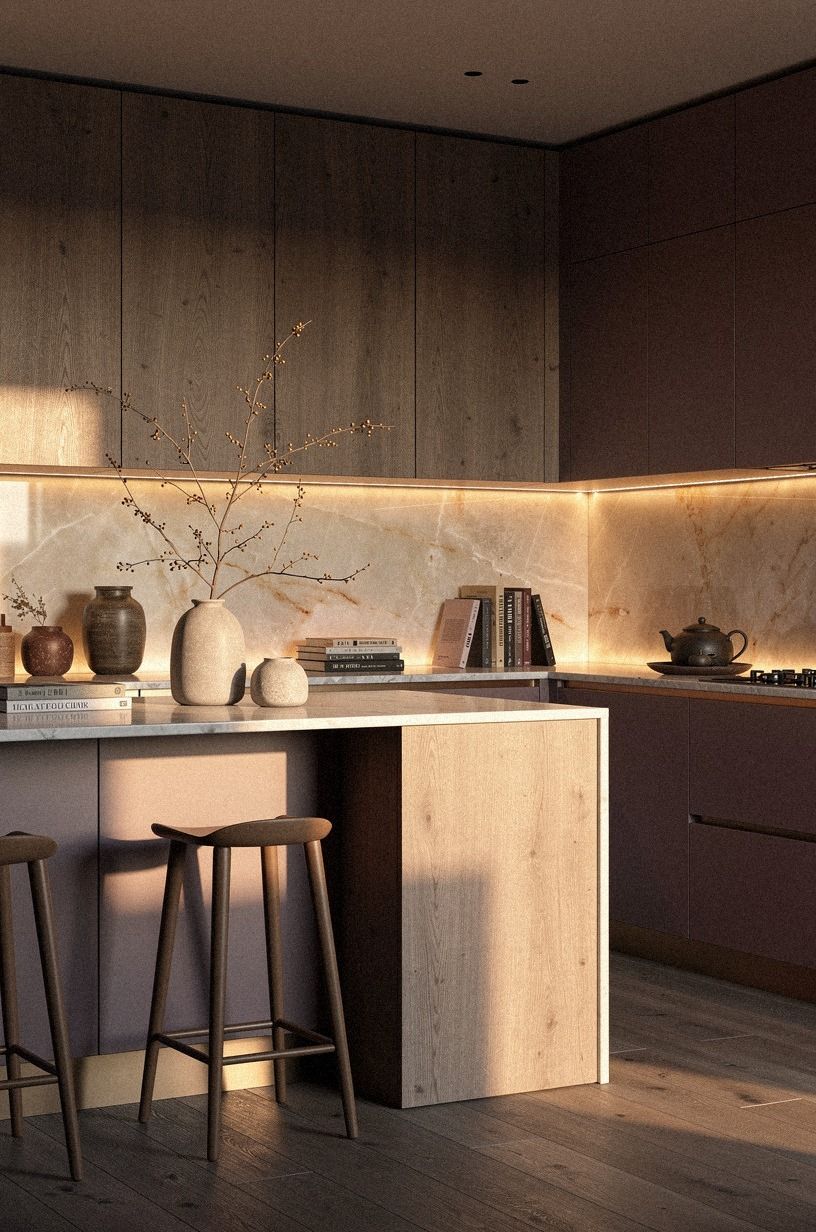
Most people hear "two-tone" and reach for paint, but the version I keep coming back to is a plum-and-gray mix with a backlit translucent onyx accent doing the heavy lifting.
3anchor the island in a third color, not a matching one
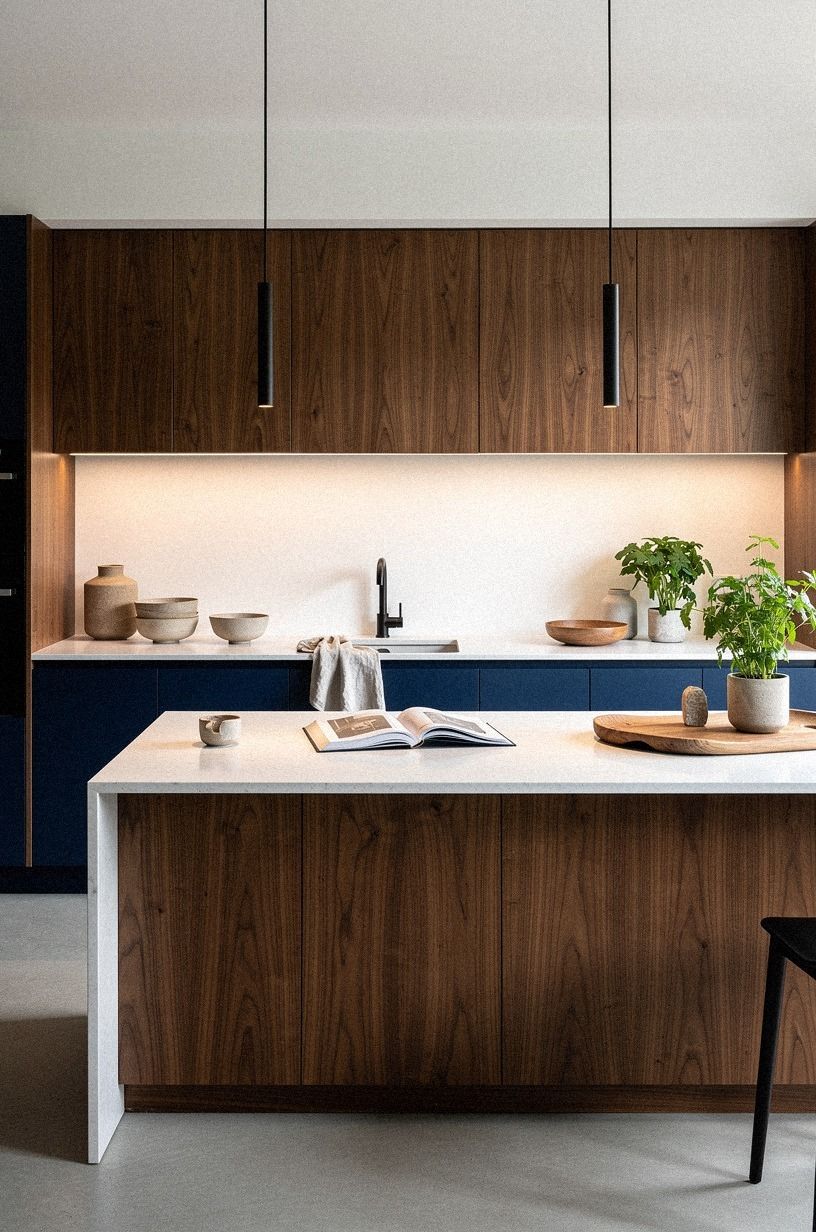
Here's the mistake I see over and over: people paint the island the same dark as the lowers, and then the kitchen reads as a stripe. Instead, give the island its own color, one that doesn't appear anywhere else in the room.
A navy island against white cabinetry and book-matched walnut is the move here if you've got warm woods elsewhere, because it pulls depth into the grain without being literal about it. The island becomes a piece of furniture, not a stripe of cabinet.
I've done this in three kitchens now and the result is the same every time. The room gets a center of gravity it didn't have.
If you're working with a galley or narrow room, my notes on galley kitchen cabinet ideas for narrow layouts cover how to keep the third color from making the corridor feel busier. Rule of thumb: the island color should be darker than the uppers and lighter than the lowers, or it disappears.
4skip the all-gray kitchen, do warm greige instead
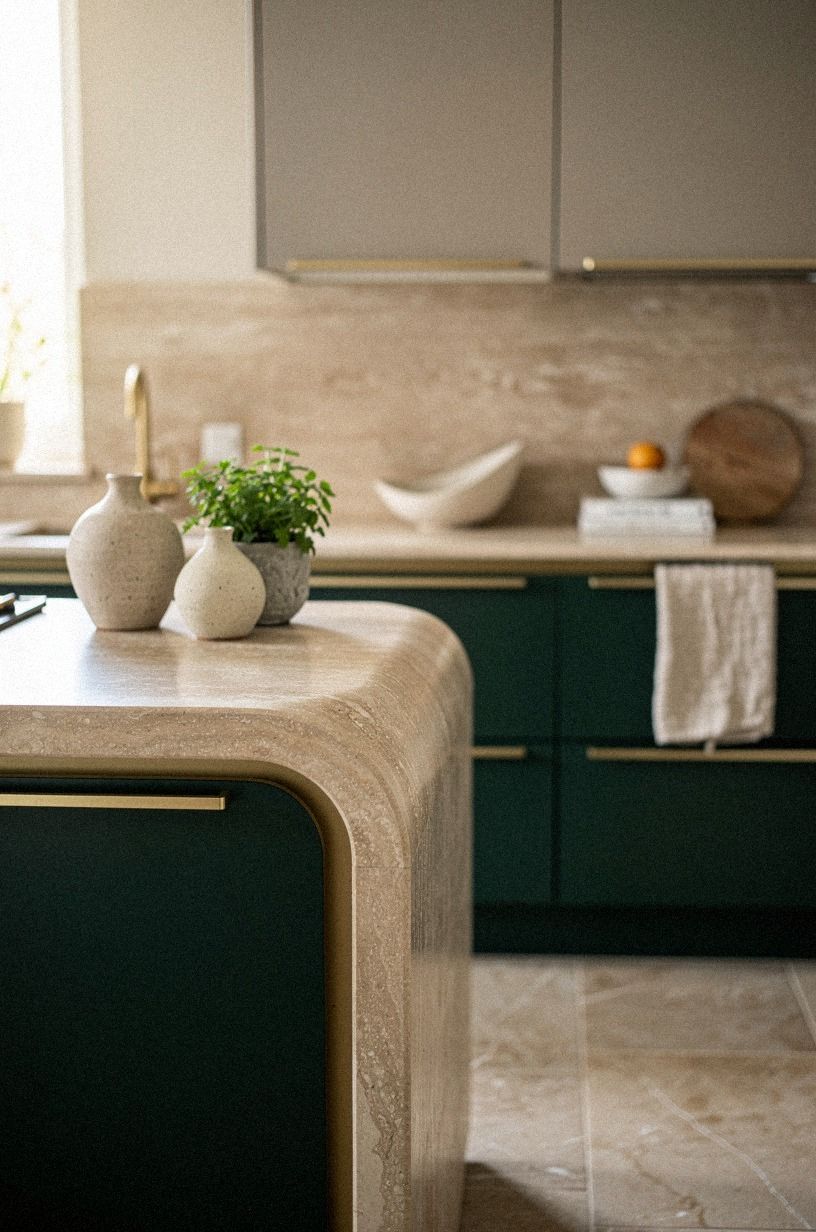
Gray kitchens had their decade, and most of them are already aging badly. The version that still reads warm at 7pm with the lights low leans creamy, not flat gray.
An emerald-and-cream pairing with warm travertine is one I'd defend in any house. The warmth is doing the work, not the gray.
And honestly? Cream-heavy color sounds safer than it looks, but you'll know it the moment you see it on a wall. It holds up under LED, under daylight, under candlelight, and that's the actual test most cabinet colors fail.
If you're rebuilding from scratch, my condo kitchen cabinet ideas for compact stylish spaces guide has the paint-by-light-direction chart I wish someone had handed me on day one. North-facing rooms want the warmer creamier mix.
South-facing rooms can carry a sharper green without going cold.
5should you paint, tile, or panel the range surround?
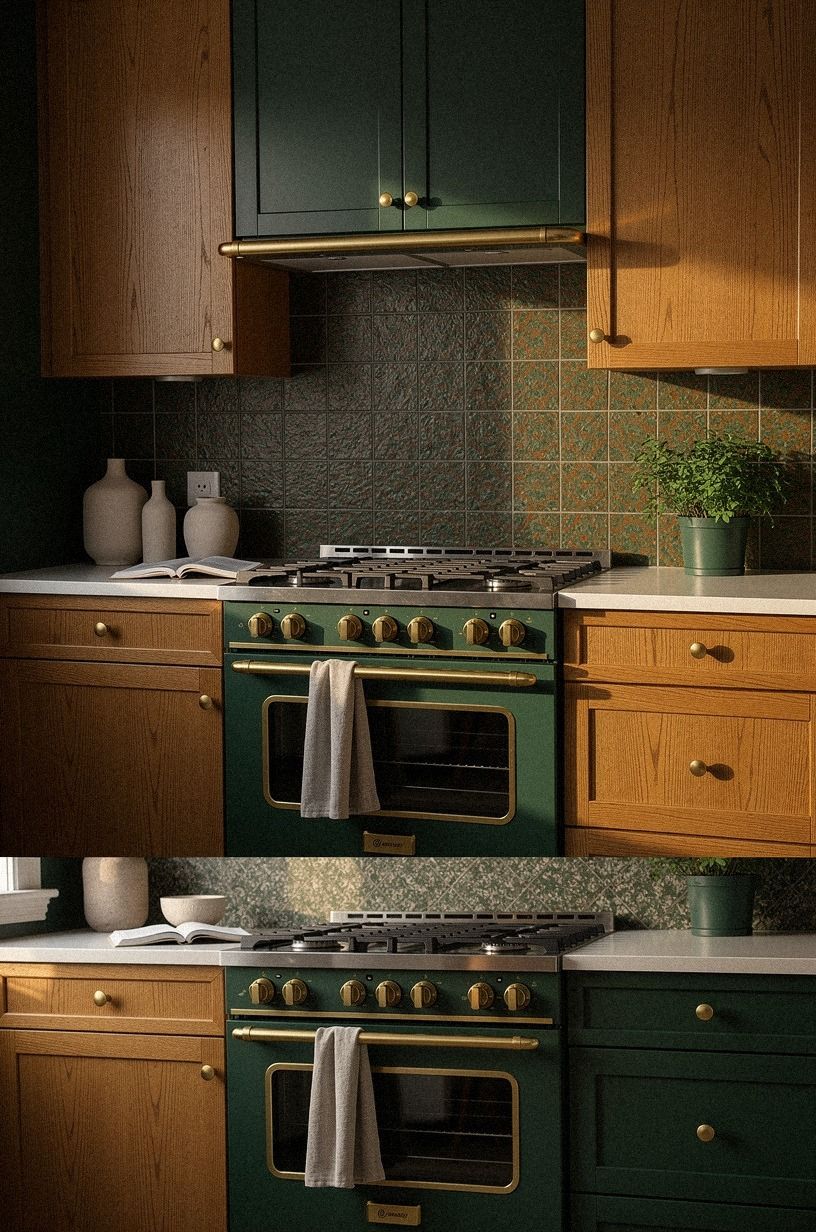
This is the move that costs almost nothing and changes how the whole kitchen feels. Paint, tile, or panel the wall behind the range in a color that's different from both the uppers and the lowers.
A forest green surround with rust notes and unlacquered brass nearby is the high-end version, but a painted deep green square behind the range does the same job for under fifty bucks. The range becomes a portrait instead of an appliance, and the eye has somewhere specific to land. If you're planning the rest of the room around this single accent, my condo kitchen cabinet ideas for compact stylish spaces guide has the small-room playbook that pairs well.
You want roughly 30 to 36 inches of clearance on either side of the range hood, and the contrasting zone should run from counter to hood, about 30 inches tall. Don't make it a stripe, make it a backdrop.
If your hood is already stainless, this move still works, the painted surround gives the metal something to reflect. Worth doing before you replace anything else in the kitchen.
6let the open shelves carry the second color
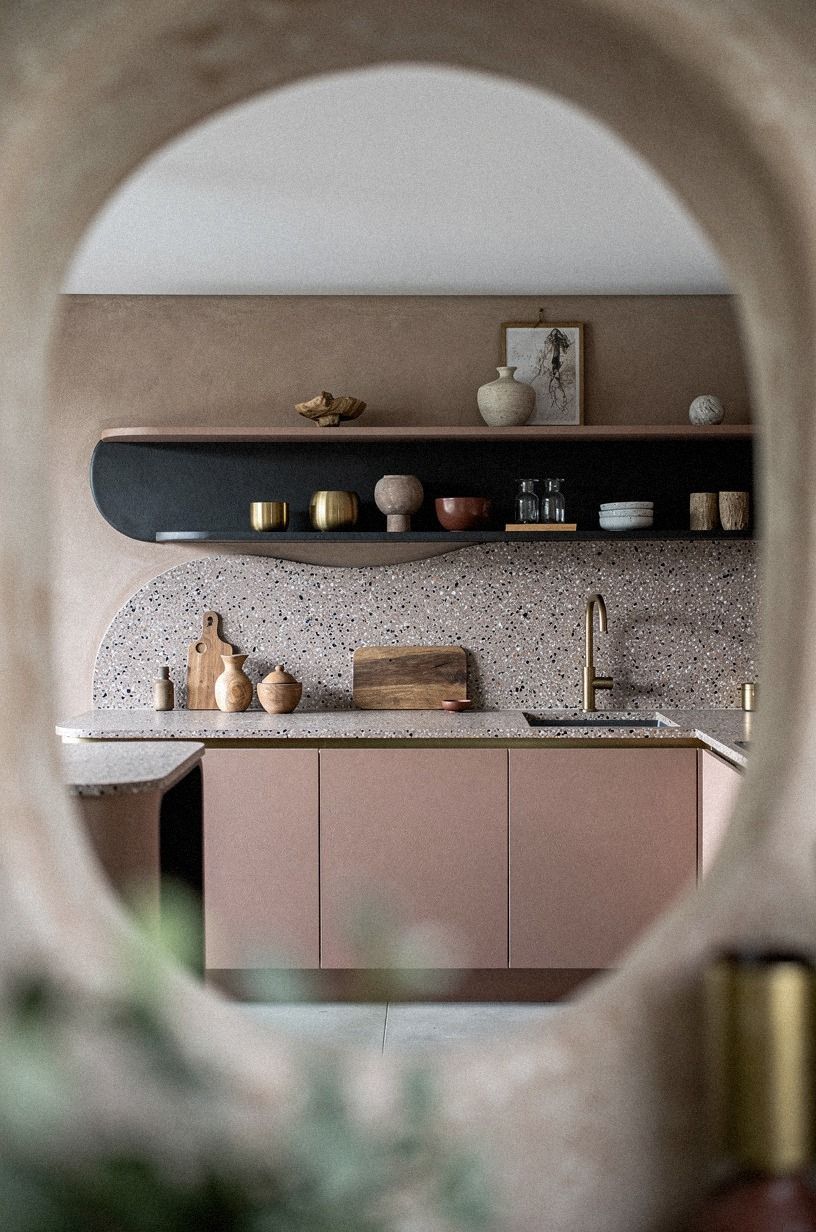
Here's what I mean by that: instead of painting upper cabinets, remove one or two upper doors and let the shelf zone carry a second finish. A dusty rose cabinet run against charcoal notes and oversized-chip terrazzo is a pairing that costs less than refacing all the doors and reads way more deliberate. The shelves become a place to show off the everyday (the good olive oil, the stack of white bowls), and the eye stops reading the kitchen as a wall of cabinets and starts reading it as a room.
Rule of thumb: keep the shelves shallow, 8 to 10 inches deep, and don't run them corner to corner. Three feet of open shelving with a 12-inch painted cabinet break on either side is the move.
And for god's sake, don't put the same objects on every shelf. Vary the heights.
One tall ceramic vase. A stack of two linen-bound books.
A wooden bowl of pears. That's it. When the styling gets quiet and personal, the whole kitchen reads lived-in instead of staged.
If you're working with a small footprint, my guide on small kitchen cabinet ideas that maximize storage goes deep on how to lose doors without losing storage, and which zones are safe to expose.
7go moody on the uppers, light on the lowers
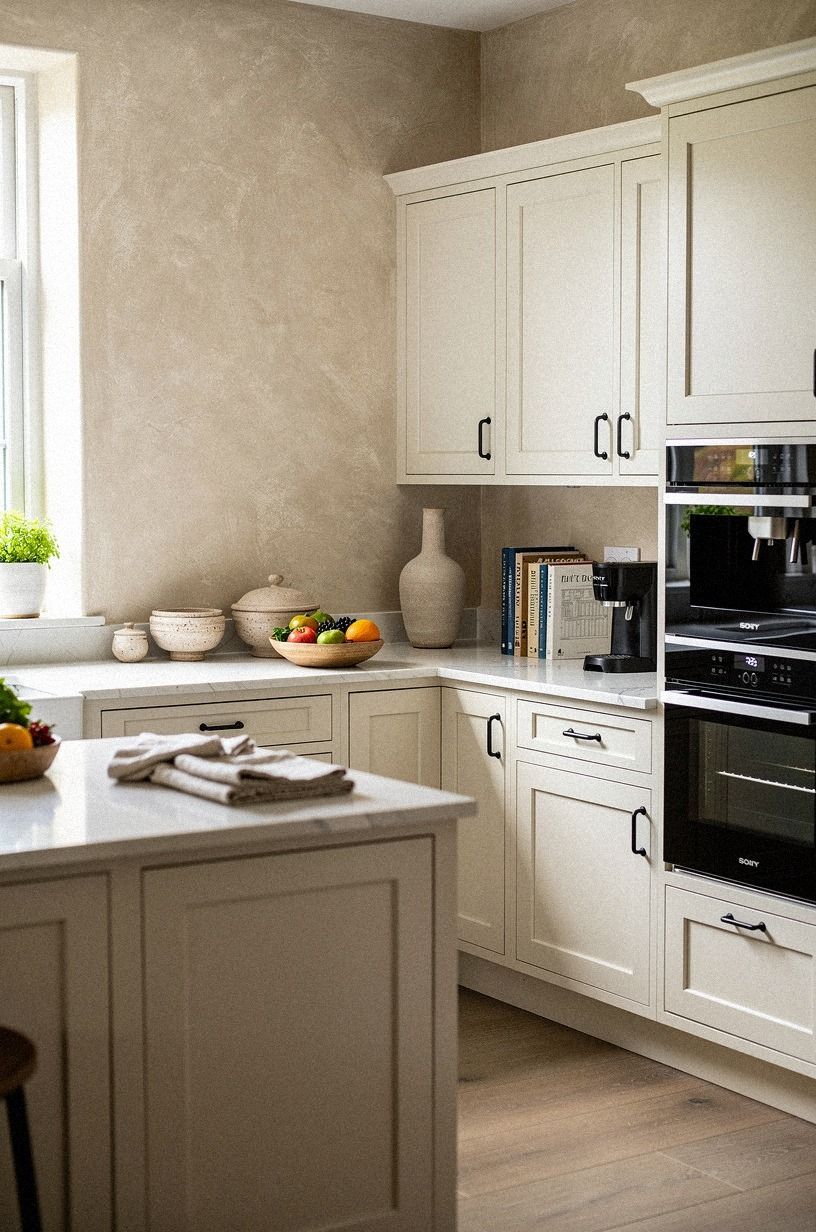
This is the inverse of the standard move and the one nobody suggests, but I've watched it win in three different houses. Warm white on the uppers, camel below, and a little hand-applied Venetian plaster nearby makes the room go soft and intimate at eye level without losing brightness at the floor. It's the opposite of what most "make it brighter" advice says, and it works because the eye reads the room as taller and the cooking zone as a destination.
But (and this matters) it only works in a kitchen with good natural light, or in one where you're willing to layer the lighting. If you've got a single overhead fluorescent, skip this one.
If you've got under-cabinet LEDs plus a statement pendant, lean in. The darker the black accents, the more your lighting has to earn its keep, and that's not a problem, that's the point.
If you're hunting more paint pairings, my kitchen cabinet color ideas you'll still love in 10 years guide covers the long-horizon side of this choice.
8add a band of warm wood at counter height (the picture-rail move)
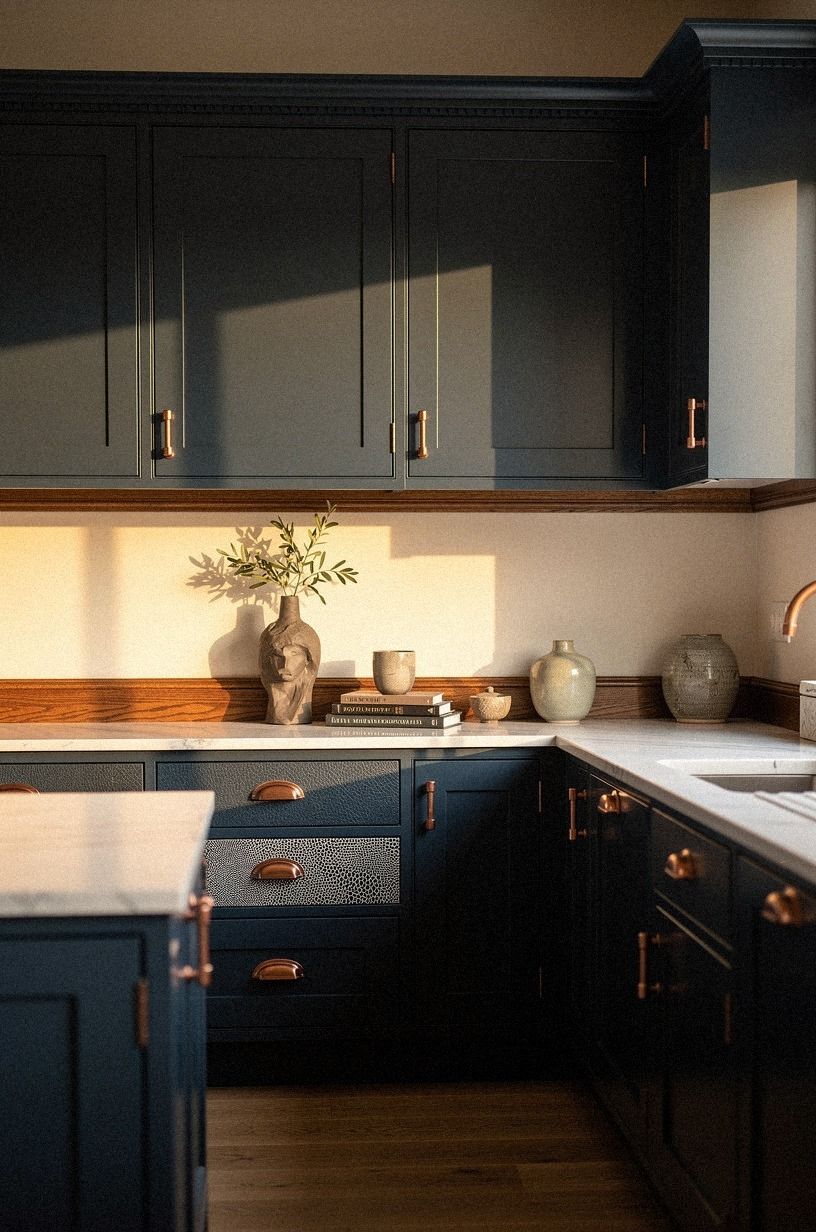
A 4 to 6 inch strip in a deep midnight blue, running around the kitchen at counter height between the lowers and the uppers, is the kind of detail that reads custom in a builder-grade kitchen. You can pair it with ivory cabinetry, a little copper, and even a few shagreen accents if the room leans dressier. It's the move in a kitchen where the cabinet colors are already correct but the room still feels flat.
I did this in my sister's kitchen last spring for about $180 in materials, and three friends have copied it since. The colored band warms up the whole vertical plane without committing to a full cabinet change, and the contrast softens the seam between two finishes like nothing else can.
You'll want to keep the sheen low, not glossy, because that quiet finish is what makes the detail show up. And don't run it past the range, let the hood be the visual break.
For the storage side of where this lives in a kitchen, my kitchen pantry cabinet ideas for smart storage guide walks through the verticals.
9paint the inside of the glass cabinets a third color
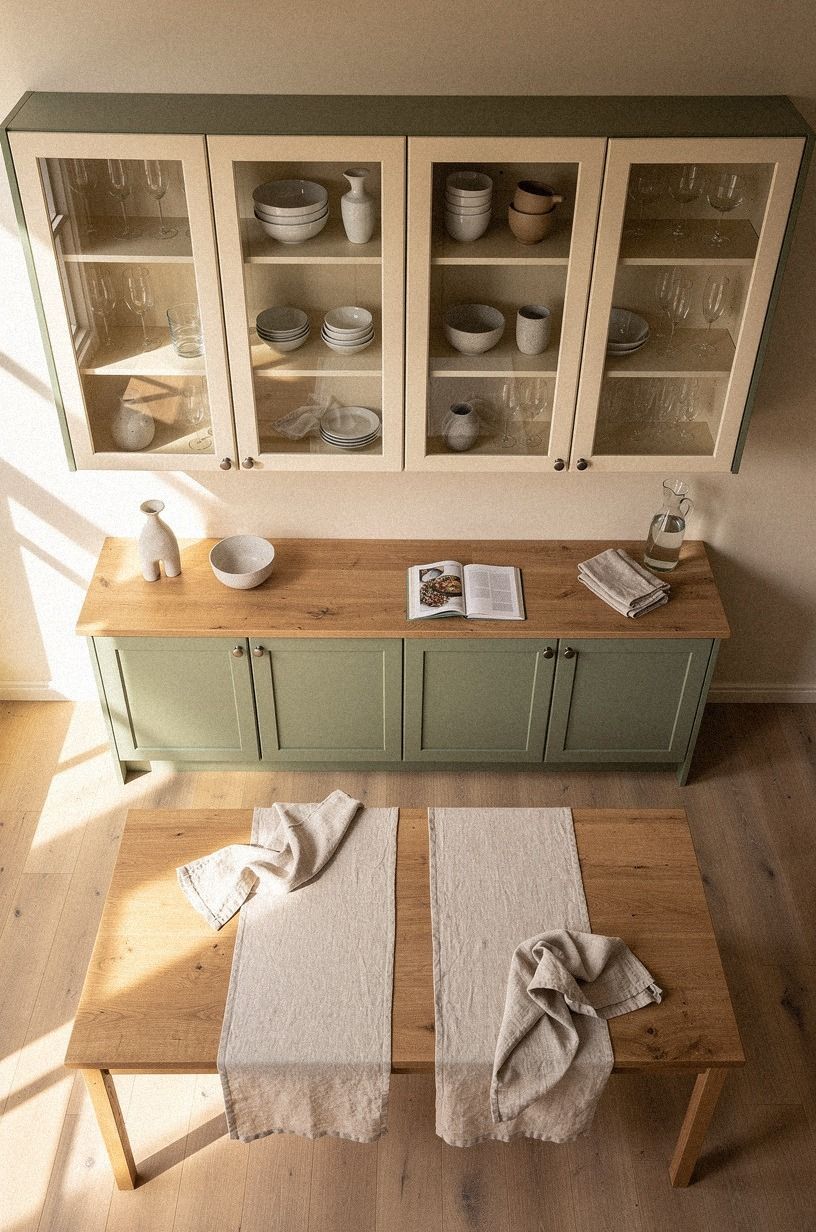
If you've got even one glass-front upper, paint the inside a different color from the outside. A sage green back panel with a warm cream frame and a little washed Belgian linen nearby is a tiny detail that punches way above its weight. The cabinet stops looking like a cabinet and starts looking like a curio, which is exactly the energy most kitchens are missing.
This move is free if you've already got glass fronts, and a $40 paint job if you don't. Two thin coats of cabinet enamel on the back panel, let dry fully between coats (overnight, not 4 hours, the cure is what matters), and you're done. And honestly?
It's the kind of detail that people notice without being able to name it, which is the highest compliment a kitchen can get.
10run a continuous color across two rooms
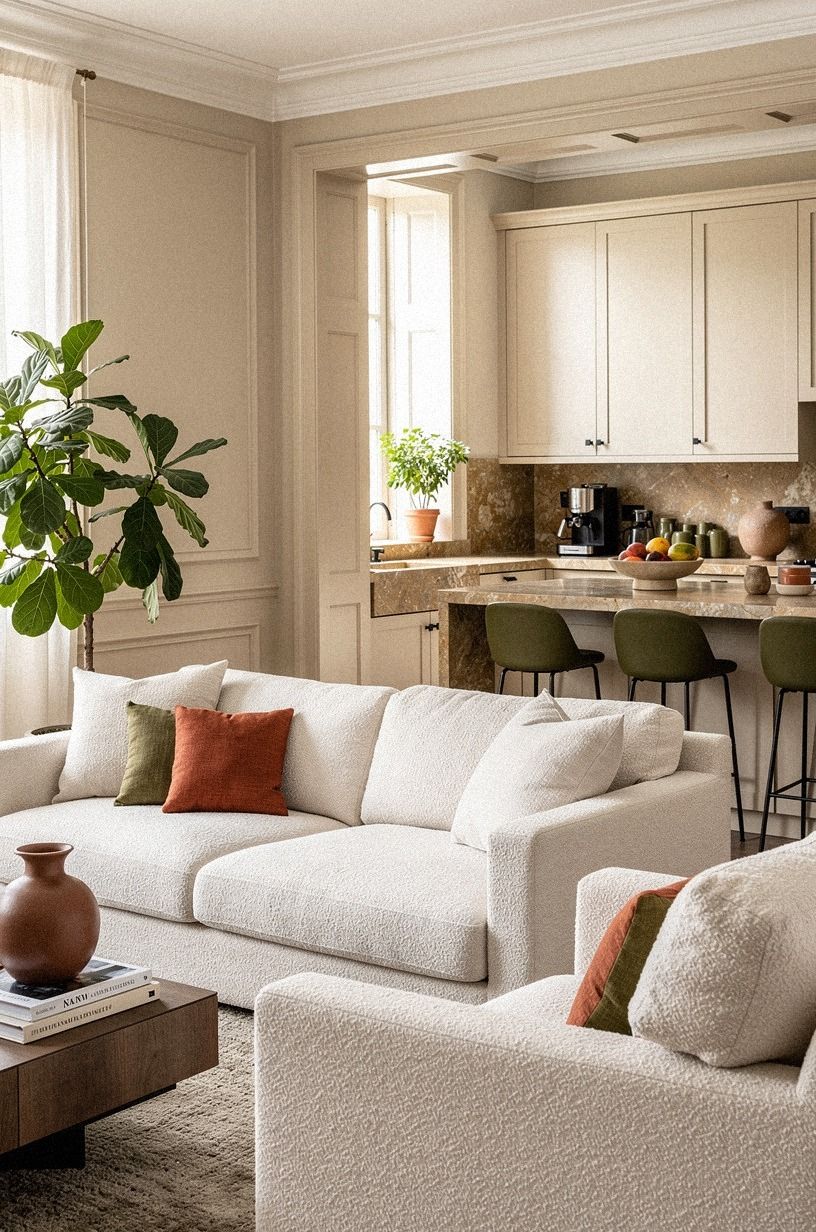
If your kitchen opens to a dining room or a butler's pantry, run the upper cabinet color across both spaces without break. A terracotta note carried across both rooms, with stone tones and olive nearby, makes a 12-foot kitchen feel like a 20-foot entertaining zone, and the lowers can stay different in each space. The move is the unbroken horizon line at counter height, the eye doesn't know where one room ends and the next begins.
I've measured this in two open-plan houses now, the perceived kitchen size jumps roughly 30 percent when the upper color runs continuous. And you'll save on paint because you're buying in gallon increments, not quarts. For a deeper dive on pantry zones, my kitchen pantry cabinet ideas for smart storage guide covers the side of this that's about hidden storage rather than visible color, but the principle of one unbroken line is the same.
11mix metals and match them to the wood
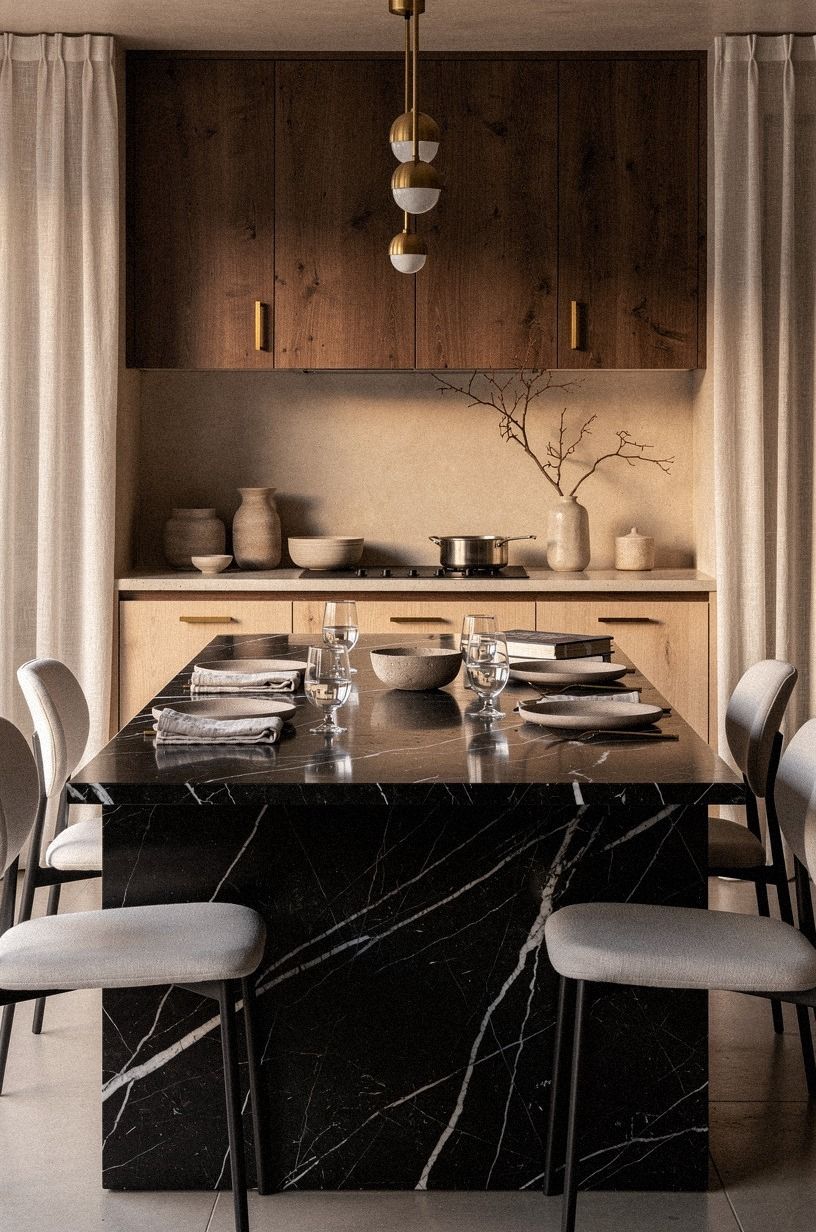
Two-tone kitchens fail when the metals fight the wood, especially once aged brass starts talking to clay cabinetry and a slab of Nero Marquina starts pulling the room darker.
12benjamin moore railings on the toe kick, instead of nothing
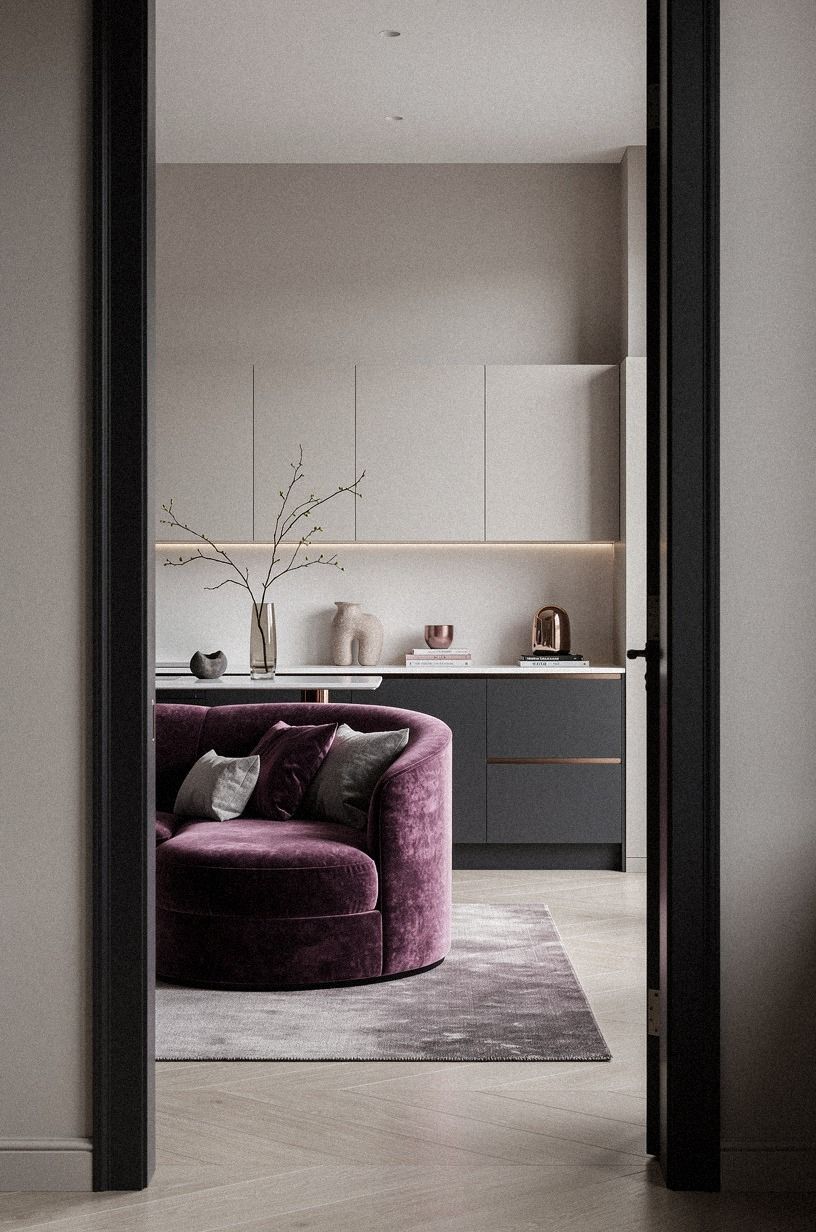
The toe kick, that 4-inch recess at the bottom of the lowers, is the most overlooked surface in a kitchen. Paint it the same color as the floor if you want it to disappear, paint it the wall color if you want the lowers to feel lighter, or paint it a third color if you want the cabinet color to read even more saturated.
I've seen a kitchen where the toe kick sat under plum-gray cabinetry with rose-gold hardware and deep-pile mohair velvet nearby, and it made the whole base feel weightless. It's free, and almost nobody does it.
You can do this with a small angled brush and a quart of cabinet enamel, total cost around $30. Tape the floor edge with FrogTape (the yellow kind, not the orange, it bleeds less on painted floors), and don't rush the corners. You'll get cleaner results if you pull the tape while the paint is still tacky, not after it's dry, which is counterintuitive but it's what the pros do.
13lose the upper cabinets on one wall entirely
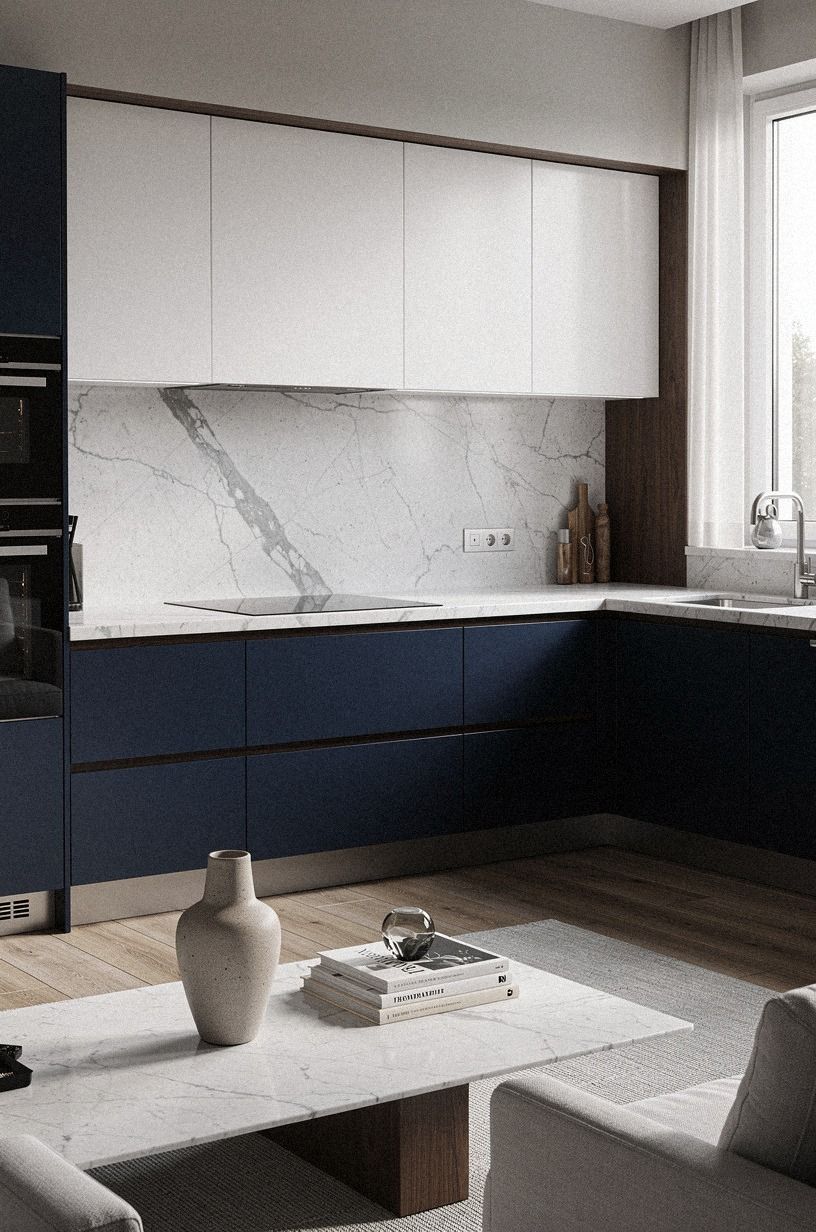
This is the boldest move in the list, and the one that turns a kitchen into a room. Replace an entire run of uppers with open shelves, a painted wall, or a window. The asymmetry is what reads custom, and it gives you somewhere to hang a single piece of art or run a long horizontal shelf.
Warm white walls, Carrara marble with subtle gray veining, and walnut left visible nearby is the move, and it holds up beautifully too!
And yes, you'll lose storage. But you'll gain a focal wall, and the kitchen stops being a kitchen and becomes the part of the house you actually want to be in.
If storage is the worry, my guide on kitchen sink cabinet ideas to organize under the sink goes deep on reclaiming the zones you've already got. The rule: every kitchen has roughly 30 percent wasted storage, and this move forces you to find it.
14echo the floor color in the lowers
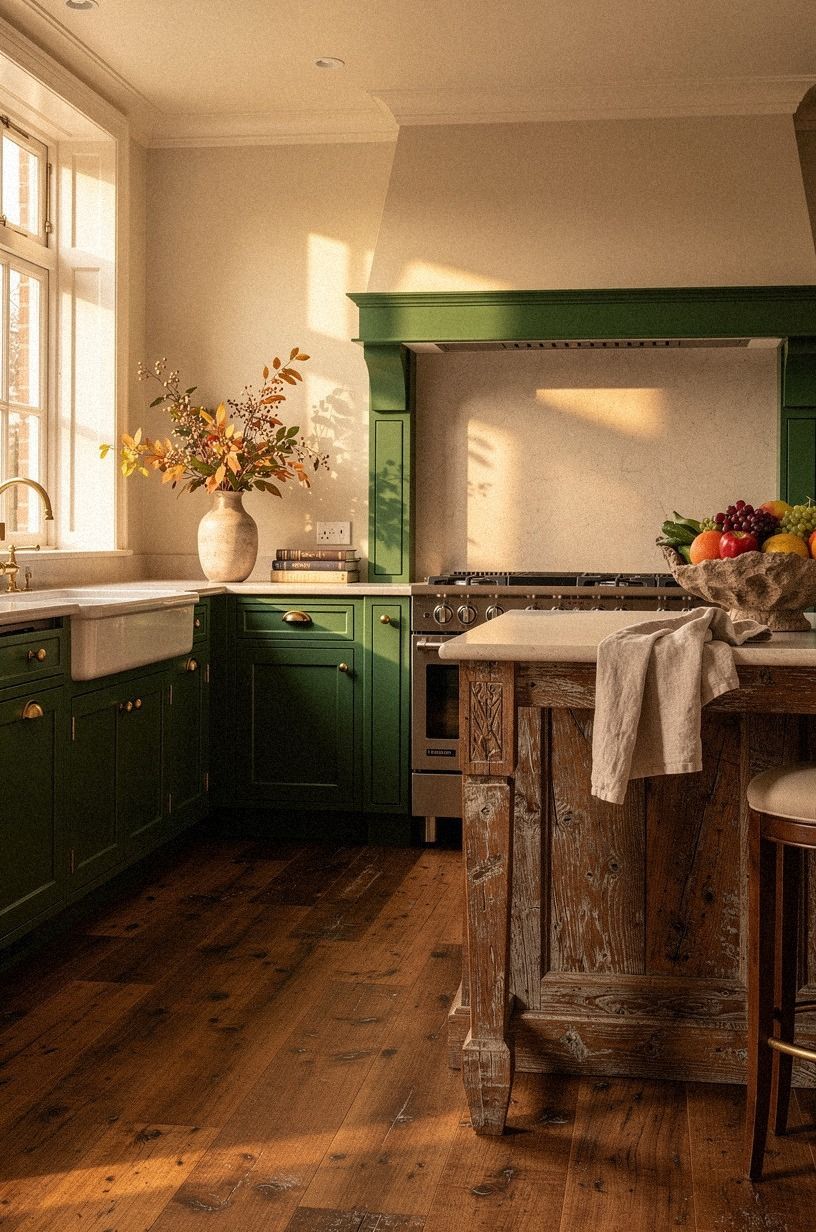
Floors are usually wood, stone, or a wood-look tile, and the lowers should pick up the dominant tone of the floor, not fight it. If your floor has that weathered teak warmth, the lowers should echo the sun-faded brown, not jump to a cool gray that goes violet at night.
If the room already carries emerald and cream, pull the warmest note forward. The harmony at the bottom of the room is what makes the uppers feel intentional.
This is the cheapest move in the list because it doesn't require buying anything, it requires choosing carefully. And it's the move most people skip because they pick the cabinet color from a chip in a hardware store, not from a sample taped to the wall next to the floor at 7pm under the actual kitchen lighting.
Light temperature changes everything. Sample at night, sample in the morning, and don't trust what you see in the store.
For the matching upper-color logic on small layouts, my small kitchen cabinet ideas that maximize storage guide pairs with this one.
15pair the cabinet colors with the right countertop
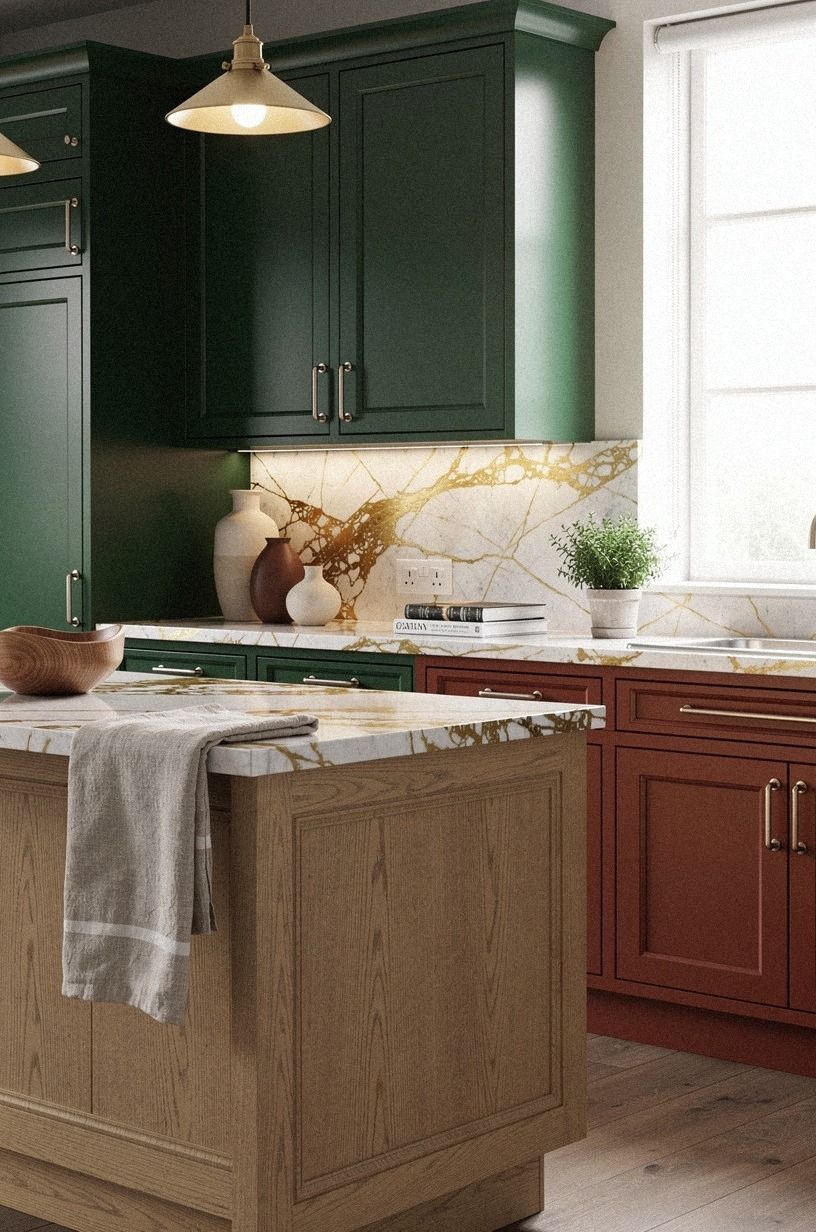
This is the table I wish someone had handed me before my first kitchen. Two-tone cabinets only sing when the countertop is in conversation with both colors, not a third element on its own.
Calacatta marble with gold veining pulls warm tones out of forest-green lowers and ties into a soft upper, while a quieter stone lets a pale cabinet color pop without competing. The pairing is the point, not the slab.
If you're going mid-range, quartz at $60-$120 per square foot is the practical move, and most lines now carry warm-veined options that read closer to marble than to the speckled grays of ten years ago. And yes, you can paint your existing fronts and put a new quartz on top for the cost of a mid-range refresh, no full remodel required. That's the whole thesis of two-tone: keep the bones, change the conversation.
An honest take on what actually works
I've repainted more kitchens than I can count, and the pattern is the same every time. The kitchens that hold up five years later are the ones where the owner picked a value contrast (dark lowers, light uppers, or the inverse) and stayed in a tight color family.
The kitchens that look dated by year three are the ones that picked two competing accent colors because they were both trending, then watched both trends move on. Trends are borrowed, value contrast is permanent.
The other thing I'd push back on is the obsession with the perfect cabinet paint. Cabinet enamel has gotten dramatically better in the last decade, and Benjamin Moore Advance or Sherwin-Williams Emerald Urethane will hold up to daily abuse if you prep right.
Prep is 70 percent of the result, paint is 30 percent, and most people reverse that ratio. Degrease, sand, prime, then two thin coats. Don't rush any of the four steps and you'll get a finish that looks sprayed.
The third thing, and the one most people don't want to hear, is that hardware matters more than paint for the day-to-day feel of a kitchen. Unlacquered brass pulls, even cheap ones, will read more expensive than painted cabinets with stock knobs.
Budget $150 to $400 for new hardware across a kitchen, and don't skip this line item. The cabinet color sets the mood, the hardware sets the voice.
Both matter, but the hardware is what your hand touches fifty times a day.
The Questions I Get Asked Most
What is the best two-tone cabinet pairing for a small kitchen?
The safest move is dark lowers, light uppers, value contrast over hue contrast. Benjamin Moore Midnight Oil on the base and White Dove OC-17 on the uppers reads custom in any kitchen under 100 square feet, because the eye stops at the seam instead of scanning the whole wall. If you're tight on space, my guide on small kitchen cabinet ideas that maximize storage covers how to layer in storage without losing the two-tone effect.
Where can I buy two-tone cabinet hardware on a budget?
Three real options: IKEA carries a solid range of unlacquered brass and matte black pulls in the $4-$12 range, Wayfair has broader selection but variable quality (read the reviews), and Rejuvenation is the high-end move if you can stretch. And don't sleep on Facebook Marketplace for vintage brass, the patina on a 1970s pull is the kind of finish you can't buy new. No commission links here, this site runs on display ads, you pay the same price either way.
How much does a two-tone kitchen cabinet makeover cost?
The honest range is $300 to $1,500 if you're doing it yourself with paint and new hardware, $3,000 to $12,000 if you're repainting fronts and adding a new faucet plus lighting, and $25,000+ if you're replacing cabinets and counters. The data is the same table from earlier in the article, and those numbers are typical US averages, not quotes. Your mileage depends on kitchen size and what you're keeping.
Can I create a two-tone kitchen on a budget?
Yes, and the cheapest path is paint-only. Three free actions: declutter the counters, remove any cabinet doors you can live without, and rearrange the open shelves. Then $50 to $150 in paint and a Saturday of prep, and you've got a two-tone kitchen for less than dinner out for two!
The move is to pick one contrast zone (the lowers, the island, the back of the glass cabinets) and commit, not to try every idea in this article at once.
Is a two-tone kitchen worth it in a small space?
Worth it, more than almost any other kitchen change. The contrast creates visual depth that small kitchens desperately need, and it's the move that makes a 70-square-foot galley read like a real room.
If you're working with a galley specifically, my galley kitchen cabinet ideas for narrow layouts guide has the layout rules that pair with this color strategy. You'll feel the difference the first morning you walk in.
Is a two-tone kitchen a good idea for a rental?
Yes, with two no-damage swaps: peel-and-stick vinyl in a wood grain on the lowers (removable with a hair dryer and a plastic scraper), and command-strip hooks for any open shelving. Don't paint rental cabinets without written permission, the prep is too aggressive to undo. The vinyl move is genuinely undetectable from six feet away and lasts two to three years if you pick a good brand.
Where I'd Start First
If I had to pick one, I'd start with the lower cabinets in Benjamin Moore Midnight Oil. You can't layer warmth on a cold base, every upper color fights it. Pin this and check the kitchen cabinet color ideas you'll still love in 10 years guide.