
 by
by Our Recommended Pick
Loom & Leaf uses 5.0 lb/ft³ premium viscoelastic foam — one of the highest densities available in consumer mattresses.
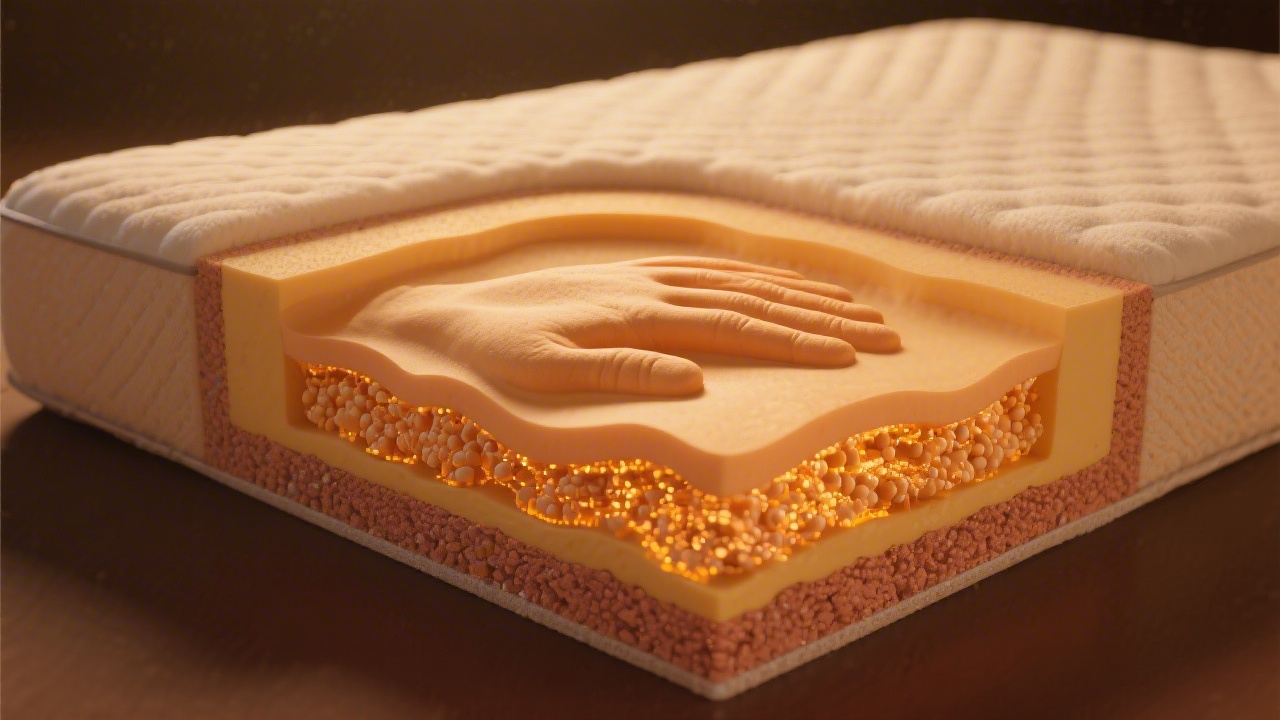
Viscoelastic foam is the technical name for what consumers call memory foam — and the name is descriptive. Visco refers to viscous flow (slow deformation under pressure). Elastic refers to the foam's ability to return to its original shape. Combined: a material that deforms slowly under pressure and recovers slowly when pressure is removed. This is what creates the body-contouring "memory" effect.
The NASA Origin
Viscoelastic foam was developed by NASA researcher Charles Yost in 1966. The original brief: create a material to cushion astronauts during launch and reentry forces — a substance that would absorb high-impact forces while conforming to body shape under variable pressures. The material Yost developed was called "slow spring back foam" internally.
NASA licensed the technology and it entered public use in the 1980s — first in medical applications (hospital pressure ulcer prevention) and then in consumer mattresses. Tempur-Pedic introduced the first commercial memory foam mattress in 1991.
The Chemistry: What Makes It Viscoelastic
Standard polyurethane foam has a uniform cell structure that springs back immediately under pressure — like a sponge. Viscoelastic foam is created by modifying the polyurethane chemistry with additives that change how the polymer chains behave when compressed:
- Viscous phase: Under initial pressure, the cell walls deform slowly, allowing the foam to flow and contour
- Elastic phase: The polymer chains store potential energy and return to shape when pressure is removed
- Temperature sensitivity: Viscoelastic polymers soften at higher temperatures — body heat accelerates contouring, room cold firms the foam
The temperature response is what gives memory foam its distinct behavior — sitting on a cold foam mattress initially feels firm, then softens as body heat transfers.
Foam Density: The Most Important Quality Indicator
Foam density (measured in lb/ft³ or kg/m³) is the single most predictive indicator of memory foam durability and quality.
| Density Tier | lb/ft³ | Characteristics | Lifespan |
|---|---|---|---|
| Budget | 2.0–3.0 | Soft, quick breakdown, off-gassing | 2–4 years |
| Mid-range | 3.0–4.0 | Balanced feel and durability | 4–6 years |
| High-density | 4.0–5.0 | Durable, less temperature-sensitive | 7–10 years |
| Premium | 5.0+ | Very durable, minimal off-gassing | 10+ years |
Most mattress brands do not publish foam density — they describe firmness levels (ILD) instead. Ask specifically for density figures when evaluating a purchase. Loom & Leaf by Saatva uses 5.0 lb/ft³ premium memory foam, which is among the higher density tiers available in consumer mattresses.
ILD vs Density: They Are Different Things
ILD (Indentation Load Deflection) measures firmness — the force required to indent the foam by 25%. A low ILD is soft; a high ILD is firm. ILD and density are independent: a low-density foam can be firm or soft, as can a high-density foam. Both matter:
- ILD → determines how the mattress feels immediately
- Density → determines how long it will feel that way
The Heat Retention Problem
Viscoelastic foam's temperature sensitivity is also its most common consumer complaint: it retains body heat. The same polymer properties that allow heat-responsive contouring create an insulating layer against the skin. This is why the mattress industry developed gel infusion, graphite infusion, open-cell structures, and phase change covers — all as responses to memory foam's inherent thermal limitation.
Cooling gel mattresses and graphite-infused memory foam are the primary solutions. An alternative is a hybrid construction — memory foam comfort layers over a pocketed coil base that provides airflow through the support core.
Off-Gassing: What to Expect
New memory foam emits VOCs (volatile organic compounds) from the polyurethane manufacturing process. This produces the "chemical smell" familiar from new foam products. Most off-gassing dissipates within 24–72 hours in a ventilated room. CertiPUR-US certified foams are tested to limit specific harmful VOCs — not eliminate all off-gassing, but confirm it is within safety limits.
Our Recommended Pick
Loom & Leaf uses 5.0 lb/ft³ premium viscoelastic foam — one of the highest densities available in consumer mattresses.
Frequently Asked Questions
Who invented memory foam?
Viscoelastic foam was developed by NASA researcher Charles Yost in 1966 for astronaut cushioning during launch forces. It entered consumer markets through medical applications in the 1980s and Tempur-Pedic's first mattress in 1991.
What is the difference between memory foam and regular foam?
Regular polyurethane foam springs back immediately under pressure. Viscoelastic (memory) foam deforms slowly and recovers slowly, is temperature-sensitive, and conforms to body shape. It is denser and more expensive to manufacture than standard polyfoam.
What foam density is considered high quality in a mattress?
For memory foam: 4.0 lb/ft³ is considered good quality; 5.0 lb/ft³ is premium. Budget mattresses commonly use 2.0–3.0 lb/ft³, which will show significant compression in 2–4 years under nightly use.
Does memory foam get softer over time?
Yes. All foam softens as the cell structure breaks down from repeated compression. High-density foam maintains its properties significantly longer. A mattress that feels very soft in year one from low-density foam will likely become uncomfortable by year three or four.
Is memory foam bad for hot sleepers?
Standard memory foam retains more heat than open-cell foam, latex, or coil systems. Modern memory foam mattresses address this through gel infusion, graphite infusion, open-cell manufacturing, or hybrid constructions with coil airflow. A hot sleeper buying memory foam should specifically verify which thermal management technologies are present.