
 by
by Quick answer: Stop using a standard platform skirt. A wrap-around or adjustable-specific skirt that attaches to the base itself, backed up with twist pins or hook-and-loop strips, is the only setup that survives repeated recline cycles.
- Standard bed skirts can shift out of alignment or get damaged as an adjustable bed moves, according to eachnight, which is why purpose-built versions exist.
- Sleepopolis judges bed skirt pins on one thing, whether they actually hold, and notes that skirt and mattress sizes vary too much for any guarantee.
- Sleep Junkie points out the attachment method depends entirely on which type of skirt you own, so the fix starts with identifying yours.
Updated July 2026 · Reviewed for accuracy
I get this question constantly, and almost every time the reader has the same setup: a classic drop-panel skirt bought for a box spring, now draped over a motorized base that folds in the middle. That skirt was never going to stay put. It's held in place by mattress weight on a rigid rectangle, and an adjustable base stops being a rectangle the moment you press the up button.
So the honest answer isn't a trick. It's a short list of attachment methods that work with the way these bases are built, plus a few that quietly wreck either the fabric or the mechanism. Here's how I'd sort them.
Why the skirt slides off in the first place
A traditional bed skirt is a flat deck panel with fabric sewn to its perimeter. You lay the deck across the box spring, drop the mattress on top, and gravity does the rest. There's no fastener anywhere in that system. It works because nothing underneath the mattress ever changes shape.
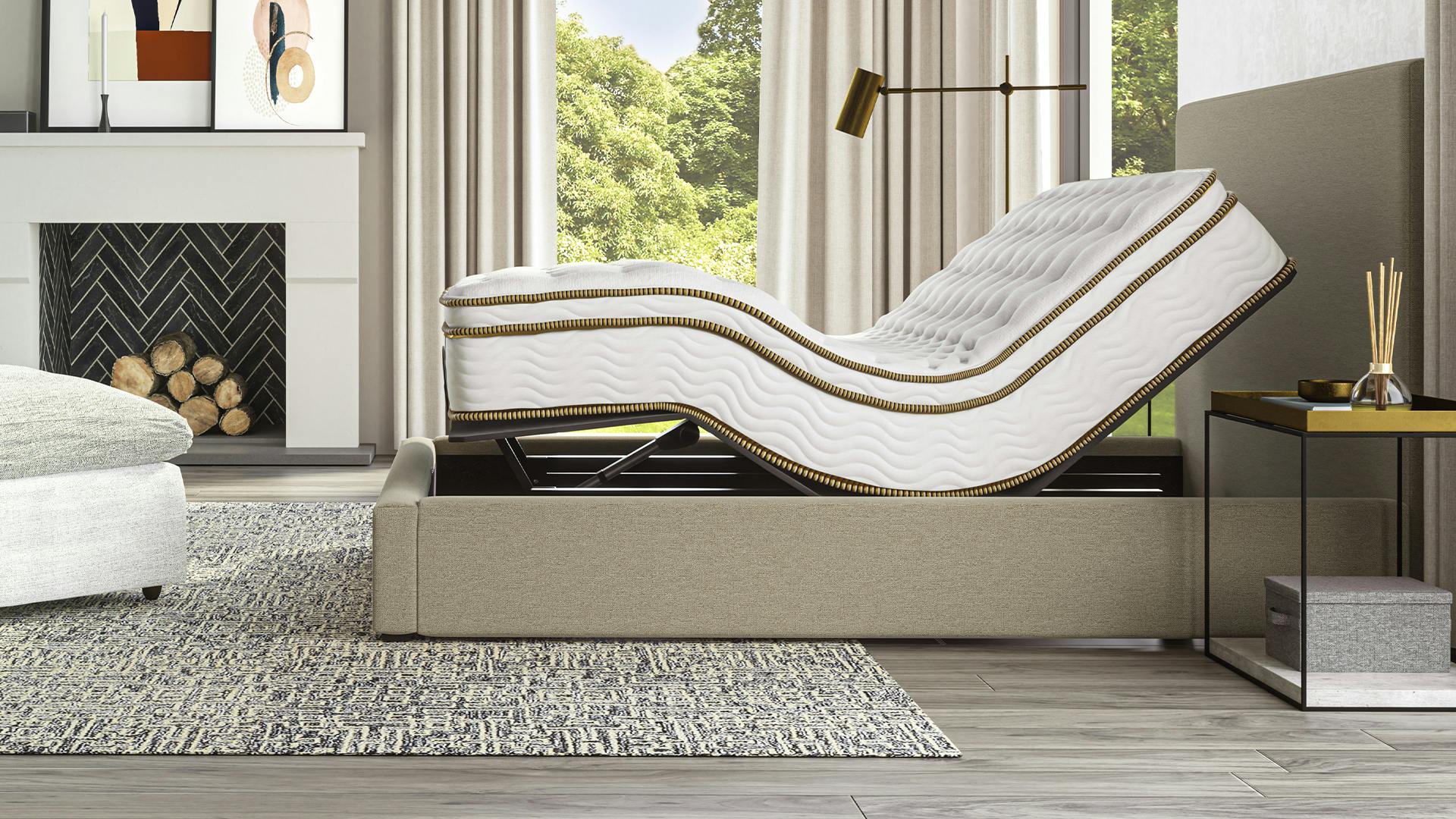
An adjustable base breaks all three assumptions. There's no box spring to hold the deck. The sleeping surface is hinged into segments, so the head and foot sections pivot away from the frame's footprint. And the mattress itself flexes, which means the fabric caught under it gets pulled toward the fold on the way up and released slack on the way down. Do that twice a day and the skirt migrates. eachnight makes the same point in its guide, noting that the bed's movement can leave a standard skirt misaligned or damaged.
There's a second problem people underestimate. Adjustable bases have live parts underneath: a motor housing, a control cable, a power lead, and pinch points where the linkage scissors closed. Banner Mattress covers this directly in its guide to concealing an adjustable frame, and the framing I'd borrow from it is the right one, hide the hardware without interfering with the recline mechanism. Any fix that lets loose fabric hang into that space is a bad fix, however well it holds.
The Nut's rule: if a solution requires fabric to pass through, over, or under a moving hinge, it isn't a solution. Anchor to the outside of the base, never across the fold.
Method one, switch to a skirt built for the base
This is the fix with the highest success rate, and it's the least popular because it means buying something. Sleep Junkie's guide gets the diagnosis right: how you attach a skirt to an adjustable bed depends on which kind you're holding. Two categories actually belong on a motorized base.
Wrap-around skirts. These have no deck panel. They're a continuous band of fabric with an elastic top edge that hugs the perimeter of the base or the mattress itself. Because nothing runs underneath, the fold has nothing to grab. The elastic tension is doing the work, so the fit matters more than the fabric.
Adjustable-specific skirts. eachnight notes there are skirts made specifically to accommodate an adjustable bed's functionality. In practice that means split or paneled construction, so the section covering the head end can move independently of the sides instead of tearing at the corners.
What both types share is where they attach. They grip the base or the mattress perimeter, not the space between two layers. That single design difference is why they stay put through a full recline cycle when a platform skirt won't. If you're still figuring out what's actually under your mattress, our explainer on what an adjustable base is lays out the frame anatomy you're trying to cover.
Method two, pins and clips as the backup layer
Pins are the most-recommended fix on the internet and the most oversold. Sleepopolis frames its assessment of bed skirt pins around a single question, will they actually hold, and it's careful to say no guarantee is possible because skirts and mattress sizes vary so much. That caution is warranted, and it tells you how to use them: as reinforcement, not as the primary anchor.
Here's how the common types behave in an adjustable setup.
- Twist pins. Corkscrew shanks that screw into the side of a mattress or foundation and hold the fabric under the head. Best grip of the pin family because the thread resists pull-out along the fabric's direction of travel.
- Straight T-pins. Push straight in. Fast, but they back out under repeated lateral drag, which is exactly what an adjustable base produces.
- Spring clips. Clamp fabric to a frame rail rather than piercing anything. Good on exposed metal edges, useless where there's no rail to bite.
Placement is where most people go wrong. Pin the corners and the midpoint of each long side, and keep every pin on the fixed perimeter of the base, away from the hinge lines at the head and knee break. Pin across a fold and you're asking the mechanism to tear your own fabric each time it lifts.
One material caution. Pins go into upholstered foundations and mattress side panels reasonably well. They do not belong in a foam encasement wall or a knit cover with visible stretch, where the puncture becomes a run. If your mattress cover is a fine knit, clip to the frame instead.
Method three, hook-and-loop and adhesive strips
Zoma's guide covers sticking a bed skirt in place for a cleaner look, and adhesive-backed hook-and-loop is the version I'd use. Loop tape on the base's side panel, hook tape sewn or ironed to the skirt's top hem, and the skirt becomes semi-permanent while staying removable for washing.
The catch is the surface. Adhesive bonds well to smooth, sealed material and poorly to anything fuzzy, dusty, or textured, which describes the upholstery on a fair number of bases. Clean the strip first, press it for a while before hanging any weight, and expect to re-do a section eventually. On a raw metal rail, adhesive is a losing proposition and clips win.
Elastic straps with clamp ends are the third variant worth knowing. They run under the base from side to side, pulling the skirt's hem inward. They hold well, but they need routing discipline. Under the fixed center section only, never crossing a linkage arm.
Which method to use, by situation
| Method | What holds it | Best for | Watch for |
|---|---|---|---|
| Wrap-around skirt | Elastic tension around the perimeter | Daily recliners who move the bed often | Loose fit sags at the corners |
| Adjustable-specific skirt | Split panels sized to the base | Split-king setups and heavy articulation | Narrower selection of styles |
| Twist pins | Threaded shank in upholstery | Reinforcing a skirt you already own | Punctures fine knit covers |
| Hook-and-loop strips | Adhesive bond plus mechanical grip | Smooth upholstered side panels | Poor bond on textured or dusty fabric |
| Frame clips | Clamp force on a rail edge | Exposed-metal bases | Nothing to clamp on a fully clad base |
| Under-base straps | Elastic tension across the underside | Hems that flare outward | Must clear the linkage entirely |
My default combination for someone who already owns a skirt they like: wrap the fabric to the perimeter, anchor with hook-and-loop along the flat side panels, and add twist pins at the four corners where the tension concentrates. Layered, not single-point. The failure mode of a bed skirt is always a corner giving up first and dragging the rest of the panel with it.
Keeping the mechanism safe while you do it
This is the part I care about most, because a skirt is cosmetic and a motor isn't. Amerisleep's guide on fitting a bed skirt to an adjustable bed treats the goal as hiding the underside of the base cleanly, and clean means the fabric ends where the hardware begins.
Before you call the job done, cycle the base through its full range and check:
- The hem clears the floor with the bed flat and still clears it at full recline, since raising the head pulls the frame's footprint inward.
- No fabric sits inside a scissor joint, hinge gap, or the arc the foot section travels through.
- The power cable and hand control cord run outside the skirt, not trapped behind it where a fold can pinch them.
- Wall-hugging bases have room to slide back without dragging fabric against the wall.
- Nothing blocks the under-bed lighting or the emergency release, if your base has them.
If your base does deep articulation, a zero gravity preset for example, the footprint change is more dramatic than most people expect. Our breakdown of zero gravity positioning explains how far the frame actually travels, which is the number that determines your hem length.
When the skirt isn't the right answer
Sometimes the honest recommendation is to stop attaching fabric to a machine. Banner Mattress's guide runs through several ways to conceal an adjustable frame, and skirts are only one of them. The alternatives are worth weighing.
A headboard-and-footboard bed frame that surrounds the base hides the hardware structurally, no fasteners required. A low-profile platform or a bed with side rails does the same job. And if the base is genuinely the eyesore, an upholstered model with a finished exterior removes the problem at the source rather than covering it; the Saatva Adjustable Base is one to look at on the official site if you're comparing options and current pricing.
There's also a compatibility angle people skip. Some mattresses handle repeated flexing far better than others, and a skirt that keeps getting yanked out of position is often a symptom of a mattress fighting the base. Our guide on whether you can use an adjustable base with any mattress covers which constructions bend cleanly and which resist.
How I'd choose, in order
Start by identifying what you have. Deck-panel skirt with a flat center sheet? It's the wrong tool, and no amount of pinning will fully fix it. Wrap-around already? Then you have a fit problem, not a design problem, and pins or hook-and-loop at the corners will likely close the gap.
Next, look at your base's side panel. Smooth upholstery favors adhesive hook-and-loop. Exposed metal rails favor clips. Bare frame with neither favors buying the purpose-built skirt and skipping the workarounds.
Last, match the drop to the recline. Measure with the bed in the position you actually sleep in, not flat, because that's when the hem is under the most tension and closest to catching. If you're cross-shopping bases while you're at it, the Tempur-Pedic Ergo breakdown shows how much the frame profile itself varies between models, which changes how much there is to hide.
FAQ
Can I use a regular bed skirt on an adjustable bed at all?
You can, but expect it to shift. eachnight notes that a standard skirt on an adjustable bed can end up misaligned or damaged as the bed moves, since the deck panel has nothing holding it once the frame folds. If you're set on keeping it, convert it to a wrap-around by attaching the fabric to the base perimeter instead of laying the panel underneath.
Do bed skirt pins really work on an adjustable base?
They help, they don't solve. Sleepopolis assesses pins on whether they actually hold and is explicit that no guarantee is possible because skirt and mattress dimensions vary so widely. Use twist pins at the corners as reinforcement behind a properly fitted wrap-around, not as the only thing holding the skirt.
Will Velcro or adhesive damage my adjustable base?
Adhesive can leave residue or lift fibers on upholstered panels when removed, so test a small hidden spot first. On smooth sealed surfaces the bond is strong and the removal is usually clean. Avoid adhesive anywhere near a hinge, a cable channel, or a moving joint.
What's the best skirt type for a split king adjustable base?
Two independent wrap-around or adjustable-specific skirts, one per half. Sleep Junkie's point that the method follows the skirt type applies double here, since a single full-width panel bridges the gap between two bases that move separately and will bind the moment one side reclines.
How do I hide the motor and cables the skirt doesn't cover?
Route the power lead and hand control along a frame leg and secure them with cable clips well clear of the linkage, then let the skirt hang outside that path. Banner Mattress's guide to concealing an adjustable frame treats the motor housing and dangling cable as the two things that give the setup away, and both are easier to manage with clips than with more fabric.
ONE OPTION WORTH COMPARING
Shopping as well as reading? Here is one current option worth comparing: the Saatva Adjustable Base. Check today’s price, sizing and return terms on the official product page before you order.
Saatva Adjustable Base
- Saatva Adjustable Base is one to look at on the official site if you're comparing options and current pricing
The bottom line
Holding a bed skirt on an adjustable bed base comes down to changing where the skirt grips. Off the deck, onto the perimeter. A wrap-around or adjustable-specific skirt anchored at the corners with twist pins or hook-and-loop will stay square through daily recline cycles, and it does it without putting fabric anywhere near a hinge. If your base has no surface worth attaching to, a surrounding bed frame or a finished base hides the hardware permanently and saves you the maintenance. Either way, cycle the bed through its full range before you decide the job's done.