
 by
by Quick answer: A dense all-foam mattress with a memory foam comfort layer. Foam swallows movement where it happens. If you want some bounce, choose a hybrid with individually pocketed coils, never connected springs.
- Dense foam absorbs kinetic energy at the point of impact instead of passing it across a spring grid, which is why all-foam builds lead motion isolation rankings.
- SleepJunkie's motion isolation roundup and eachnight's motion-isolating picks both put foam-heavy and pocketed-coil constructions at the top of the category.
- Sleep Foundation's couples guide rates beds partly on how much movement crosses the bed, using owner reviews alongside its own testing team.
Updated July 2026 · Reviewed for accuracy
The bed you're describing has a name in the industry: high motion isolation. It's not a brand, it's a construction outcome, and it comes down to what's inside the mattress and how those layers are connected to each other.
I've spent years pulling these beds apart on paper and in showrooms, and the pattern never changes. Foam absorbs. Linked steel transmits. Everything else is a detail.
The Build That Actually Stops Movement
An all-foam mattress with a memory foam comfort layer is the answer for most couples. Memory foam is viscoelastic, meaning it responds slowly and turns motion into heat rather than bouncing it back. Your partner rolls over, the foam under their hip compresses, and the energy dies right there instead of traveling sideways to your shoulder.
My own analysis of this category lands in the same place every time: dense foam absorbs kinetic energy at the point of impact rather than sending it across a spring grid. That's the whole mechanism. There's no clever engineering trick that beats it.
Density matters more than thickness here. A thin layer of genuinely dense memory foam deadens movement better than a thick slab of cheap, airy foam that bottoms out and lets the support core do the talking. When a spec sheet lists foam density, that number is telling you how much material is packed into the layer, and more material means more energy absorbed before the wave reaches you.
The Nut's rule: if a brand won't publish foam density and coil type, assume both are the cheapest option that still passes a durability test. Motion isolation is expensive to build and easy to fake in marketing copy.
Why Springs Betray You (And Which Ones Don't)
An old innerspring uses coils that are wired together into one connected grid. Push down on one, and its neighbours move too. That grid is a very efficient way to deliver your partner's 2am bathroom trip directly into your ribs. If your current bed feels like a trampoline with a memory, this is almost certainly why.
Pocketed coils fix a lot of that. Each spring is wrapped in its own fabric sleeve, so it compresses more or less independently of the ones beside it. That's what makes a good hybrid workable for couples: you get airflow and pushback from steel, with the coils acting as separate units instead of one connected sheet. Both eachnight and SleepJunkie's motion isolation coverage include hybrid constructions alongside foam beds for exactly this reason.
Pocketed coils still aren't foam. Steel stores and returns energy by nature, so a hybrid will always pass along a little more than a dense all-foam build. The question is whether you notice it, and that depends on how thick and how dense the foam sitting above those coils is.
Construction Types, Ranked by How Much Your Partner Ruins Your Night
| Build | Movement across the bed | The trade-off | Who it suits |
|---|---|---|---|
| All-foam, dense memory foam comfort layer | Lowest. Motion dies at the point of impact. | Slower response, can sleep warmer, harder to reposition on | Light sleepers with a restless partner, side sleepers |
| All-foam with latex or fast-response poly on top | Low, but you feel more of the movement's edge | Latex is springier, so a little more travel | Couples who hate the sinking feel but still share a bed |
| Hybrid, individually pocketed coils under thick foam | Moderate to low, depends on the foam above the coils | More airflow and easier movement, slightly more transfer | Hot sleepers, heavier bodies, combination sleepers |
| Traditional innerspring, connected coil grid | Highest. The grid moves as one piece. | Cheap and breathable, poor for shared beds | Guest rooms, solo sleepers on a budget |
The Spec Sheet Checklist I Use
Skip the adjectives in the product description and go looking for these. If a brand publishes them, you can predict how the bed behaves before it arrives.
- Memory foam in the comfort layer, with a published density. Higher density means more energy absorbed and slower response.
- Pocketed coils, stated explicitly. "Innerspring" or "coil support" with no mention of pocketing usually means a connected grid.
- Zoned coil layouts. Firmer coils under the hips help stop the deep compression that sends a wave outward.
- A thick comfort layer over any coil unit. The foam is the buffer. Thin quilting over springs isn't one.
- Reinforced edges. A collapsing perimeter makes every getting-in and getting-out event feel like a small earthquake.
- Firmness on the medium side. Very firm beds have less material compressing to soak up movement, so more of it travels.
One warning on the middle of the market. A bed can advertise memory foam and still transfer motion badly if that foam sits as a thin veneer over a bouncy poly core. The comfort layer has to be thick enough to compress fully under a shoulder or hip before the layer beneath ever gets involved.
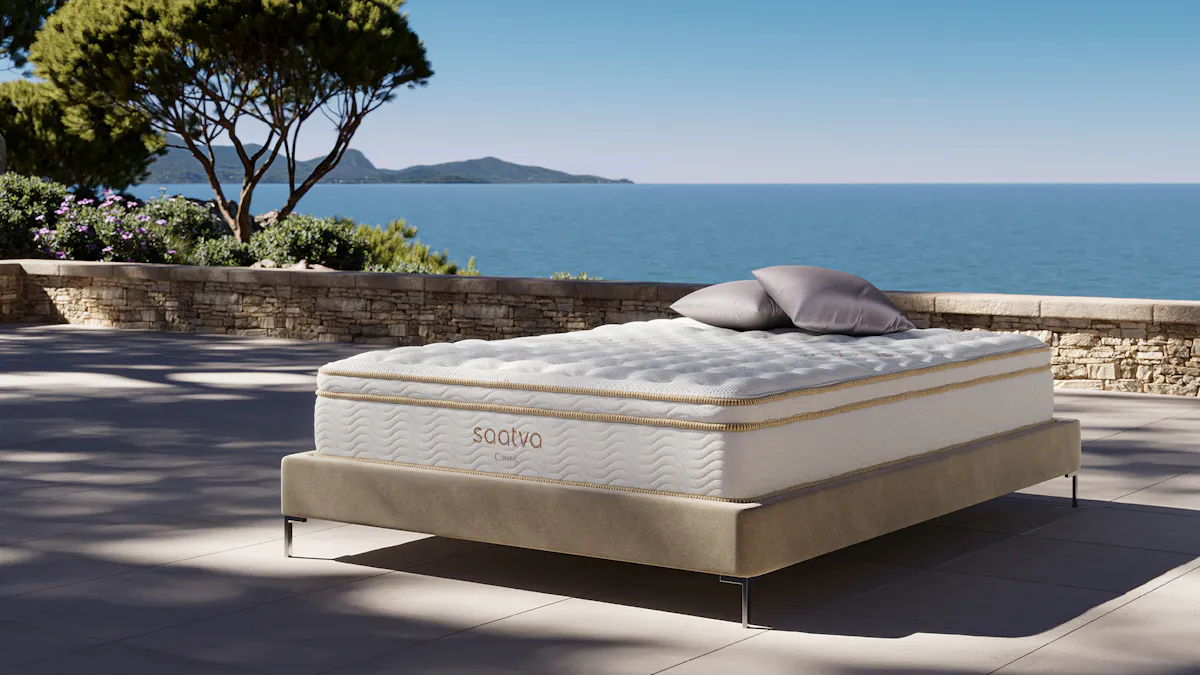
If foam simply isn't for you and you want a coil bed you can shop in person, the Saatva Classic is the one readers ask me about most in this conversation; check its layer breakdown and current price on Saatva's official page rather than assuming any coil bed behaves like foam.
What Wakes You Up That Isn't the Mattress
I get emails from people who bought an excellent foam bed and still feel every movement. Nine times out of ten, the mattress isn't the culprit.
A slatted frame with wide gaps flexes, and a flexing frame transmits movement no matter what's on top of it. Metal frames with loose bolts do worse: they creak, and creak wakes you even when the surface stays still. Old box springs are literally springs, so they undo the work the mattress just did.
Bed size is the other quiet fix. Two adults on a full-size bed are close enough that a shoulder shift becomes a shared event through simple proximity. Moving up a size buys you dead space between bodies, which no foam formulation can manufacture on its own.
Then there's the mattress you already own. Foam softens unevenly under the heaviest parts of each body, and once those impressions form, you're both rolling into troughs that pull movement toward the middle. That's often what people mean when they say the bed changed on them, and I broke down the mechanics of that in this piece on why a mattress starts feeling different over time.
Motion Isolation Gets Worse With Age
This is the part the reviews rarely cover. Motion isolation is a property of intact foam and healthy coils, so it degrades on the same curve as everything else in the bed.
Low-density foam is the first to go. It loses its cell structure, stops rebounding, and starts behaving like a hammock instead of a buffer. Once it collapses, movement travels through the compressed material and along the support core underneath. Denser foam costs more upfront and holds its behaviour far longer, which is the entire argument for paying attention to density rather than layer count.
Coils fail differently. A pocketed coil whose fabric sleeve has torn starts interacting with its neighbours again, which reintroduces exactly the transfer you paid to avoid. Cheap thin-gauge coils in a heavily used sleeping zone lose tension first, so the bed develops a soft channel where one body sleeps and a firmer shelf where nobody does.
Practical read: a bed that isolates motion beautifully in year one and poorly in year four wasn't a motion isolation bed. It was a soft bed that hadn't broken down yet.
How to Test It Before You Commit
Showroom testing takes about three minutes and tells you more than any star rating. Lie on one side of the bed in your normal sleeping position. Have your partner get on, roll over twice, then get off. You're feeling for whether the movement arrives as a wave or stops dead. Do the same test at the edge, since that's where transfer and collapse both show up worst.
If you can't bring a partner, press down hard with a flat palm about a foot from your body and see whether your hips lift. Some sales floors still do the bowling ball or wine glass demonstration, which is theatre, but the underlying question it answers is real.
Trying before buying is easier with brands that keep physical showrooms, and I've written about where that's possible in this guide to testing a Saatva mattress in person. If you'd rather buy online and rely on a sleep trial instead, my rundown of where to buy a mattress covers which channels give you a real return path versus a restocking headache.
Whichever route you pick, read the trial and warranty terms on the manufacturer's own policy page before you order. Return windows, minimum break-in periods, and who pays for pickup vary enough between brands that they should factor into the decision.
Who Should Buy What
Buy a dense all-foam bed if you're the lighter sleeper in the pair, your partner changes position often or works a different schedule, and you sleep mostly on your side. That build gives up the least to movement, and side sleepers benefit from the deep contouring anyway.
Buy a pocketed-coil hybrid with a thick foam comfort layer if you sleep hot, you're on the heavier side, or you switch positions all night and feel trapped in foam. You'll accept slightly more transfer in exchange for airflow, support, and easier repositioning. Sleep Foundation's couples coverage treats this trade-off as the central decision for shared beds, and I agree with that framing.
Skip connected-coil innersprings entirely for a shared bed. There's no configuration of that construction that solves the problem, because the coils are physically joined.
FAQ
Does memory foam really stop you feeling your partner move?
Yes, better than any other common material, because it converts movement into heat instead of returning it. The caveat is quality: dense memory foam does this well and cheap low-density foam does it briefly, then stops as the cell structure breaks down.
Are hybrid mattresses bad for couples?
Not if the coils are individually pocketed and there's a substantial foam layer above them. Motion isolation roundups from SleepJunkie and eachnight both include hybrids for this reason. A hybrid with connected coils or thin quilting is a different animal and will transmit plenty.
Would a bigger bed help more than a new mattress?
Sometimes, and it's worth considering first if you're currently on a full or small queen. Distance between bodies reduces what you feel regardless of construction. If you're already on a king and still feel everything, the problem is the build or the foundation.
Why did my mattress start transferring motion after a few years?
Foam softened unevenly under the heaviest parts of each body, or the coil sleeves tore and the springs began working as a connected unit again. Both create troughs that funnel movement inward. Rotating the mattress regularly slows it down but won't reverse structural breakdown.
Does firmness affect how much movement I feel?
It does. Very firm surfaces have less material compressing to absorb energy, so more of it travels laterally. Medium and medium-firm builds with a real comfort layer generally isolate motion better than a rock-hard build with thin padding.
ONE OPTION WORTH COMPARING
Shopping as well as reading? Here is one current option worth comparing: the Saatva Classic. Check today’s price, sizing and return terms on the official product page before you order.
Saatva Classic
- 365-night home trial and lifetime warranty, per saatva.com
- Handcrafted in the USA, free white-glove delivery
- Flexible financing available
The Bottom Line
The mattress where you can't feel your partner move is a dense all-foam bed with a genuine memory foam comfort layer, or a hybrid whose coils are individually pocketed and buried under thick foam. Ignore the marketing language and read the construction: foam density, coil type, comfort layer thickness, edge reinforcement.
Then fix the frame underneath it. A great mattress on a flexing slatted base or an old box spring will still hand you every movement your partner makes, and that's a much cheaper problem to solve than a new bed.