 by
by Quick answer: No, a weighted blanket is not safe for a newborn. Pediatric guidance advises against weighted bedding for babies under 12 months. Adults shopping for themselves can consider the True Temp™ Weighted blanket instead.
- Safe-sleep guidance from the American Academy of Pediatrics: a bare crib, firm mattress, fitted sheet, no loose or heavy blankets.
- The familiar weight rule, about 10% of body weight, applies to older children only, never to babies.
- Swaddles, sleep sacks, white noise, and a steady routine are the safer soothing tools for newborns.
Updated July 2026 · Reviewed for accuracy
Short answer: no. If you landed here hoping to buy a weighted blanket for a new baby, I get the instinct. New parents will try almost anything for one more hour of sleep. But this is one purchase to skip, and the reasons are refreshingly clear-cut.
Is a weighted blanket safe for a newborn?
No, and I won't soften that. The safe-sleep guidance published by the American Academy of Pediatrics calls for a bare crib: a firm, flat mattress, a fitted sheet, and nothing else. No loose blankets, no pillows, and certainly nothing weighted. Most pediatric guidance draws the line at 12 months, which means weighted blankets are off the table for a newborn entirely. Even past that age, they're a supervised, ask-your-pediatrician item rather than a nursery staple.
I understand why people search this. A newborn who won't settle is brutal, and deep pressure genuinely works on adults, so it's natural to wonder whether a small version would calm a baby. The physiology doesn't cooperate. The same pressure that relaxes a grown adult restricts an infant, and an infant can't do anything about it.
The safe-sleep baseline: per the American Academy of Pediatrics, a baby's sleep space should have a firm mattress and a fitted sheet, with no loose or heavy coverings. That single rule answers most "can I add this to the crib" questions before you even ask them.
Why weighted blankets and newborns don't mix
The concerns come down to three hazards that appear consistently across pediatric and consumer product safety guidance: suffocation, entrapment, and heat. All three trace back to how these blankets are actually built, which is my usual angle here anyway.
Open a weighted blanket and you'll typically find glass beads or plastic pellets sewn into quilted pockets, or a dense beadless knit that gets its heft from thick yarn. The entire design goal is steady, distributed pressure across the body. I break down the fill types in detail in my piece on what's inside weighted blankets. On an adult, that pressure calms the nervous system. On a newborn, who has neither the motor control to push fabric away from the face nor fully developed airway protection, that same pressure becomes a hazard instead of a comfort.
The three hazards, per the safety guidance:
- Suffocation: a newborn can't shift weight off their face or chest.
- Entrapment: the blanket settles and holds position when a baby squirms or rolls against it.
- Overheating: heavy fill traps warmth, and newborns regulate body temperature poorly.
Entrapment deserves a closer look because it's the quieter risk. A weighted blanket doesn't move when a baby moves. It settles. If a newborn rolls or wedges against it, the weight stays put instead of lifting away the way a light muslin blanket would. That's the feature working exactly as designed, on exactly the wrong body.
Then there's heat. Heavy fill traps warmth, which is why I tell even hot-sleeping adults to read up on whether weighted blankets sleep hot before buying one. For a baby, who overheats far more easily, a heat-trapping layer in the crib is a firm no under any safe-sleep framework.
One more construction note worth knowing: bead-filled blankets can leak if a seam gives way, and loose beads are a choking hazard. Consumer product guidance for kids' weighted blankets specifically flags small parts for this reason, which is another argument for keeping them away from the crib years entirely.
Comparing options? The True Temp™ Weighted blanket is the pick we keep coming back to — see the final verdict ↓
When is a weighted blanket actually OK?
Every major piece of pediatric sleep guidance I'm aware of draws the same line: nothing weighted on a baby under 12 months. Full stop. Past that line, the answer turns into "maybe, carefully, with your pediatrician involved," which is a very different conversation from clicking buy on a nursery blanket.
For older children, occupational therapy guidance uses a weight rule you've probably seen quoted: about 10% of body weight, give or take a pound or two, with a ceiling around 12%. That rule gets misapplied constantly. It was never designed for babies. It assumes a child who can move the blanket independently, say so when they're uncomfortable, and sleep in a bed rather than a crib. A newborn checks none of those boxes.
Even for toddlers, the guidance stresses supervision and professional input. Some older kids are directed toward deep-pressure tools by occupational therapists, kids with sensory processing challenges among them, and that's a clinician-guided scenario with proper weight selection. I cover that use case in my article on weighted blankets for autism. A newborn in a crib is nowhere near that scenario.
Label check: many weighted blankets carry an explicit "not for infants" warning. If a listing doesn't state an age range clearly, treat that as a red flag rather than a loophole.
Safer ways to help a newborn sleep
What actually works for a newborn? Boring, proven stuff. None of it is heavy, and most of it costs less than a weighted blanket anyway. Here's the honest lineup:
| Option | Why it helps | What to watch |
|---|---|---|
| Swaddle | Recreates snug pressure safely when done correctly | Stop once baby shows signs of rolling; keep it hip-friendly per pediatric guidance |
| Sleep sack (wearable blanket) | Warmth without any loose fabric in the crib | Pick a size that can't ride up over the face |
| White noise | Masks household sounds that startle newborns awake | Keep volume modest and the machine across the room |
| Consistent routine | Predictability cues the brain that sleep is coming | Takes a couple of weeks to stick, so don't quit early |
| Bare, firm crib | The safe foundation everything else sits on | Fitted sheet only, no extras, no exceptions |
A note on swaddling, since it delivers the snug sensation parents are usually chasing with a weighted blanket: pediatric guidance on swaddling has been updated over the years, and done correctly it's a mainstream, accepted tool. The two rules that matter most are keeping the wrap loose around the hips and transitioning to a sleep sack as soon as your baby shows signs of rolling. Your pediatrician can walk you through technique in about two minutes at a checkup.
The thread connecting every option in that table: none of them add weight to the baby. Warmth without loose fabric, pressure without restriction, sound and routine for the rest. It's not glamorous, but it matches the safe-sleep guidance point for point.
Shopping for an older child, or for yourself
Maybe you landed here looking for a baby gift, or maybe you're the sleep-deprived parent and the real question is what helps you. If the intended sleeper is an older child with pediatrician sign-off, or an adult, here's what I actually look for in a weighted blanket:
- Even weight distribution: quilted pockets that keep fill from pooling into corners, or a beadless knit with consistent density.
- Breathable shell: cotton or bamboo over heavy synthetics, especially for warm sleepers.
- Machine-washable construction: a blanket you can't wash easily won't survive family life.
- Clear age labeling: reputable brands state who the blanket is for and often who it isn't for.
- No loose or small parts: check seams and closures, particularly for anything used around kids.
If the blanket is a gift for a new parent, skip the weighted category for the baby entirely and buy a quality sleep sack instead. That's the present that actually gets used. The weighted blanket can wait until the child is well past the first birthday, and only then with a pediatrician weighing in on weight selection and supervision.
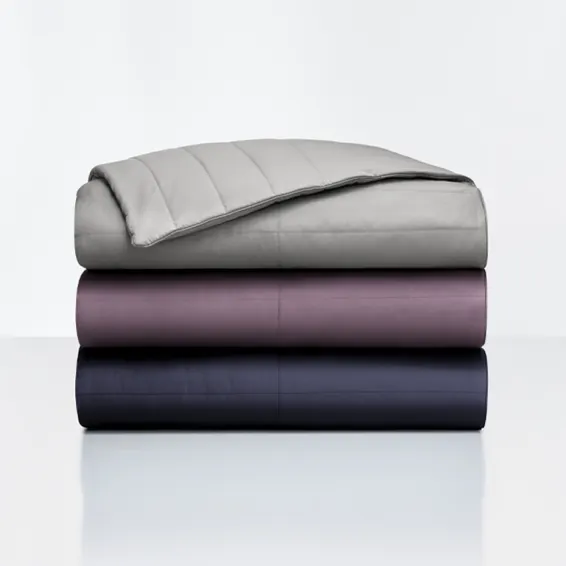
For adults, deep-pressure comfort has a genuine following, and I've written separately about whether weighted blankets help sleep. If you're buying for your own bed, my pick in the category is Sleep Number's True Temp™ Weighted blanket. It's a temperature-regulating design, which directly addresses the heat complaint I raised earlier, and it sits in the premium tier. Check the current price and available weight options on the official site before you buy.
The bottom line
Weighted blankets are genuinely useful products for the right sleeper. A newborn is never the right sleeper. Keep the crib bare, lean on swaddles and sleep sacks for the snug feeling, and revisit weighted options only after the first birthday with your pediatrician's sign-off. If the blanket is really for you, buy a breathable, washable one sized to your own body weight and enjoy it guilt-free. As a new parent, you'll need the sleep more than the baby will.
FAQ
Can a newborn sleep under a weighted blanket?
No. Pediatric guidance, including the American Academy of Pediatrics' safe-sleep recommendations, says babies under 12 months should sleep without loose or heavy coverings. A weighted blanket adds suffocation, entrapment, and overheating risks that a newborn has no ability to protect against.
At what age can a child use a weighted blanket?
Most pediatric and occupational therapy guidance sets 12 months as the earliest threshold, and even then only with supervision and a pediatrician's input. For most families, weighted blankets become a reasonable question for older toddlers and children, not infants.
How heavy should a weighted blanket be for a child?
The guideline commonly cited in occupational therapy guidance is about 10% of the child's body weight, give or take a pound or two, with a ceiling around 12%. That rule applies to older children who can move the blanket themselves. It has no safe application to babies.
Are weighted swaddles or weighted sleep sacks safe for babies?
The same caution applies. Anything that adds weight to a baby's sleep setup conflicts with safe-sleep guidance, whether it's a blanket or a wearable product. Talk to your pediatrician before using any weighted sleep product with an infant.
What helps a newborn sleep without a weighted blanket?
A properly done swaddle, a well-fitted sleep sack, white noise, and a consistent routine cover most of what parents are chasing. The crib itself should stay bare, firm mattress and fitted sheet only, per the American Academy of Pediatrics.
FINAL VERDICT
Before you settle: if weighted blanket for newborn is what brought you here, the True Temp™ Weighted blanket is the value pick on this page — the strongest trial-and-return terms of the options covered here. Confirm current price, dimensions and terms on the official product page before ordering.
OUR CATEGORY-MATCHED PICK
True Temp™ Weighted blanket
- Adults shopping for themselves can consider the True Temp™ Weighted blanket instead
- If you're buying for your own bed, my pick in the category is Sleep Number's True Temp™ Weighted blanket