
 by
by A hybrid mattress pairs a pocketed-coil support core with at least 2 inches of integrated foam or latex comfort layers. The best hybrid for most sleepers is the Saatva Classic: dual-coil construction, zoned lumbar support, three firmness options, and a 365-night trial. The Amerisleep AS3 is the top all-foam alternative if you want deeper pressure relief and lower motion transfer.
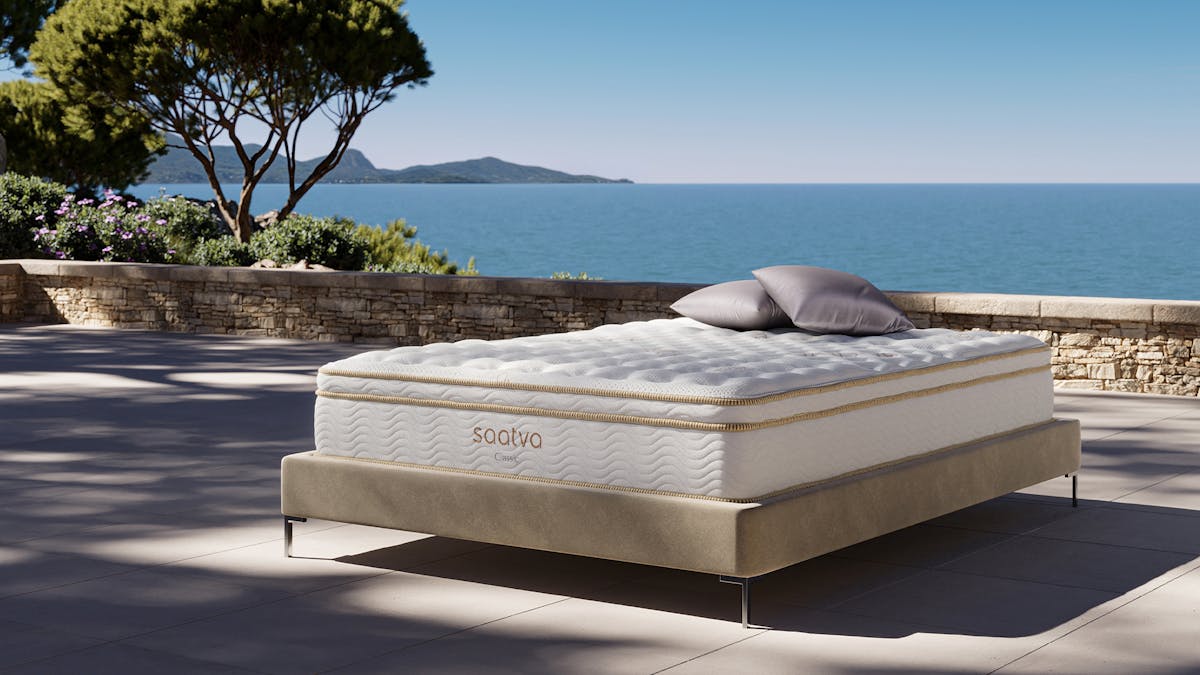
Saatva Classic
9.2/10
- Dual-coil construction, pocketed upper coils over tempered steel base, exceptional durability
- Zoned lumbar foam pad reinforces lower back through the night
- Three firmness options (Plush Soft, Luxury Firm, Firm) covering all sleep styles
- Free white-glove delivery, setup, and old-mattress removal
- Outstanding cooling, edge support, and bounce from open coil airflow
- Ships flat, not roll-packed, so delivery scheduling is required
- $99 return pickup fee during the trial
- Higher motion transfer than all-foam for sensitive co-sleepers
The Saatva Classic is the clearest example of what a well-built hybrid delivers: dual-coil airflow keeps it cool, the lumbar zone pad holds the spine in alignment, and the 365-night trial is long enough to verify fit for any sleeper. It is our standard recommendation for a hybrid mattress guide.
Amerisleep AS3
9.0/10
- HIVE 5-zone layer varies firmness under each body zone, including dedicated lumbar support
- Bio-Pur partially plant-based open-cell foam sleeps cooler than standard memory foam
- Outstanding motion isolation, ideal for couples with different schedules
- CertiPUR-US certified, made in the USA
- Softer edge support than a coil hybrid
- Sleepers over 230 lb may prefer the AS5 Hybrid for long-term support
If deeper pressure relief and near-zero motion transfer matter more than bounce and edge firmness, the AS3 outperforms most hybrids at comparable prices. A strong all-foam alternative for side sleepers and couples who share a bed.
PlushBeds Botanical Bliss
8.8/10
- GOLS-certified organic Dunlop latex, GOTS-certified organic wool and cotton cover
- Configurable comfort layers let you adjust firmness after purchase
- Naturally breathable and resistant to dust mites and mold
- 25-year warranty, one of the longest in the industry
- Heavier than foam beds, repositioning requires two people
- Latex feel is bouncier and less contouring than memory foam fans expect
For sleepers who want certified organic materials from top to bottom, the PlushBeds Botanical Bliss is the benchmark. The configurable layers make it a long-term investment that can adapt as preferences change.
Sweetnight
8.3/10
- Pocketed coils plus gel memory foam at a price well below the hybrid average
- Good motion isolation and decent cooling for the price tier
- Accessible entry point for guest rooms or first mattress buyers
- Edge support and durability are below premium-tier hybrids
- Not ideal for heavy sleepers or daily long-term use at higher body weights
If budget is the primary constraint, the Sweetnight delivers the core hybrid experience at a price most competitors cannot match. Best for guest rooms, lighter sleepers, or anyone testing the hybrid format before committing to a premium model.
What makes a mattress a hybrid
A hybrid mattress has two non-negotiable components: a pocketed-coil support core and at least 2 inches of integrated foam or latex comfort layers above it. That combination is what earns the label. A basic innerspring with a thin fiberfill pad is not a hybrid, and neither is an all-foam bed that mixes memory foam and polyfoam layers, however creative the marketing copy.
The pocketed-coil requirement matters because individually wrapped springs compress independently. Each coil responds to the weight directly above it rather than the whole bed reacting to one point of pressure. That mechanical independence is what gives hybrids better contouring and lower motion transfer than old-style Bonnell or offset springs, which are wired together and move as a unit.
How a hybrid is built, layer by layer
Most quality hybrids run 10 to 14 inches tall. The construction stacks three distinct zones:
- Comfort layer (top 2 to 4 inches): the material you feel immediately. Memory foam at 3 to 5 lb density contours closely and absorbs motion. Polyfoam is firmer and more responsive. Latex, either Dunlop or Talalay, is the bounciest and naturally the coolest of the three. Premium hybrids often layer two materials, such as a thin gel-memory-foam pad over a latex base.
- Transition layer (1 to 2 inches): a buffer of medium-density polyfoam between the soft comfort section and the firm coil unit. It prevents you from feeling the springs through the foam above and slows wear on both components. Budget hybrids frequently skip this layer, which shortens useful life.
- Pocketed-coil core (6 to 8 inches): the structural backbone. The number of coils matters far less than coil gauge. An 8-gauge wire is firmer and more durable than a 14-gauge wire at the same count. Most queen-size hybrids run roughly 800 to 1,200 coils. Claims of 3,000-plus coils usually indicate thin narrow-gauge springs chosen for the marketing number, not for durability. Most quality hybrids also stiffen the perimeter coils to build firm edges that hold seated weight without collapsing.
Top picks at a glance
| Mattress | Type | Firmness | Trial | Queen price |
|---|---|---|---|---|
| Saatva Classic | Dual-coil hybrid | 3 options (4-8/10) | 365 nights | ~$1,395 |
| Amerisleep AS3 | All-foam (Bio-Pur) | Medium 5/10 | 100 nights | From $1,049 |
| PlushBeds Botanical Bliss | Natural latex | Configurable 5-7/10 | 100 nights | ~$1,800 |
| Sweetnight | Budget hybrid | Medium-firm 6/10 | ~100 nights | Under $600 |
Hybrid vs. all-foam vs. innerspring: real trade-offs
| Feature | Hybrid | All-foam | Traditional innerspring |
|---|---|---|---|
| Cooling | Excellent (coil airflow) | Moderate (heat retention) | Good (open coil) |
| Motion isolation | Good | Excellent | Poor |
| Edge support | Strong (reinforced perimeter) | Softer | Variable |
| Bounce / responsiveness | High | Low to moderate | Very high |
| Pressure relief | Good to excellent | Excellent | Limited |
| Lifespan | 7 to 10 years | 6 to 8 years | 5 to 7 years |
| Typical queen price | $900 to $2,200 | $700 to $1,800 | $500 to $1,400 |
Hybrids sleep noticeably cooler than all-foam beds because air circulates freely through the open coil layer. They also hold their edge better and feel more responsive for combination sleepers who shift positions during the night. All-foam beds, particularly memory foam, still lead on motion isolation and often cost less at the same comfort tier. Traditional innersprings, using interconnected Bonnell or offset coils with thin fiberfill tops, move the entire coil unit together, which generates more motion transfer and less precise body contouring than either alternative.
Who hybrids suit best
Hybrids cover a wide range of needs, but they are not universally superior for every sleeper:
- Back sleepers: generally the best match. The coil core holds the lumbar spine in alignment while the comfort layer relieves hip pressure.
- Side sleepers: work well with a medium or medium-soft hybrid that has enough foam depth to cushion the shoulder and hip. Too little comfort layer and side sleepers feel the coils.
- Stomach sleepers: do best on a firm hybrid where the coils resist hip sinkage, which prevents lumbar hyperextension.
- Hot sleepers: hybrids sleep cooler than all-foam as a category. Latex comfort layers and gel-infused foam tops extend that advantage further.
- Heavier sleepers (230 lb and up): the coil core distributes weight more evenly and resists permanent compression better than foam alone, making hybrids a longer-lasting choice at higher body weights.
- Combination sleepers: the natural bounce of pocketed coils makes repositioning easier than on a slow-response memory-foam bed.
The coil-count myth
Coil count gets heavily marketed. The number of coils in a queen mattress ranges from about 800 to 3,000 depending on the brand, but count alone says nothing about feel or durability. What matters is coil gauge, the wire thickness. Lower gauge numbers mean thicker wire and firmer, more durable coils. An 8-gauge perimeter coil is meaningfully sturdier than a 14-gauge interior coil. A hybrid with 800 well-gauged, individually wrapped coils will outlast one with 2,000 thin, cheaply made springs.
Coil height also matters. The Saatva Classic 14.5-inch configuration uses 7-inch support coils, which create more travel before bottoming out than the 4-inch coils in the 11.5-inch version. For heavier sleepers or anyone who wants that traditional hotel-mattress depth, the extra coil height makes a measurable difference.
Hybrid lifespan and care
Most quality hybrids last 7 to 10 years. The pocketed coils are typically the more durable component. Sagging in the comfort foam layer, not coil failure, is the most common reason a hybrid gets replaced early. Higher-density comfort foam, 3 lb per cubic foot or above for memory foam, resists compression set significantly longer than the 1.5 lb foams used in entry-level hybrids.
Rotate your hybrid 180 degrees every 3 to 6 months to distribute compression wear evenly across the comfort layer. Most hybrids are not designed to be flipped, the comfort and support zones are directional. Use a slatted or solid platform base with slats no more than 3 inches apart to support the coil perimeter without sagging.
A hybrid mattress means pocketed coils plus at least 2 inches of integrated foam or latex. The Saatva Classic is our top pick for anyone who wants the full hybrid experience: dual-coil construction, zoned lumbar support, and a 365-night trial. The Amerisleep AS3 is the best alternative for sleepers who prioritize pressure relief and motion isolation over coil bounce.
Frequently asked questions
What is the minimum comfort layer for a true hybrid?
Industry consensus sets the floor at 2 inches of integrated foam or latex built directly into the mattress structure. A mattress that relies on a removable topper to reach that depth does not qualify. The comfort layer must be structurally bonded above a pocketed, individually wrapped coil core.
Are hybrid mattresses better for back pain?
For many back-pain sufferers, yes, but firmness and zoning matter more than construction type alone. A medium-firm hybrid with a lumbar reinforcement zone, such as the Saatva Classic foam lumbar pad, keeps the spine aligned while the comfort layer relieves hip pressure. Side sleepers with back pain often do better on a medium hybrid; back and stomach sleepers typically prefer firm.
Do hybrid mattresses sleep cooler than all-foam?
Generally, yes. Air circulates through the open coil layer in a way all-foam beds cannot replicate. A thick, dense memory-foam comfort layer on top of a hybrid can still trap some heat near the sleep surface, so a hybrid is not a guaranteed cool sleep, but it is cooler than a comparable all-foam build at the same firmness.
How long does a hybrid mattress last?
Most quality hybrids last 7 to 10 years. The pocketed-coil core is usually the more durable component. Sagging in the foam comfort layer is the typical failure mode, which is why higher-density comfort foam (3 lb per cubic foot or above for memory foam) extends a hybrid useful life compared with budget 1.5 lb foams.
What is the difference between a hybrid and a traditional innerspring?
Traditional innersprings use interconnected Bonnell or offset coils wired together, with only a thin foam or fiberfill comfort layer, usually under an inch. Hybrids use individually wrapped pocketed coils and integrate at least 2 inches of quality foam or latex. The result is meaningfully better motion isolation, body contouring, and pressure relief than a conventional innerspring.
Is a hybrid mattress worth the extra cost over all-foam?
If you sleep hot, need strong edge support, weigh over 200 lb, or find all-foam beds too difficult to move on, a hybrid is likely worth the premium. If motion isolation is the single top priority and you share a bed, a quality all-foam bed may outperform a hybrid for your specific needs. Either way, a 100-to-365-night trial lets you verify before committing.
This guide is part of our Mattress Buying Guide hub, compare all the top picks and narrow down your choice there.