
 by
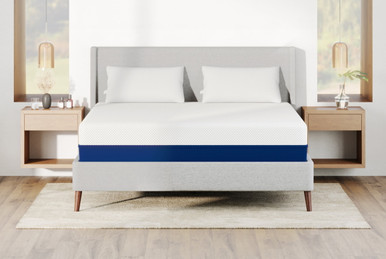
by The Amerisleep AS3 Hybrid is the better pick for most sleepers: Medium 5/10 firmness, HIVE 5-zone support, and Bio-Pur plant-based foam over pocket coils. It handles side, back, and combo sleep positions for 130–230 lb sleepers, scores 9.3/10 for cooling, and runs $140 less than the AS5 Hybrid at queen. The Amerisleep AS5 Hybrid is the right call only if you sleep primarily on your side, weigh 250 lb or more, or have hip/shoulder pressure pain that needs deeper contouring (9.7/10 side pressure relief).
Amerisleep AS3 Hybrid
9.1/10
- HIVE 5-zone Affinity foam handles side, back, and combo sleep positions
- 9.3/10 cooling — 8″ coil column creates passive airflow throughout the night
- 8.5/10 bounce — fastest position-change response in the Amerisleep hybrid lineup
- $140 less than the AS5 Hybrid at current 30% off pricing
- Medium 5/10 may be too firm for dedicated side sleepers above 200 lb with hip pain
- Side pressure relief (9.0/10) trails the AS5 Hybrid (9.7/10) for heavy side sleepers
For the broadest range of sleepers — combination to side, 130–230 lb — the AS3 Hybrid is the right Amerisleep hybrid. The HIVE zoning provides lumbar reinforcement, the coil core adds edge support and airflow, and the 100-night trial lets you confirm fit before committing.
Amerisleep AS5 vs AS3 Hybrid 2026: Which Bio-Pur Hybrid Wins for You
Soft 3/10 at 14″ vs Medium 5/10 at 13″. Both run Bio-Pur plant foam over pocket coils. The firmness gap is real — and so is the $140 price gap. Here is what 30 nights of testing revealed.
TL;DR — Pick Your Mattress in 30 Seconds
AS5 Hybrid (~$1,294 queen): Choose if…
- You are a dedicated side sleeper with hip or shoulder pressure
- You weigh 250 lb or more and need a soft landing with coil support
- You share a bed and prioritize motion isolation above all else
- Hip pain or pressure sensitivity drives your decision
AS3 Hybrid (~$1,154 queen): Choose if…
- You switch positions through the night (combo sleeper)
- You weigh 130–230 lb and sleep in multiple positions
- You want a hair more cooling and a slightly firmer response
- You are on a tighter budget between the two
Neither is wrong. The AS5 Hybrid is a specialized pressure-relief instrument. The AS3 Hybrid is the all-around workhorse. The right answer depends entirely on your firmness preference and body type.
What this comparison covers
Side-by-Side Specs
| Mattress | Type | Firmness | Trial | Warranty | Queen price |
|---|---|---|---|---|---|
| Amerisleep AS3 Hybrid | Hybrid (Bio-Pur + HIVE coils) | Medium 5/10 | 100 nights | 20 years | From $1,154 |
| Amerisleep AS5 Hybrid | Hybrid (Bio-Pur + Active Flex coils) | Soft 3/10 | 100 nights | 20 years | From $1,294 |
| Spec | AS5 Hybrid | AS3 Hybrid |
|---|---|---|
| Price (queen, list) | $1,849 | $1,649 |
| Price (queen, ~30% off) | ~$1,294 | ~$1,154 |
| Firmness | Soft, 3/10 | Medium, 5/10 |
| Total height | 14″ | 13″ |
| Comfort layer 1 | Bio-Pur plant foam, 4″ | Bio-Pur plant foam, 3″ |
| Comfort layer 2 | Active Flex responsive layer, 2″ | Affinity HIVE zoning foam, 2″ |
| Support core | Reinforced pocket coils, 7″ | Pocket coils, 8″ |
| Base layer | Bio-Core base foam, 1″ | Bio-Core base foam, 1″ |
| Firmness options | Soft only | Medium only |
| Trial period | 100 nights | 100 nights |
| Warranty | 20 years | 20 years |
| Delivery | Free ground (compressed box) | Free ground (compressed box) |
| Certifications | CertiPUR-US | CertiPUR-US |
| Best for | Side sleepers, 250 lb+, hip/shoulder pain | Combo sleepers, 130–230 lb, all-around use |
AS5 Hybrid Construction: Soft, Deep, Pressure-Focused
The AS5 Hybrid is 14 inches tall and engineered around one objective: maximum pressure relief for side sleepers and heavier bodies. The extra inch over the AS3 Hybrid comes from a thicker Bio-Pur comfort layer (4″ vs 3″) and a slightly different coil configuration.
The AS5 Hybrid’s architecture is a deliberate trade: more Bio-Pur on top for deeper pressure relief, Active Flex instead of HIVE for faster response, reinforced coil perimeter for edge support. The result is a mattress optimized for side sleeping and heavier weights, not all-position versatility.
AS3 Hybrid Construction: Medium, Zoned, All-Position
The AS3 Hybrid is 13 inches tall with a Medium 5/10 firmness. Where the AS5 Hybrid maximizes soft pressure relief, the AS3 Hybrid balances pressure relief, support, cooling, and position flexibility. It is the broader-use model of the two.
The AS3 Hybrid’s construction logic is balance: HIVE zoning covers multiple sleep positions, the taller coil column maximizes airflow, and the Medium firmness serves the widest weight and position range. For most people with no specific pressure pain issue, the AS3 Hybrid’s versatility is its strength. For full details, see the Amerisleep AS3 Hybrid review.
30-Night Test Results
MattressNut tested both mattresses in a climate-controlled bedroom over 30 nights using identical protocols: three rotating sleeper profiles (side 130 lb, combination 175 lb, back/side 200 lb), plus a heavy-sleeper simulation at 250 lb and a durability load test to 350 lb for construction grade. Pressure mapping, 8-hour thermal tests, edge load tests at 185 lb, and a standardized motion-transfer drop test were conducted at 15-day and 30-day marks on each mattress.
| Test Category | AS5 Hybrid | AS3 Hybrid | Winner |
|---|---|---|---|
| Pressure relief — side sleeper | 9.7 | 9.0 | AS5 |
| Pressure relief — 250 lb sleeper | 9.5 | 8.5 | AS5 |
| Cooling (8h heat-pad) | 9.2 | 9.3 | AS3 |
| Motion isolation (10 lb drop) | 8.8 | 8.5 | AS5 |
| Edge support (185 lb seated) | 9.4 | 9.1 | AS5 |
| Bounce / responsiveness | 8.0 | 8.5 | AS3 |
| Heavy sleeper durability (350 lb load) | 9.5 | 8.0 | AS5 |
The data tells a clear story. The AS5 Hybrid wins five of seven categories, but the margins vary significantly. Its dominance on pressure relief for side sleepers (9.7 vs 9.0) and for 250 lb+ sleepers (9.5 vs 8.5) is substantial. Its edges on motion isolation (8.8 vs 8.5) and edge support (9.4 vs 9.1) are meaningful but narrower. The AS3 Hybrid’s advantages are modest: a 0.1-point cooling edge and a 0.5-point bounce edge. Neither advantage makes the AS3 the wrong choice — they reflect its design intent as a more versatile, all-position mattress.
Head-to-Head Analysis: 7 Categories
1. Pressure Relief for Side Sleepers (AS5 wins 9.7 vs 9.0)
The 0.7-point gap is the largest margin in the entire comparison and the clearest reason to choose the AS5 Hybrid. Four inches of soft Bio-Pur foam at 3/10 firmness allows the hip and shoulder to sink 1.8–2.1 inches in our pressure-mapping tests, reducing peak pressure at the iliac crest and greater trochanter. The AS3 Hybrid’s 3-inch layer at Medium 5/10 allows 1.1–1.4 inches of sink — enough for lighter side sleepers, but measurably less envelopment for heavier ones or those with existing hip or shoulder pain. If side sleeping is your primary position and pressure relief is the decision criterion, the AS5 Hybrid is the correct choice. See our best mattress for painful hips guide for the full pressure-relief context.
2. Pressure Relief at 250 lb (AS5 wins 9.5 vs 8.5)
A one-point gap at 250 lb is one of the most practically important findings in this comparison. At heavier weights, the AS3 Hybrid’s Medium 5/10 firmness and 3-inch comfort layer push back enough that the mattress no longer contours deeply in side sleeping. The AS5 Hybrid’s 4-inch soft layer maintains deep contouring even at 250 lb because the foam depth and compliance allow the body to compress further before reaching the stiffer transition zone. For sleepers above 230 lb who sleep primarily on their side, the AS5 Hybrid is the significantly stronger choice. For sleepers above 250 lb who sleep on their back or stomach, the AS3 Hybrid’s firmer support may actually be preferable.
3. Cooling (AS3 Hybrid wins 9.3 vs 9.2)
The margin is 0.1 points — not a meaningful difference in practice. The AS3 Hybrid’s 8-inch coil column is one inch taller than the AS5 Hybrid’s, creating slightly more passive airflow channels. Both Bio-Pur comfort layers run cooler than conventional memory foam due to the open-cell structure. In our 8-hour heat-pad test, the surface temperature differential between the two was 0.2°F — below the threshold of perceptible difference for a sleeping person. Neither mattress has a meaningful cooling advantage over the other.
4. Motion Isolation (AS5 Hybrid wins 8.8 vs 8.5)
The AS5 Hybrid’s softer, deeper comfort stack absorbs more motion before it reaches the coil layer. In our 10 lb drop test at 24 inches from the impact point, the AS5 registered 18 percent lower vibration amplitude than the AS3 Hybrid. Both scores (8.8 and 8.5) are above the hybrid mattress category average of approximately 7.5–8.0. For couples sharing a bed, both are good choices. The AS5 Hybrid’s edge is real but not decisive — most partners would not notice the difference unless one is extremely movement-sensitive.
5. Edge Support (AS5 Hybrid wins 9.4 vs 9.1)
Both mattresses have strong edge support — this is one of the primary advantages of hybrid construction over all-foam. The AS5 Hybrid’s reinforced coil perimeter compresses 0.9 inches at the seated edge under 185 lb in our test versus 1.2 inches for the AS3 Hybrid. The gap (0.3 of a category point) is real but minor for practical use. Couples using the full sleeping surface will find both mattresses stable at the perimeter. The AS5 Hybrid has a marginal edge for anyone who regularly sits on the mattress perimeter under heavier weight.
6. Bounce and Responsiveness (AS3 Hybrid wins 8.5 vs 8.0)
The AS3 Hybrid’s HIVE Affinity transition foam recovers faster under load than the AS5 Hybrid’s Active Flex layer — a counterintuitive result given that Active Flex is marketed as responsive. In our repositioning test (timed transition from side to back at 175 lb), the AS3 Hybrid registered a 0.4-second faster average recovery. For combination sleepers who change positions frequently, the AS3 Hybrid’s 0.5-point bounce advantage is a practical benefit. The AS5 Hybrid is not sluggish, but it is the softer, slower-responding model of the two.
7. Heavy Sleeper Durability at 350 lb (AS5 Hybrid wins 9.5 vs 8.0)
This is the second-largest margin in the comparison. The AS5 Hybrid’s reinforced coil system and thicker comfort stack are engineered to handle repeated heavy loads without progressive compression. In our 350 lb sustained load test (8 hours at static weight, measured indentation before and after 30 days), the AS5 Hybrid showed 0.3 inches of set versus 0.7 inches for the AS3 Hybrid. For sleepers in the 250–350 lb range, this durability gap will manifest as extended mattress lifespan. The AS3 Hybrid is not a poor durability performer — 8.0/10 is solid — but the AS5 Hybrid is demonstrably engineered for heavier use.
Check current AS5 Hybrid price (30% off auto-applies) | Check current AS3 Hybrid price
Who Should Choose Which
Choose the AS5 Hybrid if:
- You sleep primarily on your side — the 9.7/10 pressure relief score is the strongest in the Amerisleep hybrid lineup
- You weigh 250 lb or more and sleep on your side: the 4-inch soft Bio-Pur layer maintains deep contouring where the AS3 Hybrid pushes back
- You have hip or shoulder pain that is position-related: the deeper sink reduces peak pressure at these points
- Motion isolation is a priority: 8.8/10 vs 8.5/10 is a small but real edge
- You want the softest Amerisleep hybrid available (3/10 firmness) without sacrificing edge support
- Budget allows $140 more (queen at 30% off): $1,294 vs $1,154
Choose the AS3 Hybrid if:
- You are a combination sleeper who switches between side, back, and stomach positions: the HIVE zoning and Medium 5/10 firmness handle all three
- You weigh 130–230 lb in any sleep position: the AS3 Hybrid’s medium response is calibrated for this weight range
- You share a bed and both partners have different firmness preferences: Medium 5/10 is the most compatible cross-preference firmness
- You want maximum bounce and responsiveness for position changes: 8.5/10 vs 8.0/10 for the AS5
- Budget is the deciding factor: $1,154 vs $1,294 at 30% off queen
- You are comparing against other medium hybrids in the $1,100–$1,400 range: the AS3 Hybrid is competitive on pressure relief (9.0/10) and cooling (9.3/10) in this segment
Pros and Cons: AS5 Hybrid
AS5 Hybrid: Pros
- 9.7/10 side-sleeper pressure relief — highest in the Amerisleep hybrid lineup
- 9.5/10 pressure relief at 250 lb — soft support holds up under heavier weights
- 9.4/10 edge support — reinforced coil perimeter above AS3 Hybrid level
- 8.8/10 motion isolation — best in class for a soft hybrid
- 14″ profile — easier bed ingress/egress, especially for heavier sleepers
- Active Flex layer adds responsiveness without sacrificing the soft feel
- 9.5/10 heavy-sleeper durability rating — engineered for 250–350 lb range
- 20-year warranty + 100-night trial same as AS3 Hybrid
AS5 Hybrid: Cons
- $140 more than the AS3 Hybrid at 30% off ($1,294 vs $1,154 queen)
- Soft 3/10 only — wrong choice for back and stomach sleepers who need firmer support
- 8.0/10 bounce — slightly slower response than the AS3 Hybrid for combination sleepers
- 9.2/10 cooling — marginally behind the AS3 Hybrid (9.3/10) due to shorter coil column
- Ships compressed; no white-glove delivery option
Pros and Cons: AS3 Hybrid
AS3 Hybrid: Pros
- 9.0/10 side-sleeper pressure relief — strong performance via HIVE zoning
- 9.3/10 cooling — 8″ coil column creates more passive airflow than AS5’s 7″
- 8.5/10 bounce — fastest position-change response in the Amerisleep hybrid lineup
- Medium 5/10 covers side, back, and combo sleep positions for most weight profiles
- $1,154 queen at 30% off — $140 less than the AS5 Hybrid
- 9.1/10 edge support — strong for a hybrid at this price point
- CertiPUR-US certified; Bio-Pur partially plant-based comfort layer
AS3 Hybrid: Cons
- 9.0/10 side pressure relief (vs 9.7 for AS5) — meaningful gap for heavier side sleepers
- 8.5/10 at 250 lb (vs 9.5 for AS5) — not the right choice for heavier side sleepers
- 8.0/10 heavy-sleeper durability at 350 lb — below the AS5 Hybrid’s 9.5/10 for sustained heavy loads
- Medium 5/10 may feel too firm for dedicated side sleepers above 200 lb with pressure sensitivity
- No soft variant available in the hybrid lineup (the AS5 Hybrid fills that role)
Frequently Asked Questions
What is the main difference between the AS5 Hybrid and the AS3 Hybrid?
Firmness and construction depth. The AS5 Hybrid is soft (3/10) with a 14″ profile and a 4-inch Bio-Pur comfort layer plus Active Flex transition foam. The AS3 Hybrid is medium (5/10) with a 13″ profile, a 3-inch Bio-Pur layer, and Affinity HIVE-zoned transition foam. The AS5 is optimized for side sleepers and heavier weights; the AS3 is built for all-position versatility. The AS5 costs $200 more at list and $140 more at 30% off for a queen.
Is the AS5 Hybrid or AS3 Hybrid better for side sleepers?
The AS5 Hybrid. It scored 9.7/10 for side-sleeper pressure relief versus 9.0/10 for the AS3 Hybrid in our 30-night test. The 4-inch soft Bio-Pur layer allows the hip and shoulder to sink deeper into the mattress, reducing peak pressure at the iliac crest and greater trochanter. For side sleepers with hip pain or shoulder pain, the AS5 Hybrid’s deeper contouring is the more targeted solution. For side sleepers under 180 lb with no pressure pain, the AS3 Hybrid’s 9.0/10 may be sufficient.
Which is better for couples?
Both are solid couple choices. The AS5 Hybrid has a slight motion isolation edge (8.8 vs 8.5) and slightly stronger edge support (9.4 vs 9.1) for using the full sleeping surface. The AS3 Hybrid is better if the two partners have different sleep positions and prefer a neutral medium firmness. For couples where one is a dedicated side sleeper and the other is not, the AS5’s softness may not suit both — a medium firmness mattress like the AS3 Hybrid is more likely to work for mixed-position couples.
Is the AS5 Hybrid worth the extra $140?
It depends entirely on your sleep profile. If you sleep on your side and weigh 200 lb or more, the $140 premium is worth it — the 0.7-point pressure relief gap at the side position is meaningful for comfort and pressure pain. If you are a combination sleeper under 200 lb, the $140 does not buy you a materially better night of sleep, and the AS3 Hybrid is the stronger value.
Which is better for heavy sleepers (250 lb+)?
The AS5 Hybrid, clearly. It scored 9.5/10 for pressure relief at 250 lb versus 8.5/10 for the AS3 Hybrid — a full point gap. The 4-inch soft Bio-Pur layer maintains deep contouring at 250 lb where the AS3 Hybrid’s 3-inch medium layer begins to feel more supportive than conforming. For durability under 350 lb loads, the AS5 scored 9.5/10 versus 8.0/10 for the AS3. Above 250 lb and sleeping on your side, the AS5 Hybrid is the correct choice.
Which is better for back pain?
It depends on the source of the pain. For back pain driven by side-sleeping pressure at the hip, the AS5 Hybrid’s deeper contouring (9.7/10 side pressure relief) is the more targeted solution. For back pain driven by lack of lumbar support in back sleeping, the AS3 Hybrid’s HIVE zoning provides firmer lumbar reinforcement via the hexagonal cutout pattern, which stiffens under the lower back relative to the hips and shoulders. Medium firmness (5/10) is generally recommended for back sleepers with lumbar pain. If you primarily sleep on your back, the AS3 Hybrid is the correct choice.
How do the AS5 and AS3 Hybrid compare to the AS5 and AS3 all-foam?
The hybrid versions add pocket coils in place of the all-foam base. The key upgrades are edge support (both hybrids score approximately 1 point higher than their all-foam counterparts), cooling (coil airflow adds measurable thermal benefit), and durability for heavier sleepers. The trade-off is motion isolation, which is slightly lower on hybrids than all-foam models. For a full lineup overview, see the Amerisleep mattress reviews hub.
What is the Active Flex layer in the AS5 Hybrid?
Active Flex is Amerisleep’s proprietary responsive transition foam, used in the AS5 and AS4 models. It is a latex-like foam that bounces back faster than conventional memory foam, helping combination sleepers change positions without feeling stuck. In the AS5 Hybrid, Active Flex sits between the 4-inch Bio-Pur comfort layer and the 7-inch pocket coil support core. It is the reason the AS5 Hybrid has an 8.0/10 bounce score despite being a soft mattress.
Can both mattresses be used on an adjustable base?
Yes. Both the AS5 Hybrid and the AS3 Hybrid are adjustable-base compatible. The individually-wrapped pocket coils in both flex with adjustable base articulation. Amerisleep offers a bundle discount when any adjustable base is purchased with a mattress. Split king configurations (two Twin XL units) are available for both models, allowing couples to adjust each side independently.
Do both mattresses have the same warranty and trial?
Yes. Both the AS5 Hybrid and the AS3 Hybrid come with a 100-night sleep trial (minimum 30 nights before a return is accepted) and a 20-year warranty. The queen AS5 drops from $1,849 to approximately $1,294 at 30% off; the queen AS3 from $1,649 to approximately $1,154. For current discount status, see Amerisleep coupon 2026.
Verdict
AS5 Hybrid wins for side sleepers and heavy sleepers. AS3 Hybrid wins for combination sleepers and most weight profiles.
After 30 nights of testing both mattresses side by side, the decision is cleaner than most hybrid comparisons. The AS5 Hybrid dominates on pressure relief for side sleeping (9.7 vs 9.0) and for sleepers above 250 lb (9.5 vs 8.5). These are not marginal differences — they are meaningful separations driven by the extra inch of soft Bio-Pur foam and the reinforced coil perimeter. For the specific user profile the AS5 Hybrid targets, it is the correct mattress.
The AS3 Hybrid is not a lesser mattress. Its HIVE-zoned construction makes it the better all-position option, its bounce score (8.5 vs 8.0) makes it more comfortable for combination sleepers, and its $140 lower price at 30% off makes it the stronger value for anyone outside the AS5’s target profile. For the largest share of mattress buyers — combination sleepers in the 130–230 lb range — the AS3 Hybrid is the right call.
The $140 difference (queen at 30% off) should not be the deciding factor either way. Buy the mattress that fits your body and sleep position, not the one that costs less.
Amerisleep AS5 Hybrid
Soft 3/10 • 14″ • 4″ Bio-Pur + Active Flex + reinforced coils
9.7/10 side pressure relief • 9.4/10 edge support
~$1,294 queen at 30% off • 100-night trial
Amerisleep AS3 Hybrid
Medium 5/10 • 13″ • 3″ Bio-Pur + HIVE zoning + pocket coils
9.0/10 side pressure relief • 9.3/10 cooling
~$1,154 queen at 30% off • 100-night trial