
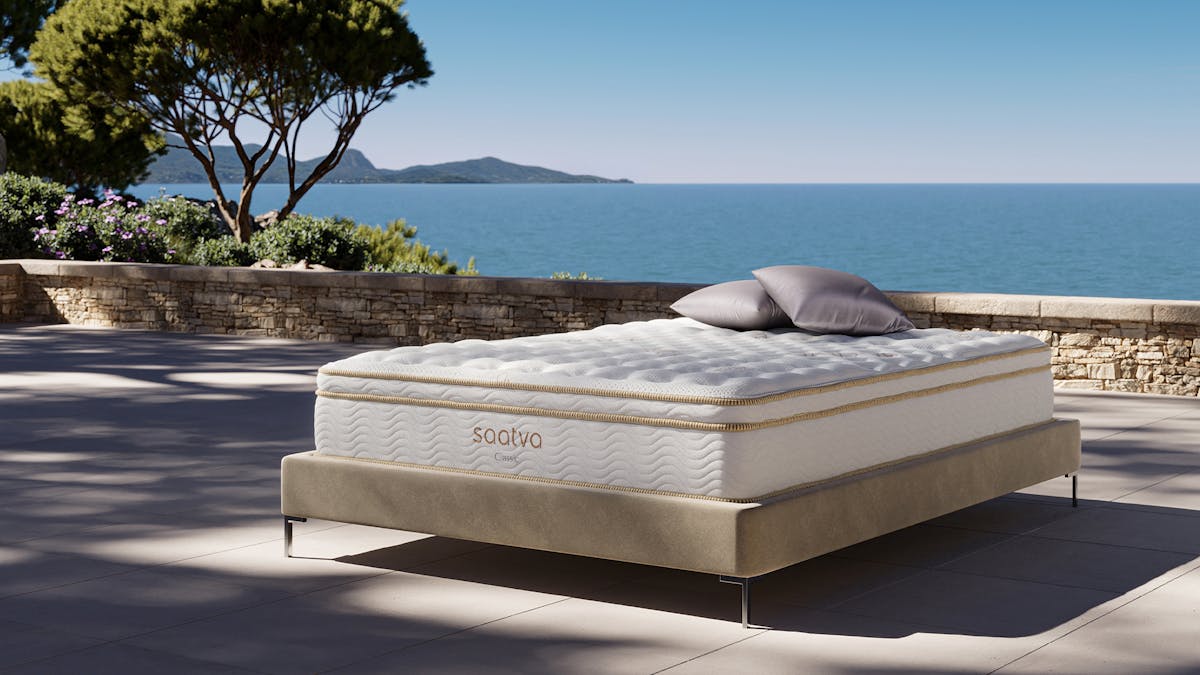
 by
by Saatva Foundation
9.0/10
This is the correct recommendation for foundation and box-spring comparisons. The article should sell support hardware, not a mattress.
Amerisleep Bed Bases
8.8/10
A good second option when the reader wants a modern platform or adjustable base instead of a traditional foundation.
Puffy Bed Frames
8.6/10
A practical partner backup for shoppers comparing frames, slats, and box springs on price.
A bed frame is the right choice for most people today. Modern platform frames support foam, hybrid, and latex mattresses directly, no box spring required. A box spring is only worth it if you have a traditional innerspring mattress, a basic metal frame without slats, or you need extra bed height. For anyone buying a new mattress in 2026, a platform bed frame handles everything a box spring once did.
Bed frame vs box spring: the core difference
A bed frame is a structural unit, wood or metal, that holds your mattress off the floor. Modern platform frames include built-in slats or a solid surface, so they support a mattress directly. A box spring is a separate foundation, a fabric-covered wooden box with metal springs inside, that originally sat between a basic metal frame and a thin innerspring mattress to add cushion and height.
That original role has largely disappeared. Modern mattresses are thicker, with dense foam or coil support cores built in. Most foam, hybrid, and latex beds specifically require a firm, flat surface, and placing a box spring underneath can create instability and void the warranty. The question today is less "frame or box spring?" and more "do I even need a box spring at all?"
Head-to-head comparison
| Feature | Bed frame (platform) | Box spring |
|---|---|---|
| Mattress compatibility | All types: foam, hybrid, latex, innerspring | Best with traditional innerspring only |
| Height added | 5 to 18 inches depending on frame | 7 to 9 inches |
| Lifespan | 10 to 20 years (wood or steel) | 5 to 8 years |
| Weight capacity | 1,000 to 3,000+ lbs | 300 to 800 lbs typically |
| Storage options | Many models include drawers | None |
| Price (queen) | $150 to $600 | $80 to $300 |
| Noise over time | Low (metal may creak; wood rarely does) | Higher, springs loosen with use |
| Airflow under mattress | Good with slatted frame | Good with spring design |
| Required for modern mattress? | Yes (or equivalent support surface) | No, for most modern mattresses |
When a box spring still makes sense
Box springs are not obsolete for everyone. There are three scenarios where they remain the practical choice:
- Traditional innerspring mattress + basic metal frame: Older metal frames with only a center support bar offer minimal surface area. A box spring distributes load evenly and adds the shock absorption the mattress needs.
- Warranty requirement: Some older or budget innerspring mattresses specify a box spring in the warranty terms. Check before buying a frame-only setup.
- Extra bed height: A box spring adds 7 to 9 inches. If you or a partner has mobility issues and needs a taller bed, combining a low platform frame with a box spring is a legitimate fix.
When you can skip the box spring
For the majority of buyers in 2026, the answer is: skip it. You do not need a box spring if:
- You have a platform bed frame with slats spaced 3 inches apart or less
- Your mattress is foam, latex, or hybrid (most brands recommend against box springs for these)
- You have an adjustable base
- Your mattress warranty says "flat, rigid surface" rather than "box spring required"
Using a box spring under a foam or latex mattress can create an uneven support surface. The springs flex in ways the mattress's own support core was not designed for, which can cause premature sagging and uneven wear.
Platform bed frame: strengths and limits
Strengths
- Compatible with every modern mattress type without modification
- Longer lifespan than a box spring, typically 10 to 20 years for quality wood or steel
- Storage options: many models include deep drawers that reclaim bedroom floor space
- Visual design variety: platform frames come in hundreds of styles, from minimalist steel to upholstered fabric
- No extra cost: you buy the frame and mattress, nothing else
Limitations
- Lower profile than a frame-plus-box-spring setup. Some people find a very low bed hard to get in and out of.
- Heavy and awkward to move, especially storage bed frames
- Metal frames can develop squeaks over time if hardware loosens
Box spring: strengths and limits
Strengths
- Adds substantial height (7 to 9 inches) without a taller frame
- Springs absorb some shock, which can extend the life of a traditional innerspring mattress
- Lighter and easier to move than a solid bed frame
- Lower upfront cost than most quality bed frames
Limitations
- Wears out in 5 to 8 years, faster than most frames
- Springs loosen and squeak over time
- Not recommended for foam, hybrid, or latex mattresses by most manufacturers
- No storage value, just height
Price breakdown
| Option | Queen price range | Best for |
|---|---|---|
| Box spring | $80 to $300 | Traditional innerspring on a basic metal frame |
| Platform bed frame | $150 to $600 | Any mattress type, replaces box spring entirely |
| Bunkie board | $50 to $150 | Adding firm support to a slatted frame without full height |
| Adjustable base | $300 to $1,500 | Head and foot elevation, pairs with foam or hybrid |
For most modern mattresses, a platform bed frame with slats 3 inches apart or less is all you need. Save the box spring for traditional innerspring setups or situations where extra bed height is non-negotiable. If you are buying a new mattress today, confirm its support surface requirements before purchasing a box spring separately.
Frequently asked questions
Can I put a box spring on a platform bed?
Yes, but it raises the total bed height significantly and is rarely necessary unless you have a very old innerspring mattress that needs the spring support. Most platform beds already provide adequate support without a box spring.
What happens if I use a box spring under a memory foam mattress?
Most foam mattress warranties recommend against it. The springs flex and create an uneven surface, which accelerates sagging in the foam. A firm, flat platform is what foam mattresses are engineered to sit on.
How far apart should slats be on a platform bed?
No more than 3 inches apart for foam and latex mattresses. Wider spacing lets foam dip between slats, creating pressure points and uneven support. For innerspring or hybrid mattresses, up to 4 inches is generally acceptable.
Do box springs wear out?
Yes. Box springs typically last 5 to 8 years, considerably shorter than a quality bed frame. Signs it needs replacing: visible sagging, squeaking when you move, or broken spring coils you can feel through the mattress.
Is a bed frame the same as a foundation?
Not quite. A foundation is a flat, rigid support surface (no springs) that sits between the mattress and the frame. A bed frame is the structural unit that holds everything off the floor. Some platform frames combine both functions, eliminating the need for a separate foundation.
More: platform vs box spring | box spring alternatives | do you need a foundation | best frames for Saatva | adjustable bed frames.