
 by
by The Mechanics: Why Hip Rotation Causes Back Pain
When sleeping on your side without knee support, gravity causes the top knee to drop toward the mattress. This movement internally rotates the top hip, creating a twisting force on the lumbar spine. Over a full night, this sustained torsion causes the same type of stress as poor ergonomics during the day -- accumulated tissue loading that creates inflammation and pain upon waking.
The 7 Knee Pillows for Back Pain
1. Amerisleep Flex Pillow
Best for: Knee Pain
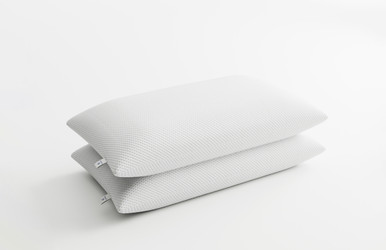
If you are asking what pillow should I use if I have knee pain, this is where we start. Its hundreds of MicroFlex cushions can be reshaped. If you try it between your knees, check that it stays comfortable when compressed; it is not a contoured knee pillow.
From $100, with reshapeable MicroFlex cushions. Made in the USA, with a 10-year warranty; final sale with no sleep trial. Check the current Amerisleep Flex Pillow price.
2. Memory Foam Contoured Knee Pillow -- Best for Back Pain Specifically
The hourglass/contoured shape fits between the knees and prevents lateral shifting more effectively than rectangular pillows. Medium-firm memory foam (45-55 ILD) provides enough height (typically 6-7 inches) to keep hips stacked. The contouring prevents the pillow from sliding out from between the knees when repositioning during sleep.
3. Knee Pillow with Adjustable Leg Strap -- Best for Position Changers
Side sleepers who frequently roll or reposition benefit significantly from a strap that keeps the pillow attached. The strap should be adjustable, padded, and positioned to avoid compressing the calf or popliteal vein. Memory foam with a strap provides both the alignment benefit and positional consistency that unsecured pillows cannot maintain.
4. Cylindrical Support (6-inch diameter) -- Best Budget Option
A firm cylindrical support between the knees provides consistent hip-stacking support at lower cost than contoured designs. Less stable than an hourglass shape but adequate for sleepers who do not move much. Buckwheat cylindrical supports provide the best firmness retention over time.
5. Half-Moon Support -- Best for Combination Sleepers
Half-moon shaped foam pillows work both between the knees (side sleeping) and under the knees (back sleeping) to reduce lumbar compression. For back pain sufferers who alternate between side and back positions, the half-moon's versatility makes it more practical than a single-position contoured design.
6. Wedge Knee Pillow -- Best for Leg Elevation
Some knee pillows are designed as leg wedges that improve the entire lower leg rather than just providing knee separation. This creates a different mechanical effect -- reducing lumbar curve while on the back rather than eliminating torsion during side sleeping. More appropriate for herniated disc or stenosis-related back pain than for positional torsion issues.
7. Inflatable Knee Pillow -- Best for Travel
Inflatable knee pillows pack small and provide adequate support when properly inflated. Support quality is inferior to foam but substantially better than no support. Useful for travel, hospital stays, or testing whether knee elevation helps before investing in a quality foam option.
Sizing: Getting the Height Right
Frequently asked questions
Frequently asked questions about pillows
Our top pillow pick
The Saatva Pillow
Shredded Talalay latex core, removable fill, 45-night trial, the most adaptable pillow for multi-position sleepers. From $165.
How often should you replace your pillow?
Every 18–36 months depending on fill. Latex pillows last 5–7 years; solid memory foam 2–3; down 2–5 with fluffing. The fold test tells you: fold the pillow in half, let go. If it doesn't spring back, it's done. Saatva's pillow range covers all major fill types.
What's the best pillow loft by sleep position?
Side sleepers: 5"–7". Back sleepers: 3"–5". Stomach sleepers: 1"–3". Combination sleepers: 4"–5" adjustable-fill.
Are expensive pillows actually worth it?
Cost-per-year, yes: a $150 latex pillow over 6 years ($25/year) beats a $30 polyester pillow over 1 year ($30/year), plus you get better neck support the whole time.
Luxury mattress alternative
Saatva Rx
Zoned hybrid with a dedicated lumbar pad foam layer, engineered for back and joint pain. Queen $3,295.
Which mattress firmness is best for chronic back pain?
Research from the Journal of Chiropractic Medicine consistently points to medium-firm (6–7/10) as the sweet spot for chronic lower-back pain. A bed that's too soft lets the lumbar spine sag into hyperextension overnight; too firm and the hips can't settle, compressing the lumbar discs. The Saatva Rx and Saatva Classic Luxury Firm both hit that 6.5–7/10 range with an active lumbar zone.
Do adjustable beds actually help lower-back pain?
Yes: elevating the head 7°–10° and the legs 15°–20° (the "zero-gravity" angle) offloads pressure on the L4-L5 disc space, which is where most chronic lower-back pain originates. The Saatva Adjustable Base Plus has a single-button zero-gravity preset. Pairs it with any Saatva mattress (the Rx and Classic flex the best under articulation).
How long before a new mattress actually relieves pain?
Clinical orthopedic literature gives 4–6 weeks as the adaptation window for a supportive new mattress to meaningfully reduce chronic pain. That's why mattress brands worth buying offer 100+ night trials. Saatva gives 365 nights, which is long enough to separate adaptation pain from actual mattress mismatch.
Is memory foam or latex better for back pain?
Latex wins for most back-pain sleepers because it supports the hips and shoulders more uniformly without the deep sinkage that misaligns the lumbar spine on pure memory foam. A latex-hybrid (springs + latex top) is the most-recommended build. Pure memory foam is better when pain is concentrated at pressure points (hips, shoulders) rather than the lumbar region.
The correct knee pillow height aligns your hips parallel to the mattress when lying in the side position. Measure the distance between your knees when lying on your side in neutral hip position -- this is your target pillow height. Most adults need 5-8 inches. If uncertain, start at 6 inches and adjust based on morning results after 3-4 nights.
A knee pillow addresses alignment but not mattress-level support. For back pain relief, the mattress needs to provide zoned support that fills the lumbar curve -- see our back pain mattress guide for specifics. Also relevant: our side sleeper mattress guide and body pillow guide for complete alignment.
Mattress Alternative
The Saatva Classic is an innerspring alternative to consider alongside a knee pillow.
Affiliate disclosure: We may earn a commission at no extra cost to you.
MATTRESSES FOR PAIN RELIEF
MATTRESSES FOR PAIN RELIEF
Frequently Asked Questions
How does a knee pillow relieve back pain?
Placing a pillow between the knees as a side sleeper prevents the top hip from rotating internally (dropping toward the mattress). This internal rotation creates lumbar torsion -- a twisting force on the lower spine that is a primary cause of positional back pain. A knee pillow eliminates this rotation mechanism by maintaining hip stack alignment.
What firmness should a knee pillow be for back pain?
Medium-firm (40-60 ILD foam) is the most effective for back pain relief. Too soft and the pillow compresses fully, losing its alignment benefit. Too firm creates localized knee pressure that is uncomfortable. Memory foam at medium-firm density conforms to the knee contour while maintaining height.
Do knee pillows with straps actually work?
Straps help prevent the pillow from shifting when you change positions during sleep. However, straps that are too tight can restrict blood flow or create pressure points. Look for adjustable velcro straps with at least 2 inches of adjustment range, and check that the strap does not compress the calf.
Can I use a regular pillow between my knees instead?
A folded regular pillow works for testing whether knee elevation helps your back pain. However, it compresses during the night and loses its shape, meaning the alignment benefit disappears partway through the sleep cycle. A purpose-designed knee pillow maintains consistent height throughout the night.
Is a knee pillow good for hip replacement recovery?
Yes, knee pillows are commonly recommended for post-hip replacement recovery to prevent the operated hip from internally rotating past safe limits. Consult your surgeon for specific positioning protocols, as requirements vary by surgical approach (anterior vs. posterior).