
 by
by Our #1 recommendation for shoppers with Ehlers-Danlos syndrome
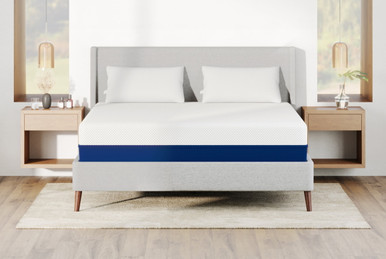
Amerisleep AS3
Our first foam option for shoppers who prefer Medium.
Amerisleep AS3
8.7/10
- HIVE 5-zone layer adjusts firmness across 5 body zones, reducing pressure points
- Plant-based Bio-Pur foam runs cooler than standard memory foam
- CertiPUR-US certified, made in the USA
- Ships compressed in a box, easier setup if white-glove delivery is unavailable
- Softer edges than a coil hybrid, less bracing surface for EDS transfers
- All-foam can allow more joint migration than a coil core for severe hEDS
The AS3 has a Medium feel, Bio-Pur foam, and HIVE five-zone support. Its HIVE zoning reduces pressure across joints, but the softer edges make it less ideal for patients who rely heavily on the mattress edge for repositioning.
Our first mattress recommendation for Ehlers-Danlos syndrome is the Amerisleep AS3. Consider the AS3 if a medium all-foam surface suits your comfort needs.
The hypermobility sleep problem
Ehlers-Danlos Syndrome (EDS) is a group of connective tissue disorders characterized by joint hypermobility, skin hyperextensibility, and tissue fragility. The most common subtype, hypermobile EDS (hEDS), creates a specific sleep challenge: joints that are too mobile sublux or partially dislocate during sleep, causing pain that disrupts sleep architecture and makes restorative rest rare.
In typical joints, connective tissue provides passive stability during sleep. Even relaxed muscles receive support from ligaments and joint capsules. In hEDS, this passive restraint system is compromised. The shoulder can roll forward into subluxation. The hip can rotate beyond its normal range. The wrist or ankle can fall into a position the joint was never designed to sustain for hours.
A mattress that contours closely to the body may help with comfort and positioning; talk to your doctor about support for unstable joints. This argues for a supportive, medium to medium-firm surface rather than a very soft foam that allows unrestricted sinkage.
Why firmness is different for EDS
Our top pick: Amerisleep AS3
HIVE 5-zone Bio-Pur foam · Medium 5/10 · 100-night trial · 20-year warranty
EDS patients often need a firmer mattress than their pain level alone would suggest. Very soft mattresses allow joints to migrate into unstable positions over hours of sleep: the hip rotates internally, the shoulder collapses forward, the lumbar spine sags. Medium to medium-firm support adds some of the passive resistance that lax ligaments do not provide.
However, many EDS patients also have significant pressure sensitivity from widespread pain. This creates a real tension: firmness for joint stability versus softness for pressure relief. One answer is zoned foam, as in the Amerisleep AS3: a firmer lumbar zone that resists joint migration, with softer shoulder and hip zones that absorb pressure. The Bio-Pur comfort foam relieves pressure, while HIVE five-zone support provides targeted support.
Why edge support matters for EDS transfers
EDS patients frequently use the mattress edge to push themselves up, brace during repositioning, or sit upright safely. Standard mattresses with soft perimeter foam compress significantly at the edge, creating instability that is dangerous for hypermobile joints. Strong edge support, achieved with high-density perimeter foam or reinforced coil perimeters, is a critical feature for EDS patients, not an optional upgrade.
The Amerisleep AS3 uses HIVE zoning across five body areas, so support changes along the mattress instead of being uniform. EDS patients who need bracing without a hard surface are the clearest fit for this construction; if you rely on the edge for transfers, the AS3 Hybrid adds a coil perimeter, and a rigid foundation matters more than the comfort layer.
EDS subtypes and mattress considerations
Classical EDS (cEDS) involves skin fragility alongside joint hypermobility, surface texture and pressure from mattress seams can cause skin irritation or bruising. A smooth Euro pillow-top or mattress cover reduces this risk. Vascular EDS (vEDS) patients should consult their physician for positioning recommendations, as vascular fragility creates different priorities. Kyphoscoliotic EDS (kEDS) involves significant spinal curvature that may require individualized support mapping beyond general recommendations.
How the top EDS mattress picks compare
| Mattress | Type | Firmness | Edge support | Trial | Queen price |
|---|---|---|---|---|---|
| Amerisleep AS3 | All-foam (Bio-Pur) | Medium 5/10 | Moderate (foam-only) | 100 nights | $1,249 (queen, sale) |
Positioning aids alongside the mattress
The right mattress is the foundation, but EDS patients typically see the best results combining it with positioning aids:
- Body pillow: placed between the knees for side sleepers helps limit internal hip rotation and strain at the hip and SI joint.
- Cervical pillow: maintains the cervical spine in neutral alignment for patients with cervical instability, a common EDS comorbidity.
- Wedge pillow: elevates the torso for EDS patients with postural orthostatic tachycardia syndrome (POTS), which frequently co-occurs with hEDS.
- Adjustable base: zero-gravity positioning reduces joint load in the lower limbs and pairs well with the AS3.
For EDS, choose zoned support with real pressure relief. The Amerisleep AS3 is our pick: HIVE zoning braces the lumbar area while the Bio-Pur comfort layer protects sensitive joints, backed by a 100-night trial and a 20-year warranty.
Frequently asked questions
What mattress firmness is best for Ehlers-Danlos Syndrome?
There is no clinical standard. Many people with EDS do well on medium to medium-firm (5 to 7 out of 10) with a pressure-relieving comfort layer; the right level depends on your joints, weight and pain, so use the trial and ask your physiotherapist.
Is memory foam a good choice for EDS?
There is no evidence-based rule against memory foam for EDS. Very soft, slow-response foam can make repositioning harder, so look for responsive foam such as Bio-Pur, or a hybrid such as the AS3 Hybrid if you want more push-back.
Why does edge support matter for EDS patients?
EDS patients frequently use the mattress edge for bracing during safe transfers, repositioning, and getting in and out of bed. A mattress that collapses at the edge provides no support for hypermobile joints during these moves, increasing subluxation risk. Look for high-density perimeter foam or reinforced coil perimeters.
Can a mattress prevent EDS joint subluxation during sleep?
A mattress cannot prevent subluxation, but supportive positioning may help limit extreme joint positions. Combined with positioning aids and physician-directed management, the right mattress can improve sleep quality for many people with EDS.
How long before a new mattress helps EDS sleep?
Assess whether a new mattress suits you throughout the sleep trial, as comfort needs vary. Use the full 100-night trial: it gives you enough time to assess whether the firmness level is right for your specific joint pattern.
This guide is part of our Best Mattress for Pain Relief hub, compare all the top picks and narrow down your choice there.
Our pick for Ehlers-Danlos support
HIVE 5-zone Bio-Pur foam · Medium 5/10 · 100-night trial · 20-year warranty
Our #1 pick for shoppers with Ehlers-Danlos syndrome
The Amerisleep AS3 is where we would start.