
 by
by Our #1 recommendation for mattress for sex
Amerisleep AS3
The AS3 is the foam pick for couples who prioritize quiet sleep after intimacy.
Our first recommendation for mattress for sex is the Amerisleep AS3. The AS3 is the foam pick for couples who prioritize quiet sleep after intimacy. The Saatva Classic is our runner-up.
Most "best mattress" roundups score beds on sleep alone. That's fine until you factor in everything else a mattress does. Sex loads a mattress completely differently than sleeping: movement is dynamic, weight shifts fast, and the edge of the bed suddenly matters a lot. A bed that cradles you nicely at 2 a.m. can feel like quicksand at the wrong moment.
I've spent years breaking down mattress construction, coil systems, foam densities, layer stacks, and this is one category where construction really is destiny. Dense memory foam absorbs energy. Coils return it. That single fact drives almost every recommendation below.
Amerisleep AS3
8.5/10
- Best-in-class motion isolation for undisturbed post-activity sleep
- HIVE 5-zone layer provides differentiated support without collapse under pressure
- Plant-based Bio-Pur foam, CertiPUR-US certified, with a 20-year warranty per amerisleep.com
- Medium 5/10 firmness balances resistance with pressure relief
- Softer edges than a coil hybrid: less stable perimeter under lateral force
- Less bounce than innerspring or latex: slow-rebound feel can limit responsiveness
The AS3 is the foam pick for couples who prioritize quiet sleep after intimacy. Its motion isolation is top-class, and the HIVE zoning means the mattress supports rather than collapses. From $1,049 for a queen according to the manufacturer's page, it's also the best-priced premium option here. If bounce is your first priority, the Saatva wins; if motion isolation matters equally, the AS3 is the cleaner call.
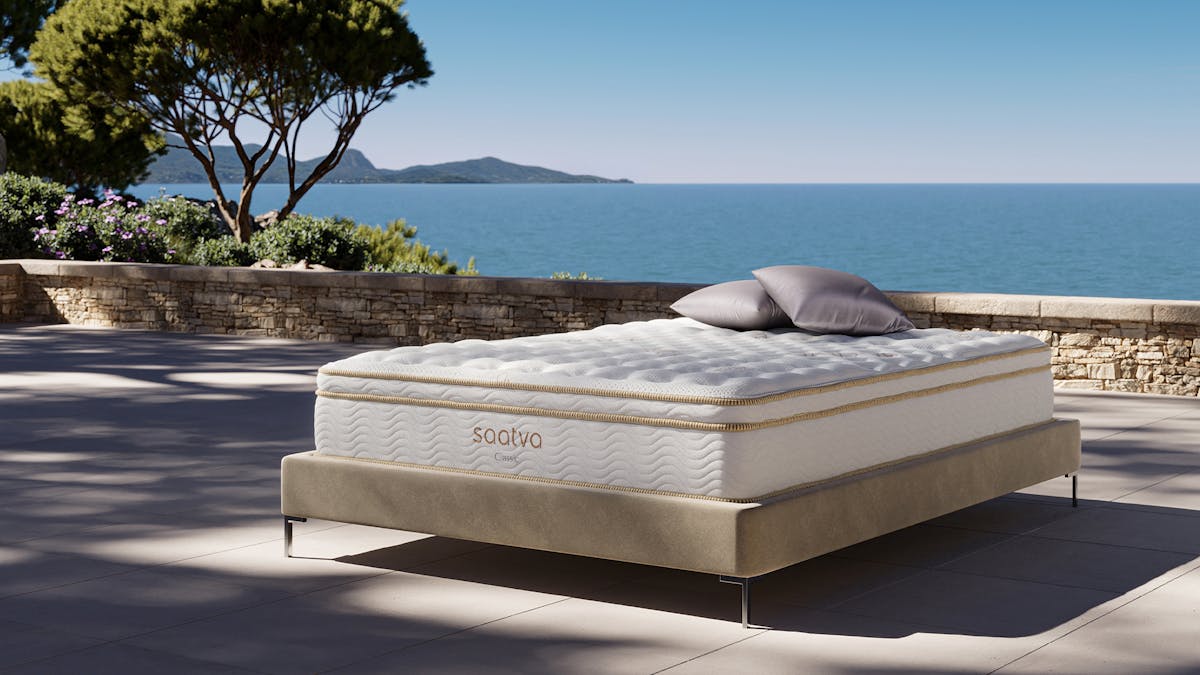
Saatva Classic
9.2/10
- Dual-coil construction gives real bounce and responsiveness, not a slow foam rebound
- Outstanding edge support: full usable surface, no roll-off near the perimeter
- Euro pillow-top comfort without sacrificing stability under dynamic movement
- Free white-glove delivery, a 365-night trial and lifetime warranty, per saatva.com
- More motion transfer than an all-foam bed during sleep
- Heavy, ships flat (not compressed), $99 return fee during trial
Bounce and edge support are the two most consistent predictors of mattress performance during sex, and the Saatva Classic leads on both. The dual-coil system responds immediately to movement, the reinforced perimeter means every inch of the surface is usable, and three firmness options let couples dial in the right feel. At ~$1,695 for a queen per the brand's site, it's a premium buy, but the construction justifies it.
PlushBeds Botanical Bliss
8.7/10
- Natural Talalay latex provides buoyant, springy rebound comparable to coils
- Excellent edge support from the dense latex construction
- Sleeps cooler than memory foam thanks to latex's open-cell structure
- GOLS organic certified, no off-gassing, chemical-free materials, per the manufacturer
- Higher price point than foam competitors
- Natural latex has a distinct feel that some couples prefer more time to adjust to
Latex is among the most responsive mattress materials available. The PlushBeds Botanical Bliss delivers a buoyant, immediately-rebounding surface that many couples prefer for activity, plus the organic certification makes it a strong pick for health-conscious buyers. The 100-night trial and 25-year warranty, as listed by the brand, back it up.
Puffy Original
8.4/10
- Balanced medium-firm feel works for a wide range of couple configurations
- Strong pressure relief with good motion isolation for post-activity sleep
- Lifetime warranty and 101-night sleep trial, per puffy.com, and ships free
- More responsive than traditional dense memory foam
- Less bounce than coil-based beds; not ideal if maximum responsiveness is the top priority
- Edge compression greater than coil hybrids
The Puffy Original sits in a practical middle ground for couples: enough firmness to stay stable under movement, solid motion isolation for sleep, and a lifetime warranty that reduces replacement risk. At roughly $1,499 for a queen as listed on the brand's site, it's a strong pick when bounce is less critical than consistent comfort.
Sweetnight Breeze
8.1/10
- Accessible price point without sacrificing core performance requirements
- Hybrid options with pocketed coils deliver usable bounce at a budget price
- Good for couples who want a starter mattress with solid fundamentals
- Less refined edge support than premium builds
- Shorter warranty coverage (10 years per the brand's listing) compared to Saatva or Amerisleep
If budget is the binding constraint, Sweetnight offers a practical entry point. The hybrid options in the lineup bring coil responsiveness into reach at a significantly lower price than the Saatva or PlushBeds, making it a sensible compromise for price-conscious couples. The 100-night trial, as listed on sweetnight.com, gives you room to evaluate it at home.
What makes a mattress good for sex
Four properties determine how well a mattress performs during intimacy: bounce and responsiveness, edge support, cooling, and noise. Firmness also matters, though for a different reason than sleep comfort.
| Property | Why it matters | Best construction |
|---|---|---|
| Bounce / responsiveness | Immediate surface rebound during movement; slow-returning memory foam absorbs and resists motion | Coil-based (innerspring, hybrid) |
| Edge support | Stable perimeter means full surface is usable; edge collapse limits positioning | Reinforced coil perimeter or high-density foam rail |
| Cooling | Body heat increases during activity; a hot mattress worsens discomfort | Coil airflow, latex, or copper-infused foam |
| Noise | Squeaking coils are disruptive; pocketed coils are near-silent versus open innersprings | Pocketed coils, foam |
| Firmness | Medium-firm (6/10) provides enough resistance to support without collapse | Medium-firm across all construction types |
Notice the pattern in the right-hand column: coil-based construction wins on bounce and edge support, which are the two heaviest hitters. That's not marketing, it's physics. Steel springs store and return energy; viscoelastic foam was literally engineered to do the opposite.
Quick comparison: sex performance specs
| Mattress | Type | Bounce | Edge support | Motion isolation | Trial |
|---|---|---|---|---|---|
| Saatva Classic | Dual-coil innerspring | Excellent | Excellent | Moderate | 365 nights |
| PlushBeds Botanical Bliss | Natural latex | Very good | Very good | Good | 100 nights |
| Puffy Original | All-foam | Moderate | Good | Excellent | 101 nights |
| Amerisleep AS3 | All-foam (Bio-Pur) | Moderate | Good | Excellent | 100 nights |
| Sweetnight | Hybrid / foam | Good | Moderate | Good | 100 nights |
Trial lengths above are per each manufacturer's published terms as of this writing. Always confirm current terms before buying, since brands adjust trial and warranty policies periodically.
Foam vs hybrid vs innerspring for sex
The trade-off between foam and coil is the central design choice for couples evaluating sex performance:
- Foam beds: Excellent motion isolation for sleep, lower bounce for activity. Dense memory foam absorbs energy rather than returning it. The AS3 Bio-Pur formulation is more responsive than traditional petroleum-based memory foam, but still slower to rebound than coil beds.
- Latex beds: Natural latex delivers the most responsive surface of any foam-category material. Talalay latex in particular has a buoyant, immediately-rebounding feel that many couples prefer for both activity and sleep comfort.
- Hybrid beds: Pocketed coils deliver bounce and airflow while a foam comfort layer absorbs some vibration, making hybrids a practical middle ground for couples who want both responsiveness and controlled motion transfer.
- Innerspring (dual-coil) beds: Maximum bounce and edge support. Motion transfers more than foam during sleep. For couples who both sleep well regardless of motion, the Saatva's responsiveness and full-surface edge stability put it ahead for sex performance.
Is a firmer mattress better for sex?
Medium-firm (6/10) generally outperforms both very soft and extra-firm mattresses for sex. A very soft bed collapses under weight distribution during dynamic movement, reducing stability and control. An extra-firm mattress creates pressure points that interrupt comfort. The Saatva Classic Luxury Firm option at around 6/10 is the most consistently recommended firmness for this purpose, offering enough surface resistance to feel stable while still allowing comfortable positioning for both partners.
For couples with significant weight differences, a mattress with firmness choices like the Saatva's three-option range allows customization that a single-firmness bed cannot match. The heavier partner gets support, the lighter one doesn't feel like they're lying on a board.
Does memory foam affect sex?
Traditional dense memory foam mattresses are among the lower performers for sex. The high-viscosity foam absorbs and delays the return of energy: when you push into the surface, it compresses and slowly reforms rather than pushing back. This dampening effect, valued for motion isolation during sleep, works against responsiveness during activity.
Plant-based foam formulations like the AS3 Bio-Pur have a more responsive, open-cell structure that rebounds faster than petroleum-only memory foam, per the manufacturer's material descriptions. The HIVE zoning creates firmer zones under pressure-bearing areas. This narrows the performance gap with hybrids for lighter activity, but the structural difference from coil or latex bounce remains.
Edge support: why it matters more than most guides acknowledge
Edge support is consistently underweighted in general mattress guides but is directly relevant for sex. A mattress that collapses when weight is applied near the perimeter effectively reduces usable surface area and creates instability. Coil-based beds with reinforced perimeters hold their shape under lateral load; all-foam mattresses compress more at the edge under equivalent pressure.
The Saatva Classic's dual-coil construction maintains shape at the perimeter under compression. All-foam options compress more at the perimeter, which is their primary disadvantage for this topic. Latex beds like the PlushBeds Botanical Bliss offer competitive edge stability thanks to dense natural latex construction.
Noise: pocketed coils vs open innerspring
Open innerspring coils squeak under friction and repeated compression, a problem that worsens with age as coil-on-coil contact wears. Pocketed coils, where each coil is individually fabric-wrapped, move independently and produce almost no noise. Modern quality innersprings like the Saatva pair pocketed comfort coils with a tempered steel support base, which is far quieter than the old-style connected coil units. Foam and latex beds are silent by construction, which is one genuine point in their favor.
Buying tips: where and when to shop
Once you've narrowed your shortlist, two practical questions remain. First, where to buy: direct-from-brand sites usually carry the fullest trial terms, and I've laid out the landscape in my guide to where to buy the best mattress in 2026. Second, timing: mattress pricing cycles hard around holiday sales, so check my breakdown of when the best time to buy a mattress is before paying full price.
If you're still unsure any of these picks fit your broader sleep needs, my overview of what the best mattress is for different sleeper types can help you sanity-check the choice against how you actually sleep, not just this one use case.
For sex performance, choose a mattress with genuine bounce and strong edge support. The Saatva Classic leads on both metrics with its dual-coil construction and reinforced perimeter, and it carries a 365-night trial per saatva.com. For couples who prioritize motion isolation for sleep, the Amerisleep AS3 is the foam alternative.
Frequently asked questions
Is foam or spring better for sex?
Spring (coil-based) mattresses are generally better for sex due to their responsiveness and bounce. Dense memory foam absorbs energy and dampens movement. Natural latex is the closest foam-category material in terms of responsiveness, and plant-based foams like the Amerisleep AS3 Bio-Pur are more responsive than traditional memory foam, but still slower to return than coils.
What firmness is best for sex?
Medium-firm, around 6 out of 10, is the most consistently recommended firmness for sex performance. It provides enough surface resistance to feel stable under dynamic movement without the pressure points of extra-firm options. The Saatva Classic Luxury Firm option fits this range precisely.
Does edge support matter for sex?
Yes. A stable perimeter means the full mattress surface is usable. Mattresses with weak edge support collapse under weight near the perimeter, limiting positioning options. Coil-based beds with reinforced perimeter coils maintain their shape under edge loading, while all-foam beds compress more at the perimeter.
Are latex mattresses good for sex?
Latex is among the most responsive mattress materials, with faster rebound than either foam or coils. Natural Talalay latex has a buoyant, springy feel many couples prefer. The PlushBeds Botanical Bliss is worth considering if responsiveness and natural materials are both priorities.
Do cooling features matter for sex?
They help. Body heat rises during activity, and a mattress that traps heat amplifies discomfort. Coil beds move air through the spring unit by design, latex runs cooler than memory foam due to its open-cell structure, and gel or copper infusions in foam beds are intended to offset heat retention. If you sleep hot already, weight cooling higher in your decision.
Our #1 pick for mattress for sex
The Amerisleep AS3 is where we would start.