
 by
by
TL;DR
Saatva Bunk & Trundle Mattress
9.0/10
This is the Saatva model built for bunk beds and trundle beds. Use it before generic kids mattresses when height clearance matters.
Saatva Foundation
8.8/10
For bunkie-board and support-system questions, the mattress still needs a stable base. Saatva Foundation is the cleaner partner support recommendation.
Bunk and trundle fit check
Measure the actual frame before buying. Top bunks need enough guardrail height above the mattress, and trundles need enough clearance to slide under the upper bed without scraping. A 6-inch low-profile mattress is usually safer than a thick pillow-top on these frames.
| Rank | Pick | Best for | Why |
|---|---|---|---|
| #1 | Saatva Bunk & Trundle Mattress | Bunk beds, trundles, low-profile kids/guest setups | 6-inch profile fits the intent better than thick adult mattresses. |
| #2 | Saatva Foundation | Support / bunkie-board questions | Use when the article is really about support under the mattress. |
| Context | IKEA / Linenspa / Lucid / Amazon options | Budget comparisons | Mention honestly, but do not use them as MattressNut buy-button recommendations. |
Sleep Lab Pick · Memorial Day Sale
Amerisleep's Memorial Day Sale is on, adjustable bed bases with zero-gravity positioning and wireless remote.
Comprehensive guide.
Jump to section
- Bunk bed sizing quick reference (2026)
- What are 'shorty' bunk beds?
- What size are bunk beds?
- How long are standard bunk beds?
- How tall are bunk beds?
- How tall are triple bunk beds?
- What size are bunk beds in a camper?
- What size are travel trailer bunk beds?
- What's the size of a shorty bunk bed?
- What's the minimum size of a room for a bunk bed?
If you’re looking to invest in a quality mattress that can actually help, this is our pick:
Bunk bed sizing quick reference (2026)
| Bunk bed type | Top/bottom mattress | Ceiling clearance needed | Best for |
|---|---|---|---|
| Twin-over-twin | 38" x 75" | 8 ft minimum | kids ages 6-12, siblings sharing |
| Twin-over-full | top 38" x 75" / bottom 54" x 75" | 8.5 ft | teen + younger sibling, guest room |
| Full-over-full | 54" x 75" | 9 ft | adult guest rooms, tall teens |
| Twin XL-over-queen (L-shape) | top 38" x 80" / bottom 60" x 80" | 9 ft | adults + kids combo, vacation homes |
| Loft bed (twin) | 38" x 75" | 8 ft minimum | dorm rooms, space savers |
| Triple bunk (three-tier) | 38" x 75" x 3 | 9+ ft | 3+ kids sharing |
Mattress thickness for bunks: 6-8" max for top bunk (safety: your child needs 5" of guardrail clearance above the mattress). Bottom bunk can use standard 10-12" mattresses.
A bunk bed is a type of bed configuration wherein one bed is stacked or placed over another. The bunk bed design is most commonly used to create two functional beds; however it is possible for three beds to occupy a single floor space when it is properly reinforced and secured in place. There are also unconventional bunk beds where at least one of the multiple beds is attached perpendicularly in an L-shape instead of just being stacked flush on top of another. Some bunk beds even have a third bed called a trundle bed hidden inside a drawer underneath the bottom. Instead of a trundle bed, other bunk beds may have a set of drawers for clothes. Even though there are slight variations in the aesthetic features incorporated, the basic structural design remains unchanged.
So, for a quick answer…
The size of a Standard, Single or Twin bunk bed is 75 in. x 39 in. x 65 in. The size of a Full bunk bed or Double bunk bed is 75 in. x 54 in. x 65 in. Other sizes of bunk beds also exist such as short bunk beds, triple bunk beds, and bunk beds with trundles. Queen and King bunk beds are rare.

Much like ordinary platform beds, bunk beds come in different sizes. And in many cases the top bunk and the bottom bunk are different sizes. Usually the top bunk is smaller (usually a Twin) while the bottom is larger (usually a Full or larger). To make bunk beds sturdy enough to withstand the weight of two or more people, they are usually constructed out of strong wood, metal or a combination of both. We also have tips for making bunk beds more sturdy.
Since bunk beds save a ton of bedroom space, they're quite popular for shared rooms that are used by two or more people. Typically bunk beds are used in communal sleeping quarters such as youth hostels, ships, military barracks, student dormitories and summer camps. It's also a good bed setup for siblings. So, if you're a parent and you're saving on bedroom space for your kids, then get them bunk beds instead of single beds! You might also enjoy our article on making bunk beds look cuter or how to hang curtains on a bunk bed.
What are 'shorty' bunk beds?
A shorty bunk bed is a bunk bed that is - short. Because the thought of having young children sleeping several feet above ground is terrifying for parents, the shorty bunk bed was invented. In short (pun very much intended), this type of bunk bed is made especially for younger children.
Make sure to check out our article on how to make bunk bed ladders safer too.
What size are bunk beds?
The first two measurements of the bunk bed dimensions below correspond to the lengths and widths of the accepted standard dimensions of mattresses with a third measurement corresponding to the height of the bunk bed as assembled. 'As assembled' means that the size includes the full height of the bunk bed to the top of the posts.
The size of a Standard, Single or Twin bunk bed is 75 in. x 39 in. x 65 in. Other sizes of bunk beds also exist. The size of a Full bunk bed or Double bunk bed is 75 in. x 54 in. x 65 in. The size of a Queen bunk bed is 80 in. x 60 in. x 65 in. The size of a King bunk bed is 80 in. x 76 in. x 51.5 in. Remember that a 'King' bunk bed usually indicates that the bottom bunk is a king while the top bunk is a twin. It's rare to see a bed larger than a full size bed on the top bunk.
Some of the other standard mattress sizes below are unusual for ready-to-assemble bunk beds but are still possible options for custom-made bunk bed projects.
The size of a Narrow or 3-ft mattress bunk bed is 36 in. x 75 in x 65 in.. The size of a Twin Extra Long or Twin XL bunk bed is 39 in. x 80 in. The size of a California Queen bunk bed is 60 in. x 84 in x 65 in. The size of an Expanded Queen bunk bed is 66 in. x 80 in. x 65 in. The size of a California King bunk bed is 72 in. x 84 in. x 65 in., and finally the size of a Grand King bunk bed is 80 in. x 98 in. x 65 in. These sizes are very rare. To further make use of your bunk bed room, add some accessories to your bunk bed.
We have summarized the sizes of bunk beds in the following table: (The table displays both the standard mattress length and width in parentheses as well as the length, width and height of the specific bunk bed example from Amazon as assembled.)
| Bunk Bed Size | Length | Width | Height | Example on Amazon |
| Twin /Single | Mattress (75 inches) Bed |
Mattress (39 inches) Bed |
Bed 65 inches |
Link to Amazon |
| Double / Full | Mattress (75 inches) Bed |
Mattress (54 inches) Bed |
Bed 65 inches |
Link to Amazon |
| Queen | Mattress(80 inches)
Bed |
Mattress (60 inches) Bed |
Bed 65 inches |
Link to Amazon |
| King | Mattress (80 inches) Bed |
Mattress (76 inches) Bed |
Bed 51.5 inches |
Link to Amazon |
| Twin over Full | Mattress 1 (75 inches) Mattress 2 (75 inches) Bed |
Mattress 1 (39 inches) Mattress 2 (54 inches) Bed |
Bed 65 inches |
Link to Amazon |
| Triple Twin Bunk Bed | Mattress (75 inches) Bed |
Mattress (39 inches) Bed |
Bed 74.2 inches |
Link to Amazon |
| Twin Bunk Bedwith Twin Bed Trundle | Mattress (75 inches) Bed |
Mattress (39 inches) Bed |
Bed 65 inches |
Link to Amazon |
| Twin over Twin Shorty Bunk Bed | Mattress (75 inches) Bed |
Mattress (39 inches) Bed |
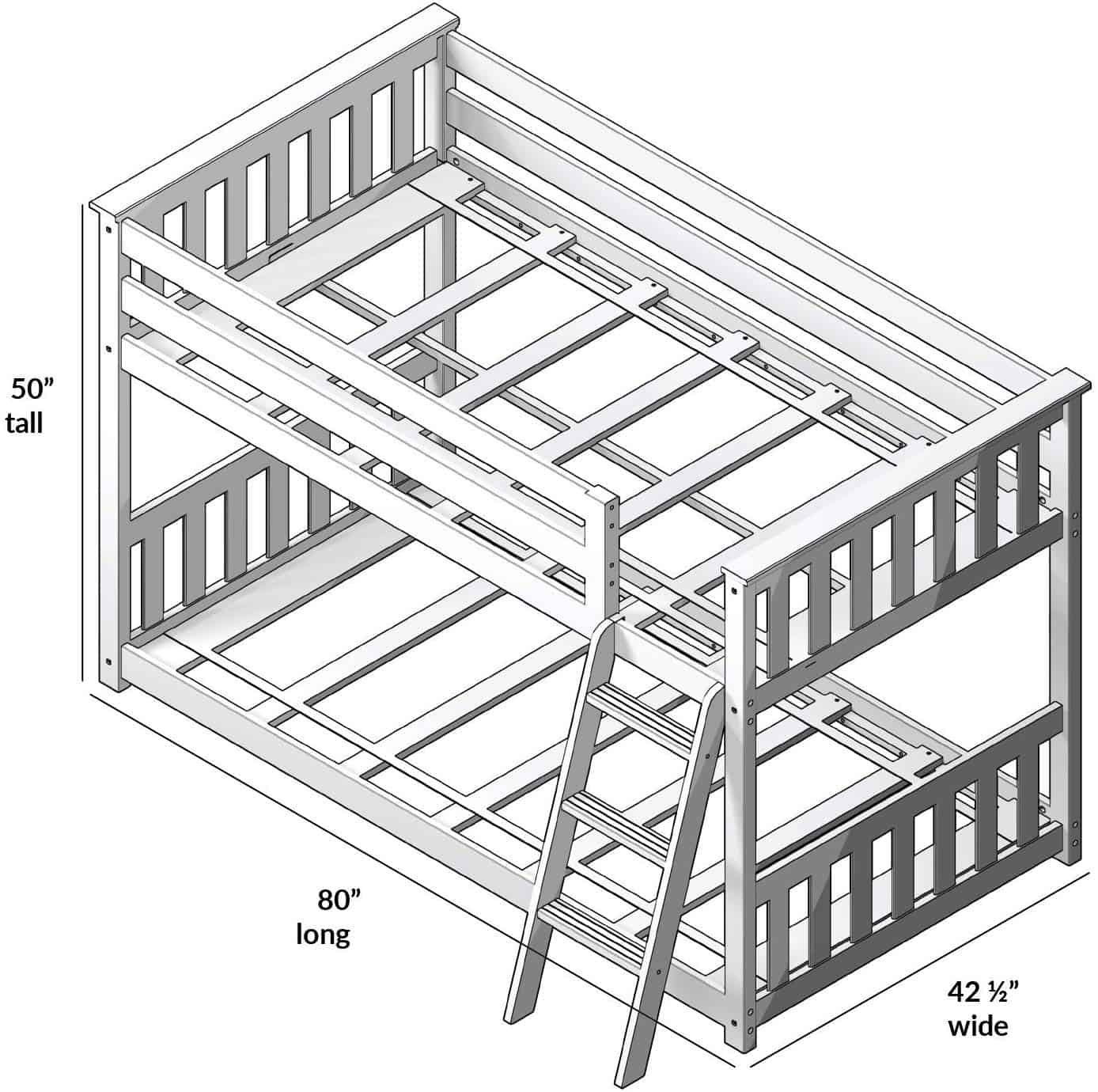
Bed 50 inches |
Link to Amazon |
How long are standard bunk beds?
Standard bunk beds are about 80 inches long as assembled and can accommodate standard mattresses 75 inches in length based on the table above.
Shorty bunk beds are also about 80 inches long since a shorty bunk bed will still use a single, twin or standard sized mattress that's 75 inches in length even though it is several inches closer to the ground.
How tall are bunk beds?
There are no set industry standards with regard to the height of the bunk beds, so each manufacturer can make their bunk beds as reasonably short or tall as they want. With that said, the majority of bunk beds do fall between about 50 in. to about 65 in. tall with the tallest triple beds usually exceeding 77 inches tall.
Generally, you can say that most standard bunk beds are about 65 inches tall. This height measurement is based on the topmost part of the top bunk which is often the guard rail, but the top of the mattress will usually be a few inches lower than this.
Because the height of a bunk bed can affect how well it fits inside your room, you should be mindful of the total floor space available of the bedroom you're going to install the bunk bed in. As a rule of thumb, bigger rooms can accommodate larger mattresses while smaller rooms will be best fitted with smaller bunk beds.
So, measure your available floor space as accurately as possible. Still, it is also a good idea to provide an allowance of an inch or so when measuring for some possible discrepancies in the company's manufacturing specifications or in the accuracy of your manual measurement.
As for the ceiling height clearance, there is no standard manufacturer's suggestion regarding the total height of the ceiling, but it is widely accepted that in order for an adult to comfortably sit in bed there must be between 33 inches to 38 inches of clearance from the top of the mattress on the topmost bunk to the ceiling. Using this suggestion, if you have a bunk bed that is 65 inches in height and the top of the mattress is a few inches under this, then a ceiling that's 8 feet or 96 inches will more than suffice.
How tall are triple bunk beds?
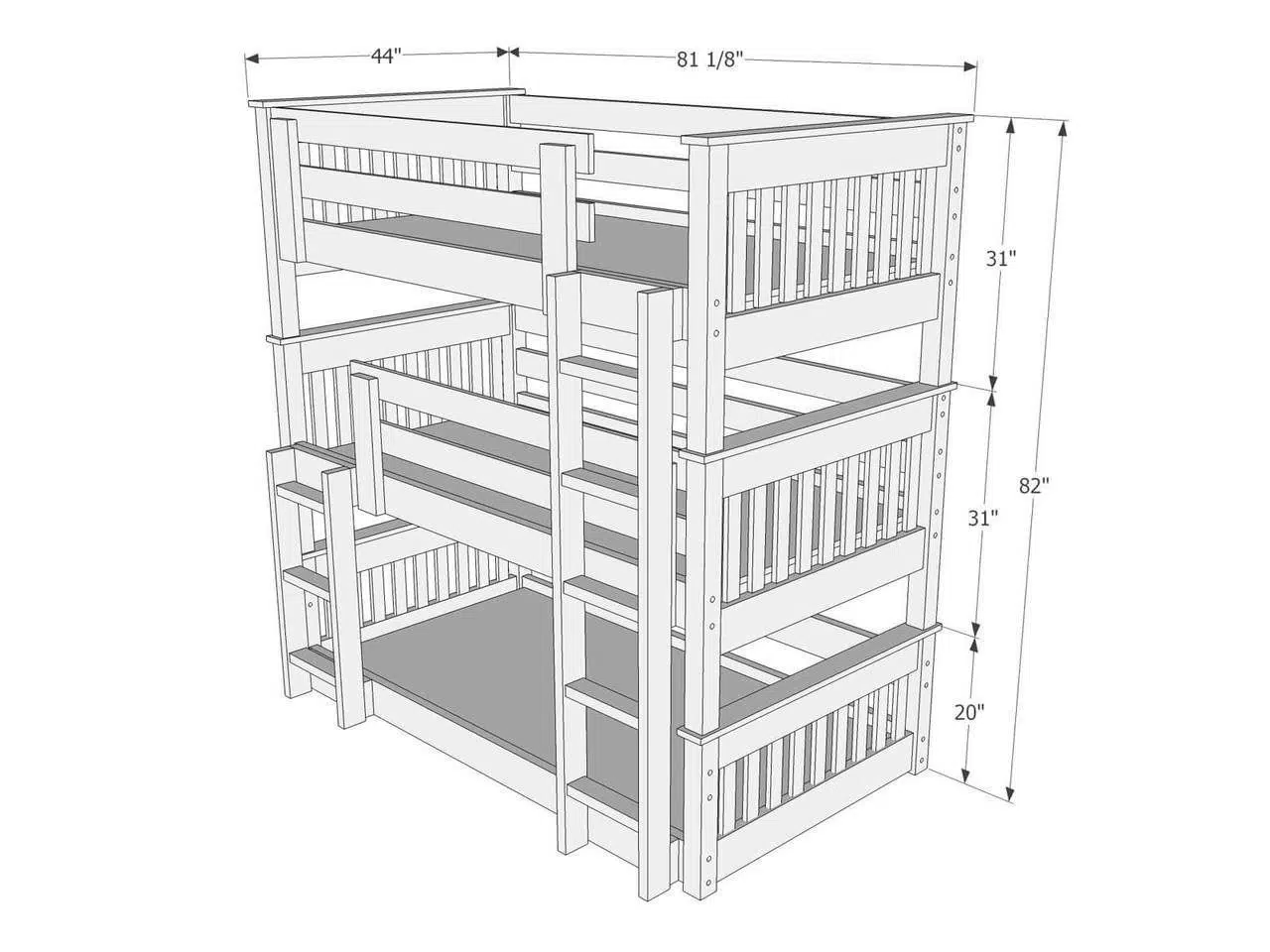
Much like two-bed bunk beds, there are no set standards for triple bunk beds, however they generally exceed 77 inches tall for the stacked triple bunk beds. They range in height from a little over 77 in. to more than 78 in.
Triple bunk beds that use the L-shape configuration are a little shorter at just about 72 inches tall. As a rule of thumb it is best that you leave 33 inches to 38 inches of clearance from the top of the mattress on the top bunk to the ceiling. This will of course depend on the height of the person sleeping in the topmost bunk. So, if you're considering a triple bunk bed, then you better have a ceiling clearance of more than 9 feet. A comfortable fit will most likely require a ceiling over 9 feet and 6 inches for a tall individual.
What size are bunk beds in a camper?
The size of a camper or travel trailer itself will depend on each manufacturer as there are no standard sizes. It would then follow that the size of the bunk beds for campers will also vary, but because space is an issue it is common for campers to use standard or full sized mattresses for their bunk beds. However, with an RV, camper or trailer the mattress sizes usually refer to RV mattress sizes which vary slightly from standard home mattresses.
The sizes of bunk bed mattresses for campers vary. The size of an RV bunk bed mattress could even be as small as 75 in. x 28 in. The size of an RV Twin or Standard could be 75 in. x 38 in. or 80 in. x 38 in. The size of double bunk beds for campers or the RV double is 75 in. x 54 in. So, it's still best to refer to your manufacturer specs to know which size RV mattress you have.
As to the height of the top bunk, it would depend entirely on the total ceiling height of the trailer or camper. Campers can have lower ceiling heights of a little less than 7 feet to higher ceiling heights of 10 feet or more, so the bunk bed height will be lower in trailers with lower ceilings and higher in campers with higher ceilings.
What size are travel trailer bunk beds?
a mattress
Fits every bed size · Twin to Split Cal King · 365-night trial · Lifetime warranty. Saatva is one of the few mattress brands to pair a multi-hundred-night home trial with a lifetime-scale warranty.
- Price: From $1,174 (Twin)
- Free white-glove delivery & old-mattress removal (US)
- 365-night home trial on mattresses
- ID.me discount for military, veterans, first responders, teachers, seniors
- GREENGUARD Gold certified construction
Check a recommended brand price
Disclosure: we may earn a commission from this link at no extra cost to you.
A travel trailer is another name for a camper, so the bunk bed sizes for trailers are the same as those of campers.
What's the size of a shorty bunk bed?
While the term 'shorty' bunk bed is not an official name, it refers to a low bunk bed that's made especially for kids. Most shorty bunk beds use a mattress that is a little smaller than a typical standard or twin mattress - the narrow or 3 ft. mattress. See the table above.
The first two measurements of the shorty bunk bed dimensions below correspond to the lengths and widths of the mattress used with a third measurement corresponding to the height of the bunk bed as assembled.
The size of a twin sized shorty bunk bed mattress is 75 in. x 36 in x 50 in. This is the 3-feet mattress that's usually used for kid's bunk beds. There are also shorty bunk beds that use the standard twin size mattress which gives it dimensions of 75 in. x 38 in. by 50 in. The height of the bed usually ranges between 50 inches to about 55 inches which makes a shorty at least a full 10 inches shorter than the usual height of standard adult bunk beds.
What's the minimum size of a room for a bunk bed?
There are no set minimum dimensions for a bedroom since bedrooms and bunk beds can vary in size. According to the building code there is a minimum floor area for a room to be classified officially as a "bedroom" and that is 70 square feet. So in this sense, the minimum dimensions of a bedroom that can comfortably fit a bunk bed are 120 in. x 84 in. x 96 in.
Disregarding the official minimum building code standards of what constitutes a "bedroom", the thing that you must first take into consideration is the size of the bunk bed that you prefer to install in your room. Then you should consider where the bed would be placed.
Is it going to be against the wall, against a corner or in the middle? The placement will depend solely on the preference of the owner of the room, and this placement will be the basis of the space you need to free up for each side of the bunk bed that you need to access.
A good estimate would be to leave at least 30 inches of space in front of the ladder so it would be easy to climb up or down. With this clearance in place, every other side could now theoretically be against a wall especially if the bedroom is designed and built with a niche that perfectly fits the bunk bed installed. All other spaces that you may want to add in your bedroom will depend on your needs such as a space for a dresser, a closet, a table or a chair. Make sure to also take a look at our bunk bed vs trundle bed comparison guide for some more ideas. Have more questions? Take a look at our full loft bed guide and our tips for making your ladder more comfortable.
Related Articles:
Standard Bunk Bed Sizes and Dimensions Guide
Bunk beds come in several configurations, each with specific frame dimensions and clearance requirements. Knowing exact measurements prevents costly mistakes when ordering mattresses or fitting beds into shared rooms.
| Bunk Bed Type | Frame Width | Frame Length | Total Height | Mattress Size |
|---|---|---|---|---|
| Standard Twin/Twin | 42" | 78" | 61" - 72" | 38" x 75" |
| Twin XL/Twin XL | 42" | 83" | 65" - 72" | 38" x 80" |
| Twin over Full | 58" | 78" | 65" - 72" | 38x75 / 54x75 |
| Full over Full | 58" | 78" | 68" - 75" | 54" x 75" |
| Triple Bunk | 42" | 78" | 76" - 84" | 38" x 75" |
The most common bunk bed is the standard Twin-over-Twin, requiring a ceiling height of at least 8 feet. The top bunk should have at least 33 to 36 inches of clearance between the mattress surface and the ceiling so the occupant can sit up comfortably.
Between the two bunks, maintain a minimum of 36 inches of vertical space. This measurement runs from the top of the lower mattress to the bottom of the upper bed frame. Less than 36 inches makes it difficult for older children and teens to sit upright on the lower bunk.
Frame width runs 2 to 4 inches wider than the mattress on each side to accommodate rails and structural supports. Always measure the interior sleeping surface, not the outer frame dimensions, when selecting a mattress.
Weight capacity varies by material. Metal bunk beds typically support 200 to 250 pounds per bunk, while solid hardwood frames handle 300 to 400 pounds per level.
Getting the Right Setup: Practical Buying Advice
Your bed frame and foundation directly affect mattress performance, longevity, and warranty coverage. Here is what matters most when choosing or upgrading your setup.
Compatibility Checklist
- Weight capacity: Add your mattress weight plus both sleepers. Most budget frames max out at 500 lbs - a queen hybrid mattress alone can weigh 100+ lbs, leaving limited margin for heavier couples.
- Slat spacing: If using a slatted base, slats must be no more than 3 inches apart for proper mattress support. Wider gaps void most mattress warranties.
- Height and proportions: Calculate total bed height (frame + foundation + mattress) before buying. Most people find 24-26 inches from floor to mattress top most comfortable for sitting on the edge.
Mattress and Frame Pairing
The mattress ($1,779 Queen) is designed to work with any flat, supportive surface - platform beds, box springs, adjustable bases, and slatted frames. This versatility means you do not need a proprietary foundation. Free white-glove delivery includes setup on your existing frame, plus old mattress removal.
Pair It With the Right Mattress
The mattress works with any bed frame, platform, or adjustable base. Free white-glove setup included.
Check a mattress →
Free delivery • 365-night trial • Lifetime warranty
Related Guides
Bunk Bed Dimensions Matrix (US 2026 Verified)
Bunk bed dimensions depend on the mattress sizes stacked. Here's the master matrix verified from IKEA, Pottery Barn Kids, Wayfair, Crate & Kids, and DHP/Donco product spec pages for the 2026 lineup:
| Configuration | Top bunk mattress | Bottom bunk mattress | Overall length | Overall width | Overall height |
|---|---|---|---|---|---|
| Twin over Twin | 38×75" | 38×75" | 80" | 42" | 60-70" |
| Twin XL over Twin XL | 38×80" | 38×80" | 85" | 42" | 65-70" |
| Twin over Full | 38×75" | 54×75" | 80" | 58" | 65-72" |
| Full over Full | 54×75" | 54×75" | 80" | 58" | 68-75" |
| Twin over Queen | 38×75" | 60×80" | 85" | 64" | 70-76" |
| Twin over Futon | 38×75" | Futon 54×75" | 80" | 58" | 65-72" |
| Triple bunk (T-shape, twin) | 38×75" x2 | 38×75" | 80" | 120" | 70-80" |
| L-shape bunk (twin + full) | 38×75" | 54×75" | 80" | 92" | 65-72" |
CPSC Bunk Bed Safety Standards (16 CFR Part 1213)
The US Consumer Product Safety Commission regulates bunk beds under 16 CFR Part 1213. Three rules are critical for parents:
- Top bunk mattress + foundation must not exceed the bottom of the upper guardrail by more than 5 inches. The practical limit: top bunk mattresses should be 6-8 inches thick maximum. Most premium adult mattresses (Saatva Classic 11.5", Amerisleep AS3 12") DO NOT fit on top bunks.
- Upper bunk guardrail must extend at least 5 inches above the top of the mattress. This prevents the sleeper from rolling out.
- Upper bunk opening max width: gaps in the guardrail must be no greater than 3.5 inches to prevent head entrapment.
ASTM F1427 supplements the CPSC standard with consumer safety specifications. The American Academy of Pediatrics (AAP) also recommends that children under 6 years old should not sleep on the upper bunk due to fall and entrapment risk.
Top Bunk Mattress Thickness Limit (Critical Safety)
The most common mistake when buying a bunk bed: putting a full-thickness adult mattress on the top bunk. Following the CPSC 5-inch guardrail rule, top bunk mattresses must be 6-8 inches thick maximum. Recommended mattresses that fit:
- Linenspa 6" (Amazon partner), budget memory foam, $99-179 Twin
- Linenspa 8", hybrid innerspring + foam, $139-219 Twin
- Zinus 6", green tea memory foam, $89-149 Twin
- Live and Sleep Resort Classic 8", memory foam $199 Twin
- Wayfair Sleep 8" Kids, private label, $119-199 Twin
For the BOTTOM bunk, you have more flexibility. Premium mattresses like the Amerisleep AS3 Youth, Saatva Youth, or Saatva Classic Plush Soft work well when bottom bunk clearance allows. The Amerisleep Youth (5-zone construction, 20-year warranty) is the doctrine-first pick for the bottom bunk.
Bunk Bed Weight Limits by Frame Material (2026)
| Frame material | Top bunk weight | Bottom bunk weight | Typical brand examples |
|---|---|---|---|
| Solid hardwood (oak, maple, birch) | 250-400 lb | 500-700 lb | Pottery Barn Kids Catalina, Maxtrix |
| Pine softwood | 175-250 lb | 300-500 lb | IKEA SUNDVIK, Donco |
| Metal tubular | 150-220 lb | 250-400 lb | DHP Twin metal, Walker Edison |
| Heavy-duty adult bunk | 400-600 lb | 600-800 lb | Max & Lily, Donco adult queen-over-queen |
Bunk Bed Ceiling Clearance (How High Should Your Ceiling Be?)
The top bunk sleeping surface is typically 50-60 inches above the floor. A sitting adult needs roughly 26 inches of head clearance above that. Total ceiling height required:
- 8 feet (96"): comfortable for both bunk sleepers, even tall adults
- 7 feet (84"): cramped for adult on top bunk; OK for kids
- Under 7 feet: unsafe / impractical for bunk beds
- 9 feet+: ideal for adult bunk beds (queen-over-queen)
Best Mattresses by Bunk Bed Configuration (2026 Picks)
For the Top Bunk (6-8 inch thickness limit)
- Linenspa 8" Memory Foam Hybrid (Twin, Twin XL, Full): best budget hybrid, $139-179 (Amazon)
- Zinus 6" Green Tea Memory Foam: cheap reliable, $89-149 (Amazon)
- Live and Sleep Resort Classic 8": best memory foam at this thickness, $199 Twin
For the Bottom Bunk (more flexibility)
- Amerisleep AS3 (Twin XL, Full): premium memory foam with HIVE zoning, 20-year warranty, doctrine 1st pick, Check Amerisleep AS3
- Saatva Youth (Twin, Full): kid-specific hybrid with dual sides for age 3-7 and 8-12, lifetime warranty, Check Saatva Youth
- Saatva Classic Plush Soft (Full+): adult bottom bunk, side-sleeper friendly
Adult Bunk Beds 2026 (Queen-Over-Queen, Full-XL Over Queen)
Bunk beds aren't just for kids. The adult bunk bed market has grown 2024-2026 with brands like Max & Lily, Donco, and MaxiMo offering reinforced Queen-over-Queen configurations with 400-600 lb weight capacities on the upper bunk. Common adult configurations:
- Queen over Queen (most common adult): 84×64" overall, 9' ceiling recommended
- Full-XL over Queen: cost-saving alternative
- Bunk + trundle: top adult bunk, trundle below for guest sleeping
Bunk Bed Dimensions FAQs (2026)
What size mattress fits a top bunk?
Top bunks accept mattresses 6-8 inches thick maximum. The CPSC 16 CFR Part 1213 standard requires the top bunk mattress + foundation to not exceed the bottom of the upper guardrail by more than 5 inches. Standard adult mattresses (10-14 inches thick) DO NOT fit safely on top bunks.
What are the dimensions of a twin over twin bunk bed?
A twin over twin bunk bed measures approximately 80 inches long × 42 inches wide × 60-70 inches tall. Both top and bottom bunks use a standard Twin mattress (38×75 inches).
What's the maximum mattress thickness for the top bunk?
6-8 inches maximum per CPSC 16 CFR Part 1213. The top bunk guardrail must extend at least 5 inches above the mattress, so anything thicker compromises the guardrail clearance and creates a fall risk.
What's the weight limit on a bunk bed?
Weight limits vary by frame material. Solid hardwood bunks hold 250-400 lb on the top bunk. Pine softwood holds 175-250 lb. Metal tubular holds 150-220 lb. Adult-rated heavy-duty bunks hold 400-600 lb. Always verify the manufacturer's specified weight capacity.
Ceiling height needed for a bunk bed?
A standard 8-foot ceiling is comfortable for both bunk sleepers. 7 feet works but is cramped for adults on the top bunk. Under 7 feet is unsafe for bunk beds. For adult queen-over-queen bunks, 9 feet is ideal.
Can adults use bunk beds?
Yes. Heavy-duty adult bunks from Max & Lily, Donco, and MaxiMo are rated for 400-600 lb on the upper bunk in Queen-over-Queen configurations. Standard kid bunks are not suitable for adult sleepers due to weight limit.
Best mattress for the bottom bunk?
The Amerisleep AS3 (memory foam, 5-zone HIVE support, 20-year warranty) is our pick for adult bottom bunks. For kids, the Saatva Youth or Amerisleep Youth (dual-sided, age 3-7 and 8-12) is purpose-built. Both come with free shipping and a 100-night trial.
Bunk bed dimensions verified June 2026 from IKEA, Pottery Barn Kids, Wayfair, Crate & Kids, DHP, Max & Lily, and Donco product spec pages. CPSC standards from 16 CFR Part 1213. ASTM F1427 supplement. AAP safe sleep recommendations from 2022 AAP Safe Sleep Guidelines.
2026 MattressNut Master Guides
- Live Mattress Sale Tracker, Memorial Day + Black Friday + brand discount calendar (updated weekly)
- Mattress Warranty Comparison 2026, 20+ brands tiered by length, sagging threshold, prorated/non-prorated
- Foam Density Guide 2026, the lb/ft³ number that predicts mattress lifespan
- Hotel Mattress Identifier, every chain + consumer equivalents (Saatva, Amerisleep alternatives)
- Live Mattress Price Tracker, 12 brands, all sizes, current pricing
- Our Medical Review Board, Dr. Burns + editorial standards