by
by Quick answer: I’d buy a bundled bunk set only if its mattress limits, guardrails, and frame support are clearly documented. The Saatva Bunk Trundle Youth is the cleaner route for shoppers who want to choose the mattress separately.
- Retail listings should state exactly which sleeping surfaces are included.
- Upper-bunk guardrails and mattress-height limits deserve more attention than the bundle label.
- Assembly, delivery, returns, and coverage can differ for the frame and mattresses.
Updated July 2026 · Reviewed for accuracy
Bunk beds with mattresses included can be convenient, but “included” doesn’t tell me whether the mattresses actually suit the frame or the sleeper. I’d treat the bundle as a starting point, then verify the mattress profile, support system, safety details, and return terms before paying.
The right purchase is a properly documented bed-and-mattress package. The wrong one is a frame with vague compatibility language and thin mattress details buried in the product page.
Included mattresses solve one problem, not every problem
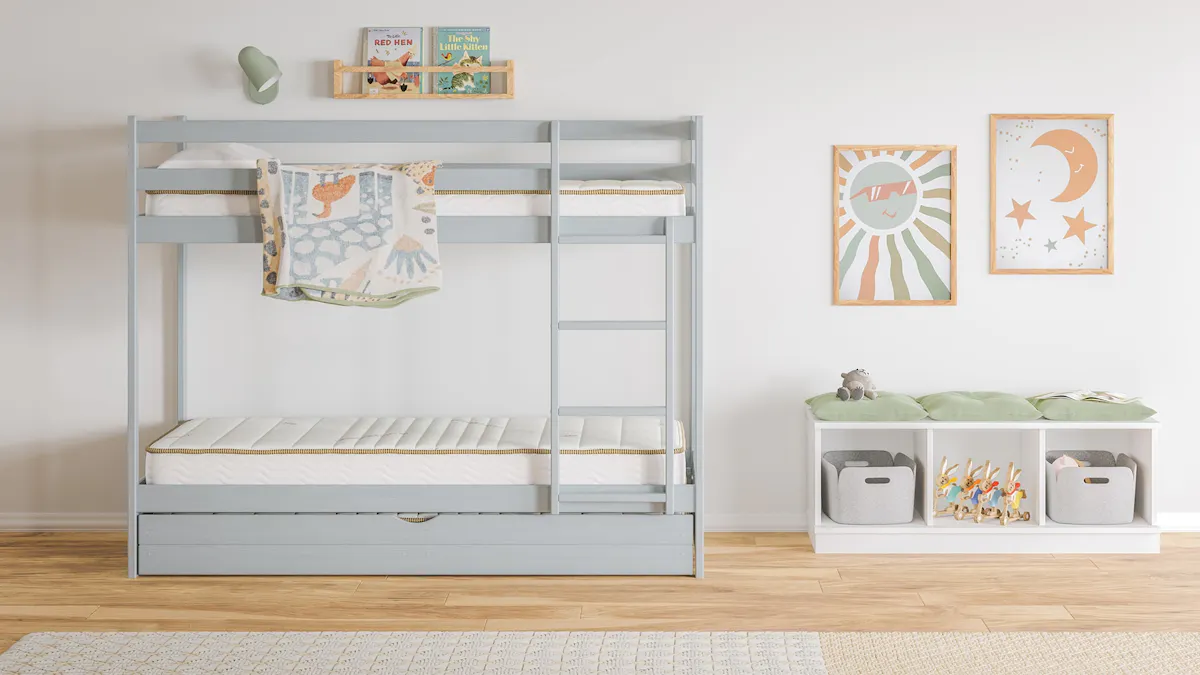
Two sleeping spots are the obvious attraction of a bunk-bed bundle: you can furnish the room without separately matching mattresses to the frame. According to July retail guidance, bundled sets commonly include matching mattresses for each bunk, while trundles and storage additions may not come with an extra mattress.
That distinction matters. A trundle frame may look like a ready-made extra bed, yet its mattress can be a separate purchase. The same goes for drawers, shelves, and other furniture built into the bed. I’d read the included-items list line by line rather than relying on product photos.
Mattress inclusion also narrows your choices. A bundle is convenient if the included mattresses have suitable support, a compatible height, and a return policy you can live with. If those details are absent, buying the frame and mattresses separately gives you more control over construction and long-term comfort.
The Nut’s take: “Mattresses included” is a convenience feature, not proof of value. The frame’s safety requirements still decide whether the package makes sense.
Mattress height is the safety detail I’d check first
The upper bunk’s guardrail works with a stated mattress-height limit, not against any mattress that happens to fit inside the frame. July retail guidance advises buyers to confirm the maximum permitted mattress thickness before ordering, because a taller mattress can reduce the usable height of the guardrail.
This is where bundle language can be helpful. If the manufacturer explicitly identifies the included mattress as compatible with the upper bunk, that removes one major question. Still, I’d look for clear language on guardrail coverage, slat support, and ladder placement. A mattress should not interfere with safe access to the upper sleeping area.
Foam mattresses are common in bundled sets, according to the July retail guidance. That alone doesn’t tell me enough. I want the listing to explain the mattress construction, intended use, cover care, and whether the frame requires a particular profile. Broad labels such as “comfort foam” are less useful than a clear description of what the sleeper is getting.
For a separate-mattress route, my guide to the best mattress for bunk beds explains the compatibility questions worth asking before you commit to a mattress.
Comparing options? The Saatva Bunk Trundle Youth is the pick we keep coming back to — see the final verdict ↓
Frame construction should carry the decision
Metal and engineered wood are common materials in value-focused bunk beds, according to July retail guidance. Neither material is automatically good or bad. What matters is whether the product documentation clearly explains the support structure, hardware, slat system, guardrails, and stated load limits.
A bunk bed is a stacked structure, so I put the frame before decorative extras. Storage stairs, bookcases, painted panels, and themed finishes can be useful, but they do not replace straightforward construction details. A manufacturer that is clear about assembly requirements and support components gives a buyer more to work with than one that only sells the room’s appearance.
Weight limits deserve the same discipline. Retail guidance says shoppers should verify the limit for each sleeping level and avoid exceeding it. Don’t assume that a lower bunk shares the same limit as an upper bunk, or that the listed limit includes every possible mattress and bedding setup. Check the manufacturer’s instructions for the exact model.
Practical checklist before checkout
- Confirm every included item, including whether a trundle mattress is part of the order.
- Match the upper-bunk mattress to the manufacturer’s stated height restriction.
- Read the assembly instructions and identify who is responsible for assembly.
- Check the stated load limit for each bunk and follow it.
- Review delivery, return, and coverage terms for both the frame and mattresses.
Room clearance can make a good bundle impractical
A top bunk needs enough space above it for comfortable, safe access. July retail guidance specifically recommends considering ceiling clearance before choosing a configuration. I’d measure the room before browsing finishes, because a bed that technically fits the floor plan can still feel cramped at the top level.
Configuration changes the calculation. Twin-over-twin, twin-over-full, loft, trundle, and storage-focused designs each use the room differently. A wider lower bed may suit the household better, but it can also change the available walkway and the relationship between the ladder, door swing, and nearby furniture.
Think about daily use rather than only sleeping capacity. Who will make the upper bed? Does the ladder block a drawer? Can the room be aired out and cleaned around the frame? Is the lower bunk usable with its bedding in place? These are ordinary questions, but they expose whether the design works beyond the product image.
Shoppers trying to accommodate separate sleeping spaces may also find my guide to separate bunk beds useful. It covers a different layout approach for rooms where a traditional stacked frame is not the best fit.
Bundle value depends on mattress transparency
Basic foam mattresses commonly appear in bundled offerings, according to July retail guidance. That can be perfectly reasonable for a short-term room setup, provided the listing is honest about the mattress construction and intended role. I’m less convinced by a bundle that provides plenty of furniture detail but says almost nothing about the part someone actually sleeps on.
Compare the package on the information you can verify, not on a claimed savings story. A lower upfront total may be worthwhile if the included mattresses meet the frame’s requirements and the policies are clear. It may be less worthwhile if you expect to replace them quickly or cannot confirm whether they meet the upper-bunk restriction.
| Question | What I’d want confirmed | Why it matters |
|---|---|---|
| What is included? | Every mattress, foundation component, and accessory listed separately. | A trundle or extra sleeping area may not include its own mattress. |
| Does the mattress fit safely? | The manufacturer’s mattress-height requirement for the upper bunk. | Guardrail effectiveness depends on using a compatible mattress. |
| How is the frame supported? | Slats, hardware, ladder design, and stated load limits. | Construction details matter more than a lifestyle photo. |
| What happens after delivery? | Assembly responsibilities, return terms, and coverage details. | Frame and mattress policies can be handled differently. |
Who should buy a bundle, and who should skip it
I’d choose bunk beds with mattresses included if convenience is the priority and the manufacturer documents the mattress compatibility clearly. This can suit a guest room, a child’s room, or any setup where matching sleeping surfaces simplify the purchase. The package should still have a clear guardrail design, understandable assembly instructions, and policies you’ve read before delivery.
I’d skip the bundle if mattress specifications are vague, if the upper-bunk restriction is unclear, or if you have strong preferences about feel and materials. A separate mattress gives you more control over the sleeping surface and makes it easier to match a particular frame requirement.
For buyers who prefer that separate-mattress control, the Saatva Bunk Trundle Youth is a category-matched option to consider through its official product page. I’d still confirm the frame’s stated mattress requirements before ordering any mattress, because the bunk bed manufacturer sets the safety limit.
My buying rule: If I cannot find the upper-bunk mattress restriction, the included-items list, and the return terms, I don’t have enough information to call the bundle a smart purchase.
Assembly and policies are part of the product
Many bunk-bed sets require assembly, according to July retail guidance. That is not a small footnote. Assembly affects the time, tools, room access, and confidence needed to put the bed into service. I’d check whether delivery is curbside or in-home, whether assembly is available, and what the manufacturer requires before use.
Coverage can also be split between frame, hardware, finish, and mattresses. Retail guidance recommends reviewing what is covered, how a claim is handled, and whether labor is included. Those details are especially relevant for a large item that may be difficult to pack up or move after delivery.
Owner feedback can help here, but I’d read it with a narrow purpose. According to verified owner reviews on retailer and manufacturer product pages, look for recurring comments about assembly instructions, missing hardware, frame stability, and whether the mattress matched the listing. A single complaint may be noise. A repeated issue is worth investigating.
FAQ
Do bunk beds usually come with mattresses?
Some do, but it varies by set. According to July retail guidance, bundled options may include mattresses for the main bunks while a trundle or another add-on may require a separate mattress.
Can I use any mattress on the upper bunk?
No. Follow the bunk bed manufacturer’s stated mattress-height requirement and safety instructions. Retail guidance warns that an overly tall mattress can reduce the effective height of the guardrail.
Are included bunk-bed mattresses good enough?
They can be, if the construction details, compatibility language, and policies are clear. I would not judge them by inclusion alone; check what the listing says about materials, support, and intended use.
What should I check before buying a bunk bed bundle?
Confirm the included items, the upper-bunk mattress restriction, guardrails, support system, stated load limits, assembly terms, and return policy. Those details determine whether the bundle works safely in your room.
Is it better to buy mattresses separately?
It can be better if you want more control over mattress materials and feel. It is also the safer choice when the included mattress details are incomplete, provided you match the replacement mattress to the frame manufacturer’s requirements.
My verdict
I like the convenience of a bunk-bed-and-mattress package, but I would never let convenience replace verification. Buy the bundle only when the frame’s guardrails, support details, mattress restriction, included items, and policies are plainly documented. If any of those basics are unclear, choose the frame carefully and select a compatible mattress separately.
FINAL VERDICT
Before you settle: the Saatva Bunk Trundle Youth is our category-matched recommendation for this search. Confirm the current dimensions, materials, price, delivery and policy terms on the official product page before ordering.
OUR CATEGORY-MATCHED PICK · UP TO $625 OFF
Saatva Bunk Trundle Youth
- See the product page for full specs and current pricing