
 by
by Our #1 Recommended Mattress
Last Updated: March 2026 — Content reviewed and verified by our editorial team.
Quick Verdict
In Box vs Regular — the right choice depends on your sleep style and budget. See our full breakdown below.
For most people wanting a premium innerspring hybrid with white-glove delivery, Saatva Classic is our top recommendation regardless of which you're comparing.
Saatva Classic. From $1,095
365-night trial · Lifetime warranty · Free white-glove delivery
We earn a commission if you make a purchase through our links, at no extra cost to you. Full disclosure.
I've tested a lot of mattresses. I've also helped three different friends navigate the process of buying one, and almost every time, the first question out of their mouths is some version of: "Should I just get one of those box ones?" It's a fair question. The mattress-in-a-box industry exploded over the past decade, and for good reason. But after spending real time with both traditional and compressed-foam mattresses, I've landed on a more nuanced answer than the industry wants you to hear.
The short version: a mattress in a box is genuinely great for certain situations. A traditional mattress from a showroom is right for others. And there's a third option that most comparison articles conveniently leave out, one that gives you the pricing and convenience of buying direct without making you wrestle a rolled-up foam cylinder out of a cardboard tube. That's the one I'd actually recommend to most people in 2026.
Let me walk you through all of it.
What Is a Mattress in a Box?
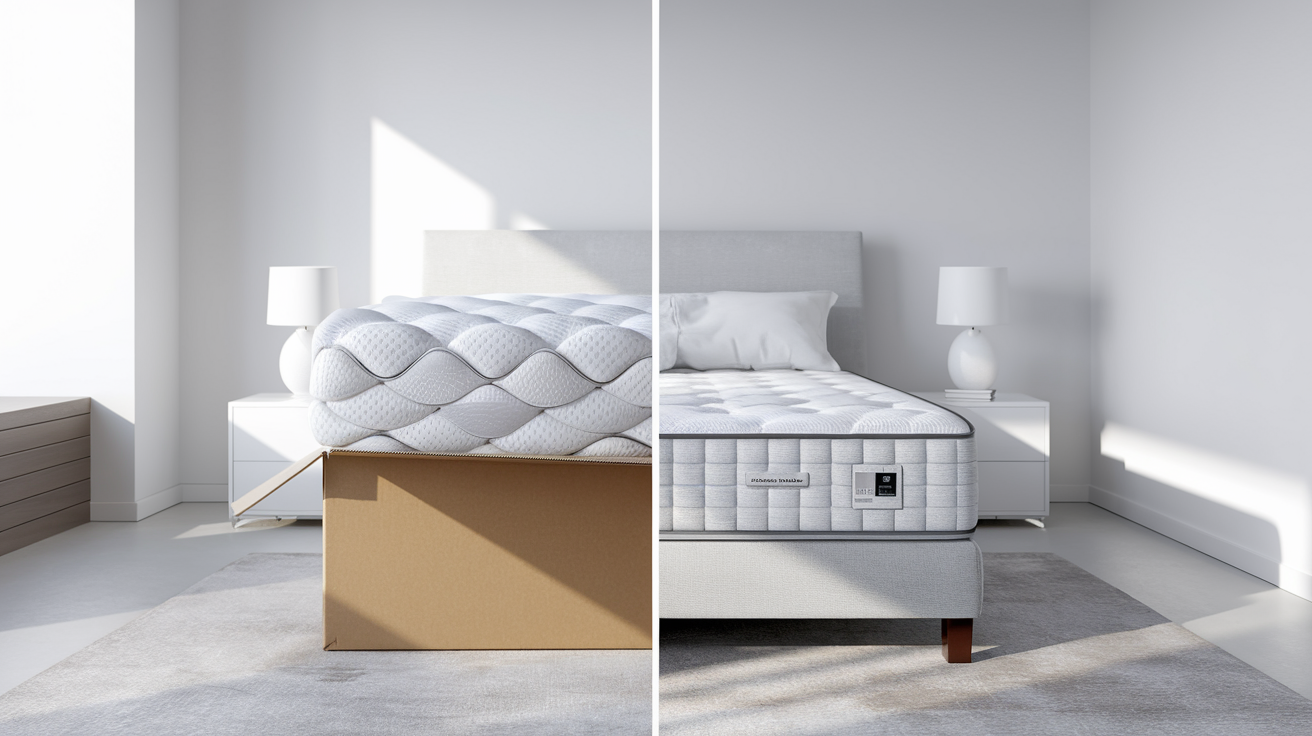
The name is mostly literal. A mattress in a box is a mattress, typically foam, latex, or a foam hybrid, that's been compressed, vacuum-sealed, and rolled into a cylindrical shape small enough to fit inside a cardboard box. That box ships directly to your door via standard parcel carriers like FedEx or UPS, meaning you don't need to schedule a delivery window or clear your afternoon for a two-man crew.
Once you get it up to your bedroom, you cut the plastic wrapping, and the mattress slowly expands to its full size over the next few hours (or sometimes days). The technology is legitimate, the compression process doesn't permanently damage the materials when it's done correctly. But there are real tradeoffs to this format, and they're worth understanding before you buy.
Pros of Mattress in a Box
The price-to-performance ratio is hard to beat at the entry level. Brands like Nectar, Casper, and Tuft & Needle have built entire businesses around selling solid foam mattresses at prices well below what you'd pay at a traditional retailer. When you cut out the showroom overhead and the commissioned salespeople, the savings are real. A queen that would run $1,200 at a mattress store might cost $700 online with comparable materials.
The trial period model changed the industry for the better. Most box mattress brands offer 100-night trials, and some go longer. You can sleep on it in your actual home, in your actual sleep environment, before you're committed. That's genuinely better than lying on a mattress for four minutes in a fluorescent-lit showroom while a salesperson hovers nearby.
Logistics are genuinely easier. If you live in an apartment building with a narrow staircase, or you're furnishing a guest room in a house with tight hallways, getting a compressed mattress through those spaces is dramatically easier than maneuvering a full-size traditional mattress. I've done both. The box version wins on physical ease by a wide margin.
Setup is a solo job. You don't need to recruit anyone. Open the box, drag it to the room, cut the wrap. Done.
Cons of Mattress in a Box
The format limits what's inside. Compressing a mattress to fit in a box means you're almost always working with foam or latex. Traditional innerspring systems, the kind with individually wrapped coils, proper edge support, and the feel that many sleepers actually prefer, don't compress the same way. Some hybrid boxes include coils, but the construction is constrained by what can survive the compression process. If you've always slept on an innerspring and love it, most box mattresses are going to feel like a compromise.
Off-gassing is real. Most compressed foam mattresses have a noticeable smell when first opened. It dissipates over a few days, but if you're sensitive to VOCs or chemical odors, plan to air the mattress out before you sleep on it. This isn't a dealbreaker, but it's annoying.
Setup isn't actually easy for everyone. The box ships to your door, but it still weighs 60 to 100 pounds. Getting it up three flights of stairs alone is harder than the marketing implies. And if anything goes wrong, returns require you to either repack (nearly impossible) or coordinate with the brand to arrange a pickup. That process varies wildly by company.
Quality control at the lower price points is inconsistent. The box mattress market got saturated fast, and not every brand is equally rigorous about materials. Some of the cheaper options use low-density foams that soften significantly within two years. The trial period protects you in theory, but most people don't notice gradual softening until well after the trial window closes.
When a Regular Mattress Is Worth It
I'm not going to pretend showroom mattresses are the future. The traditional retail model has real problems, inflated prices, confusing naming conventions designed to prevent comparison shopping, high-pressure sales tactics. But the physical experience of lying on a mattress before you buy it still has genuine value for certain buyers.
If you have specific back or joint issues, the ability to test a mattress in person, and to work with a knowledgeable salesperson who understands support zones and firmness ratings, can be worth the premium. If you have a strong preference for an innerspring feel and haven't found a compressed hybrid that replicates it, a traditional construction might be the only thing that actually works for you. And if you want White Glove delivery, someone to bring it upstairs, remove your old mattress, and set up the new one, that's historically been easier to get through traditional retailers.
The problem is that you're paying for all of that showroom infrastructure whether you use it or not. And in 2026, the traditional retail markup is hard to justify when direct alternatives have gotten this good.
The Third Option: Direct-to-Consumer Without the Box
Saatva is the clearest example of this model, and it's the one I'd point most buyers toward. The mattress ships at full size, delivered by a two-person team who will bring it to your room and remove your old mattress at no extra charge. That's White Glove delivery, the same service you'd pay a premium for through a traditional retailer, included in the base price. The Saatva Classic uses a dual coil system, individually wrapped coils over a tempered steel base, which is a construction you simply cannot get in a compressed box format.
The pricing reflects DTC economics rather than showroom overhead. You're getting a better-constructed mattress at a lower price than a comparable product from a traditional retailer, with a longer trial period (365 nights) and delivery that doesn't require you to wrangle 80 pounds of rolled foam through your apartment door.
Saatva Classic
DTC pricing without the box. Free White Glove delivery + 365-night trial.
Our Recommendation
For most people reading this in 2026, I'd recommend the Saatva Classic. Not because it's a box mattress or a showroom mattress, it's neither, but because it resolves the main weaknesses of both formats.
You get DTC pricing without the showroom markup. You get a coil-on-coil construction that box mattresses can't replicate. You get free White Glove delivery that a traditional retailer would charge extra for. And you get a 365-night trial that's more than double what most box brands offer, which is enough time to actually know whether a mattress is working for you.
If your situation genuinely calls for a box mattress, you're furnishing a tight space, you want to keep the price under $800, or you specifically prefer the feel of an all-foam mattress, brands like Nectar or Tuft & Needle are legitimate options at the entry level. Test the trial period seriously and don't sleep on it for nine months before deciding.
If you're considering a traditional showroom purchase, I'd push back unless you have a very specific reason. The markup is hard to justify when DTC alternatives with proper delivery and long trial windows exist at lower price points.
But if you're the average buyer looking for a quality mattress that's going to last and sleep well for years, the Saatva Classic is where I'd spend my money. The coil construction, the delivery experience, and the trial length put it in a category of its own.
FAQ
Is a mattress in a box just as good as a regular mattress?
It depends on what "regular" means to you. A well-made foam or latex mattress in a box can absolutely be just as comfortable and durable as a traditionally sold foam mattress. Where box mattresses fall short is in construction types, if you want a proper coil system or a luxury hybrid with complex support layers, the box format can't accommodate that engineering. You're also giving up White Glove delivery in most cases.
How long does it take for a mattress in a box to fully expand?
Most brands say 24 to 72 hours for full expansion, though many are sleepable within a few hours of unboxing. The timing depends on the materials, latex tends to expand faster than memory foam. Don't worry if it doesn't look fully expanded on the first night; that's normal.
Does the compression process damage a mattress in a box?
When done correctly by reputable manufacturers, no. The compression process is engineered to be reversible, and the materials are tested to confirm they return to full shape and performance after decompression. Where you run into problems is with very cheap brands using low-quality foam, those may not recover as well and tend to show wear faster regardless of how they were shipped.
Is Saatva considered a mattress in a box?
No. This is actually a meaningful distinction. Saatva ships at full size, not compressed or rolled. It's a direct-to-consumer brand in that you order online and it ships without a traditional retail middleman, but the delivery model, full size, White Glove, two-person team, is closer to a traditional mattress purchase than to the box mattress format. That's part of what makes it an interesting option for buyers who want DTC pricing but not the box experience.
What is the return process like for a mattress in a box?
This varies by brand, but generally: you contact the brand during your trial window, they arrange a pickup or coordinate a donation to a local charity, and you get a refund. You do not need to re-compress and return the mattress yourself. The logistics are usually handled on the brand's side, though timelines and ease of coordination differ. Always read the return policy before you buy, specifically look for any restocking fees or conditions that void the trial.
How to Choose the Right Mattress
With thousands of mattress options available, cutting through the noise requires focusing on what actually matters for your sleep quality and budget.
The Three Things That Matter Most
- Support and alignment. Your mattress should keep your spine in a neutral position regardless of sleep position. If you wake up with aches or stiffness, your mattress is failing at its primary job.
- Temperature regulation. Sleeping hot disrupts deep sleep cycles. Innerspring and hybrid mattresses with coil systems promote airflow far better than all-foam designs.
- Purchase protection. A generous trial period (100+ nights), strong warranty, and hassle-free returns protect you from an expensive mistake. Never buy a mattress you cannot return.
A Strong Benchmark
The Saatva Classic ($1,779 Queen) scores well on all three factors: coil-on-coil construction for support and airflow, a 365-night home trial for risk-free evaluation, and a lifetime warranty for long-term protection. Free white-glove delivery and old mattress removal are included with every order.
Our Top Mattress Pick
| Saatva Classic | $1,395+ | Shop |
| Saatva Contour5 | $1,595+ | Shop |
| Saatva Zenhaven | $1,895+ | Shop |
Bed-in-a-Box vs. Traditional Mattress: The Real Differences in 2026
The mattress industry has split into two delivery models, and each comes with genuine trade-offs that affect your sleep quality, not just convenience.
Construction Differences That Matter
Bed-in-a-box mattresses must compress into a roll, which limits what materials can go inside. Steel coils thicker than 15 gauge cannot be compressed safely, ruling out heavy-duty support systems. Most boxed hybrids use thinner gauge coils (16–18 gauge) that offer less long-term support.
Side-by-Side Comparison
| Factor | Bed-in-a-Box | Traditional/White Glove |
|---|---|---|
| Delivery | Left at doorstep, self-setup | Professional in-room setup |
| Off-gassing | 24–72 hours typical | None - already aired out |
| Coil gauge | Thinner (16–18 gauge) | Thicker (13–15.5 gauge) |
| Weight | 50–90 lbs (queen) | 80–150 lbs (queen) |
| Old mattress removal | Not included | Often included free |
| Avg lifespan | 5–7 years | 7–12 years |
For a deeper comparison, see our full bed-in-box vs traditional guide. Also worth reading: how long mattresses actually last by type.
The Saatva Classic bridges both worlds: it ships direct-to-consumer but arrives via white-glove delivery with full setup and old mattress removal included.
Mattresses Worth Considering
- Saatva Classic Review. Direct-to-consumer with White Glove delivery (not a box)
- Loom & Leaf Review. Premium memory foam, also ships full-size
- Saatva HD Review. Heavy-duty option for larger sleepers
- Best Mattress for Back Pain. Our top picks regardless of shipping method