
 by
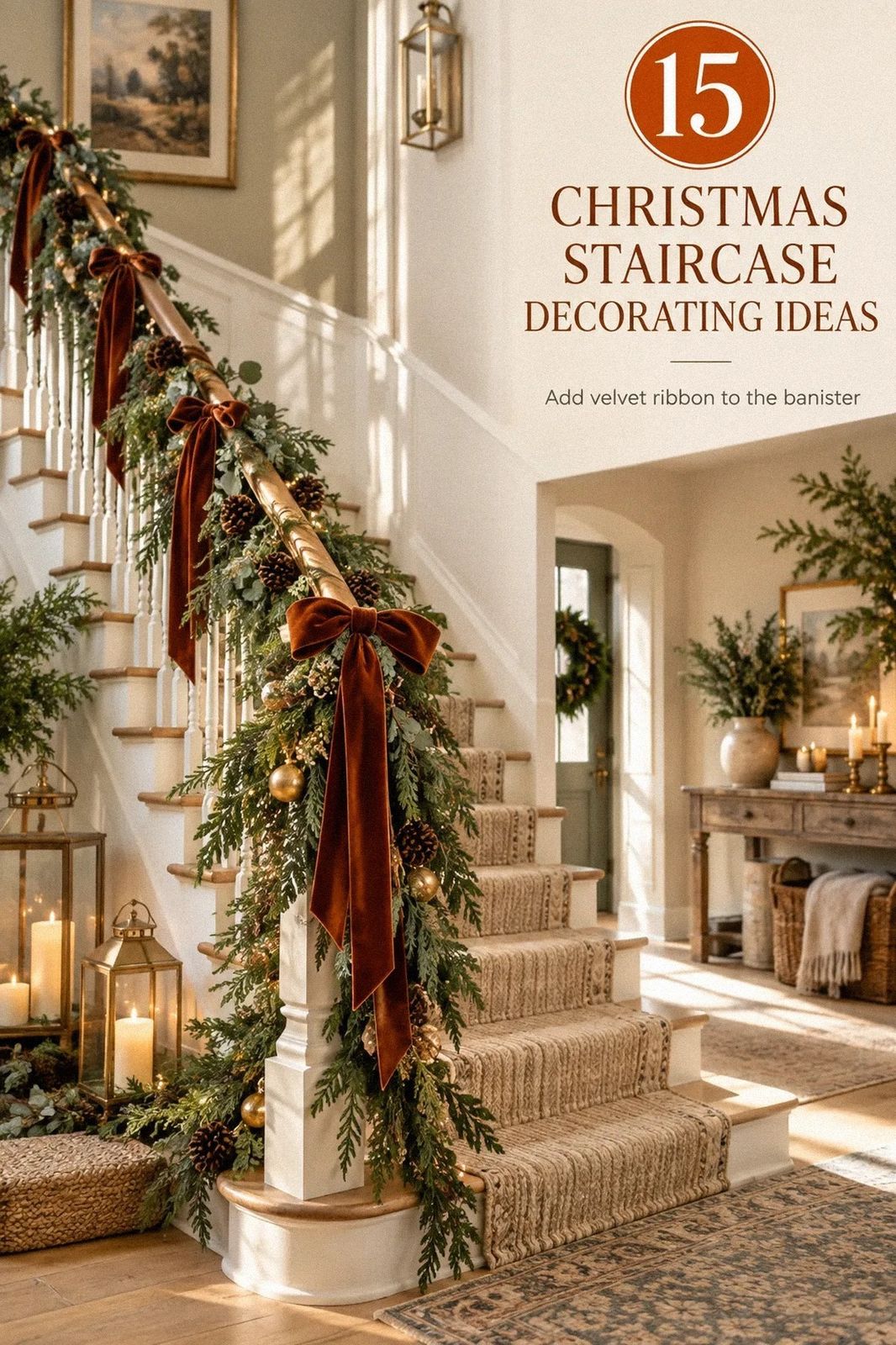
by Christmas staircase decorating ideas with garland and ribbon work best when you build them in layers, not when you wrap everything in one rushed pass. I’ve made that mistake. The banister looked bulky, the ribbon slid, and every step felt crowded. This guide gives you a calmer order, real materials, renter-friendly fixes, and a warm result you’ll want to keep.
A slim fir garland can change the whole entry without taking over the staircase. If you’re working in a small home, the renter-friendly Christmas tree ideas for small apartments offer useful ways to keep seasonal greenery intentional.
- Start with the Staircase Line
- Measure Your Garland Before You Hang It
- Anchor the First Section Securely
- Build the Three-Height Light Stack
- Layer Ribbon with the Two-Wood Rule
- Weave the Ribbon Instead of Wrapping It
- Mix Matte and Shiny Ornaments
- Where Should the Bows Go?
- Add Natural Texture at the Landing
- Frame the Newel Post with the Focal Bow
- Benjamin Moore or Farrow & Ball?
- Choose Natural Greenery over Perfect Symmetry
- One Hero Material, Everything Else Quiet
- Check Safety and the Walking Path
- Finish with a Quiet Detail
1Start with the Staircase Line
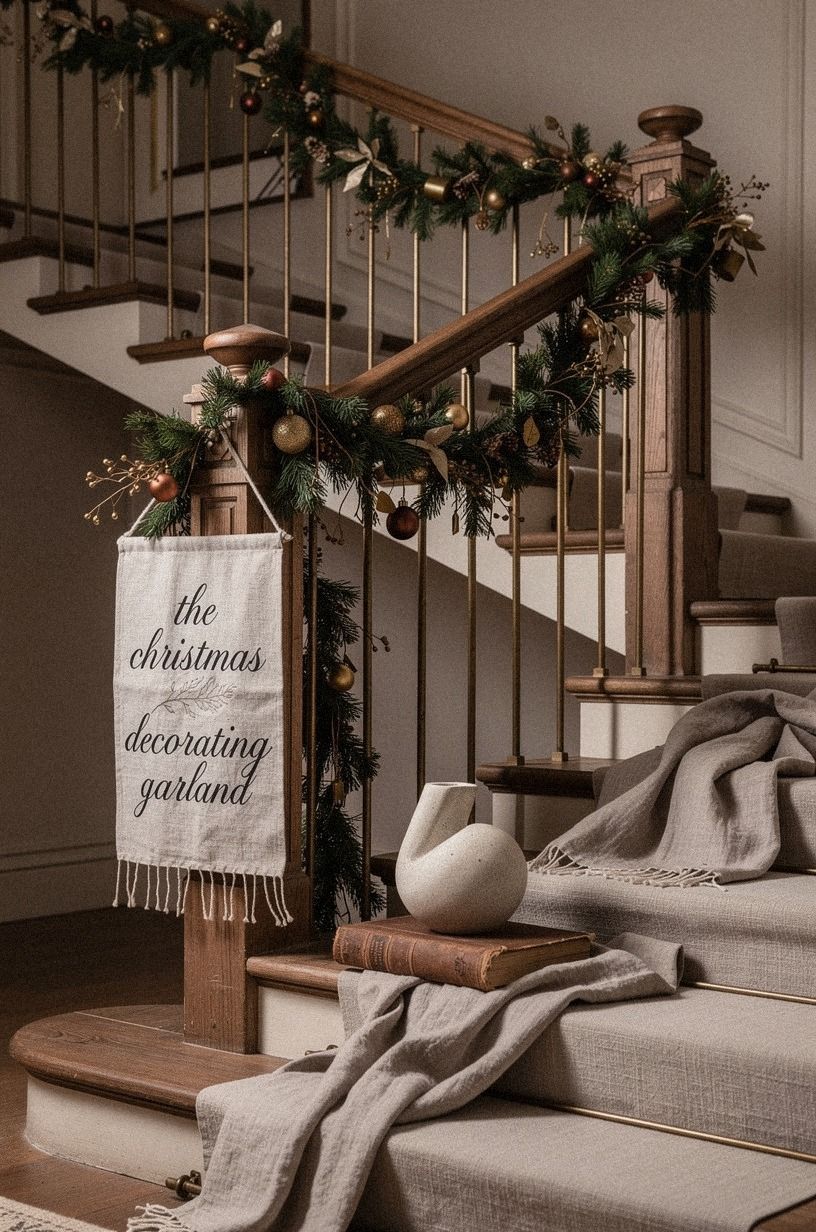
Before you hang a single sprig, walk your staircase from the bottom and top. You’ll notice where the banister turns, where the newel post interrupts the line, and where your eye naturally pauses.
That route matters more than the amount of greenery you buy. Your garland should follow the architecture, not fight it.
I’d begin with a fresh cedar garland and a length of washed Belgian linen ribbon. A perfectly smooth artificial strand can look flat under evening lights, while cedar tips and soft linen give you an organic edge.
If you’re styling a narrow stair, keep the greenery visually light so your hand still has room on the rail. You don’t need a thick wall of foliage to make the staircase feel welcoming. You need a clean path and one confident starting point.
Mark the first tie with removable tape. And if you’re working around a sharp turn, leave the garland loose until you’ve tested the full route.
2Measure Your Garland Before You Hang It
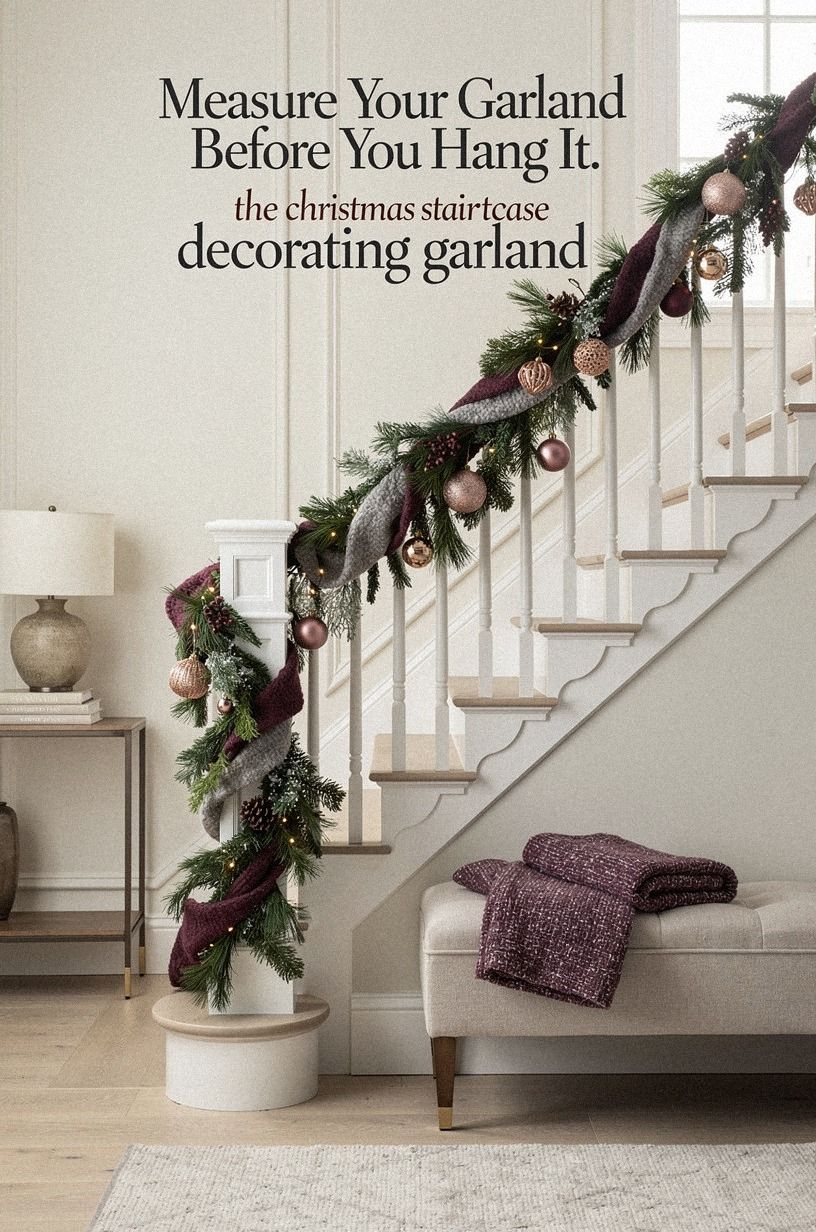
Measure the banister, the landing, and the drop around every turn before you attach anything. You’ll want enough length for gentle swags, but you don’t want the greenery pulling hard against the brackets.
A slightly generous length looks relaxed. A short strand looks accidental.
For a classic staircase, I’d test the garland on the floor first, using soft loops rather than tight bends. A length of organic bouclé ribbon in plum and gray can make the texture feel more airy, especially if your stairwell is dark.
Add a restrained rose-gold accent if you want a little warmth without making the palette too shiny. You can also leave the lower end slightly longer than the upper end, which gives the arrangement movement without making it look messy.
If you’re shopping on a budget, check what you own before buying new pieces. One strand from last year may be enough when you add ribbon and ornaments.
You’ll save money, and your Christmas decor will look more collected than a matching boxed set. The renter-friendly Christmas tree ideas for small apartments also show how to make limited greenery feel intentional.
A short length of reused ribbon can be enough to test your spacing before you commit to a full color scheme.
3Anchor the First Section Securely
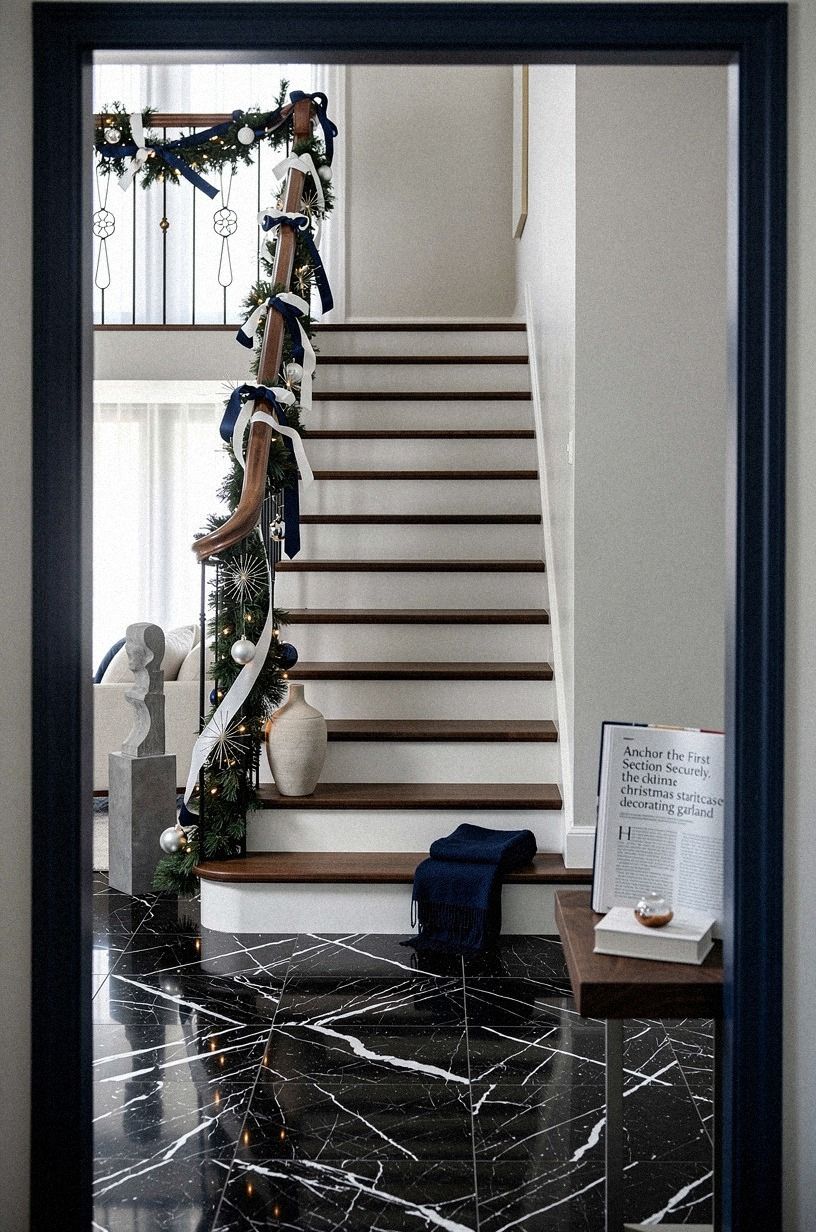
Start at the newel post or the strongest end point, then secure the garland before you style anything else. You’ll want the first attachment to carry the weight of the strand, ribbon, and ornaments. If that anchor slips, the whole staircase begins to sag by the second day.
I prefer green floral wire for a permanent setup and clear removable hooks for rentals. Wrap the wire around the garland stems, not the decorative tips, so the visible greenery stays full. Your attachment should hold firmly but still allow the rail to be used safely.
Leave your hand a clear path, especially if children or older guests use the stairs.
A nearby Nero Marquina black marble surface with white veins can act as a dark anchor, so keep the garland lighter against it. Give the greenery a shallow dip between attachment points.
A soft curve catches light better than a rigid line, and it creates room for ribbon to move. Don’t pull the strand tight just because the first section looks neat. A little looseness is what makes the display feel warm and lived-in.
For a rental, clear removable hooks let you adjust the spacing without marking the rail. The same low-impact approach works throughout the small-apartment Christmas guide.
4Build the Three-Height Light Stack
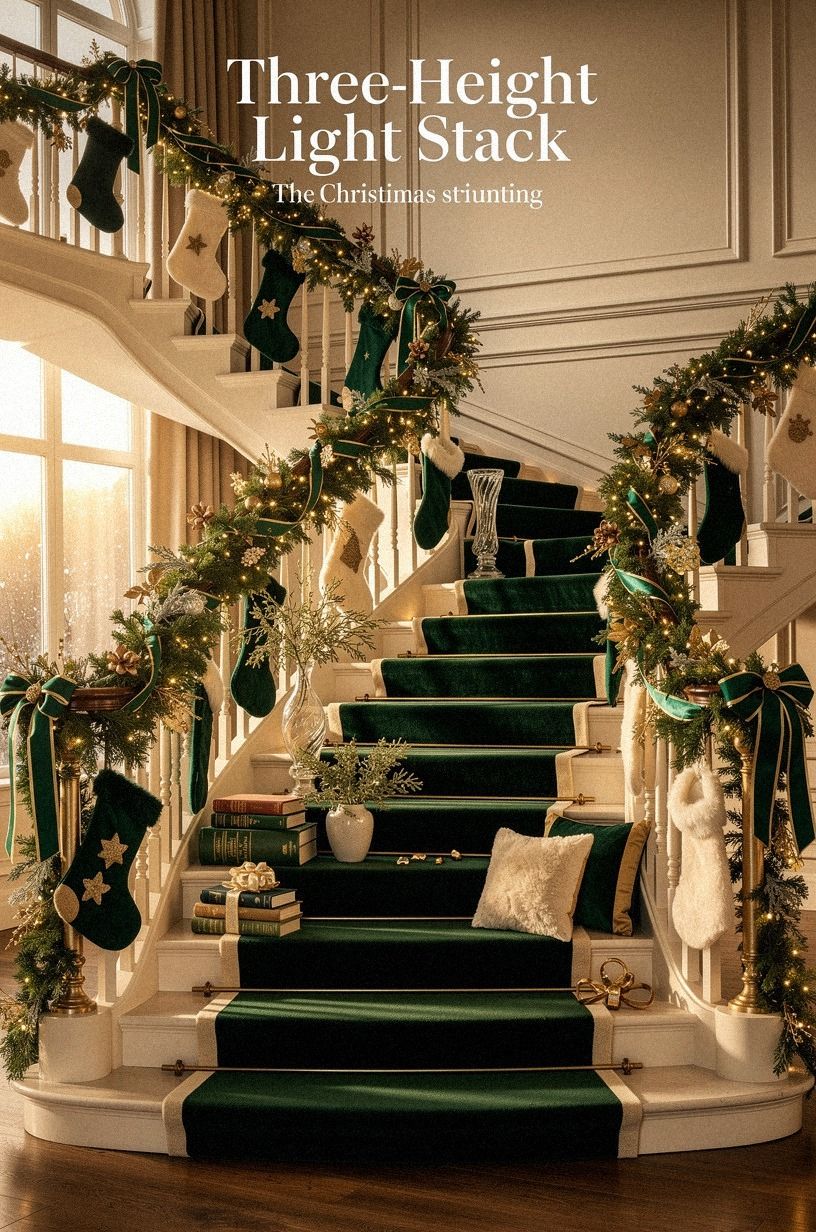
Use three levels of light so your holiday staircase doesn’t look like one bright stripe. Start with the existing overhead light, add small warm bulbs along the garland, and place a softer lamp or candle glow nearby. The standard design rule is three light sources per room, and your stairwell benefits from the same layered approach.
I’d use warm white mini lights rather than icy blue bulbs. Thread them through the middle of the garland first, then bring a few points toward the front so the glow doesn’t disappear inside the greenery. You’ll want the cord tucked behind the rail where possible.
Battery-operated lights can help in a rental, but hide the battery box behind a deep-pile mohair velvet bow or at the landing.
And don’t light only the top half. The lower steps should receive some glow too, or the staircase will feel visually heavy above and unfinished below.
The Christmas tablescape ideas for small dining rooms use a similar principle, with light distributed rather than concentrated in one bright cluster. This is one of the easiest changes you can make tonight!
Use a discreet overhead fixture as the third layer instead of adding another decorative object. Your staircase needs atmosphere, not more clutter.
5Layer Ribbon with the Two-Wood Rule
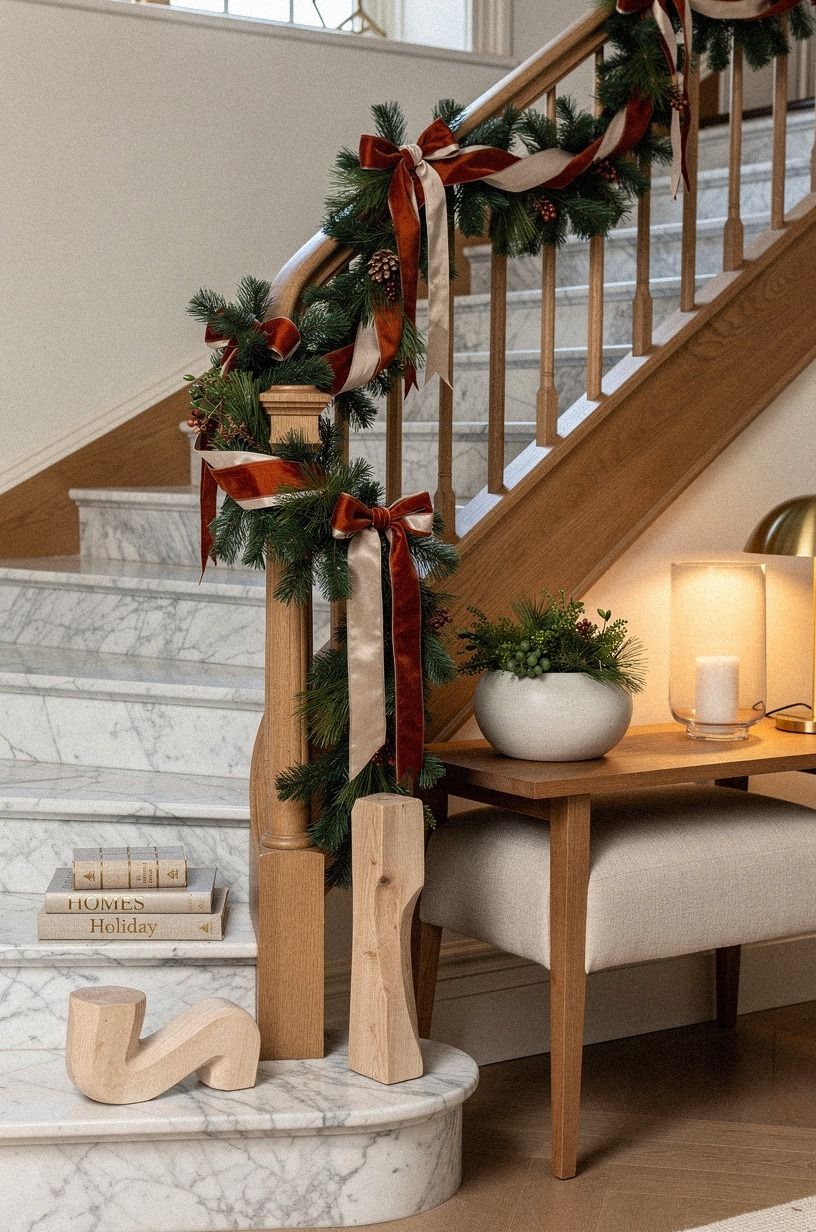
Choose one ribbon with a soft finish and one with a more structured texture. That contrast gives your staircase dimension without turning it into a craft-store display. I call this the Two-Wood Rule because the best pairings behave like materials in a room: one carries the pattern, and the other carries the warmth.
Try rust-toned velvet ribbon with a natural cotton or linen strip. You’ll get a rich color against the matte greenery, while the second ribbon keeps the display from feeling too formal.
The warm rust also works beautifully near Carrara marble with subtle gray veining. I’d skip three busy prints together. They compete at every curve, and your eye won’t know where to rest.
Cut several long pieces instead of one continuous length. Tuck the ribbon into the garland at uneven intervals, then let each piece fall or loop naturally. If you’re using a narrow stair rail, keep the ribbon close to the greenery so it doesn’t catch sleeves.
You’re building movement, not creating a curtain. The Christmas table setting ideas with red and white plaid can help you choose a plaid that feels festive without overwhelming the room.
A strip of cotton ribbon gives the eye a resting point when the main ribbon has a strong pattern.
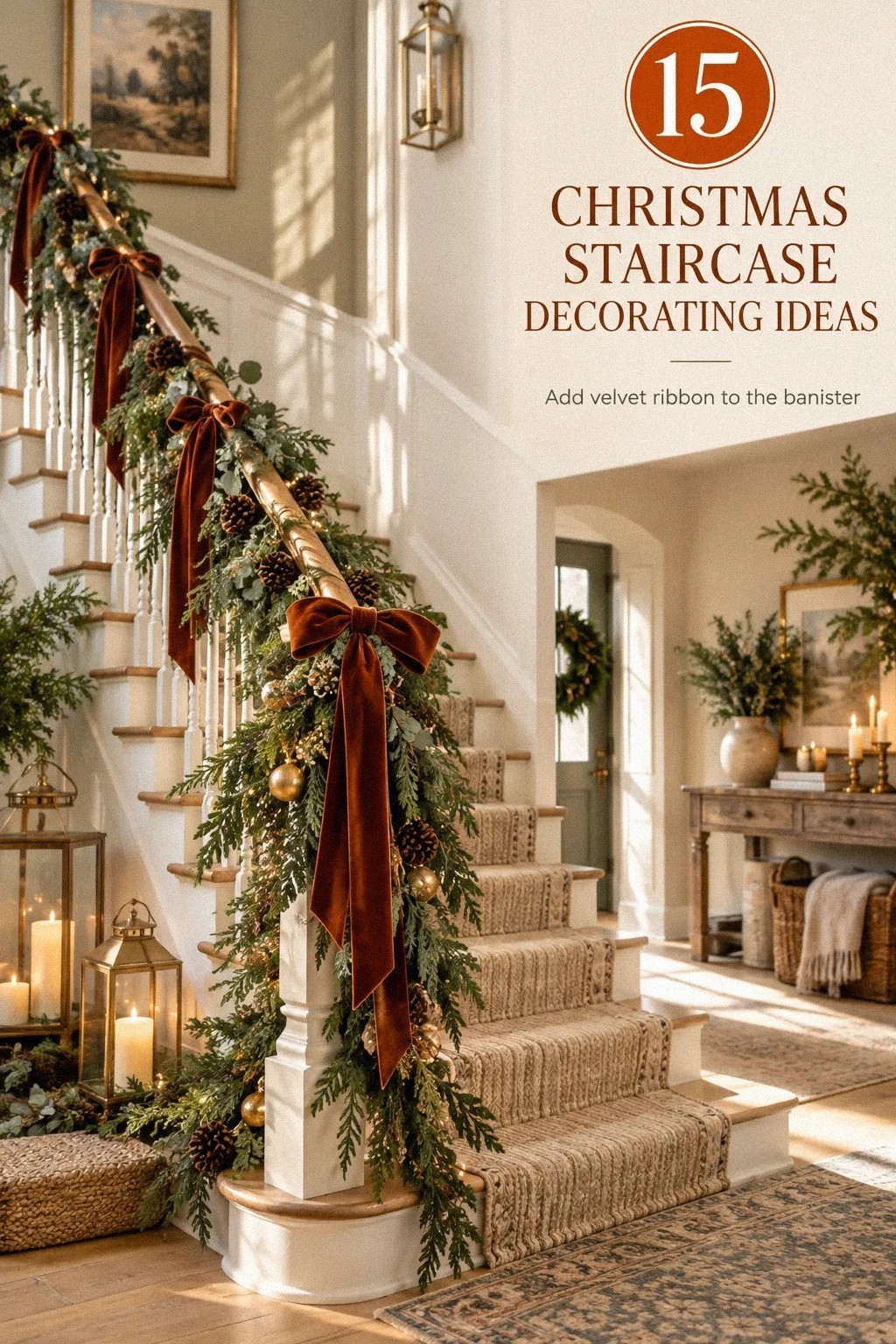
6Weave the Ribbon Instead of Wrapping It
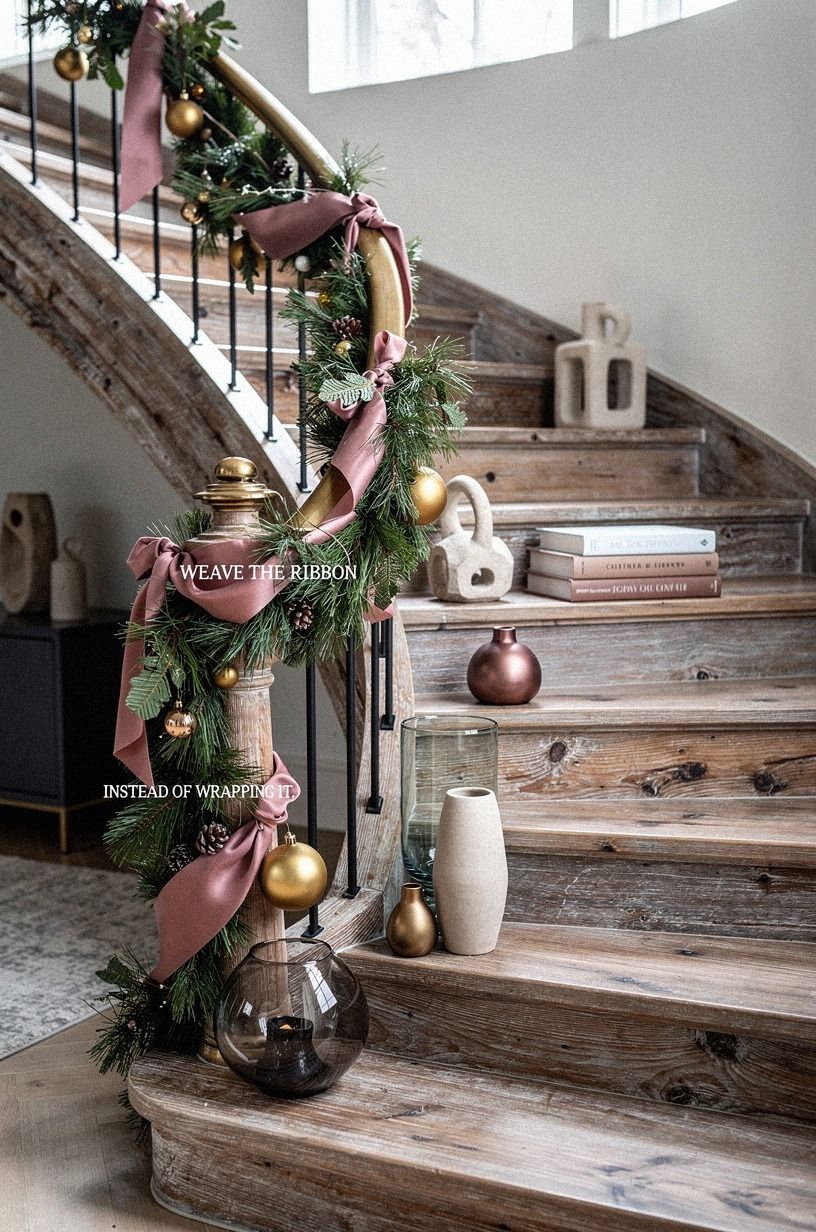
Weave ribbon over and under the garland in loose sections rather than winding it around every inch. You’ll use less material, and the finished staircase will show more greenery. This approach also makes the display easier to adjust when one loop falls flat.
I’ve found that 18-inch dusty-rose ribbon bows can look oversized on a narrow banister, so I’d make smaller loops and vary their direction. Turn one loop toward the stairs and the next toward the room.
Add a charcoal or aged-brass accent when you want more contrast. That small change catches light across the rail and gives your eyes a reason to travel.
Your ribbon should look as if it belongs to the garland, not as if it was taped on afterward. Pinch it at the back of each bend, then secure the pinch with floral wire or a small twist tie.
You’ll want the attachment hidden under a branch. But don’t compress the ribbon so tightly that it loses its shape.
Soft folds are more inviting than perfect spirals, especially when you’re styling a home that needs to feel lived in.
If the ribbon keeps sliding, test the attachment near a branch junction instead of on a bare section. A small reclaimed weathered teak ornament can give the arrangement a grounded stopping point without adding much weight.
7Mix Matte and Shiny Ornaments
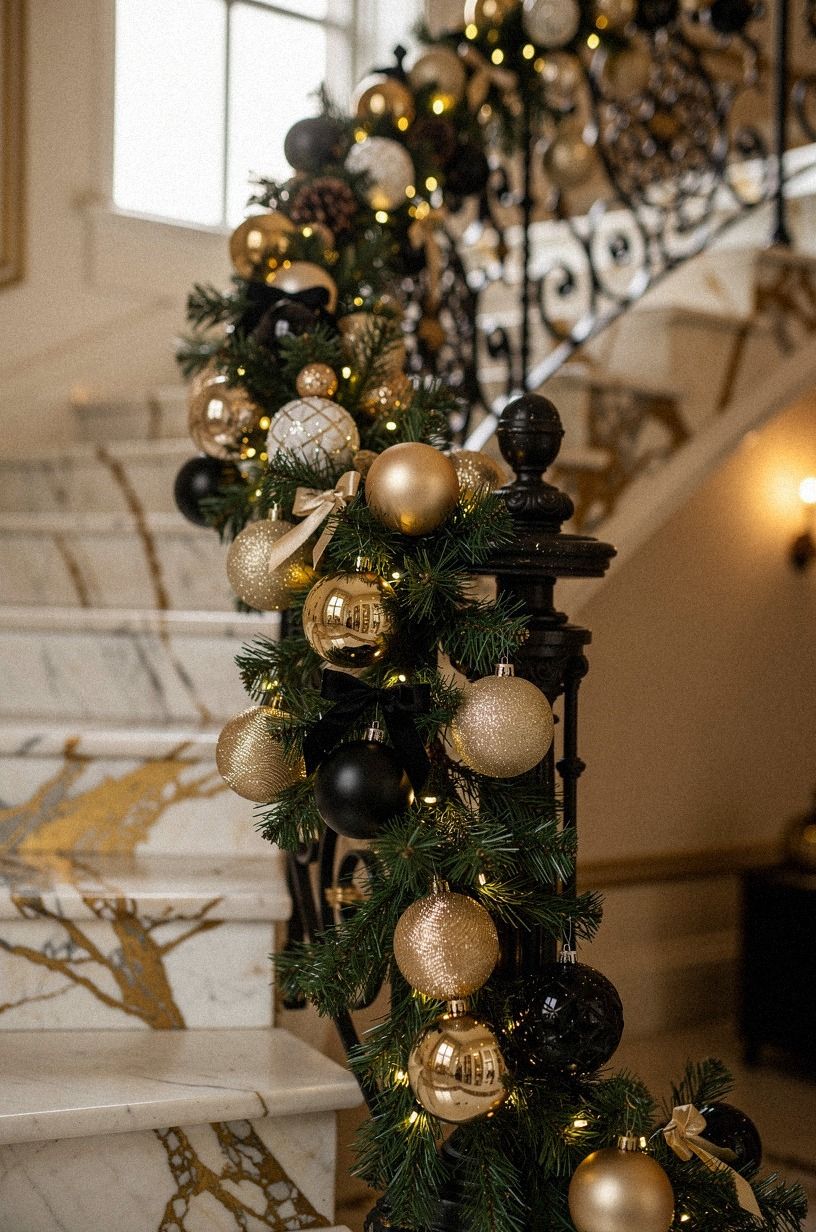
Add ornaments only after the garland and ribbon are stable. Start with matte pieces, then add a few reflective ones where you want the eye to pause. This gives your Christmas banister ideas a more layered finish than a line of identical balls.
A mix of warm-white ornaments, camel-toned pieces, and a few black accents can feel refined without becoming flashy. If the staircase sits near a console in Calacatta marble with gold veining, repeat that warmth with one restrained metallic detail. I’d skip high-gloss red on every section unless your room already has strong red accents.
Too much shine makes a staircase look busy during the day, and the bulbs can create harsh spots at night.
Use larger ornaments near the newel post and smaller ones as the arrangement moves along the rail. You’ll want a few pieces tucked deep into the greenery, not all hanging on the outside edge.
That depth is what makes the display feel full. If you’re styling with children, place breakable ornaments above shoulder height and use lightweight wood ornaments or fabric pieces below.
Safety matters more than a perfectly balanced display.
Try one reflective ornament every few feet rather than repeating the same finish at every tie. That restraint is what keeps the staircase from feeling like a retail display.
8Where Should the Bows Go?
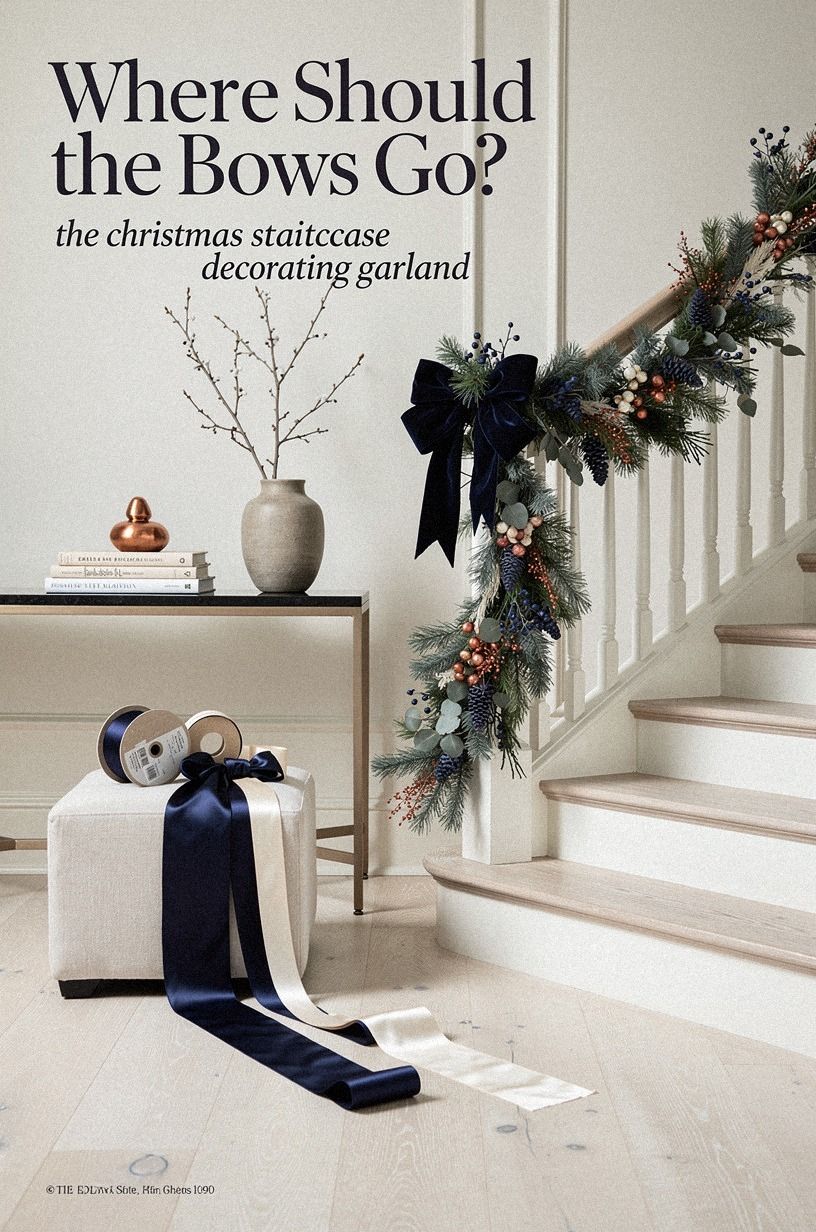
Place your largest bows at architectural moments, such as the bottom post, the landing, or the top turn. Midnight-blue ribbon with copper centers and ivory tails gives the staircase depth, especially near a cerused white oak surface. Keep smaller bows between those anchor points so the arrangement feels connected without becoming repetitive.
9Add Natural Texture at the Landing
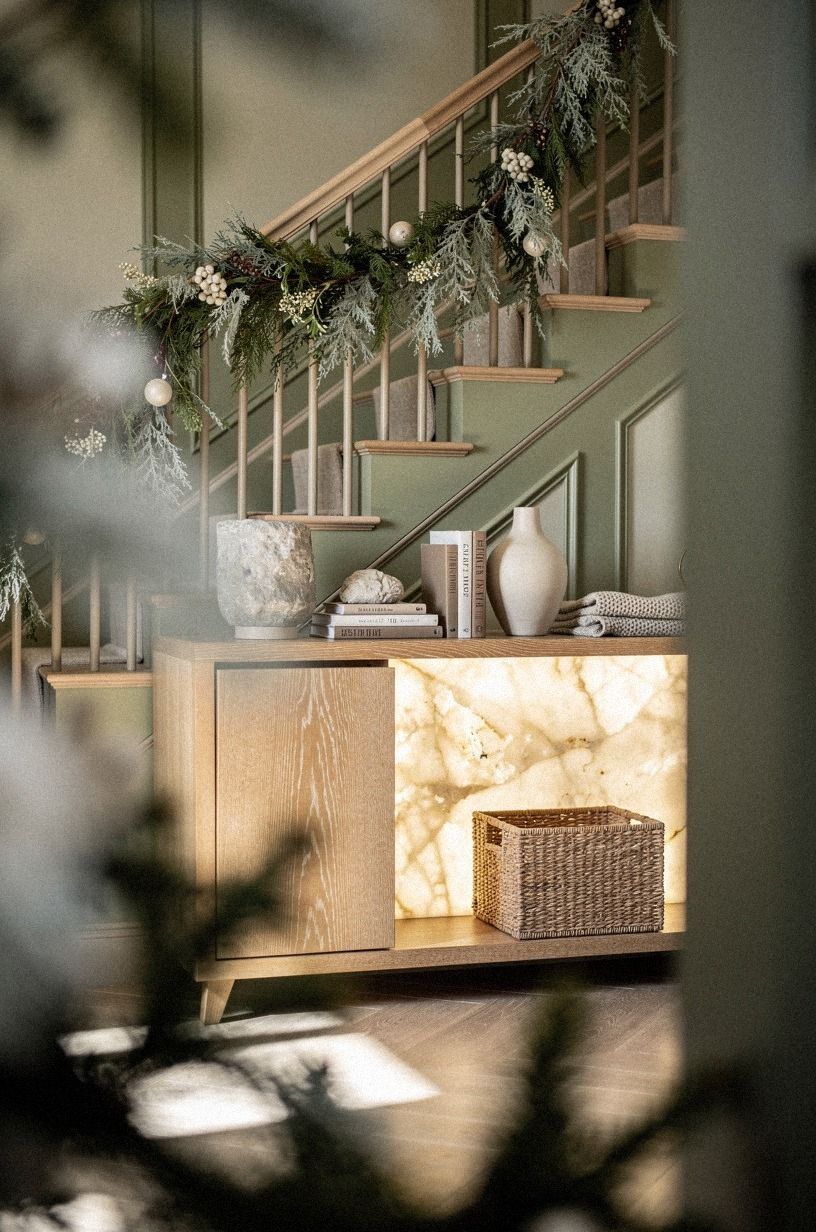
Use the landing as a pause point instead of covering every inch of the banister. A small arrangement of pinecones or branches can connect the staircase to the rest of your Christmas decor. Your display will feel more considered when the landing has its own quiet moment.
A small backlit translucent onyx accent or pedestal can give natural texture without adding visual weight. Place a small basket nearby with extra blankets if the area is wide enough, but keep the walking path open.
I’d avoid placing a tall vase directly beside the rail. It can make the turn feel crowded, and it’s the first thing someone bumps while carrying laundry.
If you want color, use a few dried orange slices rather than another cluster of shiny ornaments. Their warm scent and uneven edges make the stairwell feel comforting. You don’t need to make the entire display rustic.
One natural material is enough to break up the polished ribbon and artificial greenery.
The weekend fall porch decorating ideas offer another good lesson in using one seasonal material as an accent instead of filling every available surface.
10Frame the Newel Post with the Focal Bow
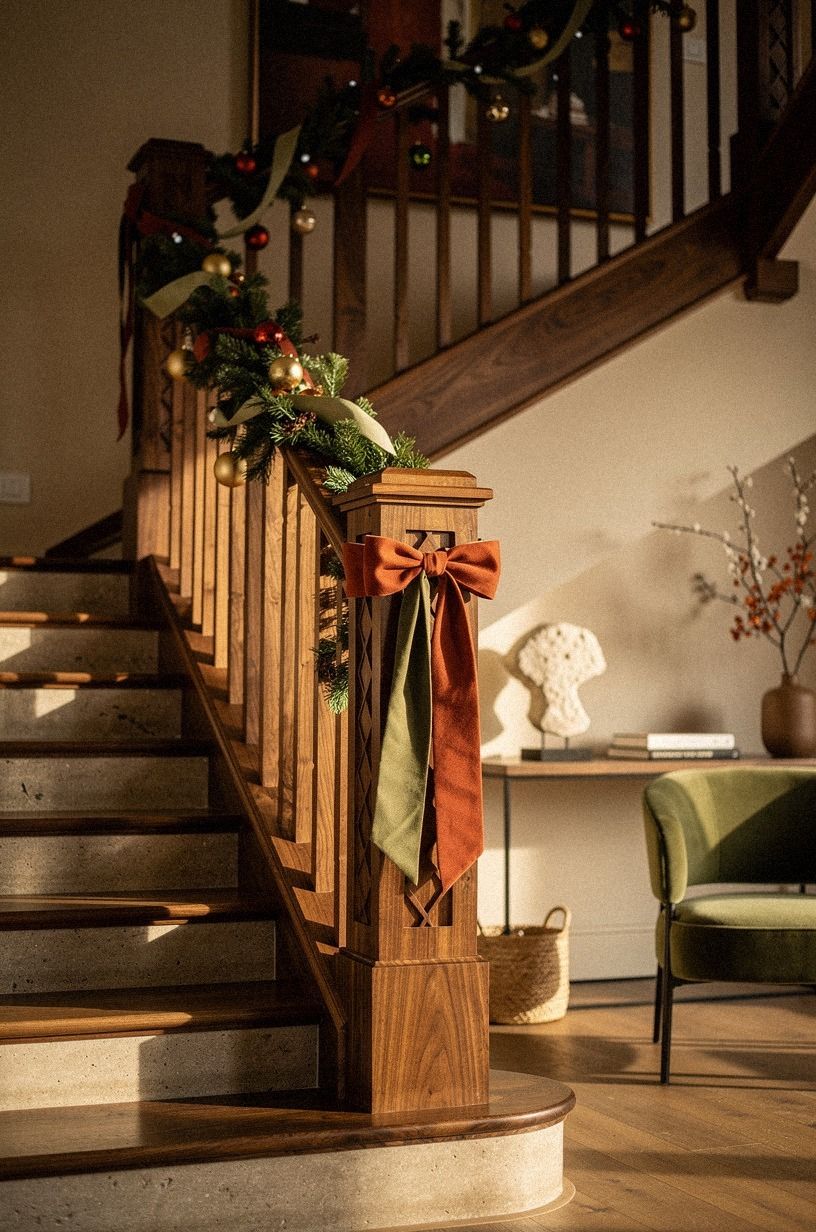
Treat the newel post as the visual beginning of your holiday staircase. A focal bow there helps the garland read as one composition, especially when the staircase is visible from the entry. Your eye will find the bow first, then follow the ribbon upward.
Use a small terracotta or olive-toned ornament with a book-matched walnut detail if you want warmth and depth. I’d keep the scale modest.
A giant bow can block the post and make the entry feel cramped, while a compact arrangement looks more architectural. Secure it with wire behind the post, then test the rail with one hand before you finish.
And don’t forget the underside of the bow. Let one ribbon tail fall toward the floor and another angle toward the first step. You’ll create direction without making the arrangement look perfectly symmetrical.
The weekend fall porch decorating ideas use the same kind of asymmetry, with one strong anchor and smaller details leading away from it.
A few asymmetrical ribbon tails usually look more natural than two perfectly matching lengths.
11Benjamin Moore or Farrow & Ball?
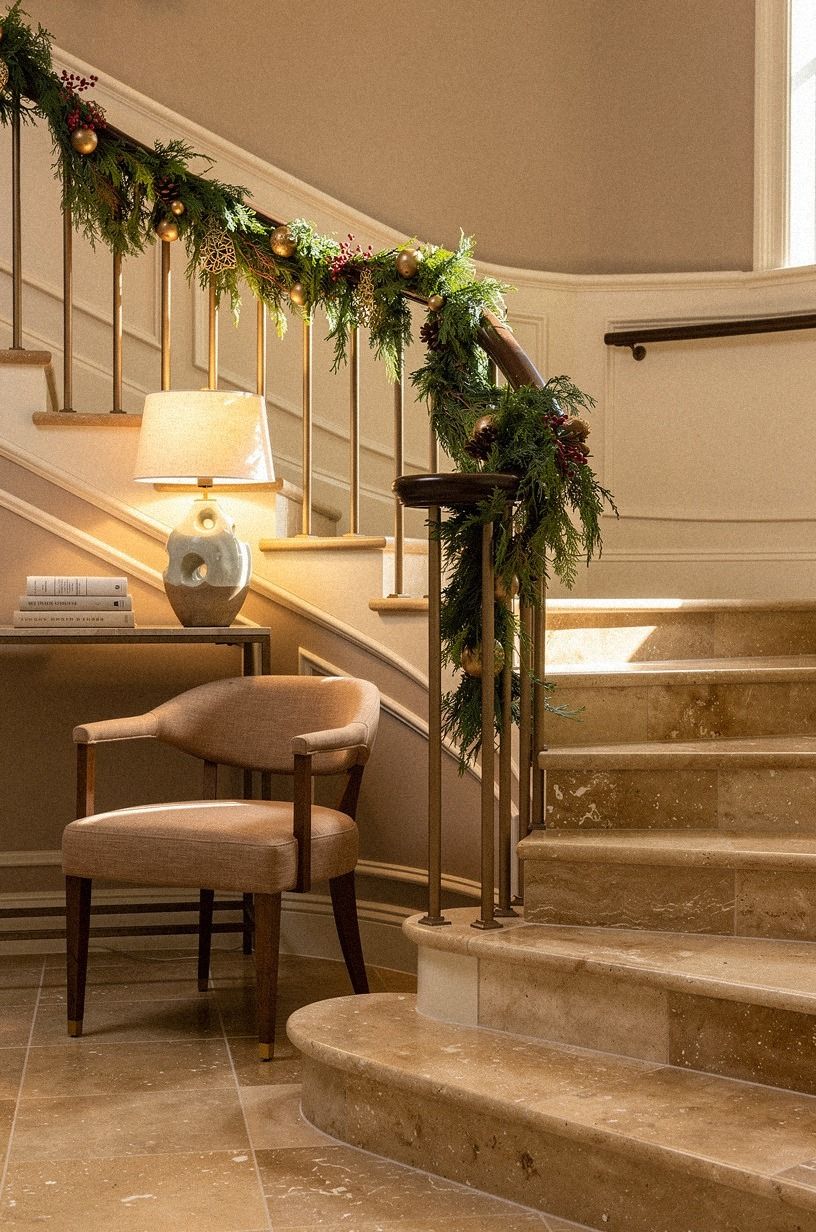
If your staircase wall needs a seasonal refresh, paint before you hang the garland. A clean backdrop makes every strand look more intentional, and you won’t have to work around hooks or ribbon. You’ll also see the true contrast between your wall color and the greenery.
Benjamin Moore Chestertown Buff HC-9 gives red ribbon and deep green branches a soft clay-toned background without making the stairwell feel stark. For a lighter linen effect, Farrow & Ball String No. 8 brings a quiet neutral cast that works well with aged brass and warm travertine. I’d skip a very bright white if your bulbs are warm, because the contrast can feel sharp at night.
Your paint choice should respond to the light your staircase receives. North-facing rooms can make beige look cooler, while afternoon sun warms almost everything. Test a sample pot at the top and bottom of the stairs.
You’ll notice the difference as you move, and that’s the information a tiny paint chip can’t give you.
The soft color approach in the Christmas tablescape ideas for small dining rooms is useful here too. Seasonal color doesn’t need to be loud to feel festive.
12Choose Natural Greenery over Perfect Symmetry
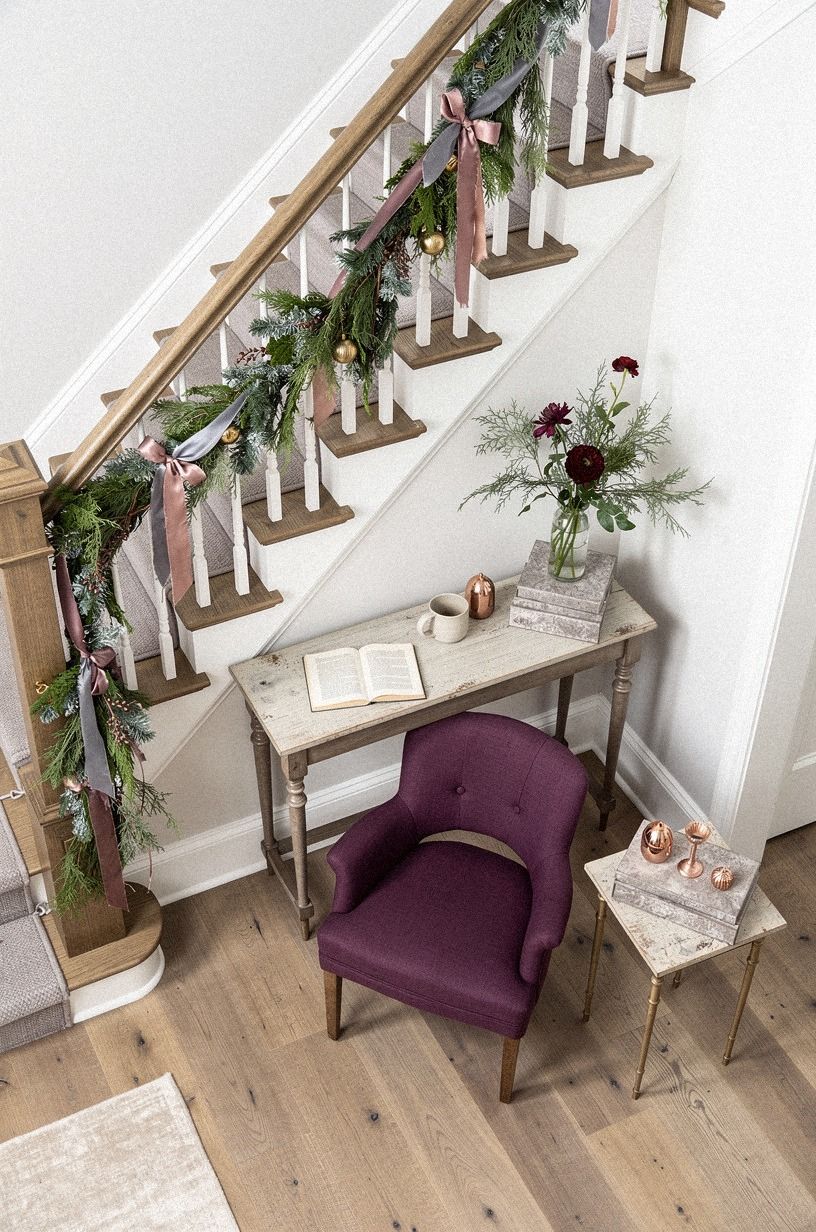
Mix two or three greenery shapes so your stair garland has variation. Combine pine, cedar, eucalyptus, or olive-toned leaves rather than repeating one perfectly uniform strand. You’ll get a more organic, charming result, and small gaps will look intentional.
I’d pair muted plum ribbon with gray-green stems and a few rose-gold accents when the stairwell has beige walls or pale flooring. A small piece of unlacquered brass adds warmth as it develops its natural patina. If your room already has strong wood tones, use more cedar and less gray-green foliage so the display stays balanced.
Perfect symmetry is not the goal here. One side of the rail can be fuller near the landing, while the lower section stays lighter.
Your home has traffic patterns, shadows, and furniture that won’t match a catalog display. Let those conditions guide you. But don’t leave random bare spots where the garland looks accidentally thin.
Fill those areas with a short cedar branch, then stop.
If the staircase is already visually busy, the small-apartment Christmas ideas can help you edit the display around the space you actually have.
13One Hero Material, Everything Else Quiet
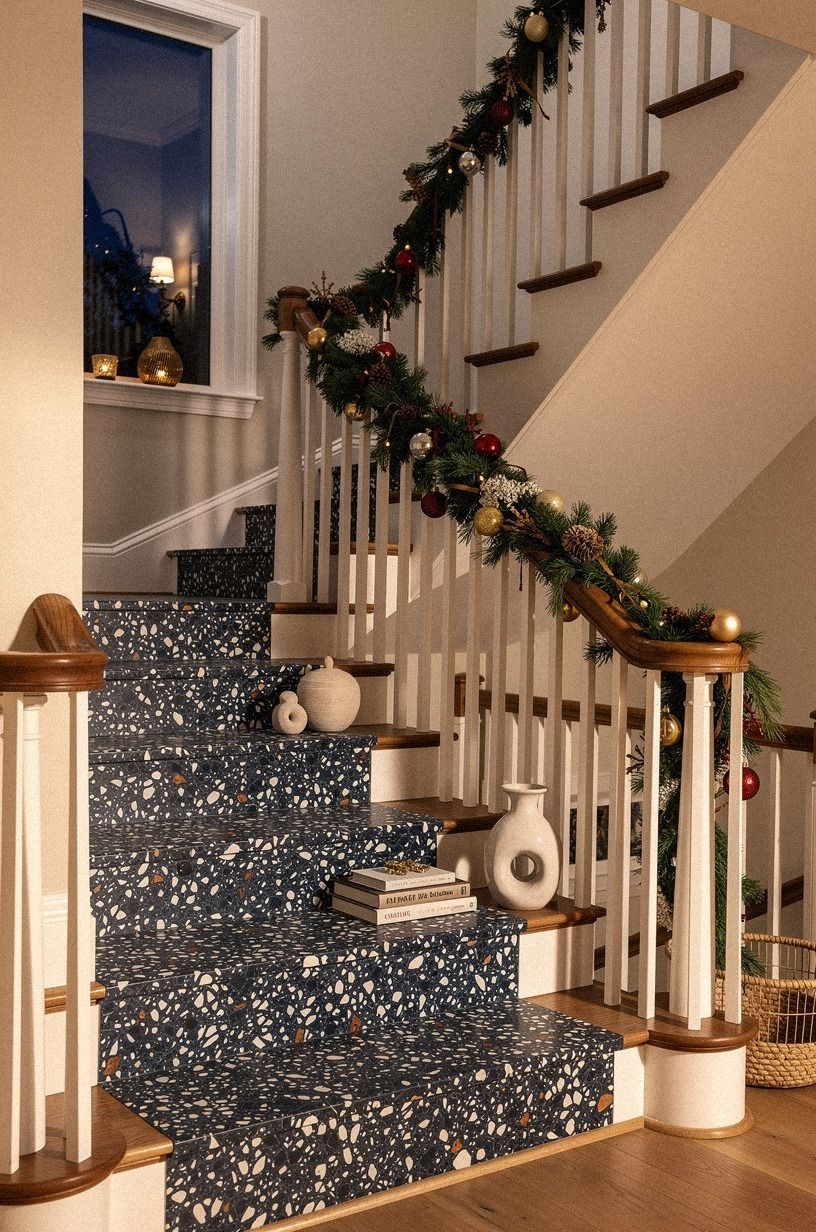
Choose one hero material and let the other decorations support it. Oversized-chip terrazzo can bring navy, white, and walnut tones together near the landing, while the garland and ribbon stay comparatively simple.
14Check Safety and the Walking Path
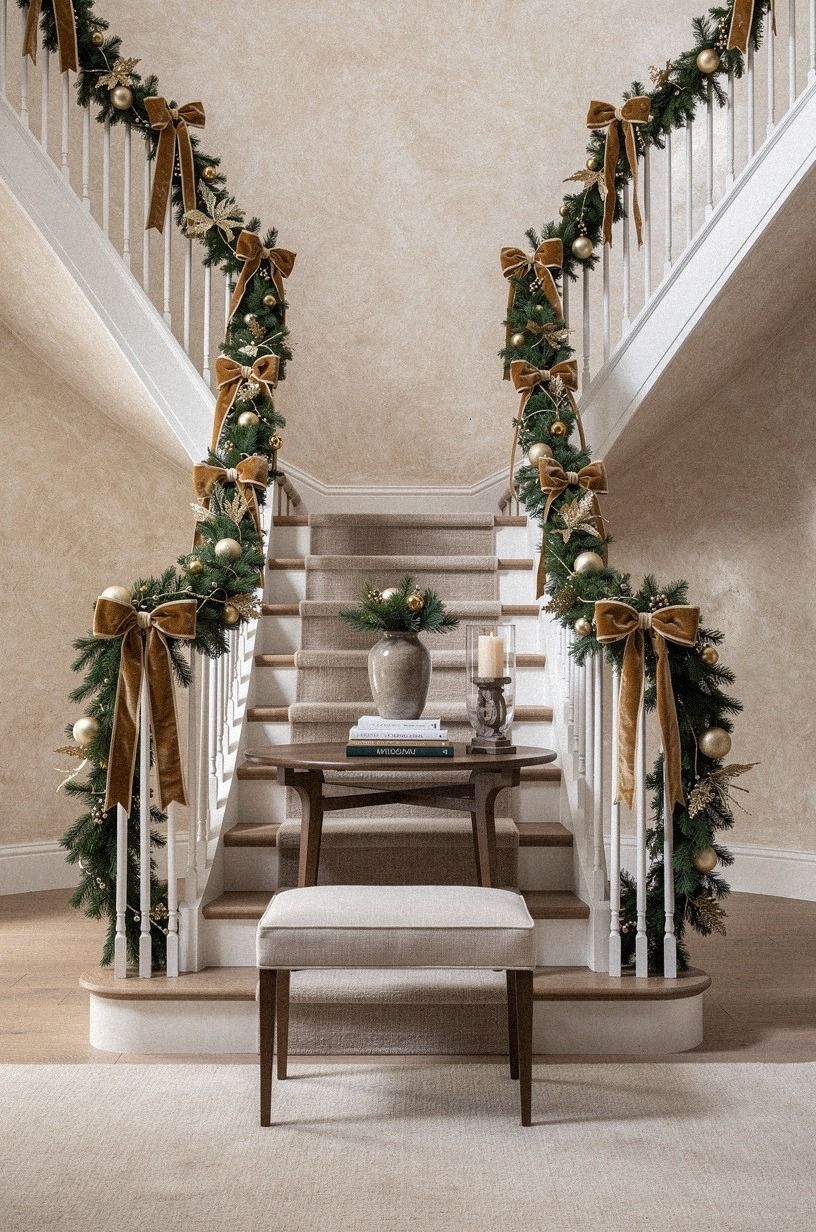
Step back and inspect the staircase as if you were carrying a basket up it. Your hand should still reach the rail, your feet should have a clear path, and no ribbon tail should hang where it can catch a shoe. A warm display isn’t successful if you’re adjusting it every time someone walks by.
Use removable hooks rated for the weight you’re hanging, and keep wire ends tucked into the greenery. Felt-backed ties can protect painted rails from scratches if you’re securing heavier garland. You’ll want the attachment points firm, but you shouldn’t cinch them so tightly that the rail finish marks.
I made the mistake of placing a low bow on a busy corner once. It looked charming for a moment and irritating for every trip upstairs afterward. Move anything that brushes your shoulder or blocks your view.
And if you have pets, keep edible dried fruit and fragile ornaments out of reach. Safety matters more than a perfectly balanced display.
On a wall with hand-applied Venetian plaster, avoid attachments that could pull at the surface. Safety wins over symmetry every time. If a detail makes the staircase harder to use, it doesn’t belong there.
15Finish with a Quiet Detail
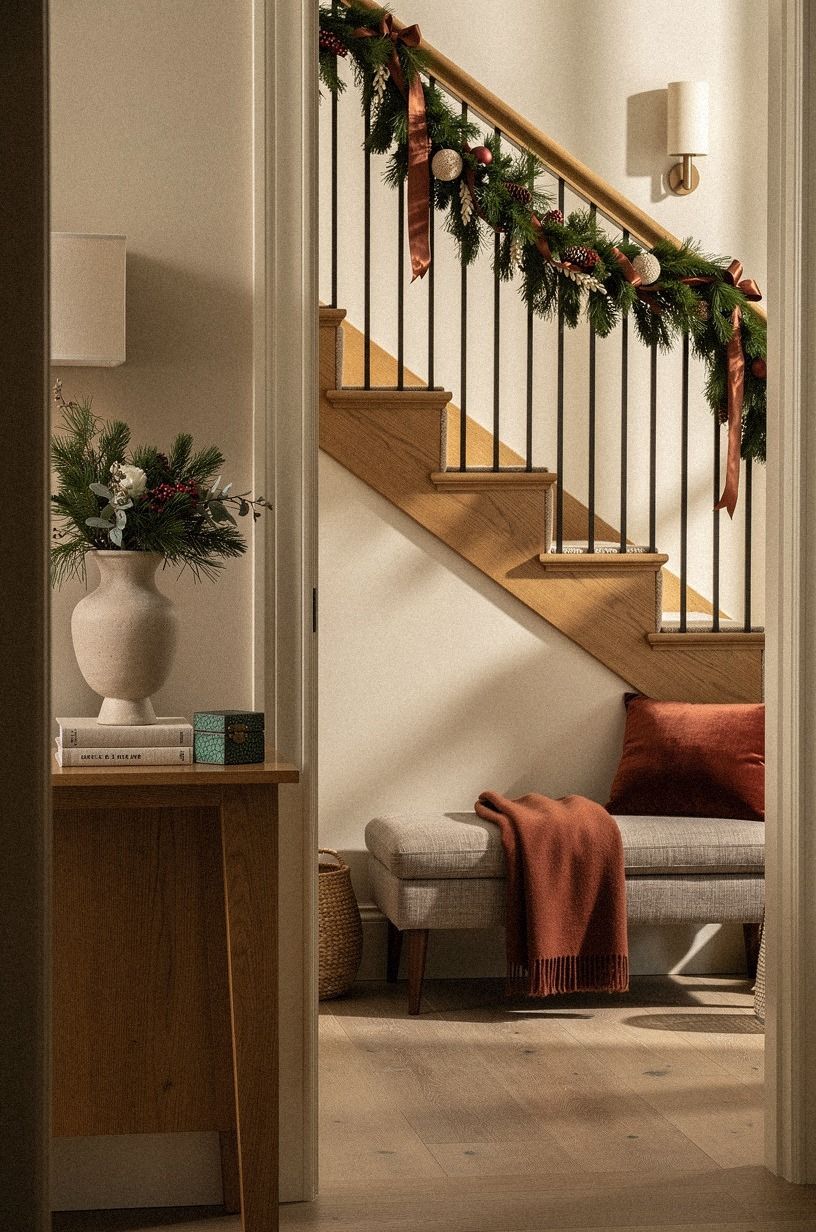
Finish the staircase with one detail that repeats a material already in your home. It could be a small terracotta ornament, a shagreen accent, a brass bell, or a strip of the same ribbon used on your tree. You’ll create connection without making the staircase match every other decorated surface.
Place the final detail where the eye needs a soft landing, usually near the top post or at the end of the garland. I’d avoid adding another large bow at this stage.
The display should feel finished, not crowded. If the staircase already has strong ribbon, a small shagreen detail or a few matte wood beads may be all you need.
Stand at the entry and look again after the lights are on. Your staircase should read clearly from a distance, then reward you with texture when you come closer.
The Christmas sleep tips are a useful reminder that seasonal rooms still need to feel restful. If your display is the brightest thing in the house, lower the light level until the greenery looks softly illuminated rather than electrically loud.
That final warm-white light check is worth doing before guests arrive. Sometimes the best finishing move is turning one strand off!
The Honest Case for a Layered Staircase
I used to think Christmas staircase decorating was mostly about buying enough garland. It isn’t. The real work is deciding where the eye should travel, where the hand needs space, and which materials deserve attention.
A staircase is a lived-in path, not a flat wall, so decoration that looks good from one approach can feel awkward from another.
That’s why I’d rather see one strand of convincing greenery, a restrained ribbon, and three well-placed bows than a rail buried under every seasonal object in the storage bin. Farrow & Ball Pigeon No. 25 can make red ribbon look softer, while Sherwin-Williams Agreeable Gray SW 7029 gives natural greenery a quieter backdrop.
The paint matters, but it shouldn’t compete with the line of the stairs. For another restrained seasonal palette, the small-apartment Christmas tree ideas are a useful reference.
The budget can also vary widely depending on what you already own. The figures below are typical US room-decorating ranges, not a promise that your staircase will cost these amounts.
Your best value may be reusing last year’s ribbon, buying one high-quality garland, and changing the placement rather than replacing everything. The small dining room tablescape ideas make the same case for layering what you already have.
I’ve gone back and forth on faux greenery versus fresh cut branches. Fresh greenery smells wonderful, but it dries, sheds, and needs more attention near a busy stair. Faux greenery wins for me when I’m decorating early or styling a rental, especially when the strand has varied greens rather than one plastic color.
You can soften it with real pinecones, linen ribbon, and a few natural branches.
And the best staircase isn’t the one with the most decoration. It’s the one that still feels like your home after the lights are off.
You should be able to walk upstairs without navigating a holiday obstacle course, and your guests should notice warmth before they notice the work behind it. That balance is worth protecting.
A Few Things Worth Answering
What is the best Christmas staircase garland for a small staircase?
A narrow faux cedar or eucalyptus garland is usually the best choice because it gives you texture without taking over the rail. IKEA baskets or simple wood accents can add warmth nearby without crowding the steps.
Keep the garland close to the banister, leave your hand space, and use one ribbon rather than several bulky layers. The small-apartment Christmas guide has more ideas for keeping greenery visually light.
Where can I buy Christmas staircase decorating pieces on a budget?
Look at IKEA, Wayfair, Target, Facebook Marketplace, and local thrift shops for ribbon, baskets, ornaments, and faux greenery. You’ll often find better value in second-hand holiday bins than in seasonal display aisles.
Choose one material you love, then build around it with pieces you already own. The weekend fall porch decorating ideas also show how inexpensive natural accents can carry a seasonal arrangement.
How much does a Christmas staircase makeover cost?
A staircase refresh can cost very little if you reuse garland, ribbon, and lights, while a broader room-decorating budget may fall within the typical $200-$800 budget tier. Free greenery from your yard, existing ornaments, and rearranged furniture can carry much of the look. You can also borrow ideas from these small dining room decorating examples before buying anything new.
Can I create Christmas staircase decor on a budget?
Yes, and you can begin with three inexpensive moves: reuse last year’s garland, make smaller ribbon bows from leftover fabric, and add pinecones or branches from outdoors. You’ll get the most impact by improving the arrangement before buying more pieces. One strong focal bow can do more than ten scattered ornaments.
Is Christmas staircase decor worth it in a small space?
Yes, because a small staircase gives you a focused vertical area instead of requiring a whole-room makeover. Keep your garland slim, use a pale or quiet ribbon, and leave the wall visible.
Your space will feel more festive without losing the open walking path that makes it comfortable. The renter-friendly Christmas decorating ideas are especially helpful when floor space is limited.
Is Christmas staircase decorating a good idea for a rental?
Yes, especially when you use removable hooks, lightweight garland, and tension-based attachments. Avoid nails and heavy ornaments on delicate rails.
You’ll want to test every hook before adding ribbon, and removable strips can protect painted surfaces while still giving you a warm holiday display. Choose lightweight ornaments near the handrail and keep the heaviest pieces at stable architectural points.
Where I’d Start First
If I had to pick one step, I’d start with anchoring the garland at the newel post. A secure beginning keeps every ribbon loop and bow from sliding, so your staircase stays polished after people use it.
Pin this guide for later, then build upward from that first strong point. The Christmas sleep tips are a fitting final reminder: the finished room should feel warm, calm, and easy to live in.