
 by
by See live a recommended brand pricing →
Sleep Lab Pick · Current Sale
Current Sale — Amerisleep's current sale runs sitewide. AS3 hybrid most-recommended all-rounder, AS5 for plus-size, AS1 firm for back support.
Daybed Couch 2026: Frame, Mattress & Multi-Purpose Setup Guide
- A daybed couch uses a twin mattress on a 3-sided frame to function as both sofa and guest bed in one piece.
- Best for small apartments, studios, and home offices where a dedicated guest bedroom is not practical.
- Mattress firmness matters more for daybed use: firmer surfaces hold seating posture and resist edge compression over time.
- Top pick: a Twin mattress ($895) for dual-use durability, with a Twin as the best daybed option for kids rooms.
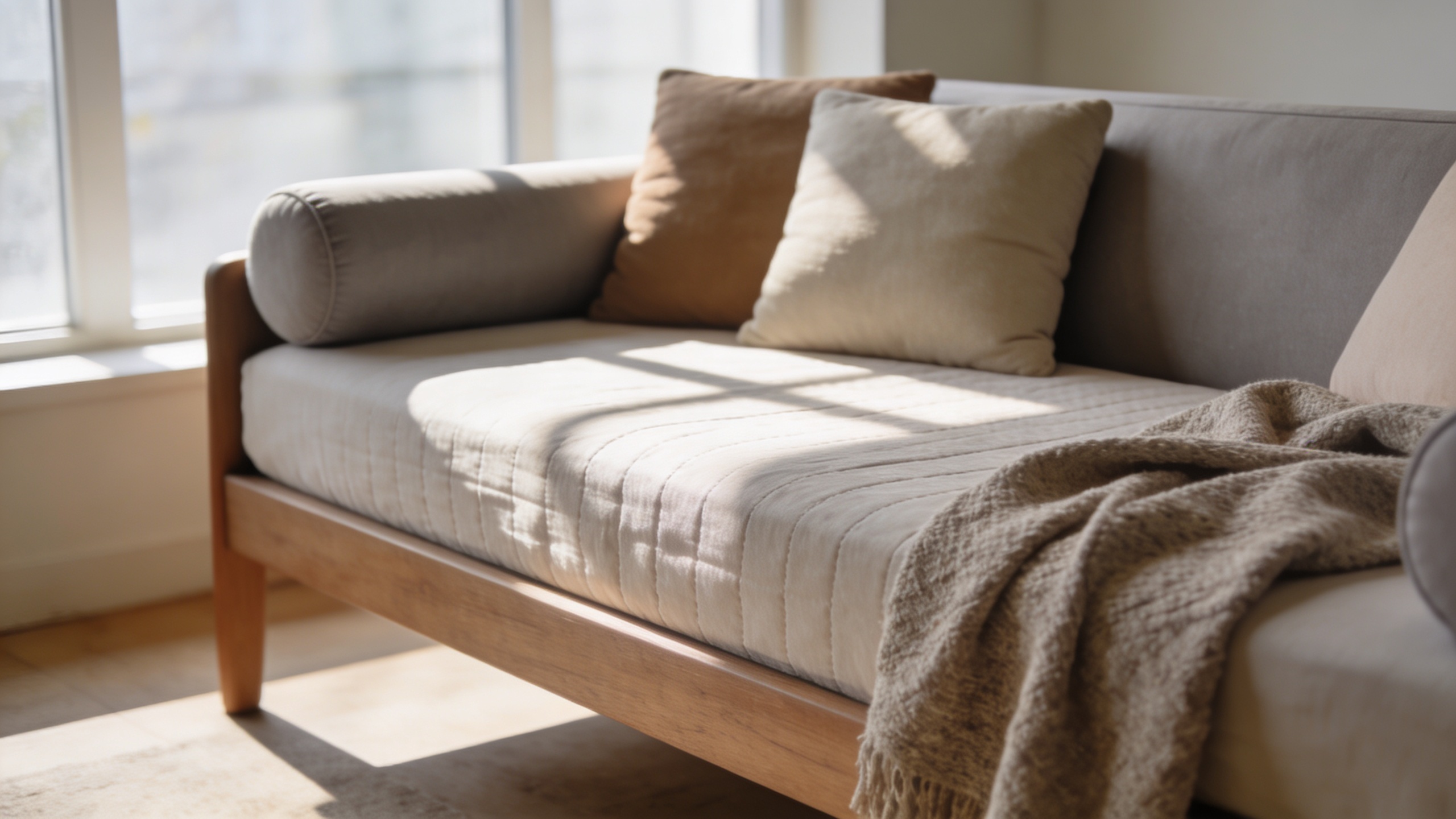
- Styling with bolster pillows, a fitted throw blanket, and a tight-fit sheet set transforms the daybed into a clean couch aesthetic instantly.
a Twin mattress
The dual-coil hybrid construction handles repeated seating stress better than foam-only alternatives while delivering genuine sleep comfort for overnight guests. 365-night trial, lifetime warranty, free white-glove delivery + old mattress removal.
Check a Twin mattress Price →
Quick Top Picks
If you are already familiar with daybed setups and want the short answer, here are the three Saatva twin mattresses ranked by dual-use performance.
| Mattress | Firmness for Seating | Softness for Sleep | Dual-Side Option | Twin Price |
|---|---|---|---|---|
| a Twin mattress | Firm (14.5-gauge inner coil) | High (Euro pillow top) | No (single-sided) | $895 |
| a Twin | Firm side (ages 3-7) | Plush side (ages 8-12) | Yes - flip at age 8 | $849 |
| Loom & Leaf Twin | Relaxed Firm (5-lb memory foam) | High (dense foam conform) | No (single-sided) | ~$1,099+ |
For most adults using a daybed as a primary seating surface, the Twin mattress in Firm is the most practical option. The 14.5-gauge tempered steel innerspring base gives the structural integrity needed for edge seating, while the Euro top handles overnight sleeping without sacrificing comfort.
What Is a Daybed Couch?
A daybed couch is a twin-sized bed frame built with a back panel and two arm panels (three sides) that allow a mattress to serve as seating during the day and a sleeping surface at night. The structural design mimics a sofa silhouette, which means it integrates into living rooms, studios, and home offices without looking like a bed pushed against a wall.
Daybed vs. Sofa Bed
A sofa bed (sleeper sofa) hides a foldout metal-framed mattress inside an upholstered couch. The mattress unfolds out from the cushion cavity, typically 3.5 to 4.5 inches thick. A daybed eliminates the folding mechanism entirely: the same surface you sit on is the full-depth mattress (typically 11 to 15 inches). This means a daybed sleeps significantly better than a sofa bed because the mattress has no fold seam running through the middle of the sleeping area.
Daybed vs. Futon
A futon uses a thick cotton or foam roll that folds flat to create a sleeping platform and folds up against a frame to create a seat. Most futon mattresses run 6 to 8 inches and compress with use. A daybed uses a standard twin mattress at full depth, which holds its performance over years of dual use. The trade-off is that a daybed takes slightly more floor area because the mattress remains horizontal at all times, while a futon frame can fold the seat portion up at a 90-degree angle.
Daybed vs. Guest Bed
A dedicated guest bed is typically a queen or full frame with a standard mattress placed in a spare room used only for sleeping. A daybed serves the same guest-sleeping function but earns its square footage by serving as daily seating. For apartments under 600 square feet or home offices that double as guest rooms, a daybed replaces two pieces of furniture with one.
Best Mattress for Daybed Use
Why Firmness Matters More for Daybeds Than for Standard Beds
Standard bed-use metrics focus on pressure point relief, spinal alignment in a horizontal position, and motion isolation. Daybed use adds a third performance dimension: edge support under seated load. When a person sits on the edge of a daybed to watch television or work at a laptop, the mattress must resist lateral compression from approximately 150 to 250 lbs concentrated at one point on the perimeter. Foam-only mattresses without edge reinforcement will compress and sag at these contact points over 12 to 18 months of regular seating use.
Target firmness for dual-use daybed mattresses: Medium Firm to Firm on a 1-10 scale (6.5 to 8). Anything softer than a 6 will develop body impressions at seating zones within 12 months of regular use. Anything firmer than an 8.5 will be uncomfortable for overnight guests sleeping on their side.
Dual-Side Rotation for Longevity
Standard mattresses cannot be flipped because they are one-sided (comfort layer on top, base layer on bottom). For daybed use, this matters because the seating-load wear pattern concentrates at the same edges every day. The practical work-around is rotation: flip the mattress 180 degrees head-to-foot every 3 to 4 months so the seating zones alternate. This extends effective life from roughly 4 to 5 years (seating-weighted single zone) to 7 to 9 years.
The Twin is the only Saatva mattress with a true dual-sided construction (firm side / plush side), making it the only option in the lineup that can be physically flipped to equalize wear across both surfaces. For adult daybeds, rotation (not flipping) remains the standard maintenance protocol.
Coil vs. Foam for Daybed Applications
Coil systems (innerspring or hybrid) outperform foam systems on daybeds for three reasons:
- Edge support: Tempered steel coils at the perimeter maintain height and shape under repeated seated loads. Foam-only edges compress and round over time.
- Breathability: A coil layer creates airspace through the mattress body. Foam-only construction traps body heat during sleep, which is amplified on a daybed used as a couch (higher ambient room temperature during the day warms the foam before it is used for sleeping).
- Recovery time: After 8 to 10 hours of seating use, a coil mattress recovers its original height and pressure distribution more quickly than dense foam, which retains thermal impression for 30 to 60 minutes after seated loading.
Frame Styles: Traditional, Trundle, Storage, Canopy
Traditional 3-Panel Daybed Frame
The standard configuration is a metal or solid wood frame with a headboard panel, footboard panel, and back panel. The back panel is the element that makes a daybed function as a sofa: it provides back support for seated users and creates the visual silhouette of a couch. Most traditional frames accommodate twin mattresses 10 to 14 inches deep. Frames that use slat support (rather than solid deck) allow air circulation under the mattress, which is beneficial for foam-core mattresses used in sealed rooms.
Trundle Daybed Frame
A trundle frame includes a second rolling bed platform stored under the main frame. When the trundle is extended, the daybed converts from a twin sleep surface to a sleeping arrangement for two. Trundle units roll on casters and typically accommodate a 5 to 6-inch mattress (not a standard-depth mattress). This makes them practical for occasional child sleepovers but less suitable for adult guests who need a full-depth mattress. The main-frame mattress remains at full depth for daily seating and the trundle adds sleeping capacity only when needed.
Storage Daybed Frame
Storage daybeds integrate drawers under the seating platform, accessed from the front face of the frame. This variant is the most space-efficient option for studio apartments: the bed stores bedding, throw pillows, and seasonal items in the drawer cavity beneath the mattress. The trade-off is that storage frames are typically heavier and have fewer ventilation gaps between the mattress and the platform surface. For foam mattresses in storage-frame daybeds, a breathable mattress protector is recommended to manage moisture accumulation.
Canopy Daybed Frame
Canopy daybed frames add vertical posts at all four corners plus a ceiling-mounted rod or fabric panel. This configuration is primarily aesthetic: the canopy creates a defined lounge zone in open-plan living spaces. From a mattress-performance standpoint, canopy frames behave identically to traditional frames. Their practical limitation is ceiling clearance: canopy frames require 8-foot minimum ceiling height and are not suitable for basement rooms or attic conversions.
Frame Material: Metal vs. Wood
Metal frames (powder-coated steel or wrought iron) are lighter, lower cost, and easier to disassemble for moving. Solid wood frames (pine, oak, or hardwood) are heavier, more expensive, and carry higher weight ratings (typically 500 to 700 lbs for solid hardwood vs. 300 to 400 lbs for steel tube frames). For adults using a daybed as primary seating, solid wood or steel tube-and-slat frames rated above 400 lbs are the safer long-term choice.
Saatva Twin Mattress Options for Daybed
a Twin mattress - Best Overall for Adult Daybed Use ($895)
The mattress uses a dual-coil system: a tempered 14.5-gauge bonnell innerspring base layer topped by a 13-gauge pocketed micro-coil comfort layer, wrapped in an organic cotton cover with a Euro pillow top. The 14.5-gauge base springs are stiff enough to resist edge depression under seated loads in the 150 to 250 lb range. The micro-coil layer adds conforming pressure relief that a flat bonnell-only spring system cannot provide.
Available in three firmness options: Plush Soft (3/10), Luxury Firm (5-6/10), and Firm (7-8/10). For daybed applications where seating durability is the primary concern, Firm is the recommended configuration. For users who prioritize sleep comfort for overnight guests and use the daybed for seating less than 4 hours daily, Luxury Firm balances both use cases effectively.
Profile depth: 11.5 inches (Luxury Firm, Firm) and 14.5 inches (Plush Soft). Note that the 14.5-inch Plush Soft profile may exceed some frame depth constraints: verify your daybed frame's mattress depth tolerance before ordering.
Check a Twin mattress Price →
a Twin - Best for Kids Room Daybed ($849)
The Twin is the only dual-sided mattress in the recommended lineup. One side is rated for ages 3 to 7 (firmer, better spinal support for lighter-weight sleepers), and the reverse side is rated for ages 8 to 12 (slightly more cushioned, higher weight-appropriate support). For a daybed in a kids room that doubles as a reading couch, homework chair, and guest sleeping surface for visiting cousins, the Youth delivers the rotational longevity that single-sided adult mattresses cannot match.
The dual-sided construction also makes it the only Saatva option that can be physically flipped, which is especially relevant for daybeds where the seating zone compresses one side of the mattress more than the other. The Youth's organic cotton cover, natural latex layer, and tempered steel innerspring core hold up to daily use patterns that would degrade a foam-only alternative in 2 to 3 years.
Profile depth: 11.5 inches. Compatible with standard twin daybed frames with slat or solid-deck support.
Check a Twin Price →
Loom & Leaf Twin - Best for Memory Foam Feel on a Daybed
The Loom and Leaf uses a 5-pound density memory foam comfort layer over a high-density foam base. It is available in two firmness options: Relaxed Firm and Firm. For daybed use, the Firm configuration provides adequate seating support, but the all-foam construction does not match the edge-support performance of the mattress's coil system under repeated seated load.
The Loom and Leaf is best suited for users who sleep hot (the 5-lb foam has lower breathability than a coil system but is topped with a gel-infused cooling layer), use the daybed primarily for sleeping with moderate daytime seating, or prefer the deep-contouring feel of high-density memory foam. Twin pricing starts higher than the Classic at approximately $1,099 depending on the current sale cycle.
Bedding & Styling for the Daybed-as-Couch Look
The Bolster Pillow Problem
Standard bed pillows (20x26 inches) are functional for sleeping but aesthetically awkward leaning against a daybed back panel during the day. The classic daybed-to-couch conversion requires bolster pillows: cylindrical pillows or rectangular euro shams (26x26 inches) that stack against the back panel and serve as proper back support for seated users. A minimum of three euro shams or two large bolsters transforms the sleeping configuration into a seating one within 60 seconds.
Practical recommendation: keep sleeping pillows stored in the under-frame drawer (if available) or in a bedside storage basket during the day. Bring them out only when converting to sleep mode. This eliminates the visual clutter of too many pillows and reduces the time required for conversion.
Sheets and Covers
Standard fitted sheets work on daybed mattresses, but the sheet tension at the seating end of the mattress will loosen faster than on a standard bed because of the constant pull from people sitting on the edge. Two solutions: use sheets with deep pockets (15 inches or more) and silicone elastic, or use a mattress cover over a protector that prevents the fitted sheet from being the primary retaining layer.
For daytime aesthetics, a linen or cotton throw blanket draped over two-thirds of the mattress surface hides the sheet and adds texture. Pairing with two to three accent pillows in a coordinating tone completes the couch-style composition without requiring any furniture reupholstering.
Throw Blanket Protocol
The most common mistake in daybed styling is using a bedspread or comforter as the daytime throw: these are too bulky and defeat the purpose by making the daybed look like an unmade bed. Use a thin woven throw (60x80 inches) draped asymmetrically over the forward two-thirds of the mattress. This covers the seating zone while leaving the back third visible to show the fitted sheet (or a matching sham). At night, fold the throw to the foot of the mattress and replace the euro shams with sleeping pillows in 45 seconds.
Mattress Cover and Protector
A fitted waterproof mattress protector is more important for a daybed than for a standard bed because the mattress is exposed to ambient room conditions for more hours per day (no bedding covering it during seated daytime hours) and is contacted by clothed bodies (food, liquids, pet contact) rather than just sleeping bodies. Choose a protector that covers all six sides (encasement style) for maximum protection, or a fitted-top protector with deep side panels for adequate coverage with easier installation.
Best For Who
Studio Apartments (Under 500 sq ft)
The core use case. In a studio where a bedroom, living room, and home office share one room, a daybed eliminates the need for a separate couch entirely. The twin frame fits against any wall, and the 3-sided panel design creates a defined seating zone. Recommended setup: metal frame with storage drawers (for bedding, books, and items that would otherwise go on a coffee table), a Twin mattress in Luxury Firm or Firm, three euro shams in a neutral color, and a slim side table. Total floor footprint: approximately 39x77 inches (twin frame) plus 16-inch clearance on three sides = roughly 55 sq ft of floor use including walking access. Comparable to a 2-seat sofa (approximately 50 sq ft with approach clearance) while adding a full guest sleeping surface.
Home Office / Guest Room Combo
A dedicated guest room used 10 to 15 nights per year wastes significant square footage. Converting a home office guest room to a daybed setup allows the room to serve as a functional working space (with the daybed as seating for video calls and reading) and a proper guest bed on an as-needed basis. The conversion time from office couch mode to guest bed mode is under 3 minutes: remove euro shams, place sleeping pillows, unfold throw to blanket mode, done. For this application, the Twin mattress in Luxury Firm is the recommended choice since the balance between seating firmness and sleep softness is more equal than in a pure studio seating context.
Kids Room (Ages 6 to 14)
A daybed in a child's room serves as play-seating, reading nook, sleepover guest sleeping surface (when combined with a trundle), and the child's own bed. The Twin is the appropriate mattress for this application: the dual-sided construction accommodates the child's growth from the firm (ages 3-7) side to the cushioned (ages 8-12) side with a single flip, extending the mattress useful life by 3 to 4 years beyond what a single-sided mattress would provide.
Trundle frames are particularly well-suited for the kids room daybed application: the trundle provides a sleeping surface for a single sleepover guest while the main frame serves as the child's daily bed and seating. The main-frame a Twin at full depth handles all primary sleeping functions; the trundle requires only a budget 5 to 6-inch foam mattress for occasional use.
Vacation Home / Short-Term Rental
Daybed setups in short-term rentals address the common host challenge of adding sleeping capacity without dedicating a full room to a permanent bedroom setup. A daybed in a common area living space can sleep one adult guest without the visual overhead of a murphy bed or a folded-out sleeper sofa. For rental applications, the Twin mattress in Firm is the most durable configuration for high-turnover use: the tempered innerspring core resists sagging under varied guest body weights and sleeping styles, and the Euro pillow top can be protected with a fitted encasement to maintain hygiene across multiple guest cycles.
Pricing & Sales
Saatva runs structured promotional periods throughout the year. As of Spring 2026, the active promotion is up to $625 off sitewide with an additional $225 discount via ID.me verification for eligible individuals. Twin mattress base prices outside of sale periods:
- a Twin mattress: $895 (Luxury Firm or Firm at 11.5-inch profile)
- a Twin: $849
- Loom & Leaf Twin: Approximately $1,099 depending on sale timing
Twin mattresses fall at the lower end of Premium brands' pricing scale because size-based pricing means twin is typically $300 to $600 less than queen for the same model. This makes the Twin mattress one of the more accessible entry points into the recommended lineup while still delivering the full dual-coil construction and white-glove delivery service.
Frame costs vary widely by retailer and material. Budget metal daybed frames (powder-coated steel, slat deck, 400 lbs rated) start at approximately $150 to $350. Mid-range solid wood frames with storage drawers run $400 to $800. High-end wrought iron or solid oak frames with canopy options run $800 to $2,000. Combined, a Twin mattress with a mid-range daybed frame totals approximately $1,200 to $1,700 for the complete setup.
Compare this to a quality sleeper sofa with a proper spring mattress: $1,500 to $3,000 for a comparable sleep-quality outcome, with worse daytime sitting comfort (sleeper sofas have thinner mattresses to enable folding) and a higher mechanical failure rate over 5 to 7 years of use.
View Current a recommended brand Spring 2026 Pricing →
Verdict
A daybed couch works as a long-term furniture solution for small spaces when the mattress choice prioritizes seating durability alongside sleep comfort. The most common mistake is selecting a soft foam mattress optimized for side-sleeper pressure relief, which performs well for sleeping but degrades at seating contact points within 12 to 18 months of daily use.
For the majority of adult users setting up a daybed in a studio, home office, or short-term rental, the Twin mattress in Firm ($895) provides the coil-based structural integrity for daily seating and the Euro pillow top for genuine sleep comfort. The 365-night trial means the mattress can be tested in the actual daybed context before the return window closes, and the lifetime warranty covers the structural components that are most relevant to the longevity concerns of dual-use applications.
For kids room daybeds, the Twin ($849) is the superior choice due to its dual-sided construction, which accommodates a child's growth in firmness needs with a single flip and distributes wear across both surfaces over years of use.
Styling the daybed to read as a couch rather than a bed is a function of bolster pillow selection and a single thin throw blanket. Total accessory investment of $80 to $150 that transforms the room's visual composition without any structural changes.
a Twin mattress - Best Daybed Mattress 2026
Dual-coil hybrid structure for seating durability. Euro pillow top for guest sleep comfort. Spring 2026 sale active now.
Check a Twin mattress Price →
Related Mattress Nut guides
FAQ
Twin or Twin XL for a daybed?
Most standard daybed frames are designed for twin mattresses (38x75 inches). Twin XL (38x80 inches, 5 inches longer) requires a frame specifically labeled as Twin XL compatible. If your primary user is taller than 6 feet, verify the frame dimensions before purchasing a Twin XL mattress: a Twin XL mattress on a standard twin frame will overhang by 5 inches at the foot end. The mattress is available in both Twin and Twin XL.
What is the maximum mattress depth for a daybed frame?
Most daybed frames have a side rail height of 12 to 14 inches from the floor. For a mattress to function visually as a couch seat, the top of the mattress should sit approximately 17 to 18 inches above the floor (standard sofa seat height). This means the platform height plus mattress depth should equal 17 to 18 inches. A platform sitting 6 inches off the floor requires a mattress of 11 to 12 inches. The mattress Firm at 11.5 inches fits this calculation exactly for most standard frames. Avoid mattresses over 14 inches on frames with low platform heights.
Does a trundle mattress affect daybed function?
No. A trundle unit stores completely under the main frame when not in use. The main frame mattress sits at full depth regardless of whether the trundle is present. The only operational consideration is clearance: trundle units on casters require a clear path on one side of the daybed frame to roll out. Verify the trundle extension direction before purchasing a frame if wall placement is fixed.
Kids vs. guest priority: which should drive the mattress choice?
If the primary user is a child aged 3 to 12, choose the Twin for its age-appropriate dual-sided firmness and rotational longevity. The Twin should not be used as the permanent sleeping surface for adults over approximately 130 lbs. If the primary user is an adult, choose the mattress in Luxury Firm or Firm, which handles adult guest sleeping without compromise.
What is Premium brands' return policy for trial purchases?
Saatva offers a 365-night home trial on all mattresses. Returns are initiated by contacting Saatva customer service and scheduling a pickup. The mattress is donated or recycled by Premium brands' logistics partner at no cost to the customer. The full purchase price is refunded. One important note for daybed applications: the trial clock starts at delivery, not at first use, so order the frame first, verify its dimensions, then order the mattress.
How do you care for a mattress under daybed dual-use conditions?
Three maintenance actions extend daybed mattress life: (1) rotate 180 degrees head to foot every 3 months to equalize wear between the seating zone and the foot zone; (2) use a fitted mattress protector with waterproof backing to prevent liquid penetration; and (3) air the mattress monthly by removing all bedding and leaving the surface uncovered for 4 to 6 hours. For the Twin specifically, flip the mattress at the age transition point (around age 8) to shift from the firm side to the plush side and equalize wear simultaneously.