
 by
by Quick answer: Yes, house flies sleep in the broad behavioral sense. Pest Whisperer describes fly sleep as patterned rest. Still, a motionless fly isn't automatically asleep. It could be resting, trapped, weakened, or dead, so the most useful clue is a sequence of behavior rather than one quiet moment.
- Sleep is a recurring rest pattern, while stillness is only an observation.
- A fly's location doesn't reveal a universal sleeping preference.
- Later movement shows that the fly is alive then, but it doesn't identify the earlier state.
Updated August 2026 · Reviewed for accuracy
That distinction clears up most of the confusion. You can see a fly sitting quietly on a wall or window, but you can't directly see whether it is asleep. What you have is an outward behavior that may fit sleep once there is enough context around it.
I’d avoid treating this like a miniature version of human bedtime. House flies don't need to look human while resting for the word “sleep” to be useful. The sensible question is whether the stillness belongs to a recognizable pattern, not whether the fly resembles a sleeping person.
Do house flies really sleep?
Pest Whisperer treats fly sleep as a genuine behavioral state and discusses how, when, and where flies rest. Its explanation also connects fly-rest patterns with wider work on insect sleep. On that basis, the plain answer is yes: house flies have periods of rest that can reasonably be called sleep.
The word “pattern” does important work here. One pause is an event. Repeated quiet periods within a fly's broader activity are more informative because they place that pause on a timeline. This is why a single glance rarely settles what a particular fly is doing.
Calling the behavior sleep doesn't mean every detail of human sleep transfers to an insect. It also doesn't give us a precise household timetable, a required room condition, or a fixed duration. Pest Whisperer addresses the subject broadly without establishing one schedule that every house fly follows.
The best answer therefore has two parts. House flies do sleep, but people watching an individual fly at home usually see only possible evidence of that sleep. Those statements aren't in conflict. One describes the species' behavior; the other recognizes the limits of a brief household observation.
The practical distinction: “The fly has remained still” reports what happened in front of you. “The fly is asleep” interprets that behavior. The interpretation becomes stronger when the stillness sits within a longer, recurring pattern.
What does a resting house fly look like?
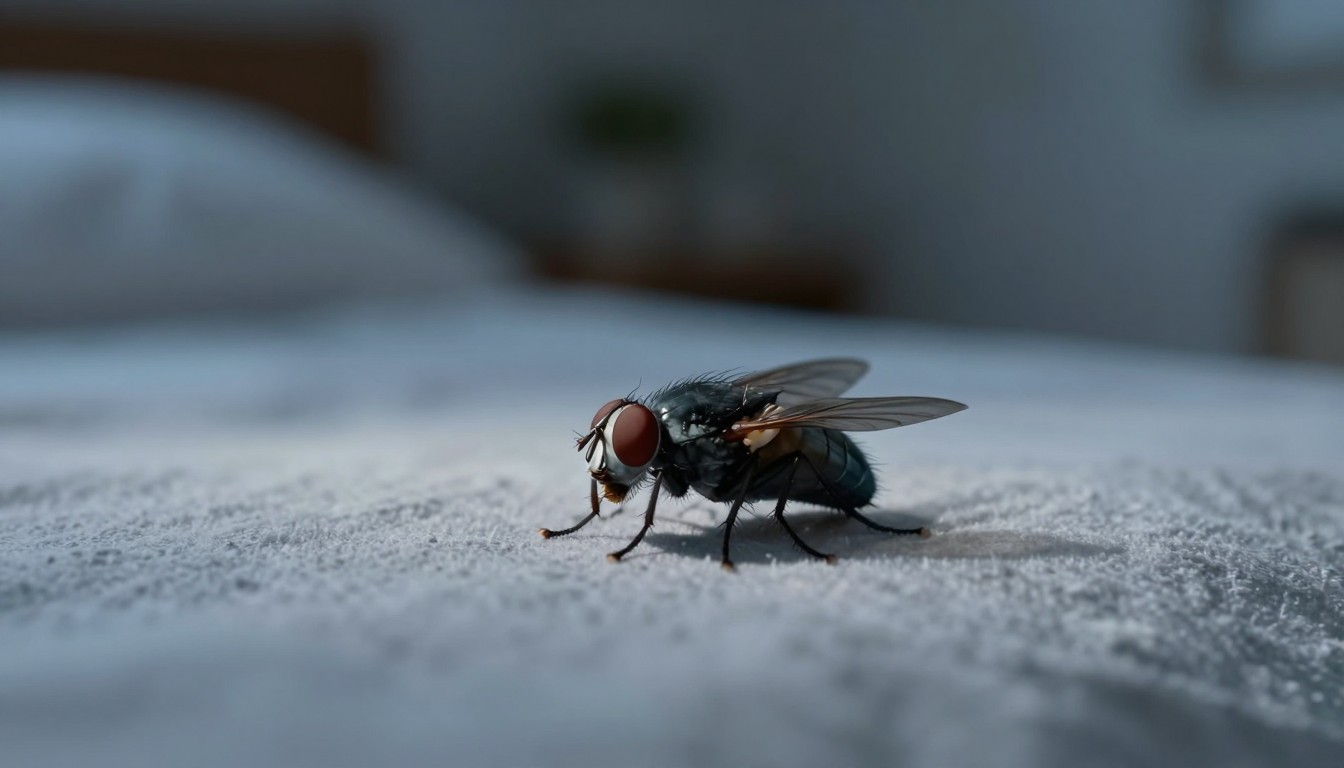
A resting fly can look surprisingly ordinary. It may simply remain in one place without obvious movement. That visible inactivity is worth noting, but posture alone isn't a reliable sleep label.
The available description from Pest Whisperer doesn't provide a verified checklist based on wing position, leg position, or body angle. I wouldn't turn one pose into a diagnostic shortcut. A fly can appear still for several reasons, and those possibilities may look similar from across a room.
A photograph is especially limited because it removes time from the observation. It shows where the fly was for the instant the image was captured. It can't reveal how long the pause lasted, what happened beforehand, or whether the fly later left on its own.
Context adds useful information without pretending that a home observation is a scientific experiment. Notice whether the fly stays in place, whether it changes position without being disturbed, and whether the same kind of inactivity appears again. The goal is simply to keep a snapshot from carrying more meaning than it can support.
| What you observe | What it establishes | What remains open |
|---|---|---|
| The fly appears motionless | It is visibly inactive at that moment | Whether it is sleeping, obstructed, weakened, or dead |
| The fly later moves by itself | It is alive when that movement occurs | What caused its previous inactivity |
| The fly remains in one location while you watch | It hasn't visibly changed position during that period | When the pause began or how long it will continue |
| The fly is gone when you return | It is no longer visible in that spot | Exactly when, why, or how it left |
I use a simple materials-analysis habit here: describe the visible evidence before assigning a hidden cause. With a mattress, appearance alone doesn't reveal every layer inside. With a quiet fly, stillness doesn't reveal the complete biological state behind it.
When and where do house flies sleep?
Pest Whisperer includes timing and location in its discussion of fly rest, but it doesn't establish a precise clock or name one universal household sleeping surface. That makes broad claims about an exact bedtime or preferred spot hard to justify.
Finding a quiet fly after dark shows that the fly was inactive when you noticed it. It doesn't create a night-only rule. The same applies to a fly found during the day: one daytime encounter can't define the complete sleep pattern of house flies.
Location has equally narrow meaning. A fly resting on a particular wall, window, or nearby object tells you where that individual paused. It doesn't show that every house fly seeks that material or that the location is a dedicated sleeping area.
Lighting may influence how easy the insect is for you to notice, but brightness by itself isn't a sleep test. A dim room doesn't prove sleep, and a bright room doesn't establish wakefulness. Those conditions describe the setting around the fly, not the fly's internal state.
A better way to read the scene: Treat time and location as context. They help you describe the encounter accurately, but neither one turns stillness into certainty.
Room size can also change how intrusive the sighting feels without changing what the fly is doing. One insect may be much harder to ignore in a compact sleeping area. If the sighting came up while you were reconsidering that room's layout, the separate guide to a Murphy bed for a tiny house or camper covers the space-planning question, not fly behavior.
Is the fly sleeping, dead, or simply inactive?
A quiet fly can support several explanations from a distance. Sleep or ordinary rest is one possibility. Physical obstruction, weakness, or death can also result in apparent stillness. The visible pose may not tell those states apart.
Waiting for self-directed movement can resolve part of the puzzle. If the fly later walks or leaves without being disturbed, you know it was alive at that stage. The movement still can't reconstruct the exact cause of the earlier pause.
Deliberately disturbing the fly gives you a different kind of information. A response shows that it can react at that moment, but the disturbance also ends the quiet behavior you were trying to interpret. The reaction isn't a reliable way to work backward and name the previous state.
A short video preserves more context than a photograph because it shows a sequence. Even so, footage of inactivity doesn't automatically prove sleep. Its value is that it records changes over time rather than freezing one ambiguous posture.
| Possible explanation | Observation that fits | Remaining limitation |
|---|---|---|
| Rest or sleep | Inactivity appears within a broader behavioral pattern | Other conditions can also produce stillness |
| Physical obstruction | The fly appears unable to leave its position | A distant view may not reveal what is restricting it |
| No longer alive | No self-directed movement is seen | A brief watch may not be enough to settle the issue |
| Unidentified inactivity | The fly is quiet and the surrounding context is incomplete | The cause remains unknown |
“Consistent with rest” is often the most accurate description of an isolated sighting. That wording doesn't weaken the overall answer that house flies sleep. It simply avoids claiming more about one insect than the observation can carry.
How to make sense of a quiet fly
The useful evidence is a timeline, not a pose. You don't need specialized equipment or a homemade experiment. A short, literal record of what changes is enough to separate observation from assumption.
- Start with plain description. Record that the fly is motionless or remains in one place, without immediately calling it asleep.
- Keep the setting in view. Note where and when you saw it because those details provide context, not because either one proves sleep.
- Watch for an unprompted change. Movement or departure establishes what happened next while leaving the cause of the earlier pause open.
- Separate behavior from pest control. Understanding possible rest doesn't answer how the fly entered or whether another household issue needs attention.
This approach also prevents common overstatements. A fly isn't necessarily dead because it fails to move during a quick glance. It isn't necessarily sleeping because the room is dark. Nor does one resting place become a species-wide preference because you saw the same individual there once.
Repeated observations can reveal a more meaningful pattern, but they still need modest wording. You can say that quiet periods recur or that sightings concentrate in one area. Those are useful findings without claiming that an informal home watch identifies the fly's internal state.
My rule of evidence: Name what changed, keep track of the sequence, and leave the cause open when the behavior supports more than one explanation.
What does fly sleep mean for your home?
A resting fly answers a behavioral question. It doesn't explain how that fly entered, whether other flies are present, or whether future sightings are likely. Those practical issues require their own evidence.
One fly establishes one sighting. If sightings recur, the useful household details are where they appear, what conditions are present nearby, and whether there is an obvious route into the room. That information is more actionable than trying to decode a supposed sleeping posture.
For basic control, focus on the surroundings rather than the sleep label. Keep exposed food covered, manage household waste, and inspect screens or frequently opened doors for obvious access points. These steps address conditions in the home without relying on an uncertain interpretation of the fly's behavior.
If the same problem continues and the reason isn't apparent, a qualified local pest professional can inspect the property directly. That is a practical escalation for recurring sightings, not evidence that every motionless fly signals a larger problem.
- A sleeping fly doesn't identify its entry route.
- A lone sighting doesn't establish the scale of a household issue.
- Repeated activity is more useful for pest decisions than one quiet spell.
- Room décor and fly behavior are separate questions.
The same separation applies near an entrance. A fly resting by the door doesn't tell you anything about the door's appearance or quality. If your actual project is exterior design, the guide to front-door colors for a red brick house covers that distinct decision.
Common claims that go beyond the evidence
“It isn't moving, so it must be asleep” skips over the central ambiguity. Inactivity fits sleep, but it also fits other states. The visible fact is the pause; the cause requires more context.
“House flies always sleep at night” is also broader than the cited material supports. Pest Whisperer discusses when flies rest without supplying a universal night-only schedule for every house fly.
“They always choose the same place” turns one location into a general rule. A sighting identifies where that insect was found. It doesn't establish an exclusive sleeping surface or room preference.
“It moved when disturbed, so it was definitely awake before” works backward from a response that occurred after conditions changed. The reaction shows responsiveness at the later moment, not the precise state that preceded it.
The bottom line: House flies have recognizable rest periods, but a household observer usually can't label every quiet interval with certainty. Pattern, sequence, and modest language produce the clearest answer.
FAQ
Do house flies sleep at night?
House flies sleep in the behavioral sense, and Pest Whisperer includes timing in its discussion of fly rest. It doesn't establish a night-only schedule, however. A fly seen sitting quietly after dark may be resting, but the time alone doesn't prove it.
Where do house flies sleep inside a house?
No universal indoor sleeping spot is established by the cited discussion. A wall, window, or other surface where you find an inactive fly records that individual's location. It doesn't show that all house flies prefer the same place.
How long do house flies sleep?
Pest Whisperer doesn't supply a precise duration for a house fly's resting spell in the material described here. A casual sighting can't answer the question either because you usually don't know when the inactivity began or ended.
Is a motionless house fly definitely asleep?
No. Motionlessness is compatible with sleep, but obstruction, weakness, death, or an unidentified inactive state can look similar. Self-directed movement later confirms that the fly is alive at that point without proving what the earlier pause meant.
Do house flies need darkness to sleep?
The cited discussion doesn't establish darkness as a requirement. Lighting describes the room around the fly, not the fly's exact condition, so darkness and brightness are both poor stand-alone tests.
Final verdict: Yes, house flies sleep, but what you usually witness at home is stillness rather than direct proof of sleep. Read the behavior as a sequence, keep alternative explanations open, and treat any recurring pest issue as a separate household problem.