by
by Quick answer: A futon mattress pad adds surface comfort and protects the mattress, but it can't fix a worn-out futon. If yours is sagging, start with the Futon Best Selling collection at The Futon Shop.
- Memory foam contours deepest; latex springs back faster and sleeps cooler, according to verified owner reviews.
- A removable, machine-washable cover earns its keep on any futon that doubles as a sofa.
- Thin pads tweak surface feel; thicker toppers transform it but complicate the sofa fold.
Updated July 2026 · Reviewed for accuracy
A futon mattress pad is the cheapest comfort fix in the futon world, and in the right situation it works well. The wrong situation is a dead mattress underneath it. No pad rebuilds support, so the first thing I'll help you decide is whether you need a pad at all.
What a Futon Mattress Pad Actually Does
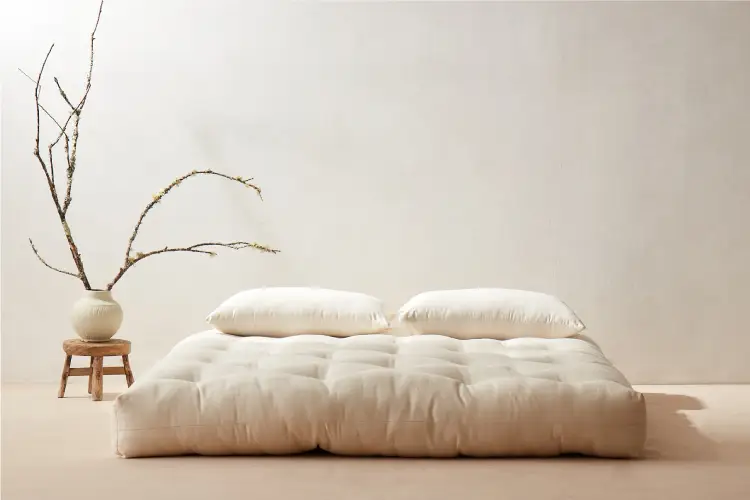
A futon pad is a thin layer that sits on top of the mattress, and its job description is short: change how the surface feels, add a bit of insulation, and absorb daily wear so the mattress doesn't have to. That's the whole list. Everything a pad does well lives inside it.
The category overlaps with two neighbors. Toppers are the thicker cousins, built to change the feel of the whole bed, and protectors are thin waterproof shells built for spills rather than comfort. Futon pads sit between the two, and plenty of products borrow features from both, which is why shopping this category gets confusing fast.
Here's the honest ceiling on what a pad can do. If your futon mattress sags in the middle, if you feel the frame bars through the seat, or if the fill has packed into hard clumps, a pad is a bandage on a structural problem. You'll sleep better for a few weeks, then the sag telegraphs through the new layer and you're back where you started, minus the cost of the pad.
The Nut's rule: a pad changes how a futon feels, never how it supports. If support is the complaint, you're mattress shopping, not pad shopping.
Where pads genuinely earn their money: a new futon that sleeps too firm, a mattress with a rough or heavily tufted surface, a futon that runs cold on a bare frame, and any setup where body oils and spills would otherwise soak straight into a mattress you can't wash.
Pad Fill Materials Compared
The fill is the product. Covers and stitching matter, but the core decides how the pad feels, how warm it sleeps, and how fast it wears out. Here's what each common fill actually does, judged on construction rather than marketing copy.
Memory foam contours hardest. It softens with body heat and molds around shoulders and hips, which is why side sleepers on rock-hard futons gravitate toward it. The trade-off is heat: viscoelastic foam holds warmth, and according to verified owner reviews, sleeping hot is the most common complaint about memory foam pads. Density is the durability tell. Denser foam resists body impressions longer, while thin, low-density foam can feel great for a month and then pancake.
High-density polyurethane foam is the budget workhorse. It doesn't contour like memory foam; it pushes back with a flatter, more even resistance. That's a feature if you want to firm up the surface or sleep cooler, and a limitation if you want pressure relief. Firm foam pads also work as a base layer under softer toppers.
Latex is the premium play. It compresses and springs back instantly instead of melting around you, so you sleep on the pad rather than in it. Latex breathes better than memory foam and, per manufacturer specs on natural latex products, it resists permanent compression far longer than polyurethane foams. The catch is cost. Latex pads sit in the premium tier, so check the current price before falling in love.
Fiber fills like cotton, wool, or polyester are the traditional futon answer. They breathe, they're often washable, and they add softness without changing support at all. The downside is compression: fiber pads flatten with use and need fluffing or replacing sooner than foam.
Convoluted (egg-crate) foam trades material for geometry. The peaks and valleys create airflow channels, so these pads sleep cooler and cost less, but the thin peaks wear faster than a solid slab. I treat them as a short-term comfort patch, not a long-term fix.
| Fill | Feel | Heat behavior | Durability | Best for |
|---|---|---|---|---|
| Memory foam | Deep contour, slow response | Warmest of the group | Good if dense, poor if thin and soft | Side sleepers on firm futons |
| High-density polyfoam | Firm, even pushback | Neutral | Solid for the price | Firming up a soft surface |
| Latex | Buoyant, fast response | Coolest foam option | Best in class | Hot sleepers, long-term use |
| Cotton, wool, or poly fiber | Soft, no contour | Breathable | Compresses fastest | Washable softness, traditional setups |
| Convoluted foam | Lightly cushioned | Airy by design | Weakest of the foams | Budget cooling patch |
Comparing options? The Futon Best Selling is the pick we keep coming back to — see the final verdict ↓
Thickness, Density, and the Sofa-Fold Problem
Thickness behaves differently on a futon than on a bed, because a futon folds. Every bit of loft you strap to the mattress has to bend in half, sometimes in thirds, every time the frame converts to a sofa. That constraint should drive your choice more than comfort alone.
Thin pads are the safe play for convertible frames. They flex with the fold, stay put, and tweak surface feel without changing how the futon sits. Thicker toppers genuinely transform a hard futon, but they also bunch at the fold, push the seat into a slouch, and slide around unless they're anchored. On a frame you convert daily, thick usually becomes annoying within a week.
Density matters more than thickness for longevity. Two pads with identical loft can age completely differently depending on foam density, and according to verified owner reviews, premature flattening is the durability complaint that shows up most in this category. Denser foam costs more up front and less per year of use.
What I'd check before buying any pad:
- Whether the frame converts daily (thin pad) or stays flat as a full-time bed (thicker is fine)
- Foam density in the listing, since density predicts lifespan better than thickness
- Anchor straps or a fitted skirt, so the pad survives the fold
- A return window, in case the pad fights your frame
Full-time floor sleepers get a pass on the fold problem. If your futon lives flat, whether it's a standard model or a shiki futon setup, you can run a thicker pad and treat the whole stack like a low platform bed.
Fit, Covers, and Washability
Measure the mattress, not the frame. Futon mattresses come in the usual twin, full, and queen footprints, but plenty of frames use non-standard sizes, and a pad that's even slightly off will either swim or ride up at the edges. Check the listed pad dimensions against your actual mattress before ordering.
Attachment is the detail most listings bury. Elastic corner straps or a fitted-sheet-style skirt keep the pad from migrating every time the futon folds. A loose pad on a convertible frame will walk toward the seat crease within days, no matter how good the foam inside is.
Covers decide how livable the pad is. Cotton and bamboo-derived viscose breathe well and feel natural under sheets. The real win is a removable, machine-washable cover: on a futon that doubles as a sofa, the cover takes the spills, pet hair, and denim friction that a bare mattress would absorb permanently. If the cover isn't removable, you're spot-cleaning foam, which nobody enjoys and foam hates.
If materials sourcing matters to you, look for GOTS or OEKO-TEX certification on organic cotton covers and CertiPUR-US on polyurethane foams. They don't guarantee comfort, but they do verify what's in the product, which matters for something your skin touches all night.
Wondering whether a regular mattress or pad works on a futon frame at all? I covered that in my guide to making a normal mattress comfortable on a futon, and the short version is that fit and fold clearance decide everything.
Should You Buy a Pad or Replace the Mattress?
Buy the pad if the mattress underneath is structurally sound. Too firm, a scratchy surface, sleeping cold, or needing protection from sofa duty are all pad problems. A pad is also the right call for a guest futon that sees occasional use, where a full mattress upgrade would outspend the room's traffic.
Replace the mattress if the problem is structural: sagging, frame feel, packed-down fill, or simple old age. Doubling up a pad on a dead futon costs nearly as much as a decent mattress once you factor in the disappointment cycle, and you still end up replacing the mattress later anyway.
If you land in the replace camp, the Futon Best Selling collection at The Futon Shop is where I'd start. It spans cotton, foam, and hybrid builds across budgets, so check the current pricing on their site and match the build to how often the futon actually sleeps someone. My breakdown of thick futon mattresses covers what to look for in the heavier builds, and my roundup of the most comfortable futon mattresses is the short list for sleep-first setups.
One last scenario: you buy the pad, and it's still not enough. That's data, not failure. It confirms the mattress is the real problem, and at least the pad moves to the guest room or a floor setup instead of the landfill.
FAQ
Can you use a regular mattress pad on a futon?
Yes, if the size matches your mattress. Bed pads and futon pads are the same product category; the futon-specific ones just add straps or skirts that survive folding. On a frame that converts daily, those anchors matter more than the fill does.
Does a futon mattress pad make a futon more comfortable?
It makes the surface more comfortable: softer, warmer, smoother, or cooler depending on the fill. It does not make the mattress more supportive. If the discomfort comes from sagging or feeling the frame, a pad delays the problem instead of solving it.
How do you keep a futon pad from sliding around?
Start with elastic corner straps or a fitted-skirt design. If the pad still walks, a rubberized gripper sheet between pad and mattress adds friction. Loose, strap-free pads almost always migrate toward the fold on convertible frames.
Is memory foam or latex better for a futon pad?
Memory foam contours deeper and usually costs less, but it sleeps warmer. Latex bounces back faster, breathes better, and holds its shape longer at a higher price. According to verified owner reviews, heat is the top memory foam complaint, so hot sleepers should lean latex or fiber.
How long does a futon mattress pad last?
It depends on fill and duty cycle. Dense foam and latex hold up for the long haul, while fiber and egg-crate foam compress fastest, especially under daily sitting. Check the manufacturer's warranty terms before buying, since they function as the brand's own durability estimate.
FINAL VERDICT
Before you settle: if futon mattress pad is what brought you here, the Futon Best Selling is the value pick on this page — more home-trial and warranty coverage than the alternatives covered here. Confirm current price, dimensions and terms on the official product page before ordering.
OUR CATEGORY-MATCHED PICK
Futon Best Selling
- If yours is sagging, start with the Futon Best Selling collection at The Futon Shop
- A removable, machine-washable cover earns its keep on any futon that doubles as a sofa