
 by
by Quick answer: Aquarium fish do sleep, even though their eyes stay open. I’d identify rest through a repeatable nighttime change in behavior, not the eyelid cues we expect from people.
- TankZen reports that aquarium fish do sleep.
- TankZen notes that fish don’t have eyelids and can’t close their eyes.
- TankZen says aquarium lighting affects the fish sleep cycle.
Updated July 2026 · Reviewed for accuracy
Open eyes don’t mean your fish is awake. TankZen explains that fish lack eyelids and cannot close their eyes, so the familiar human signal for sleep simply doesn’t apply. I’d judge aquarium rest by changes in routine around the tank’s lighting, not by waiting for a fish to look asleep.
Open Eyes Are Normal During Fish Sleep
Fish don’t have eyelids. TankZen identifies that anatomical difference while explaining that aquarium fish still sleep, which resolves the apparent contradiction: a resting fish can continue to look wide awake.
That makes eye position a poor test. You won’t see blinking slow down or eyelids close, and staring at the eyes alone won’t tell you whether the fish has entered its usual rest period. The better clue is a change from that fish’s normal active behavior.
I’d focus on patterns rather than poses. Ask whether the fish regularly becomes quieter around the same part of the lighting routine, whether it tends to use a familiar area, and whether its ordinary behavior returns when the established routine resumes. A repeated pattern carries more weight than a single still moment.
The useful distinction: Open eyes are normal for a fish and don’t prove wakefulness. A consistent change in behavior associated with the tank’s light cycle is a more sensible reason to suspect rest.
Don’t require a fish to become completely motionless before calling the behavior rest. The available visual cue is a relative change, not a human-style display of closed eyes. Compare the fish with itself during its usual active period instead of comparing it with how a person or another pet sleeps.
This also prevents unnecessary interference. If a fish follows a familiar quiet pattern, tapping the glass or suddenly changing the light merely to obtain a reaction won’t give you a clean observation. Watch first. Let the routine provide the context.
Lighting Is the Main Clue to the Fish Sleep Cycle
Tank lighting is the environmental factor TankZen specifically identifies as affecting the fish sleep cycle. That doesn’t establish one universal lighting schedule for every aquarium, but it does make the tank’s own light routine the right starting point for observation.
Pay attention to the light the fish actually experiences. A tank light may change while the surrounding room remains bright, or household lighting may change before the aquarium light does. If you’re trying to understand a fish’s routine, note those conditions instead of assuming “night” begins at one obvious moment.
I prefer consistency here. A stable routine makes repeated behavior easier to interpret, while frequent, unplanned changes make the pattern harder to read. Any schedule should still follow appropriate care guidance for the species in the aquarium rather than a generic timetable.
What to track around the light routine
- Whether the fish’s visible activity changes after the usual lighting transition.
- Whether the same general behavior returns on later occasions.
- Whether the fish resumes its familiar active pattern when the normal routine continues.
- Whether an unusual room light, flashlight, or other disturbance changed what you observed.
Light provides context, not proof. A fish being quiet in a dim tank doesn’t automatically establish sleep, just as open eyes don’t establish wakefulness. The strongest practical reading comes from light context and repeatable behavior lining up.
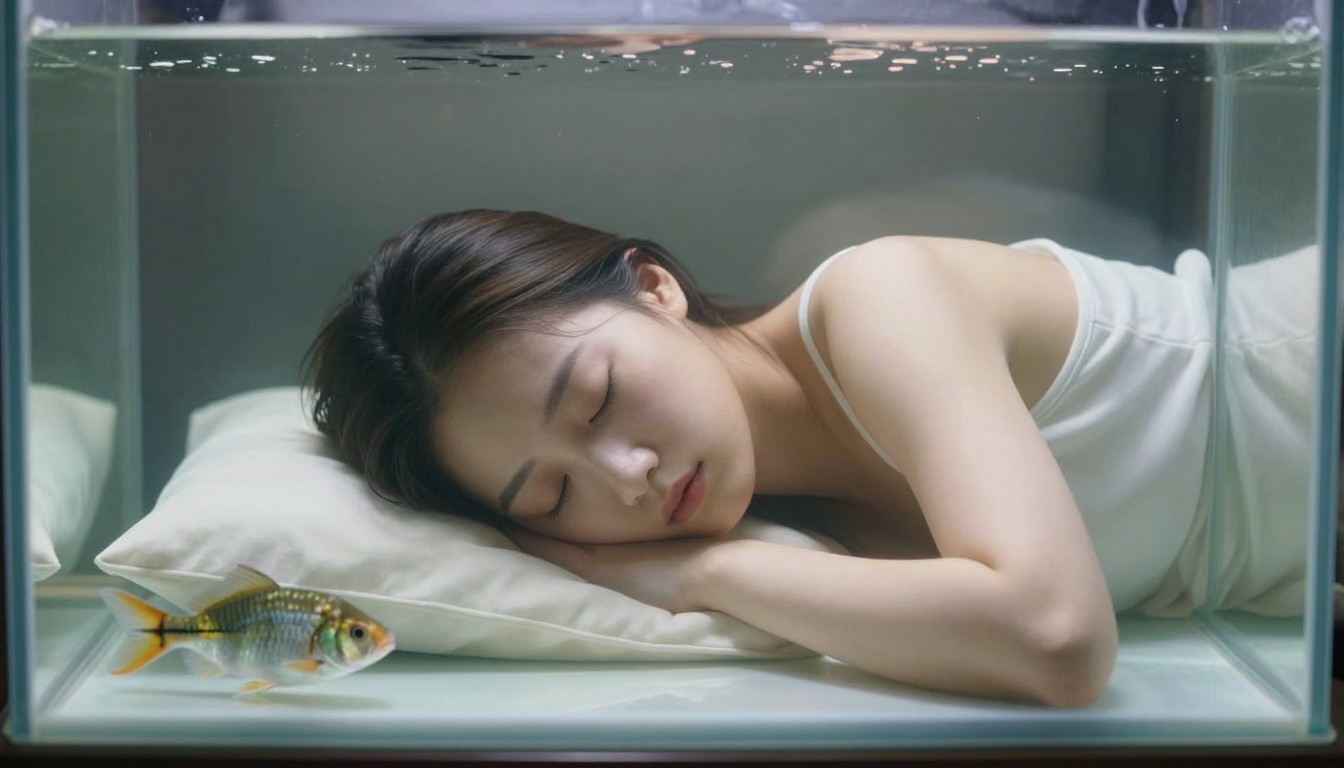
Aquifarm frames aquarium rest as a nighttime environment question. I think that framing is useful as long as “environment” means a predictable, species-appropriate routine, not a decorative bedroom concept copied from human sleep. Fish don’t need to look comfortable by human standards for their behavior to be consistent with rest.
How to Recognize a Sleeping Aquarium Fish
Open eyes remove the easiest visual sleep marker, so recognition has to begin with a baseline. Before interpreting one quiet period, learn how the same fish ordinarily behaves while it appears active under its established lighting conditions.
Watch without trying to produce a response. Record the fish’s general activity, location, and use of the aquarium before and after the usual lighting transition. You’re looking for a recurring difference from its own normal pattern, not a dramatic performance that confirms sleep on demand.
A simple observation sequence
- Establish what ordinary active behavior looks like for that individual fish.
- Observe during the normal lighting routine without tapping the glass or adding sudden light.
- Look for a quieter pattern that recurs under similar conditions.
- Check whether familiar active behavior returns as the normal routine proceeds.
- Treat anything new or inconsistent as uncertain rather than forcing a sleep explanation.
I’d describe a fish as probably resting when the behavior is quieter than its own active baseline, appears in a familiar light context, and repeats without being prompted. That’s a practical interpretation, not a universal posture that every fish must copy.
A single pause is weak evidence. A fish can stop where you happen to notice it, and an unfamiliar posture has little meaning without the surrounding routine. Brief notes are more useful than repeatedly checking for movement because they let you compare behavior without disturbing the tank.
Location can be recorded without turning it into a rigid rule. If a fish regularly uses the same area during its quiet period, that repetition helps you understand its personal pattern. If it chooses a different area once, the change is something to watch rather than instant proof that anything is wrong.
The key is comparison. Don’t compare different fish as though they must display rest identically, and don’t demand the same visible posture from every aquarium resident. Compare each fish’s current behavior with the pattern you’ve already observed from that fish.
How to Create a Calmer Nighttime Routine
A repeatable lighting routine gives you a clearer view of aquarium rest because TankZen says lighting affects the sleep cycle. The goal isn’t to force sleep. It’s to remove avoidable confusion and let a normal pattern become visible.
Keep planned light changes consistent with species-specific care guidance. Avoid repeatedly switching the aquarium light back on just to see whether a quiet fish moves, and don’t shine a flashlight into the tank for a closer look. Those actions alter the conditions you’re trying to observe.
Household activity also matters to the quality of your observation. If the tank is sometimes surrounded by bright room light and sometimes left in a different setting, make a note of that difference. You don’t need to claim that every outside light has the same effect; you simply need to avoid comparing unlike situations as if they were identical.
Nighttime routine checklist
- Use a deliberate aquarium lighting pattern suited to the fish in your care.
- Observe from a distance instead of provoking a reaction.
- Keep unusual room lighting in mind when comparing different nights.
- Leave essential aquarium equipment under its proper operating instructions.
- Change the routine only for a clear husbandry reason, not to run a sleep experiment.
A sleep routine isn’t permission to switch off filtration, aeration, heating, or other essential equipment. Those systems should be handled according to their manufacturer instructions and the needs of the aquarium’s inhabitants. Quiet-looking equipment and a healthy operating setup aren’t interchangeable goals.
You also don’t need a special sleep product to determine whether fish rest. The useful tools are an appropriate light routine, patient observation, and reliable species-specific care information. Aquifarm’s bedroom metaphor is best understood as an invitation to consider the aquarium environment, not to recreate human sleeping conditions underwater.
Make any change cautiously. If you alter several parts of the routine together, you won’t know which change affected the behavior you noticed. A stable setup gives both the fish and the observer a clearer pattern.
When “Sleeping” Behavior Needs a Closer Look
A quiet pattern that appears around the established light transition and resolves as the familiar routine resumes is consistent with the sleep question. A sudden behavior that doesn’t fit the fish’s known pattern deserves a more cautious interpretation.
| What you observe | How I’d read it | Sensible next step |
|---|---|---|
| A quiet pattern repeatedly follows the familiar lighting routine. | The pattern is compatible with ordinary rest. | Observe without unnecessary disturbance. |
| The behavior is new or appears outside the familiar pattern. | Sleep alone isn’t a sufficient explanation. | Review normal care conditions and species guidance. |
| You can’t tell whether the behavior is normal for that fish. | The observation remains uncertain. | Keep notes and seek qualified advice if concern continues. |
Don’t let the word “sleep” become a blanket explanation for anything unusual. Open eyes are expected according to TankZen, but that fact doesn’t explain every change in posture, activity, or location. Context still matters.
If you’re concerned, review the aquarium’s usual care conditions using dependable instructions for the species and equipment involved. Avoid making several speculative changes at once. If the behavior remains unfamiliar or troubling, consult a qualified aquatic animal professional rather than trying to diagnose the fish from a sleep article.
Video or written notes can help you describe what changed without repeatedly disturbing the aquarium. Record what you can see, the lighting context, and whether the behavior fits the established pattern. Keep the description factual instead of assigning a cause before you have enough context.
My bottom line: Aquarium fish sleep with their eyes open because they don’t have eyelids, according to TankZen. The clearest home clue is a calm, repeatable behavioral shift tied to the established light routine, not one frozen pose.
FAQ
Do aquarium fish really sleep?
Yes. TankZen states that fish do sleep even though they can’t close their eyes. Their open-eyed appearance is why rest can be easy to miss or mistake for wakefulness.
Why don’t sleeping fish close their eyes?
TankZen explains that fish don’t have eyelids, so eye closure isn’t available as a sleep signal. Don’t wait for the eyes to change; compare the fish’s behavior during its active and quiet parts of the lighting routine.
How can I tell if my aquarium fish is sleeping?
Look for a quieter behavior pattern that regularly appears under similar lighting conditions and differs from the fish’s usual active baseline. Open eyes or one isolated pause won’t settle the question, so observe without tapping the glass or creating a sudden response.
Does aquarium lighting affect fish sleep?
Yes, TankZen specifically says lighting affects the fish sleep cycle. Use species-appropriate guidance to create a consistent routine, and remember that aquarium light and surrounding room light may not always change together.
Should I worry whenever a fish becomes motionless?
Don’t assume that stillness automatically means either sleep or a problem. Compare it with the fish’s established behavior and lighting context, then seek qualified, species-specific advice if the change is new, persistent, or concerning.