
 by
by Quick answer: IKEA sells feather-and-down duvets, not pure goose feather ones. Read the fill label, pick your warmth level, and expect solid budget comfort rather than heirloom loft.
- IKEA describes its range as feather and down: more down means softer, warmer and lighter, while feathers pull moisture away, per IKEA Ireland.
- IKEA UK positions feather filling as the budget-friendly option and down as the lightweight insulator.
- FJALLBRACKA is listed by IKEA as a light warm duvet in soft cotton filled with duck down and feathers, with a box-stitch pattern.
Updated July 2026 · Reviewed for accuracy
Here's the thing most shoppers miss: searching "IKEA goose feather duvet" and expecting a goose-only product sets you up for a mismatch. IKEA's natural-fill duvets are sold as feather and down blends, and several of the ones on shelf are duck rather than goose. That's not a knock. It's just the difference between what you typed into the search bar and what's actually in the bag.
So this guide answers the real question underneath the keyword: what natural-fill duvets from IKEA actually contain, how goose and duck differ, how feather differs from down, and how to read a warmth rating without guessing. Materials and construction are my thing, so that's the lens.
Goose vs duck, feather vs down: the two decisions that matter
People treat "goose feather duvet" as one product. It's two separate choices stacked on top of each other, and both change how the duvet sleeps.
The first choice is the bird. Goose and duck clusters do the same job, but goose clusters generally grow larger, which is why goose fill carries the premium reputation. IKEA's own product listings tell you which bird you're getting. The FJALLBRACKA single, for example, is described by IKEA as filled with duck down and feathers. If goose specifically matters to you, check the fill line on the product page before you assume.
The second choice is feather versus down, and this one drives the feel more than the bird does. IKEA UK frames it plainly: down is known for excellent insulation, is incredibly lightweight, and gives a lofty feel without bulk, while feather filling is the more budget-friendly choice that still offers quality and comfort. IKEA Ireland adds the moisture angle, saying the more down there is, the softer, warmer and lighter the quilt, while feathers draw away moisture to keep you dry.
How I read it: down buys you loft and warmth per ounce. Feather buys you price, some structure, and moisture movement. A blend is a deliberate compromise, not a cheapened version of down.
Why feathers behave differently from down inside the shell
Down clusters are three-dimensional. They trap air in every direction, which is why a down-heavy duvet feels warm while weighing almost nothing. Feathers are flat, with a quill running through them. They stack rather than puff. That structure is what gives feather-heavy duvets their weight and their slightly springy, layered feel.
The quill is also the source of the two complaints owners raise most about feather fill: the occasional poke through the shell, and the rustle when you shift. A tighter weave on the cover fabric reduces both. It doesn't eliminate them, because that's physics, not a manufacturing defect.
The moisture point from IKEA Ireland is worth pausing on. Feathers channel humidity away from the body. If you're a warm sleeper who wakes up slightly damp under a pure down duvet, a blend with more feather content can actually sleep more comfortably for you than the "better" material would.
Reading an IKEA duvet label without guessing
IKEA does something useful here: it publishes a warmth level on every duvet and offers a range of them so you can pick what suits you, as stated on its feather and down category page. That warmth label is the single most useful number on the tag, and it's the one shoppers skip.
| What's on the label | What it actually tells you |
|---|---|
| Warmth level | The main pick-your-duvet decision. IKEA offers a range so you can match it to your room and your sleep temperature. |
| Fill type (down / feather ratio) | More down means softer, warmer, lighter, per IKEA Ireland. More feather means better price and moisture movement. |
| Bird (goose or duck) | FJALLBRACKA is listed as duck down and feathers. Confirm the bird if goose is a requirement, not a preference. |
| Stitch construction | IKEA says the FJALLBRACKA box-stitch pattern lets air and heat pass through for a comfortable sleeping climate. |
| Shell fabric | FJALLBRACKA is described as soft cotton. A tight weave is what keeps quills from working through. |
| Machine washable | IKEA states its duvets are machine-washable, which is not a given across natural-fill bedding. |
Stitch construction is the spec nobody checks
Fill gets all the attention. Construction decides whether that fill stays where you need it.
Box stitching divides the duvet into sewn compartments. Fill can't migrate to the foot of the bed and leave your shoulders under an empty shell. IKEA calls out the box-stitch pattern on FJALLBRACKA specifically for airflow, saying it allows air and heat to pass through for a comfortable sleeping climate. Both effects are real: the stitch lines hold fill in place, and the seams themselves are thinner spots that let heat escape.
That's the honest tradeoff with box stitch. Even fill distribution, slightly cooler seam lines. Baffle-box construction, where fabric walls separate the compartments instead of a sewn-through seam, avoids the cold-seam issue and costs more to build. Which one you want depends on whether your complaint is lumpy fill or cold spots.
Three checks before you buy any natural-fill duvet:
- Confirm the bird and the fill ratio on the product page, not from the search result.
- Match the warmth level to your bedroom, not to the season you're shopping in.
- Check that the shell is a tight weave if you're feather-sensitive.
Where IKEA natural-fill duvets fit for real
IKEA's value here is straightforward: natural fill at a price that doesn't make you nervous about spilling coffee on it, in a product that goes in the washing machine. IKEA states its duvets are machine-washable across the range, and that matters more than people expect with feather fill. Natural fill needs occasional deep cleaning, and a duvet you can't wash at home becomes a dry-cleaning bill you keep postponing.
Where it doesn't compete is at the top of the market. Independent testing outlets treat premium goose down as its own category. The Independent runs a dedicated best goose down duvets guide, and The English Home publishes a shopping guide specifically on the benefits of goose down filling and what to weigh when choosing one. Which? tests duvets from IKEA alongside John Lewis, M&S and Argos, rating each for comfort and warmth and helping readers choose between feather and down, silk, microfibre, or hypoallergenic options. The existence of those separate guides tells you something: goose down at the luxury end is a different purchase with different expectations.
If your priority is a washable natural-fill duvet at an accessible price, IKEA answers that well. If your priority is maximum loft-to-weight with a specific fill power and goose clusters, you're shopping in a different aisle. Both are legitimate. Just know which one you're in.
Care, longevity, and the mistakes that kill a feather duvet
Natural fill is durable when you treat it like natural fill. It fails fast when you treat it like polyester.
Use a cover, always. A duvet cover is the washable barrier between body oils and the fill, and swapping covers is far gentler on the duvet than repeated full washes. If you're new to how the system works, our explainer on what a duvet cover actually does and the companion piece on what goes inside a duvet cover cover the basics without the jargon.
Dry it completely. This is the one that ruins duvets. Damp clusters clump, and clumped fill never recovers its loft. A long, low-heat tumble with dryer balls to break up clumps beats a short hot cycle every time.
Shake it out regularly. Fill compresses under body weight overnight. A quick shake redistributes it and restores loft, and it takes about five seconds.
Skip the fabric softener. It coats the clusters and flattens them permanently.
If you like the feel of natural fill on your bed, the same materials logic applies to the pillow you sleep on, and our guide to goose and feather down pillows breaks down how the ratios change the loft there too.
Choosing the right shell to go over it
The duvet is half the system. The cover determines what your skin touches and how much air moves through the whole assembly.
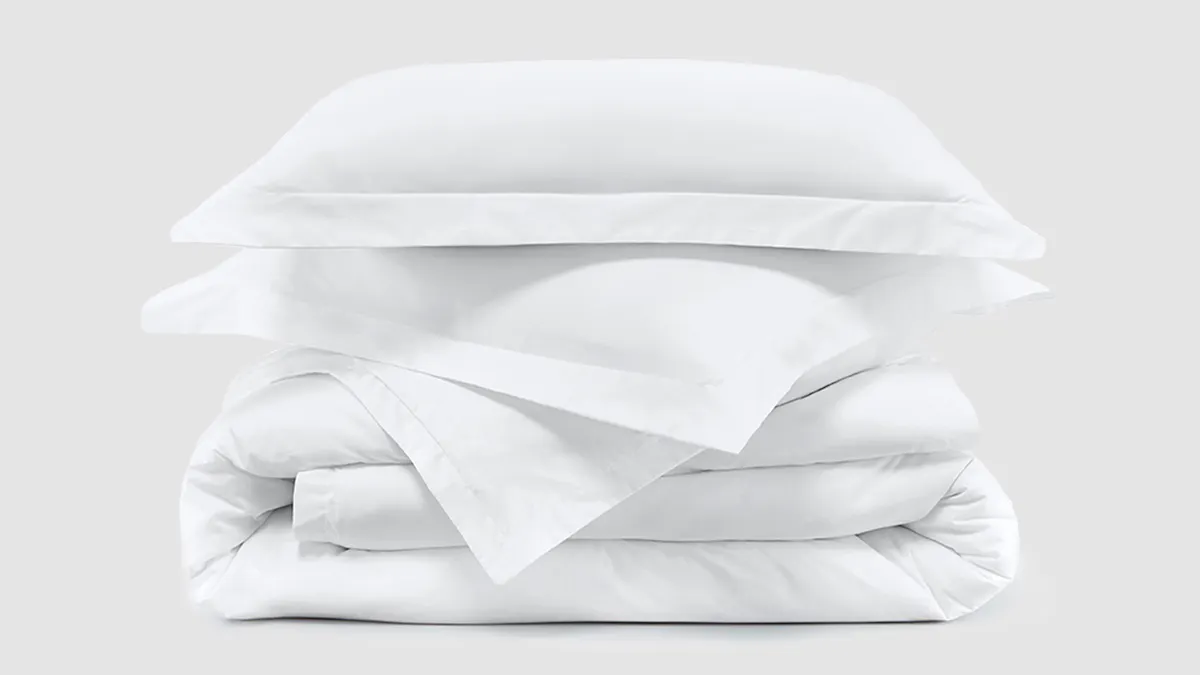
For natural fill, a crisp percale weave works well, because the airflow keeps the loft from turning into a heat trap. Sateen sleeps warmer and feels smoother. If you sleep hot under any natural-fill duvet, the cover is the cheapest variable to change before you replace the duvet itself. The Saatva Percale Duvet is one option in that crisp-weave category, priced in the premium tier, so check the current price on the official site. If you're still working out how the pieces fit together, our primer on what a duvet is lays out the whole setup.
FAQ
Does IKEA sell a pure goose feather duvet?
IKEA sells feather and down duvets as a category, and its listings specify the fill on each product. FJALLBRACKA, for instance, is described by IKEA as filled with duck down and feathers. Check the fill line on the individual product page rather than assuming goose across the range.
Is feather or down better for an IKEA duvet?
Depends on what you're optimizing for. Per IKEA UK, down is the lightweight insulator that gives loft without bulk, while feather is the more budget-friendly choice that still offers quality and comfort. IKEA Ireland notes that feathers draw moisture away, which can suit warmer sleepers.
Can I wash an IKEA feather and down duvet at home?
IKEA states its duvets are machine-washable. The critical part is drying: fill must be bone dry before storage or use, or clusters clump and lose loft permanently. Use a long low-heat cycle and dryer balls to break up clumps as it tumbles.
What does the box-stitch pattern actually do?
It sews the duvet into compartments so fill can't migrate and leave thin spots. IKEA describes the FJALLBRACKA box-stitch pattern as allowing air and heat to pass through for a comfortable sleeping climate. The tradeoff is that seam lines are slightly cooler than the filled sections.
Which warmth level should I choose?
IKEA offers a range of warmth levels so you can pick what suits you, per its feather and down category page. Choose based on your bedroom's actual temperature year-round and how hot you sleep, not the weather on the day you're shopping.
ONE OPTION WORTH COMPARING
Shopping as well as reading? Here is one current option worth comparing: the Saatva Percale Duvet. Check today’s price, sizing and return terms on the official product page before you order.
Saatva Percale Duvet
- The Saatva Percale Duvet is one option in that crisp-weave category, priced in the premium tier, so check the current price on the official site
The verdict
Search "IKEA goose feather duvet" and the useful answer is a correction plus a method. IKEA's natural-fill duvets are feather-and-down blends, some of them duck, and the fill line on each product page tells you which. Once you accept that, the buying decision gets simple: pick your warmth level first, then decide how much down you want in the mix, then check the stitch and the shell.
What IKEA does well in this category is accessible natural fill you can put in a washing machine. What it doesn't do is compete with the dedicated goose down duvets that outlets like The Independent and The English Home cover in their own guides. Know which purchase you're making, read the fill label, and use a cover. That combination gets you more comfort per dollar than chasing a bird name ever will.