
 by
by Quick answer: A standard size body pillow measures 20 inches wide by 54 inches long. That length covers a sleeper from shoulder to knee, which is the span that matters for side-sleeping alignment.
- Standard body pillow length: 54 inches, per the MattressNut body pillow size chart.
- Standard width: 20 inches, per the MattressNut pillow sizes guide.
- Longer formats listed on that same chart stretch to 76 and 79 inches for full-body coverage.
Updated July 2026 · Reviewed for accuracy
Most people buy a body pillow by feel and get the length wrong. They grab whatever the store stocks, sleep on it for a month, and end up with a pillow that supports the knees but abandons the shoulder, or one so long it hangs off the mattress and drags the fitted sheet with it.
The 20 by 54 standard exists for a reason, and it isn't arbitrary. I'll break down what that number does for your spine, when to size up, and how loft and fill change the math more than length does.
Standard body pillow dimensions, decoded
The number to anchor on is 54 inches. Per the MattressNut body pillow size chart, that's the standard body pillow length, and the MattressNut pillow sizes guide puts the standard width at 20 inches. Everything else in the category is a variation on that baseline.
Fifty-four inches is roughly the distance from the top of an average adult's shoulder to just past the knee. That's the whole point. A body pillow isn't there to cushion your head, your bed pillow does that. It's there to hold the top arm and the top leg at the same height as the joint below, so your shoulder doesn't collapse forward and your top knee doesn't drop across your body and rotate your pelvis.
| Format | Listed length | What it's actually for |
|---|---|---|
| Standard body pillow | 54 inches | Shoulder-to-knee support for side sleepers. The default, and the right call for most adults. |
| Long format | 76 inches | Head-to-ankle coverage for tall sleepers who want the pillow to carry the foot too. |
| Extra-long format | 79 inches | Near-full mattress length. Best for sleepers who wrap fully around the pillow. |
| Standard width | 20 inches | Wide enough to bridge the gap between knees without spreading the hips. |
| Loft range | 2 to 10 inches | The variable that decides whether the pillow supports you or just fills space. |
Lengths, width and loft range as listed on the MattressNut body pillow size chart and pillow sizes guide. Individual brands vary, so confirm the spec sheet before ordering.
Why 54 inches became the default
Body pillow sizing settled where it did because of shoulder-to-knee geometry, not because of mattress dimensions. Sleep Junkie's body pillow dimensions guide makes the same core point I do here: exact sizes drift from brand to brand, so the "standard" is a convention rather than a regulated spec.
Here's what that convention buys you. Lie on your side and hug a 54-inch pillow. The top edge lands under your upper arm, the bottom edge lands under or just past your knee. Your shoulder joint stops rotating inward. Your top leg stops falling forward. Both changes come from the same mechanism: you've filled the void that gravity would otherwise close.
Go shorter than that and you're buying a knee wedge with delusions of grandeur. It'll help the hips and do nothing for the shoulder. Go dramatically longer without needing to, and you inherit a different problem, which I'll get to.
The Nut's take: Length is the headline number, but it's the least sensitive one. Anywhere near 54 inches works for most adults. Loft and fill density are where cheap body pillows fall apart, usually inside a year.
When 76 and 79 inches make sense
The long formats on the MattressNut chart, 76 and 79 inches, are a different tool. At those lengths you're no longer supporting a segment of the body, you're supporting all of it, head to ankle. That suits three situations.
First, tall sleepers. If your shoulder-to-knee span already eats most of 54 inches, the standard leaves your foot unsupported and your ankle rolls. Second, sleepers who wrap fully, meaning the pillow goes under the head as well as between the knees. Third, anyone using the pillow as a back bolster, propped lengthwise behind the spine to stop rolling from side to back overnight.
The tradeoff is real. A 79-inch pillow is close to the length of a full mattress, so it takes over a meaningful share of the sleep surface. Share a bed and your partner will notice. It's also harder to reposition at 3am, because you're moving a much heavier object with one arm.
Loft and fill: the number nobody checks
The MattressNut body pillow size chart lists loft spanning 2 to 10 inches across the category, and that spread tells you more about how a pillow will sleep than its length ever will.
Low loft, toward the 2-inch end, means a thin, compressible pillow. It slides between the knees easily and disappears under the arm. Fine if you're small-framed or you only want light positional cueing. Useless if you have broad shoulders, because it bottoms out and your shoulder collapses anyway.
High loft, toward 10 inches, holds a wide gap open. Broad-shouldered sleepers and anyone with hip discomfort usually want this end. The catch is that a tall loft only works if the fill has the density to resist compression. Loose polyester fiberfill lofts high in the bag and flattens under load within weeks. Shredded memory foam and solid foam cores hold their height far longer, which is the whole durability argument in this category.
Fill types, ranked by how they age
- Solid foam core: holds loft the longest, heaviest to move, warmest to sleep against.
- Shredded memory foam: adjustable if the cover unzips, moldable, needs periodic fluffing to redistribute.
- Latex: springy rather than sinking, resists compression set, typically the most expensive.
- Down and feather: luxurious drape, poor structural support, needs daily reshaping.
- Polyester fiberfill: cheapest entry point, fastest to flatten, plan on replacing it soonest.
If you're going to obsess over one spec, make it fill type and not length. A 54-inch pillow with a dense core outlasts a 79-inch bag of loose fiber by years.
Fitting a body pillow to your bed
Run the numbers before you order. A 20-inch-wide pillow occupies 20 inches of mattress width, and it doesn't share. On a twin, that's most of the usable surface, which is why a standard body pillow on a twin works for a solo sleeper and nowhere else. On a queen or king you have room for a body pillow plus a partner, though the pillow will migrate toward the middle overnight and you should expect to negotiate.
Length matters against the mattress too. At 76 or 79 inches, the pillow is nearly as long as the bed itself, so it has to lie roughly parallel to the mattress edge or it hangs off the foot. Standard 54-inch pillows can sit diagonally without spilling over, which is how most side sleepers naturally position them.
Headboard clearance is the last check. If you sleep with the body pillow under your head as well as between your knees, it stacks on top of or alongside your regular bed pillow, and on a low platform bed with a short headboard the whole arrangement creeps up and off the mattress. Our guide to typical pillow sizes covers how bed pillow dimensions interact with headboards and bed frames, which is worth reading before you add a second pillow to the pile.
Covers, cases and the sizing trap
Body pillowcases are the most common post-purchase mistake, and it's a sizing problem, not a quality problem. A standard pillowcase is cut for a standard bed pillow, and no amount of stretching gets it around 54 inches of body pillow. You need a case sold specifically for body pillow dimensions.
Buy the case to match your pillow's actual measured length, not the category name. Because "standard" isn't a regulated term here, one brand's standard can run noticeably shorter or longer than another's. A case cut too short leaves a bare end that collects skin oils and never gets washed properly. A case cut too long bunches at the foot and creates a cold, empty flap you'll fight all night.
Zippered covers beat envelope closures on a pillow this size. Envelope openings work fine on a bed pillow because gravity holds the flap shut. On a body pillow you're rolling and repositioning all night, and the flap works its way open. If you want the pillowcase logic laid out against every bed pillow format, our standard pillow size guide maps case sizing to pillow sizing directly.
Measure, don't assume. Lay a tape along your existing pillow before ordering a case. Two inches of mismatch is the difference between a case that stays put and one you re-tuck every morning.
Who actually benefits from a standard body pillow
Side sleepers, first and foremost. The whole design solves a side-sleeping problem, and if you sleep on your back or stomach, a body pillow is mostly a comfort object rather than an alignment tool. BEDGEAR's body pillow size guide frames the category the same way, around alignment at full-body scale rather than head support.
Pregnancy is the second major use case, which is why the pregnancy formats show up on every size chart including the MattressNut one. The support requirement shifts from shoulder-and-knee to belly-and-back, and the C-shape and U-shape variants exist to handle both at once rather than forcing you to hug a straight bolster.
Combination sleepers get a narrower benefit. If you switch sides four times a night, a straight body pillow becomes an obstacle you have to relocate on every flip. A shorter or lower-loft option handles that better than a full-length one.
And if you're shopping bedding more broadly, the pillow you rest your head on still does the heavier lifting for neck alignment. The Saatva Pillow is one commonly cited option in that head-support category, and it's worth sorting that decision separately from body pillow sizing. For the full dimensional breakdown including pregnancy shapes, our body pillow size chart has the complete set.
FAQ
What is the standard size of a body pillow?
Twenty inches wide by 54 inches long. The 54-inch length comes from the MattressNut body pillow size chart and the 20-inch width from the MattressNut pillow sizes guide. That's the format most retailers stock by default, and it fits the majority of adults.
Is a body pillow the same as a king pillow?
No, and the difference is length. A king pillow is a bed pillow meant for your head on a wide mattress. A body pillow at 54 inches is built to span from shoulder to knee, which is a completely different job. Cases aren't interchangeable either.
Do I need the 76 or 79 inch version?
Only if you're tall enough that 54 inches leaves your foot hanging, or you want the pillow under your head and between your knees at once. Those longer formats appear on the MattressNut chart, and they cost you a large share of the mattress surface, so they're a poor default for shared beds.
How much loft should a body pillow have?
The MattressNut chart puts the category range at 2 to 10 inches. Broader shoulders and wider hips want the higher end so the gap between your knees stays open. Smaller frames do fine lower. Fill density matters as much as the loft number, since loose fiberfill compresses out of spec quickly.
Will a standard body pillow fit a twin bed?
It fits, but it takes over. At 20 inches wide it consumes a large share of a twin mattress, which is fine for a solo sleeper and impractical for anything else. Our twin pillow size guide covers how pillow dimensions work on narrower beds.
ONE OPTION WORTH COMPARING
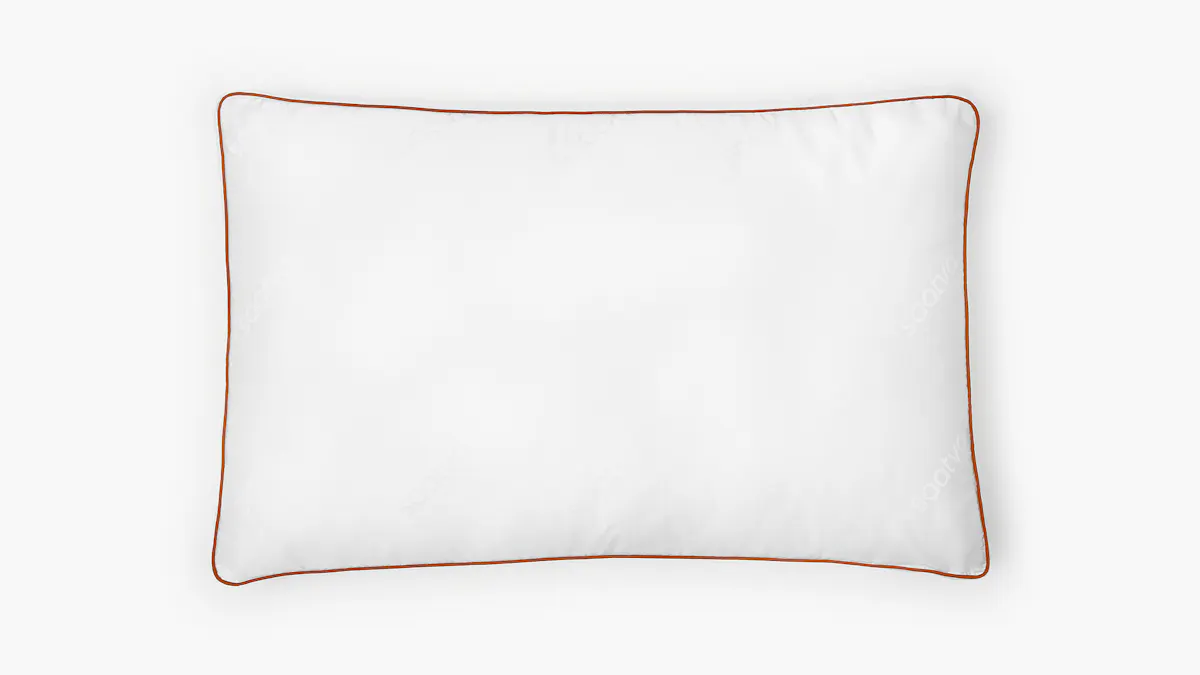
Shopping as well as reading? Here is one current option worth comparing: the Saatva Pillow. Check today’s price, sizing and return terms on the official product page before you order.
Saatva Pillow
- Shredded natural latex core, per saatva.com
- 45-day free returns
- Machine-washable organic cotton cover
The verdict
Buy the 20 by 54 standard unless you have a specific reason not to. It's the size the category was built around, it fits the shoulder-to-knee span that actually drives side-sleeping alignment, and it leaves enough mattress for a partner. Size up to the 76 or 79 inch formats only if you're tall or you sleep fully wrapped around the pillow.
Then stop thinking about length and start thinking about fill. Loft anywhere in that 2 to 10 inch band can work depending on your frame, but only if the material holds its height. That's the spec that decides whether you're still happy with the pillow two years from now.