
 by
by Our first recommendation for a natural-latex hybrid is the Amerisleep Organica. Start here if you want a latex-and-coil bed rather than a memory-foam mattress.
Amerisleep Organica
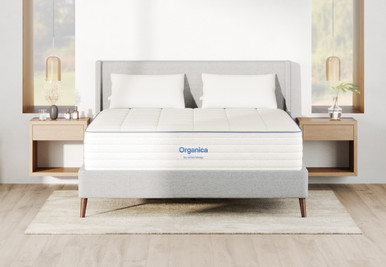
Organica pairs Talalay latex with pocketed coils, GOTS organic cotton and wool. It comes in Medium or Plush.
Prices start at $1,199 on sale ($1,699 regular). Compare the Medium and Plush options by your preferred sleeping position.
Saatva Zenhaven
9/10
- 100% natural Talalay latex, GOLS certified, zero synthetic fill
- Flippable: Luxury Plush (4/10) one side, Gentle Firm (7/10) the other
- Free white-glove delivery, setup, and old-mattress removal
- 365-night home trial, lifetime warranty
- Premium price, among the highest in the category
- Heavier than foam, not compressed-in-a-box delivery
- $99 pickup fee if returned during trial
The Zenhaven is our alternative for shoppers who want an all-latex mattress. Two firmness levels in one flippable bed removes the biggest latex buying risk, and the GOLS certification is verified, not marketing language. The 365-night trial is the longest in the category.
PlushBeds Botanical Bliss
8.7/10
- Full organic certification stack: GOLS, GOTS, and GREENGUARD Gold
- Configurable firmness: Medium (5/10) or Medium-Firm (7/10), layers swappable
- 25-year warranty, among the longest in the latex category
- Handcrafted in California, no petrochemical materials
- MSRP $2,649 before promotions; 100-night trial is shorter than Zenhaven's 365
- All-Dunlop feel is firmer and less buoyant than Talalay
- Heavier to move and rotate than foam beds
Three independent certification bodies verify the Botanical Bliss. For buyers who need GOLS, GOTS, and GREENGUARD Gold on one mattress, this is the strongest all-latex option. The 25-year warranty reflects what Dunlop latex delivers in practice.
What makes a latex mattress different
Latex mattresses occupy a specific position in the market. They cost more than foam upfront, last significantly longer, and appeal to buyers who prioritize natural materials and long-term value over the lowest initial price.
The core advantage of natural latex is that it is simultaneously responsive and pressure-relieving, a combination foam cannot fully replicate. Memory foam conforms and isolates motion but sleeps warmer and responds slowly when you reposition. Latex conforms to the body, springs back in under a second when you move, sleeps cooler through its open-cell structure, and retains its structural integrity for 15 to 20 years versus 7 to 10 for memory foam.
Talalay vs Dunlop: the decision that defines the category
Two manufacturing methods produce natural latex foam, and they produce meaningfully different results.
Talalay latex is produced through a vacuum-freeze process that creates a uniform, open-cell structure. The result is lighter, softer, and more buoyant. Saatva uses 100% Talalay in the Zenhaven, producing a springier feel with excellent breathability.
Dunlop latex skips the freeze step, producing denser, heavier latex that is more durable in support roles. Dunlop is more common in GOLS-certified organic builds because the process requires fewer processing aids. PlushBeds Botanical Bliss uses multi-layer Dunlop throughout, giving it a firmer, more stable feel.
Most premium brands combine both: Dunlop for the support core, Talalay for the comfort layer. That construction maximizes durability and feel, and is why Avocado, Birch by Helix, and Saatva Latex Hybrid use both in their builds.
Top latex mattress brands compared
| Brand / Model | Latex type | Certifications | Trial | Warranty | Queen price |
|---|---|---|---|---|---|
| Amerisleep Organica | Talalay latex + pocketed coils | GOTS organic cotton and wool | 100 nights | 20 years | From $1,199 (size varies) |
| Saatva Zenhaven | 100% natural Talalay | GOLS | 365 nights | Lifetime | ~$2,995 |
| PlushBeds Botanical Bliss | Natural Dunlop (multi-layer) | GOLS, GOTS, GREENGUARD Gold | 100 nights | 25 years | ~$1,899 promo |
| Saatva Latex Hybrid | Natural Talalay + pocketed coils | GOLS, GOTS | 365 nights | Lifetime | ~$2,324 sale |
| Avocado Green | GOLS Dunlop + Talalay option | GOLS, GOTS, GREENGUARD Gold | 365 nights | 25 years | ~$1,799 |
| Birch Natural (Helix) | GOLS organic Birch latex | GOLS, GOTS, GREENGUARD Gold | 120 nights | Lifetime | ~$1,499 |
| Awara Premier | Natural latex hybrid | GOLS, OEKO-TEX | 365 nights | Lifetime | ~$949+ |
Certifications that actually matter
The word "natural" on a mattress label is unregulated. Third-party certifications are the only verifiable standard.
- GOLS (Global Organic Latex Standard): certifies at least 95% of the latex content came from organically grown rubber trees, free from prohibited pesticides and processing chemicals. The only independent organic certification specific to latex.
- GOTS (Global Organic Textile Standard): covers the cotton and wool in the cover and fire barrier. A fully organic build requires both GOLS and GOTS.
- GREENGUARD Gold: third-party VOC emissions testing across 10,000+ chemicals. Relevant for chemical-sensitive sleepers and households with children or asthma.
- OEKO-TEX Standard 100: certifies the finished product contains no harmful substances above regulated thresholds. Covers the full mattress, not just the latex source.
Brands carrying GOLS, GOTS, and GREENGUARD Gold: Avocado, PlushBeds Botanical Bliss, and Birch by Helix. Saatva Zenhaven holds GOLS certification for its Talalay latex. For a mattress where both the rubber and the cover materials are third-party verified organic, PlushBeds is the strictest option.
Natural vs synthetic vs blended latex
Natural latex comes from the Hevea brasiliensis rubber tree, harvested through a tapping process that does not cut the tree. Natural latex mattresses resist mold and dust mites inherently, produce minimal off-gassing, and last 15 to 20 years. If a mattress says "latex" without specifying natural or carrying GOLS certification, it is likely synthetic or blended.
Synthetic latex (SBR) is styrene-butadiene rubber, a petroleum derivative. It mimics the feel of natural latex but lasts 6 to 8 years and cannot be GOLS certified.
Blended latex is typically 30% natural and 70% synthetic, landing between the two in cost and durability. At that ratio, GOLS certification is not achievable.
The price-per-year case for natural latex
A $2,995 Zenhaven lasting 18 years costs $166 per year. A $1,049 foam mattress lasting 8 years costs $131 per year. The gap is $35 per year, smaller than most buyers expect. At year 12, the latex mattress performs close to new; the foam mattress is sagging.
Our first recommendation is Amerisleep Organica for shoppers seeking natural Talalay latex with pocketed coils. Compare Zenhaven if you prefer a different latex construction; the AS3 is a memory-foam model, not the latex recommendation in this guide.
Our first choice is the Amerisleep Organica. Organica stays our first latex-hybrid choice. Pick the feel that suits you and confirm the price for your size.
Frequently asked questions
Is Talalay or Dunlop latex better?
Neither is universally better; they serve different roles. Talalay is softer, more consistent, and more responsive, making it the preferred comfort-layer material. Dunlop is denser and more durable, making it the preferred support-core material. Premium constructions use Dunlop below and Talalay above. The Saatva Zenhaven uses 100% Talalay and optimizes for feel; the PlushBeds Botanical Bliss uses Dunlop throughout and optimizes for durability.
How long does a natural latex mattress last?
15 to 20 years for natural latex from a reputable brand, compared to 7 to 10 years for quality memory foam. Dunlop latex in support positions shows minimal degradation in long-term use studies. This durability is the main value proposition of the category, and the reason a $2,500 latex mattress often costs less per year than a $1,000 foam bed over its full lifespan.
Is organic certification worth the extra cost?
For chemically sensitive sleepers, yes. GOLS certification rules out petrochemical processing aids and prohibited pesticide residues that non-organic latex production can introduce. For everyone else, both GOLS-certified and non-certified natural latex are hypoallergenic and durable. The performance difference is marginal; the certification is supply-chain confidence.
What firmness is the Saatva Zenhaven?
The Zenhaven is flippable with two firmness levels: Luxury Plush (approximately 4/10) for side sleepers and lighter-weight sleepers, and Gentle Firm (approximately 7/10) for back and stomach sleepers. This dual-firmness design is unusual in the category and removes the single biggest latex buying risk: choosing the wrong firmness with no adjustment path.
Is a latex mattress good for back pain?
Latex provides firm, responsive support that maintains spinal alignment well, particularly in medium-firm profiles. The fast response time means the mattress adjusts to position changes without the lag of memory foam. Our best mattresses for back pain guide covers foam and hybrid options alongside latex for a direct comparison.
This guide is part of our Mattress Buying Guide hub, where we compare all the top picks across categories.