
 by
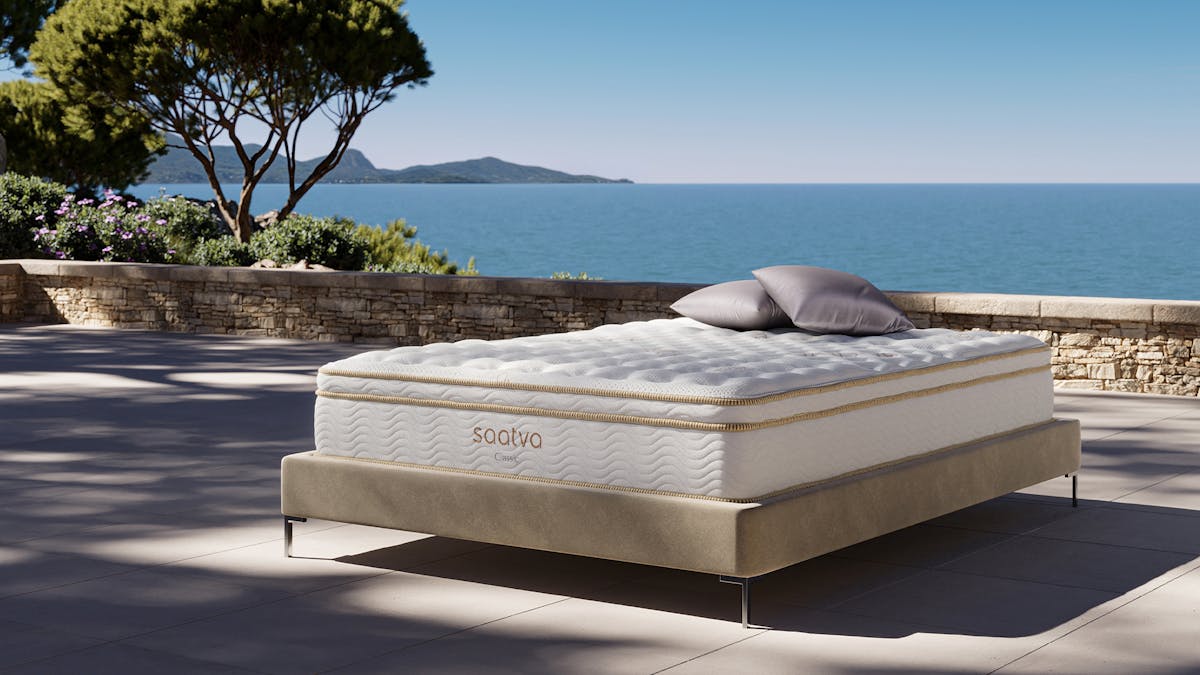
by The best mattress for pain management is medium-firm with active lumbar zoning and a responsive innerspring core. Our top pick is the Saatva Classic: its dual-coil construction with a dedicated lumbar zone reinforcement pad keeps the spine neutral, while the Euro pillow-top distributes pressure below the nociceptive threshold. White-glove delivery, a 365-night trial, and a lifetime warranty make it the most complete option for chronic pain sufferers. The Amerisleep AS3 is the strongest all-foam alternative for those who prefer a slower-response feel.
Saatva Classic
9.2/10
- Dual-coil construction with a dedicated lumbar zone reinforcement pad, the most direct engineering solution to lumbar support failure
- Outstanding edge support (10/10 NapLab) for easier sit-to-stand, critical for pain patients who are stiffest in the morning
- Free white-glove delivery, in-room setup, and old-mattress removal included
- 365-night trial and lifetime warranty, longest in the category
- Three firmness options (Plush Soft, Luxury Firm, Firm) so you match your specific pain profile
- Moderate motion isolation: coil construction transfers some partner movement
- $99 return fee applies if returned during the trial
- Ships flat, not compressed in a box
For chronic back, hip, shoulder, or joint pain, the Saatva Classic in Luxury Firm pairs a responsive innerspring feel with one of the most complete lumbar support systems available. The 365-night trial is long enough to confirm a true fit, and the lifetime warranty signals the build quality to back it up.
Why mattress choice matters for pain management
A mattress is not a medical device, but it operates for 7 to 9 hours every night as a passive pain management tool. The mechanisms are well-defined: pressure distribution, spinal alignment, sleep continuity, and temperature regulation each affect pain processing directly. Getting any one of them wrong creates nocturnal stress that amplifies the following day's pain load.
Pressure points occur when body weight concentrates on a small surface area, typically the greater trochanter (hip), the acromion (shoulder), and the lateral knee in side sleepers, or the sacrum and heels in back sleepers. When contact pressure exceeds roughly 32 mmHg, local ischemia develops and activates mechanonociceptors. On a firm, non-conforming mattress this threshold is crossed within 20 to 30 minutes, producing positional pain and micro-arousals that fragment slow-wave sleep. A conforming comfort layer distributes load across a larger surface, keeping peak pressures below the nociceptive threshold.
Spinal alignment: the medium-firm evidence
The spine has three natural curves. During sleep, maintaining them in their natural orientation prevents sustained loading of facet joints, intervertebral discs, and paraspinal muscles. A mattress that is too firm holds the body in whatever geometry it arrives in, without conforming. For side sleepers this means lateral spinal flexion and increased disc pressure. A mattress that is too soft lets the heaviest segments sink so deep the lumbar flattens into extension, loading posterior structures for the whole night.
Multiple randomized controlled trials confirm that medium-firm mattresses outperform both soft and extra-firm across pain intensity, disability scores, and sleep quality. The Kovacs study (The Lancet, 313 patients, 90 days) found medium-firm produced significantly better pain and disability outcomes than firm. The Radwan et al. review (Sleep Health) found medium-firm reduced chronic non-specific back pain over 12 weeks. The mechanism is neutral spinal alignment across the entire sleep window.
Top picks: specs at a glance
| Mattress | Type | Firmness | Key pain feature | Trial | Queen price |
|---|---|---|---|---|---|
| Saatva Classic | Innerspring hybrid | Lux Firm 6/10 | Lumbar zone pad, edge support | 365 nights | From $1,395 |
| Amerisleep AS3 | All-foam Bio-Pur | Medium 5/10 | HIVE 5-zone lumbar | 100 nights | From $1,049 |
Sleep continuity and pain recovery
Natural pain recovery requires uninterrupted slow-wave sleep (N3). Slow-wave sleep is the primary window for growth hormone secretion (tissue repair), suppression of descending pain facilitation pathways, glymphatic clearance of neuroinflammatory molecules, and HPA axis recalibration. A mattress that creates pressure points or poor alignment causes micro-arousals that fragment N3 sleep. For chronic pain patients, where recovery processes are already compromised, this fragmentation has disproportionately large effects on the following day's pain level. This is why the trial length matters: 365 nights gives more than enough time to separate normal adaptation from a genuine mismatch.
Temperature regulation and inflammatory pain
Core body temperature needs to drop 1 to 2 degrees Fahrenheit to initiate and maintain sleep. A mattress that traps heat, primarily dense viscoelastic foam, raises skin temperature and disrupts the thermoregulatory signaling required for deep sleep. For patients with inflammatory conditions such as rheumatoid arthritis or fibromyalgia, who often have dysregulated thermoregulation, heat-retaining mattresses worsen both sleep fragmentation and inflammatory markers. Open-coil innerspring systems with breathable ticking allow passive airflow that regulates temperature more effectively than all-foam constructions. The Saatva Classic's dual-coil architecture is particularly effective here.
What properties to prioritize for pain conditions
| Property | Pain mechanism it addresses | Best specification |
|---|---|---|
| Pressure relief | Nociceptor activation at pressure points | Euro pillow top 2+ inches, or adaptive latex layer |
| Spinal alignment | Mechanical loading of discs, facets, paraspinals | Medium-firm support core with zoned lumbar |
| Motion isolation | Partner-triggered micro-arousals | Pocketed coils or foam-over-coil construction |
| Temperature | Heat-disrupted sleep continuity, inflammation | Open-coil innerspring or breathable natural cover |
| Edge support | Stability when rising (pain patients often stiff) | Reinforced perimeter coils or foam encasement |
Mattress types ranked for pain management
Innerspring-hybrid (best overall). Pocketed coil support core with comfort layers of latex, foam, or pillow top. Provides the best combination of pressure relief, spinal alignment, temperature regulation, and durability for pain patients. Medium-firm variants are the most clinically well-supported mattress type for chronic pain conditions. The dual-coil construction of the Saatva Classic is a textbook example of this category.
Latex. Natural latex provides excellent pressure relief and temperature regulation, and is more responsive than foam, making repositioning easier for pain patients during the night. More expensive than foam alternatives. Dunlop latex is firmer and more supportive; Talalay latex is softer and more pressure-relieving.
Memory foam (with zoning). Good pressure relief but poorer temperature regulation and higher resistance to movement, both problematic for pain patients needing to reposition. Gel-infused or open-cell formulations like Bio-Pur reduce but do not eliminate heat retention. Best used as a comfort layer in a hybrid construction, not as a standalone recommendation for pain management.
All-foam without zoning. Lower cost, solid motion isolation, but lacks the zoned support structure needed for maintaining spinal alignment under variable load. More appropriate for lighter sleepers without severe spinal or joint pain.
Sleep position and pain type
- Back pain (lower): medium-firm 5 to 6 out of 10, with active lumbar zoning. A pillow under the knees (not the lumbar) settles the spine into natural lordosis. The Saatva Classic's lumbar zone pad reinforces exactly where L4-L5 loading concentrates.
- Hip pain: medium-soft to medium (4 to 5 out of 10) for side sleepers. Adequate sinkage at the greater trochanter prevents lateral hip compression. A pillow between the knees maintains pelvic alignment.
- Shoulder pain: same medium to medium-soft range. The shoulder needs 2 to 3 inches of conforming comfort layer to prevent acromion pressure buildup.
- Arthritis and fibromyalgia: the temperature regulation point above applies most strongly here. Innerspring-hybrid with breathable cover and a long trial. Responsive construction also makes repositioning less painful during the night.
- Sciatica: same criteria as lower back pain. Medium-firm, lumbar zoning, side sleeping with a pillow between the knees to keep the sciatic nerve decompressed.
An adjustable base adds meaningful value for lumbar, hip, and cervical pain: zero-gravity position (head 20 to 30 degrees elevated, knees slightly raised) reduces lumbar disc pressure and hip joint loading, and adjusting the position before rising reduces load-bearing stress on stiff joints.
Amerisleep AS3
8.9/10
- HIVE 5-zone layer firms under the lumbar and hips, softens under shoulders, keeping the spine neutral regardless of position
- Plant-based Bio-Pur open-cell foam relieves pressure without the heat retention of standard memory foam
- CertiPUR-US certified, made in the USA
- 20-year warranty, twice the industry average
- Average edge support for an all-foam build; the hybrid version improves this
- Sleepers over 230 lb may prefer the firmer AS5 Hybrid for long-term support
The best choice for pain patients who prefer a slower-response foam feel over a bouncy innerspring. The HIVE zoning actively reinforces the lumbar zone where most support failures concentrate, and the 100-night trial is sufficient to confirm fit.
For pain management, choose medium-firm with active lumbar zoning. The Saatva Classic is our top pick on a 365-night trial with a lifetime warranty; the Amerisleep AS3 is the best all-foam alternative on a 100-night trial.
Frequently asked questions
Is a firm or soft mattress better for chronic pain?
Medium-firm consistently outperforms both ends of the spectrum. Soft beds let the lumbar and hips sink below the shoulder line, compressing posterior spinal structures. Extra-firm beds prevent the pelvis from settling into natural alignment and concentrate pressure at bony prominences. Medium-firm, specifically in the 5 to 7 out of 10 range, balances pressure relief against support across the broadest range of pain conditions.
Can a mattress help manage sciatica or nerve pain?
Indirectly. The right mattress reduces the postural compression on the nerve root during sleep, keeps sleep consolidated so recovery processes run fully, and avoids the micro-arousals that amplify pain sensitivity the next day. It does not treat the underlying structural cause, but it removes a significant nightly stressor that worsens outcomes.
Memory foam or hybrid for pain management?
Hybrid, for most pain patients. Memory foam pressure relief is excellent, but the heat retention and repositioning difficulty are clinically significant downsides, especially for inflammatory conditions. A coil hybrid with lumbar zoning and an Euro pillow-top (Saatva Classic) is the stronger choice for pain patients who run hot or need to reposition frequently. A zoned plant-based foam (Amerisleep AS3) closes much of the gap for sleepers who prefer foam.
How long before a new mattress relieves pain?
Most people report improvement within 2 to 4 weeks of switching to an appropriate mattress, with full adaptation closer to 12 weeks. If pain is still unchanged after 4 to 6 weeks on a medium-firm bed with lumbar support, the cause may be positional or may require medical evaluation. This is why long trials matter: 365 nights (Saatva) or 100 nights (Amerisleep AS3) are long enough to separate normal adaptation from a genuine mismatch.
Does an adjustable base help with pain?
Yes, particularly for lumbar, hip, and cervical pain. Zero-gravity positioning reduces lumbar disc pressure and hip joint loading. Position adjustment before rising reduces the load-bearing challenge when joints are stiffest. The Saatva Classic (11.5-inch version) and the Amerisleep AS3 both pair well with adjustable bases.
This guide is part of our Best Mattress for Pain Relief hub, where you can compare all top picks by condition.