
 by
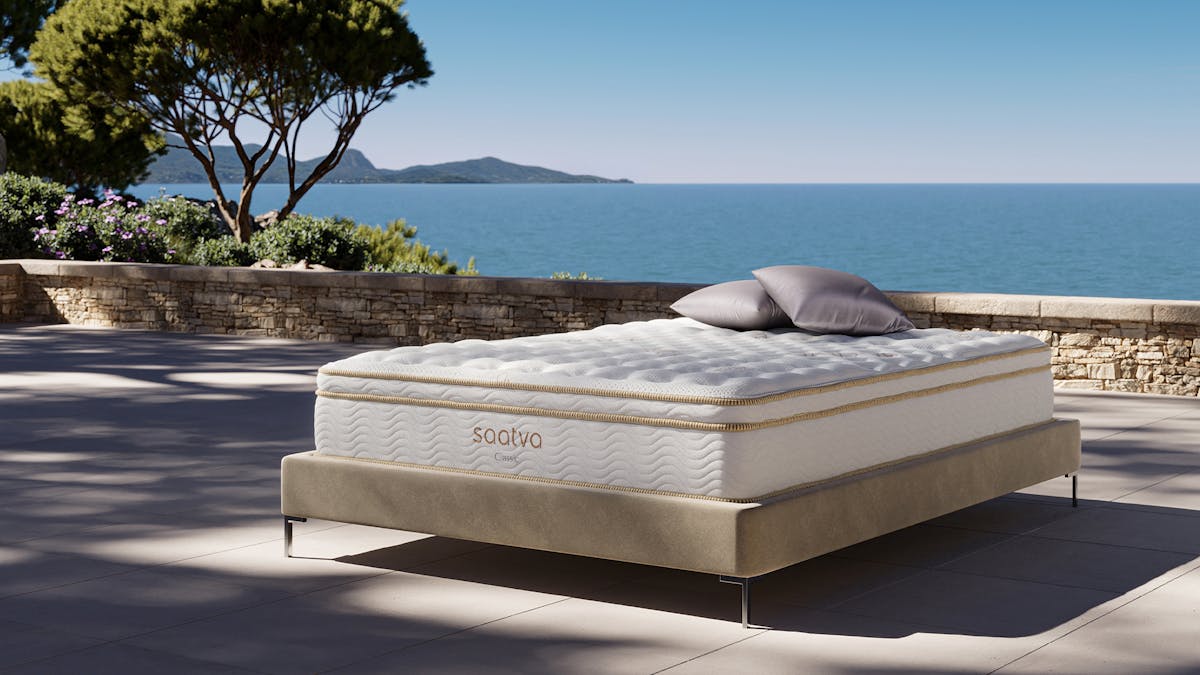
by For a trampoline bed base, choose all-foam or natural latex, not innerspring. Our top pick is the Saatva Classic: its dual-coil innerspring on a flat platform delivers the same responsive bounce many trampoline bases advertise, without spring-on-spring interference. If you own a trampoline base and want pure foam compatibility, the Amerisleep AS3 is our all-foam runner-up.
Saatva Classic
9.2/10
- Dual-coil design (pocketed coils over tempered steel base) delivers built-in responsive bounce comparable to a trampoline base
- Three firmness options: Plush Soft, Luxury Firm, and Firm, so every sleeper type has a match
- Outstanding edge support with reinforced perimeter coils
- Free white-glove delivery, setup, and old-mattress removal
- 365-night trial and lifetime warranty, the best coverage in its class
- Not suited for use directly on a spring trampoline base (dual-spring interference)
- $99 return processing fee during the trial
- Heavy at roughly 110 lb queen, harder to reposition
The Saatva Classic on a flat platform gives you the bouncy, responsive surface that draws people to trampoline beds, through a mature dual-coil system that has none of the spring-interference constraints. The 365-night trial and lifetime warranty make it the easiest high-confidence mattress decision in this category.
What is a trampoline bed?
The term covers two distinct products. The first is a children's play bed with a small trampoline integrated into the base. The second, the focus of this guide, is an adult bed frame that uses tensioned elastic webbing or springs in place of standard slats to create a responsive, bouncy sleep surface.
Several European sleep-system manufacturers and some domestic brands have incorporated spring-tensioned bases into their product lines. The stated benefit is better pressure distribution and a livelier surface than a flat platform delivers. The tradeoff: the spring mechanism constrains which mattresses you can pair with it.
Why standard mattresses fail on trampoline bases
Traditional innerspring mattresses interact poorly with a spring base. The two coil systems layer tension on top of each other in ways that produce unpredictable firmness, uneven support, and areas that are either excessively bouncy or dead flat. This is a mechanical problem, not a quality issue with either product individually.
Mattress manufacturers that design for trampoline-style bases recommend all-foam or latex for a single reason: those materials rest on the tensioned surface without fighting it. The spring base handles the responsive feel; the mattress handles contouring and pressure relief. The combination works cleanly.
Best mattress types for trampoline bed bases
All-foam mattresses
The safest choice for owners of a trampoline base. Foam does not interact with the spring mechanism at all. Memory foam or partially plant-based foam like Amerisleep's Bio-Pur sits cleanly on a tensioned base and conforms to body shape without creating dual-spring interference. The base provides the bounce; the mattress provides the comfort layer.
Natural latex mattresses
Natural latex has its own elasticity that complements a spring base without fighting it. The result is a more responsive surface than foam alone. GOLS-certified organic latex is the cleanest choice for buyers who also prioritize non-toxic materials.
Innerspring hybrids on a flat platform
If the responsive, bouncy feel is what you are after but you do not yet own a trampoline base, a quality dual-coil or pocketed-coil hybrid on a flat platform can match that feel natively. The Saatva Classic is the prime example: its dual-coil construction delivers hotel-style responsiveness without any base-compatibility constraint.
Thin hybrid mattresses
Thin hybrids under 8 inches with pocketed coils can work on a trampoline base if the coil gauge is low enough that the mattress coils flex freely rather than pushing against the base springs. There is no universal rule; test the specific combination. If you already own a trampoline base and want to try a hybrid, choose lower-gauge pocketed coils and stay under 8 inches thick.
Mattress thickness on a trampoline base
Very thick, dense foam over 12 inches can dampen the base spring response to the point where the mechanism adds no perceptible benefit. A 7 to 10 inch foam or latex mattress generally strikes the best balance: enough comfort layers for pressure relief, thin enough to let the base bounce come through.
| Mattress type | Spring interference | Ideal thickness | Best for |
|---|---|---|---|
| Dual-coil innerspring (Saatva Classic) | High on spring base, excellent on flat platform | Any | Flat platform users wanting bounce |
| All-foam (Bio-Pur, memory foam) | None | 8-11" | Trampoline base owners |
| Natural latex | None | 8-10" | Natural material preference |
| Thin hybrid (<8") | Low, gauge-dependent | 6-8" | Responsive feel seekers |
| Standard innerspring | High, not recommended | Avoid on spring base | Use on flat platform only |
Amerisleep AS3
8.9/10
- No coil-on-coil interference: pure foam rests cleanly on any spring base
- HIVE 5-zone layer delivers targeted lumbar and shoulder support
- Partially plant-based Bio-Pur open-cell foam sleeps cooler than standard memory foam
- CertiPUR-US certified, made in the USA
- 20-year split warranty, 100-night risk-free trial
- Softer edges than a coil hybrid
- Sleepers over 230 lb may prefer the firmer AS2 or AS5 Hybrid
If you own a trampoline base and want zero spring-on-spring interference, the AS3 is the cleanest foam option: medium firmness works for back, side, and combination sleepers, and the HIVE zoning adds genuine lumbar support that a bare spring base cannot provide on its own.
Is a trampoline bed right for you?
Trampoline bases appeal to people who find standard platform beds too static and want a more responsive surface without the mechanical complexity of a motorized adjustable base. The bounce can benefit couples with different firmness preferences, since a spring base distributes motion differently than rigid slats.
For most people evaluating the category, a dual-coil hybrid mattress like the Saatva Classic on a standard platform achieves comparable responsiveness without the base-compatibility constraints. If you already own or are committed to a trampoline base, pair it with all-foam or natural latex and keep the mattress under 10 inches thick.
For back-support considerations on any bouncy or responsive surface, see our mattress guide for back pain. Motion and support interact in ways that matter for spinal health, particularly for side sleepers or anyone with lumbar issues.
Use all-foam or natural latex on a trampoline base, 7 to 10 inches thick, to preserve the spring feel. If the bounce is the primary goal, the Saatva Classic on a flat platform delivers that feel natively through a dual-coil design, on a 365-night trial with a lifetime warranty. For trampoline base owners who want a pure foam option, the Amerisleep AS3 is the safest all-foam pick.
Frequently asked questions
Can I use any mattress on a trampoline bed base?
No. Traditional innerspring mattresses interact poorly with spring bases. All-foam and natural latex are the safest choices. Thin hybrids may work depending on coil gauge, but require testing the specific combination. If the bounce is the primary goal, a dual-coil hybrid like the Saatva Classic on a flat platform delivers that feel without the constraints.
What thickness mattress works best on a trampoline base?
Seven to ten inches is the practical range. Thinner than 7 inches may lack enough comfort layer. Thicker than 10 to 12 inches can dampen the spring response to the point where the base adds no perceptible benefit.
Do trampoline beds help with back pain?
Possibly, depending on the configuration. A responsive base can improve pressure distribution for certain back-pain sufferers. For others, the lack of stable firm support worsens lumbar pain. Test during the return window before committing, and see our guide to the best mattress for back pain for setup guidance.
What is the difference between a trampoline bed and an adjustable base?
An adjustable base uses motorized mechanics to change the angle of the sleeping surface. A trampoline base uses tensioned springs or elastic webbing to add bounce to a flat surface. They serve different purposes and pair with different mattress types.
How long does a trampoline bed base last?
Spring and elastic tension systems typically last 5 to 8 years before tension degrades noticeably. The mattress may need replacement before the base does, depending on use intensity and mattress quality.
This guide is part of our Best Mattress by Use Case hub, where we compare all top picks by scenario.