
 by
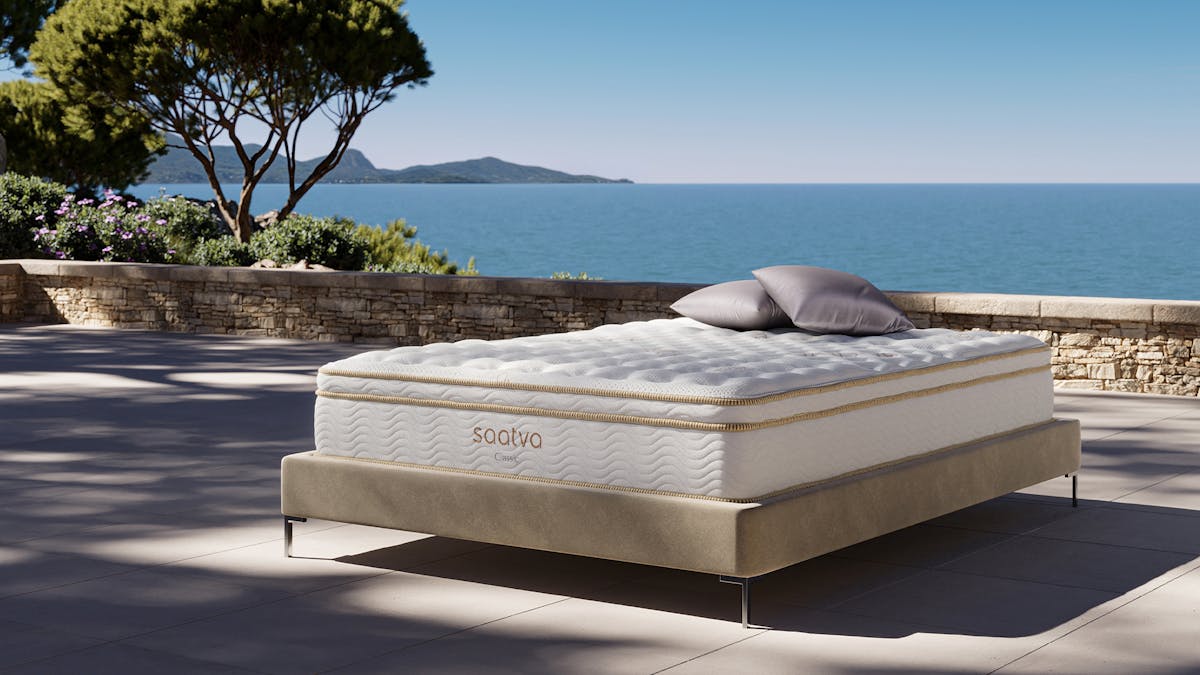
by Memory foam is a modified form of polyurethane foam, so the two share the same base chemistry. Standard polyfoam recovers fast and sleeps cooler; memory foam recovers slowly, conforms deeply to body shape, and retains more heat. For most sleepers, a mattress that combines both in a layered system outperforms either material alone. Our top pick is the Saatva Classic, a hybrid that pairs foam comfort layers with steel coils for superior airflow and support.
Saatva Classic
9.2/10
- Dual-coil construction improves airflow over dense all-foam builds
- Euro pillow top uses quality foam comfort layers over a responsive coil core
- Reinforced lumbar zone supports back and side sleepers
- Free white-glove delivery, setup, and old mattress removal
- 365-night trial, lifetime warranty
- Not a bed-in-a-box, ships flat with white-glove delivery
- $99 return fee applies during the trial period
The Saatva Classic is the strongest recommendation for a page about polyfoam versus memory foam because its hybrid construction uses both materials intelligently: a foam comfort system layered above coils that keep the whole structure well-ventilated. You get the contouring upside of foam without the heat trap of an all-foam build.
The polyurethane connection
Most mattresses sold in the US contain at least one layer of polyurethane foam, and often two or three. The industry uses polyfoam and memory foam almost interchangeably, then treats them as opposites on spec sheets. That inconsistency creates real confusion when shopping.
The short version: memory foam is polyurethane foam. The longer version explains why they feel so different, why one runs warmer than the other, and why the density number on a spec sheet matters far more than the category label.
Polyurethane is a synthetic polymer produced by reacting a polyol with a diisocyanate. The resulting material can be tuned across an enormous range of properties, from stiff rigid foam used in insulation to the flexible open-cell foams found inside every modern mattress.
Standard polyfoam (conventional polyurethane foam, or PU foam) is the baseline: responsive, relatively springy, manufactured at low cost. Memory foam, technically viscoelastic polyurethane foam, starts with the same chemistry but incorporates additional compounds that increase viscosity and slow recovery. The result softens in response to body heat, conforms closely to the shape pressing into it, then slowly returns to form. That slow spring-back was first developed under a NASA contract in the 1960s to absorb impact in aircraft seats.
So when a brand advertises multiple foam layers, they may mean a memory foam comfort layer over a high-density polyfoam support core, two members of the same chemical family doing very different jobs.
How they feel underfoot
Lay down on polyfoam and it pushes back almost immediately. The response is springy and surface-level. You sit on top of it rather than sinking in. That quick recovery makes it easy to change positions and get in and out of bed. Combination sleepers and couples tend to appreciate this.
Memory foam works differently. As body heat transfers in, it softens and conforms to your shoulders, hips, and spine, a gradual full-body hug. Recovery is slow; press your hand in and the indentation lingers two to five seconds. Some sleepers find this deeply comfortable; others describe it as feeling stuck, particularly when switching positions. Temperature matters, too. In a cool room memory foam feels firmer in the first minutes; in a warm room it softens faster. Standard polyfoam is far less temperature-reactive.
Cooling and airflow
Polyfoam's open-cell structure allows air to circulate as you move, so heat dissipates more readily. That's why the base and transition layers of most mattresses are polyfoam. Traditional memory foam traps heat. The dense, slow-response material restricts airflow and conforms closely, putting more surface area in contact with your body. Manufacturers address this with gel, graphite, copper infusions, and plant-based substitutions, which help, but a standard memory foam layer will typically sleep warmer than a comparable polyfoam layer at the same density. See our guide to gel memory foam vs regular memory foam for a deeper breakdown.
Density grades: why the number matters
Foam density is measured in pounds per cubic foot (PCF), the best proxy for durability. For polyfoam: low-density (under 1.5 PCF, breaks down within a few years), high-density HD (1.8 to 2.5 PCF, the standard for quality cores), and high-resilience HR (2.5 PCF+, the premium tier, more responsive and durable with a latex-adjacent feel). Memory foam runs higher by default: low (under 3 PCF, budget), medium (3 to 5 PCF, most common), high (5 PCF+, premium, closest contouring and longest lifespan but most heat retention). ILD (Indentation Load Deflection) describes firmness, not density. Do not confuse the two.
Polyfoam vs memory foam: comparison table
| Category | Polyfoam | Memory foam |
|---|---|---|
| Base chemistry | Standard polyurethane | Viscoelastic polyurethane (same base, modified) |
| Responsiveness | Fast, springy | Slow, gradual recovery |
| Contouring | Minimal, sleeps on top | Deep, full body conforming |
| Cooling | Better, open-cell airflow | Warmer, restricts airflow (gel helps) |
| Temperature sensitivity | Low | High, softer in heat, firmer in cold |
| Durability (quality grade) | HD/HR polyfoam: 8 to 10 years | Medium/high-density: 8 to 10 years |
| Cost | Lower, simpler manufacturing | Higher, additional compounds |
| Where used | Support core, transition, budget or hybrid comfort layers | Comfort layers, sometimes transition |
| Best for | Combination sleepers, hot sleepers, budget buyers | Side sleepers, joint pain, pressure relief priority |
How both foams work together in one mattress
Most quality foam mattresses use both in a layered system. A common configuration: a 2 to 3 inch memory foam comfort layer on top (pressure relief and contouring), a polyfoam transition layer (some pushback so you don't sink through), over a 6 to 8 inch high-density polyfoam support core (structural support, resists sagging). Hybrid mattresses combine this foam system with pocketed coils, which improve airflow substantially. That's one reason hybrids sleep cooler than all-foam beds with thick memory foam layers. See our memory foam vs hybrid vs latex comparison and the latex vs memory foam breakdown for more detail.
Which one is right for you?
It isn't really either/or. Most mattresses give you both, and how much memory foam and what density matters more than the category label alone.
Consider a memory-foam-forward mattress if you sleep on your side and need shoulder or hip pressure relief, deal with chronic joint or back pain, prefer a slow enveloping feel, or sleep in a cooler room.
Consider a polyfoam-forward or hybrid mattress if you change positions frequently, sleep hot, share a bed and prioritize ease of movement, prefer an on-top responsive feel, or want durability at a lower price with an HD or HR core.
Back and stomach sleepers often do well where polyfoam does more of the work; side sleepers benefit most from 2 to 3 inches of quality memory foam in the comfort layer. Whatever your position, density is the number to scrutinize. A mattress listing memory foam without specifying PCF almost certainly uses low-density foam that softens within a couple of years. For guidance on thickness, see the mattress thickness guide, and for memory foam specifically, our best memory foam mattress picks.
Saatva Loom & Leaf
8.8/10
- 5 PCF high-density memory foam for long-term durability and deep contouring
- Spinal Zone gel layer provides targeted lumbar support within the foam stack
- CertiPUR-US certified foams, white-glove delivery
- 365-night trial and lifetime warranty
- All-foam build runs warmer than a coil hybrid
- Heavier and harder to move than a boxed foam mattress
For sleepers who specifically want the slow-contouring feel of a quality memory foam build, the Loom & Leaf delivers premium density (5 PCF) that holds up over time, along with Saatva's white-glove service and long trial.
Polyfoam and memory foam share the same base chemistry but behave very differently. Polyfoam is springy, cool, and versatile; memory foam contours deeply and retains heat. The best mattresses use both strategically. The Saatva Classic hybrid is our top pick for pairing foam comfort with coil-driven airflow; the Loom & Leaf is the premium all-foam choice for sleepers who want high-density memory foam contouring.
Frequently asked questions
Is polyfoam the same as memory foam?
No, but they share the same base chemistry. Both are polyurethane foams. Memory foam is a modified version with added compounds that make it viscoelastic, temperature-sensitive, slow to recover, and more deeply contouring. Standard polyfoam lacks those additives and responds quickly.
Which lasts longer, polyfoam or memory foam?
Durability depends almost entirely on density, not category. High-density polyfoam (1.8 PCF+) and medium-to-high-density memory foam (3 to 5 PCF+) can both last 8 to 10 years. Low-density versions of either soften within 2 to 3 years.
Does memory foam sleep hotter than polyfoam?
Traditional memory foam typically sleeps warmer because its dense, close-contouring structure restricts airflow. Gel-infused and plant-based memory foams close some of the gap, but a thick conventional memory foam layer still sleeps warmer than a comparable polyfoam layer.
Where is polyfoam used in a mattress?
Throughout most constructions. High-density polyfoam is the standard for support cores. Transition layers are often polyfoam. Some mattresses use softer polyfoam in the comfort layer, particularly budget builds or hybrids where coils handle support.
What does high-resilience polyfoam mean?
HR polyfoam is a premium grade rated at 2.5 PCF or above with a specific resilience measurement, more responsive and durable than standard HD polyfoam, with a livelier latex-like feel. Found in mid-to-high-end mattresses.
Can a mattress have both polyfoam and memory foam?
Yes, most quality foam mattresses do. A typical configuration uses a memory foam comfort layer on top, a polyfoam transition layer, and a high-density polyfoam core. The combination usually outperforms a single foam type throughout.
Is polyfoam bad for your health?
Off-gassing from new polyurethane foam (both types) is common, a temporary chemical smell from VOCs that dissipates within a few days. CertiPUR-US certification indicates the foam was tested for harmful chemical content and is a reasonable baseline to look for.