
 by
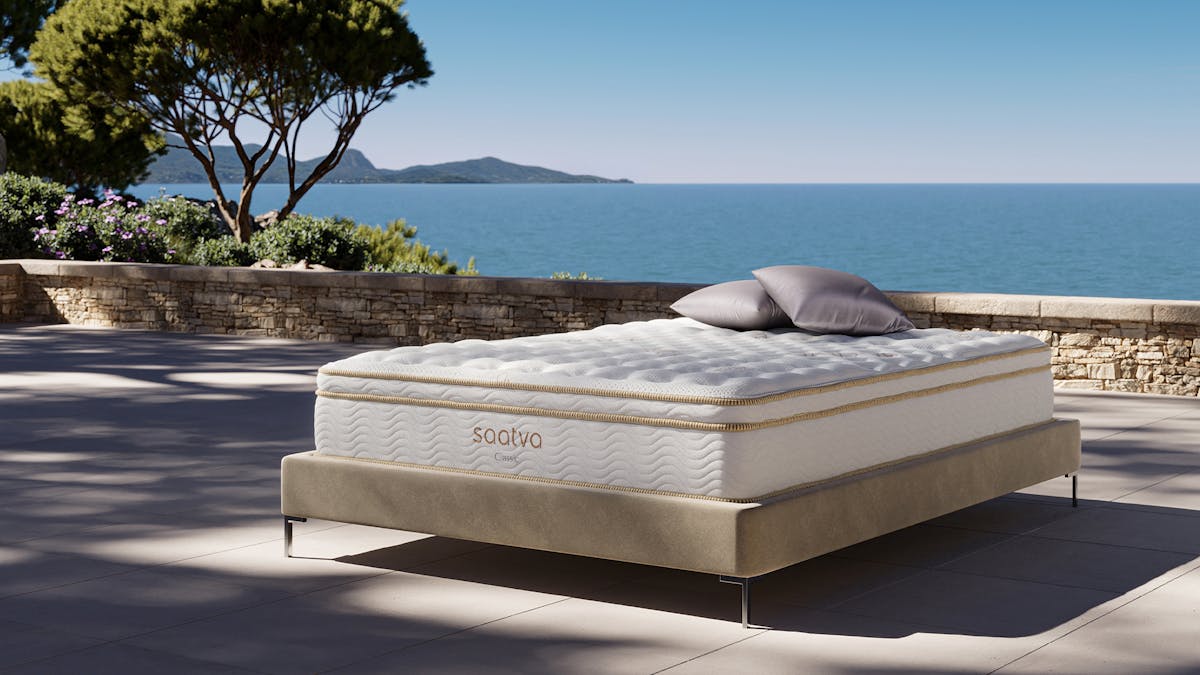
by RV mattresses differ from regular mattresses in four concrete ways: size (the RV short queen is 60"x75", five inches shorter than a standard queen), weight (lighter to respect cargo capacity), thickness (often thinner to clear low-profile bed platforms), and sometimes shape (cut or rounded corners). If your rig can fit a standard queen, a quality regular mattress is the better long-term investment. If you are locked into RV dimensions, a purpose-built RV mattress is the only practical choice. Our top pick for anyone who can use a full-size queen is the Saatva Classic.
Saatva Classic
9.2/10
- Dual-coil construction with a zoned lumbar support layer
- Euro pillow-top comfort with genuine hotel-luxury feel
- Free white-glove delivery and old-mattress removal
- 365-night trial and lifetime warranty, the longest in the category
- Three firmness options so you can match the mattress to your sleep style
- Ships flat, not roll-packed in a box, so it requires a standard delivery address
- $99 return fee applies during the trial if you decide to return it
- Heavy coil build is not practical for an RV platform that requires a thin or light mattress
If you measure your RV bed platform and find a full 60"x80" queen fits with adequate clearance, the Saatva Classic is the mattress we would recommend over any RV-specific option. The coil-on-coil build with a Euro top gives you genuine hotel-quality sleep that a compressed foam RV mattress rarely matches. White-glove delivery means the setup is handled for you.
RV vs Regular Mattress: The Real Differences
The distinction between an RV mattress and a regular mattress is almost entirely about physical fit, not about sleep quality per se. A regular mattress is engineered for a fixed bedroom with no payload limits and standard platform dimensions. An RV mattress is engineered to fit inside a vehicle with specific clearances, weight budgets, and sometimes unusual geometry.
Here is what actually changes between the two categories:
| Factor | Regular Mattress | RV Mattress |
|---|---|---|
| Standard queen dimensions | 60" wide x 80" long | 60" wide x 75" long (RV short queen) |
| Other common sizes | Twin, Full, King, Cal King | RV Twin (38"x75"), RV Full (54"x75"), RV King (72"x80") |
| Weight | 60-100+ lb for quality hybrids | Typically 30-60 lb, lighter foam builds |
| Thickness | 10-15" common for hybrids | Often 6-10" to clear low platforms |
| Corner shape | Rectangular (4 square corners) | Sometimes cut or rounded to fit coach geometry |
| Support materials | Coils, latex, high-density foam | Mostly foam (coils rare in RV-specific builds) |
| Price range | $500-2,500+ for quality | $300-900 typical |
Measure First: You May Not Need an RV Mattress
The most important step before buying anything is measuring your actual platform. A significant number of modern Class A and Class C motorhomes, as well as larger fifth-wheels, have a rear bedroom that accepts a standard 60"x80" queen. If your clearance above the platform allows for a 10-12" mattress and the floor plan is rectangular, you can use a regular queen without any modification.
Where RV-specific dimensions become unavoidable:
- Slide-out or cab-over bedrooms that physically cap the length at 75" or less
- Corner-bed layouts where a bunk tucks into a curved or angled space requiring notched corners
- Bunk platforms with strict overhead clearance that prevents using a mattress thicker than 6-8"
- Truck campers and Class B vans where every inch of width and length is fixed by the shell
If none of those constraints apply, a standard mattress will give you a better night's sleep than most RV-specific options at the same or lower price.
Sleep Quality: Regular vs RV Mattress
This is where the two categories diverge significantly. Regular mattresses from quality brands use coil-on-coil hybrid builds, thick comfort layers, and zoned support systems that are expensive to engineer into a lightweight, compact RV profile. RV mattresses are almost universally foam-only, and most sit in the lower-density range to keep weight down. That trade-off is necessary for the vehicle context, but it means a purpose-built RV mattress will generally sleep warmer, compress faster, and offer less pressure relief than a comparable regular mattress.
If you sleep in your RV seasonally or a few weeks per year, this gap matters less. If you live in your RV full-time or take extended trips, sleep quality becomes much more relevant, and the case for fitting a standard mattress is stronger.
When to Choose Each Option
Choose a regular mattress (Saatva Classic or similar) when:
- Your measured platform fits a standard 60"x80" queen with adequate clearance
- You live in your RV full-time or spend 30+ nights per year in it
- Sleep quality is a higher priority than shaving a few pounds from your cargo weight
- You want the full trial period (365 nights for Saatva) and lifetime warranty protection
Choose an RV-specific mattress when:
- Your platform requires a non-standard size (short queen, cut corners, extra-thin profile)
- Cargo weight is a genuine constraint (truck campers, Class B vans)
- You use the RV for short seasonal trips and prioritize budget over sleep quality
- You need a replacement within days and want a roll-packed option that ships easily
What to Look For in an RV Mattress
If you have confirmed you need an RV-specific mattress, the specs that matter most are:
- Exact dimensions: Measure the platform width, length, and corner geometry before ordering. RV short queen (60"x75") and standard RV twin (38"x75") are the most common, but sizes vary by brand and model year.
- Thickness: Check the clearance between your platform top and the overhead cabinet or bunk above it. A 6" profile is standard for tight clearances; 8-10" works for more open platform setups.
- Foam density: Look for at least 1.8 lb/cubic foot in the support layer. Lower-density foams compress within a year of regular use.
- Cover material: Organic cotton or bamboo covers breathe better than synthetic blends, which matters in a confined sleeping space.
- Trial period: Some RV-specific brands offer 30-100 night returns. Prioritize this since fit and feel are hard to judge without sleeping on it.
The RV Size Guide
RV bed sizes do not correspond directly to residential sizes. Here is the practical mapping:
| RV Bed Name | Dimensions | Closest Regular Size | Notes |
|---|---|---|---|
| RV Short Queen | 60" x 75" | Queen (60"x80") | 5" shorter; most common motorhome size |
| RV Full | 54" x 75" | Full (54"x75") | Same width/length as residential Full, standard Full mattress fits |
| RV Twin | 38" x 75" | Twin (38"x75") | Identical to residential Twin, standard Twin fits |
| RV King | 72" x 80" | None (wider than Cal King) | Requires RV-specific mattress, no residential equivalent |
| Three-Quarter | 48" x 75" | None | Uncommon, requires RV-specific cut |
The practical takeaway: RV Twin and RV Full are the same dimensions as standard residential Twin and Full. Only the Short Queen and RV King require RV-specific mattresses.
Frequently asked questions
Can I use a regular mattress in an RV?
Yes, if the platform dimensions and clearance allow it. Many RVs with a rear queen bedroom accept a standard 60"x80" queen. Measure before assuming you need an RV-specific size. For full-timers, a quality regular mattress like the Saatva Classic is often the better long-term investment.
What is the difference between an RV short queen and a regular queen?
An RV short queen is 60" wide and 75" long, while a standard queen is 60" wide and 80" long. The five-inch length difference is the only dimension change. A regular queen will not fit an RV short queen platform without hanging off the end or needing to be trimmed.
Are RV mattresses lower quality than regular mattresses?
Generally, yes, at the same price point. RV mattresses are foam-only to save weight, use thinner profiles to fit low-clearance platforms, and are made in smaller batches than mainstream mattress brands. The better RV-specific options close the gap, but a regular hybrid like the Saatva Classic still outperforms most RV mattresses on pressure relief, edge support, and durability.
How thick should an RV mattress be?
Measure the clearance between your platform surface and the overhead obstruction (cabinet, bunk above, or slide-out ceiling). Most RV platforms work with 6-10" mattresses. For comfort on extended trips, 8" is a reasonable target if clearance permits.
Do RV mattresses wear out faster than regular mattresses?
Often yes, particularly lower-density foam RV mattresses. The combination of lower foam density and frequent use during travel can lead to noticeable body impressions within 3-5 years. A regular mattress with a coil or high-density foam core typically lasts 8-12 years.
The difference between an RV mattress and a regular mattress is fit and weight, not sleep quality. Measure your platform first. If a standard queen fits, the Saatva Classic gives you better sleep on a 365-night trial. If your platform requires RV dimensions, prioritize exact fit, a foam density of at least 1.8 lb/cubic foot, and a return policy you can actually use.