
 by
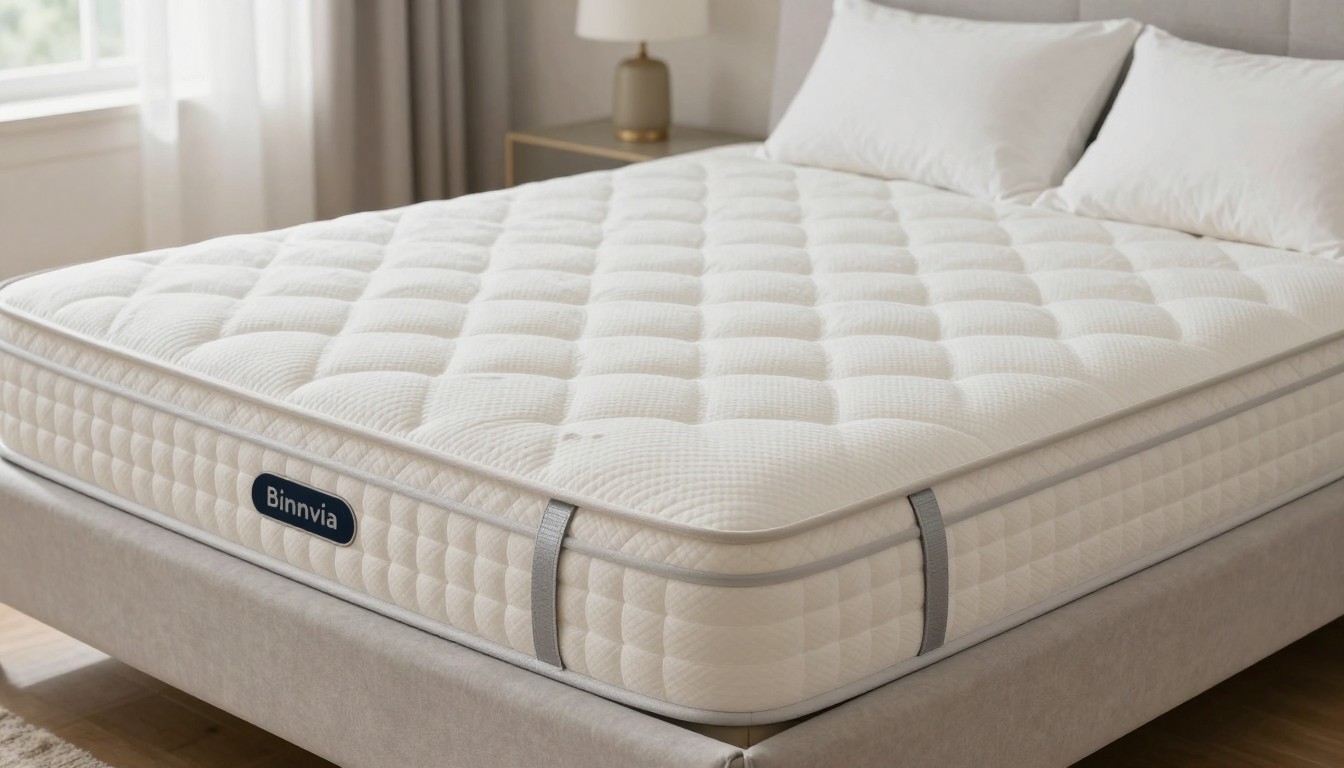
by Quick answer: Straps aren't a quality tier. They're a fit solution for toppers whose material and thickness let them slide, so thinner or slicker models get elastic corner anchors while denser, grippier ones ship without.
- Anchoring style follows the topper's own weight and surface friction, not the price of the model.
- Marketplace brands like Binnvia run many variants under one name, so strap or no strap often just marks a different production spec.
- Always read the individual listing photos and spec box, since the same brand name can cover both anchored and unanchored builds.
Updated July 2026 · Reviewed for accuracy
Straps are a shipping decision, not a status symbol. When a topper is light, thin, or wrapped in a slippery knit cover, it migrates across the mattress overnight, and elastic corner anchors are the cheapest fix a manufacturer can add. When a topper is heavy enough or has enough surface grip to stay put on its own, those straps become dead cost and get dropped from the spec.
Binnvia is a small marketplace label rather than a mainstream mattress brand, so I want to be careful here. I can't verify individual Binnvia model specs, and neither can you unless the listing states them. What I can explain is the engineering logic that drives every strap decision in this category, because it's the same across every brand I've studied over a decade in bedding, and it tells you exactly which version you want.
What the straps actually do
Elastic corner straps do one job: they hold a topper's four corners against the mattress corners so shear force from your body doesn't drag the whole slab sideways. They're not a fitted sheet. They don't compress the topper, don't change its feel, and don't stop the middle of the topper from bunching if the material itself is prone to it.
That's the important nuance. Straps fight migration, the whole-slab slide toward the foot of the bed. They do very little against rippling, where a thin foam sheet wrinkles under a sleeper who shifts position a lot. Rippling is a density and thickness problem, and no amount of elastic at the corners fixes it.
The Nut's read: If a listing leans hard on straps as a headline feature, I read that as a hint the topper is light or slick enough to need them. That's not automatically bad. It just tells me something about the build.
Why one brand ships both versions
Three mechanisms explain almost every case of a single brand name selling anchored and unanchored toppers side by side.
Different materials in the same lineup. A gel-infused memory foam sheet, a shredded-fill fibre topper, and a latex slab behave nothing alike on a mattress surface. Memory foam has a naturally tacky open-cell surface that clings to a fitted sheet. Latex is heavier per unit of volume and tends to stay where you put it. Loose fibre fill is light and encased in a smooth shell, so it wanders. Same brand, three different anchoring needs.
Different thicknesses of the same material. A thin topper has less mass pressing down and less side wall to catch against the mattress edge, so it slides more. Thicker versions of the identical foam often drop the straps because their own weight does the work. If you're weighing thickness against stability, my guide to the thickest mattress toppers walks through where added height stops helping and starts causing sheet problems.
Production changes over time. Marketplace brands revise specs between production runs constantly. A model that shipped with straps in one batch may arrive without them in the next, with the listing photos updated and nothing else announced. This is the single most common reason two buyers of the "same" topper get different products.
Which version you should actually pick
The strap question only matters in the context of your bed. Here's how the variables interact.
| Your situation | Straps or no straps | Why |
|---|---|---|
| Thin topper, restless sleeper | Straps help | Low mass plus high shear force is the classic migration setup. |
| Thick, dense foam or latex | Straps optional | Weight and surface friction usually hold it in place unaided. |
| Very deep mattress | Check strap length first | Short elastics on a tall mattress pull the topper corners inward and cup them. |
| Adjustable base | Straps help | Repeated articulation walks an unanchored topper off the head section. |
| Guest bed, light use | Doesn't matter | Migration is a cumulative-use problem. Occasional nights won't trigger it. |
| Tight deep-pocket sheets | No straps is fine | A taut sheet over the whole assembly is a stronger anchor than corner elastics. |
That last row is the one people miss. A properly sized deep-pocket fitted sheet stretched over mattress and topper together does more to stop movement than four elastic loops ever will. If your sheets already fit the combined height, the strap question drops close to irrelevant.
How to read the listing before you buy
Because I can't verify Binnvia specs independently, treat the listing itself as the only source of truth, and read it in this order.
Pre-purchase checklist
- Match the variant, not the brand. Confirm the strap detail on the exact size and thickness you're adding to cart, since variants under one title can differ.
- Look at the photos, not the copy. Corner elastics are visible in product shots. Marketing bullets get copied between variants and go stale.
- Find the fill material and, if stated, the density. This predicts slide behaviour better than any other single spec.
- Check whether strap length is given. If it isn't, and your mattress is tall, assume the elastics may be short.
- Read recent buyer reviews for the words "slides" and "moves". Owner feedback on marketplace listings is the most reliable signal of real-world migration you'll get.
- Note the return terms on that specific listing. Marketplace sellers set their own, and they vary by seller rather than by brand.
Fixing a topper that already slides
If you own the no-strap version and it's wandering, you don't need to return it. Work through these in order of effort.
Start with the sheet. A deep-pocket fitted sheet sized for mattress plus topper, pulled genuinely tight, solves the majority of migration complaints on its own. Most people are trying to stretch a standard-depth sheet over a taller assembly, and the corners pop off, which is what actually lets the topper travel.
Next, add friction underneath. A thin rug pad or non-slip mesh liner between mattress and topper raises surface grip without changing feel. It's the same physics as a rug pad on a hardwood floor.
Then consider aftermarket anchors. Adjustable bed-sheet suspenders or fastener straps clip across the underside of the mattress and hold the topper corners down. They're sold separately by plenty of bedding suppliers and work on any topper regardless of what it originally shipped with.
Last resort: check the topper isn't the wrong size. A topper cut narrower than your mattress has room to move by definition, and no anchoring system fully compensates.
One thing I'd skip: taping, gluing, or sewing a topper to anything. It voids whatever return window the seller offers and usually damages the cover.
What matters more than straps
Straps are a convenience feature. Material quality is what determines whether you're still happy with the topper in year three, and it's where I'd spend my attention instead.
Foam density is the single best durability predictor in a foam topper. Low-density foam feels fine out of the box and develops body impressions relatively quickly, because there's simply less polymer per cubic foot to resist repeated compression. Higher-density foam costs more and lasts longer. If a listing won't tell you the density, that silence is information.
Natural fibres behave differently again. Wool toppers are heavy, breathable, and resilient in a way foam isn't, which is also why they rarely need straps. I've broken down how wool compares on temperature and longevity in my wool mattress topper guide, and there's a closer look at construction and long-term wear in my wool topper review.
Cover construction is the third thing worth checking. A removable, washable cover with a grippy woven underside solves the slide problem and the hygiene problem at once. A thin, slick, non-removable shell does neither. If you want a reference point for what a fully specified premium foam topper looks like, the Saatva Graphite Topper publishes its material details openly, which is the transparency standard I'd hold any topper listing to. Check the current price on the official site.
FAQ
Do straps mean the topper is better quality?
No. Straps address fit and movement, not materials or durability. Some of the best-built toppers ship without them because their weight and surface texture hold position on their own, while some light, inexpensive sheets need elastics to stay put.
Why did my second Binnvia topper come without straps?
Most likely a different variant or a revised production run. Marketplace brands change specs between batches without announcing it, so the listing you buy today may describe a build that differs from the one you bought previously. Compare the current listing photos against your existing topper before assuming an error.
Can I add straps to a topper that doesn't have them?
Yes. Aftermarket sheet suspenders and adjustable fastener straps clip under the mattress and hold topper corners in place, and they work on any thickness. A correctly sized deep-pocket fitted sheet or a non-slip liner underneath often does the same job for less money.
Will straps stop a topper from bunching in the middle?
Not really. Corner straps stop the whole slab from sliding, but middle bunching and rippling come from thin or low-density material flexing under a sleeper. That's a material problem, and the fix is a denser or thicker topper, not more elastic.
Do straps work on a deep mattress?
Only if the elastics are long enough to reach around your mattress corners without tension. On a tall mattress, short straps pull the topper corners downward and inward, which cups the edges and creates the exact unevenness you were trying to avoid. Confirm strap length or plan on a deep-pocket sheet instead.
ONE OPTION WORTH COMPARING
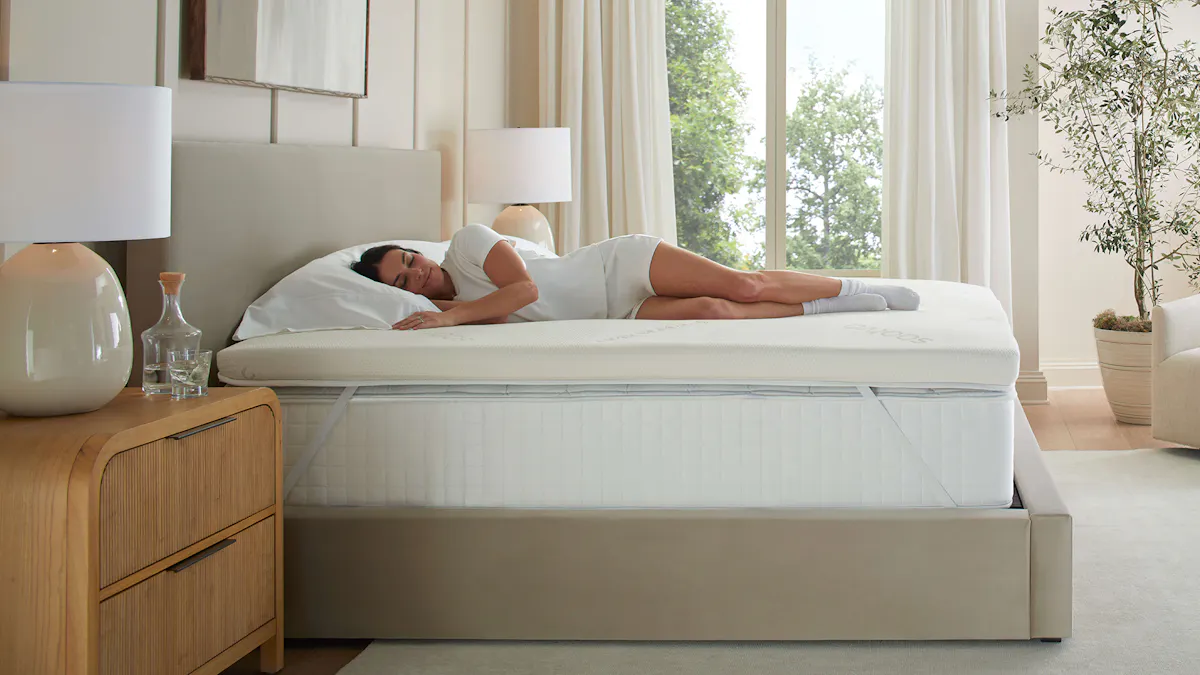
Shopping as well as reading? Here is one current option worth comparing: the Saatva Graphite Topper. Check today’s price, sizing and return terms on the official product page before you order.
Saatva Graphite Topper
- Graphite-infused memory foam, per saatva.com
- 180-night trial
- Secure anchor bands, fits deep mattresses
The bottom line
Straps on some Binnvia toppers and not others reflects material, thickness, and production-run differences rather than a good-versus-bad split. Buy on fill material, density where it's disclosed, and cover construction. If the version you want lacks straps, a deep-pocket sheet plus a non-slip liner closes the gap for very little money, and you'll have chosen the topper on the specs that actually determine how it sleeps in three years.