
 by
by Adjustable beds are consumer comfort products designed for home use, zero-gravity positioning, massage, and lifestyle features. Hospital beds are medical devices with side rails, full height adjustment for caregiver access, and Trendelenburg positioning. If you need medical care at home, you need a hospital bed, often covered by Medicare with a prescription. For sleep comfort and lifestyle upgrades, a consumer adjustable base is the right choice, and pairing it with a mattress designed to flex, such as the Saatva Solaire, gets the most from the base.
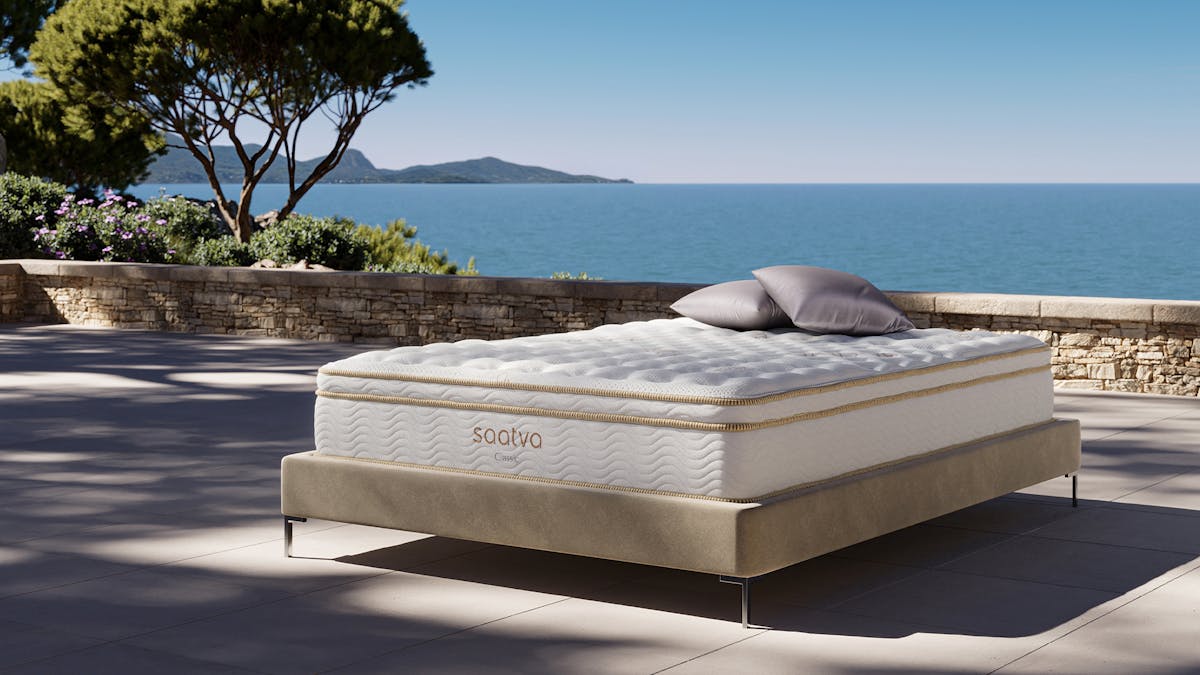
Saatva Solaire
9.0/10
- 50 firmness settings per side, adjustable via remote or app
- Designed to flex with any adjustable base, including head and foot articulation
- Organic cotton cover, individually wrapped coil base layer for edge support
- 365-night home trial, lifetime warranty, free white-glove delivery
- Premium price, not the right choice for buyers on a tight budget
- Requires an adjustable base to get full value
The Solaire is Saatva's answer to the Sleep Number: fully adjustable firmness with a far better construction standard. It is the most sensible mattress pick for anyone investing in a consumer adjustable base.
Adjustable bed vs hospital bed: what actually differs
Both look similar from across the room, but they are built to entirely different specifications and serve fundamentally different purposes. A consumer adjustable base is a lifestyle product. A hospital bed is a medical device regulated by the FDA and designed around clinical care workflows.
Side-by-side comparison
| Feature | Consumer Adjustable Base | Hospital Bed |
|---|---|---|
| Primary purpose | Comfort, lifestyle, sleep quality | Medical treatment, patient care |
| Head elevation | 0 to 65 degrees | 0 to 80+ degrees |
| Trendelenburg | Not available | Available (full bed tilts feet-up) |
| Side rails | Not included | Required safety feature |
| Height adjustment | Fixed height | Motorized, adjustable for caregiver access |
| Weight capacity | 600 to 850 lbs | 350 to 1,000+ lbs (bariatric models) |
| Medicare coverage | Not covered | Covered with physician prescription |
| Price range | $300 to $3,000 | $1,000 to $10,000+ |
| Mattress type | Standard consumer mattress | Medical-grade pressure surface |
| Portability | Fixed position | Locking swivel casters |
| Control | Wireless remote, app, voice control | Hardwired nurse call, bedside controls |
Hospital bed uses: when you need one
Safety features
Hospital beds include side rails that prevent patients from falling during repositioning. These rails also give patients with limited mobility something to grip when shifting position. Consumer adjustable bases do not include side rails as standard equipment.
Caregiver access
One of the most important features of a hospital bed is motorized height adjustment. Caregivers can raise the bed to a working height for wound care, repositioning, and bathing, then lower it close to the floor to reduce fall risk. Consumer bases do not offer this.
Trendelenburg and reverse Trendelenburg
These clinical positions tilt the entire bed platform, not just the head or foot. Reverse Trendelenburg (head up, feet down) helps with acid reflux and respiratory conditions. Full Trendelenburg (feet elevated above head) supports certain circulatory conditions. No consumer adjustable base offers true Trendelenburg.
Staying at home during recovery
A hospital-grade bed at home allows patients to remain with family during recovery from surgery or chronic illness. Medicare Part B covers hospital beds deemed medically necessary, with a physician's prescription. For details on coverage rules, see our Medicare hospital bed guide.
Adjustable bed uses: what you actually get
Zero-gravity positioning
Zero-gravity raises the head and legs simultaneously to a position that distributes body weight evenly across the surface, reducing pressure on the lumbar spine and improving circulation. This is the adjustable bed's most clinically relevant feature for everyday use.
Anti-snore positioning
Elevating the head by seven to ten degrees opens the airway and reduces the soft-tissue collapse that causes snoring. Many people with mild sleep apnea symptoms see meaningful improvement with head elevation alone. For more, see our adjustable bed for snoring guide.
Back pain relief
Raising the feet slightly reduces lumbar disc pressure by decompressing the lower spine. Combined with zero-gravity, adjustable bases are frequently recommended by chiropractors and physical therapists as a non-pharmaceutical pain management tool. See our adjustable bed for back pain guide.
Lifestyle comfort
Reading, working, or watching television in bed becomes far easier with head elevation. Premium bases add massage, USB charging ports, under-bed lighting, and split-king configurations so each partner can set their own position independently.
Key differences to understand before you buy
Inclination range
Hospital beds raise and lower both head and foot sections together or in coordinated clinical patterns. Consumer adjustable bases allow independent control of each section. You can raise the head and foot to entirely different angles, which hospital beds do not support in the same way.
Size options
Consumer adjustable bases come in Twin XL, Full, Queen, King, and Split King, accommodating standard mattress sizes and couples who want different positions. Hospital beds are uniformly narrow, designed for single-person use and clinical mobility.
Design and aesthetics
Hospital beds are built for function, easy cleaning, and durability in care settings. Consumer adjustable bases are furniture-grade products, available with headboards, fabric options, and finishes that match bedroom decor. Hospital beds have no decorative variants.
Mattress compatibility
Consumer adjustable bases require a flexible mattress. Innerspring mattresses with interconnected coil systems do not flex properly. All-foam, latex, and pocketed-coil mattresses work. Hospital beds use medical-grade pressure-relief surfaces, typically foam with anti-shear covers designed for wound care compliance.
Which do you actually need?
The decision is not really a preference question. It is a clinical one.
If any of the following apply, you need a hospital bed: side rails for fall prevention, motorized height adjustment for caregiver access, Trendelenburg or reverse Trendelenburg positioning, Medicare reimbursement for a medically necessary device.
If you want comfort at home, relief from snoring or back pain, zero-gravity positioning, or a premium sleep surface that adjusts to your preferences, a consumer adjustable base is the right product. It will be far more comfortable, far quieter, and far more visually appealing in a home bedroom.
For a consumer adjustable setup, the mattress choice matters as much as the base. A mattress that does not flex properly defeats the purpose. The Saatva Solaire is built specifically for adjustable base use, with 50 adjustable firmness settings per side and a pocketed coil layer that articulates without damage.
Frequently asked questions
Can I use a regular mattress on a hospital bed?
Hospital beds use a different mattress platform width (usually 36 inches for standard single, 42 inches for semi-electric), so standard consumer mattresses do not fit without modification. Hospital-grade mattresses are pressure-management surfaces, not comfort products.
What are the downsides of a consumer adjustable base?
Consumer adjustable bases are heavy and difficult to move once positioned. Entry-level motors can be noisy. A base without a compatible mattress will not flex properly. They do not offer the height adjustment or side rails that hospital beds provide.
Are adjustable beds covered by Medicare?
Consumer adjustable bases are not covered by Medicare. Medical hospital beds ordered by a physician for a diagnosed condition are covered under Medicare Part B as durable medical equipment. Our adjustable bed Medicare guide covers the qualification criteria in detail.
Is an adjustable base better than a box spring?
For anyone who wants to adjust their sleep position, yes. For anyone who simply needs a flat support surface, a platform or slat base works fine and costs far less. See our adjustable base vs box spring guide for a full breakdown.
Saatva Solaire
9.0/10
50 firmness settings per side, built to articulate with any adjustable base, 365-night trial, lifetime warranty, free white-glove delivery. The most thoughtfully engineered adjustable mattress on the market.