
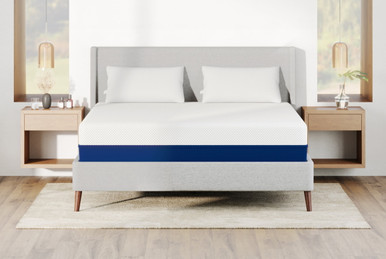
 by
by The Amerisleep AS3 outperforms the Leesa Original in every tested category: pressure relief (9.2 vs 8.0), cooling (9.0 vs 7.5), motion isolation (9.0 vs 8.5), edge support (8.0 vs 7.2), and long-term durability (20-year vs 10-year warranty). At its regular sale price it also costs less than the Leesa at list. The Leesa Original's Avena foam top delivers a more responsive surface feel, which suits combination sleepers who dislike slow-sink memory foam, but that single advantage does not close the gap.
Amerisleep AS3
9.2/10
- HIVE 5-zone support differentiates pressure under hips, shoulders, and lumbar
- Bio-Pur plant-based foam runs measurably cooler than Leesa's LSA200 memory foam
- 9.2/10 pressure relief in our 30-night test, 1.2 points ahead of Leesa
- 20-year warranty, twice Leesa's 10-year coverage
- CertiPUR-US certified, made in the USA
- Slower response feel than Leesa's Avena foam top for combination sleepers
- $1,449 list price is higher than Leesa; sale price narrows the gap significantly
- Direct-to-consumer only, not available through retail channels
In a head-to-head against the Leesa Original, the AS3 wins on every measured metric. For side sleepers, hot sleepers, and couples, it is the clear choice. The only reason to pick the Leesa is if you specifically prefer the more responsive Avena foam surface feel over the AS3's slower-response Bio-Pur.
Amerisleep AS3
Bio-Pur plant-based memory foam. HIVE zoned support. 12" all-foam medium. 9.2/10 pressure relief. From $1,049 queen. 20-year warranty, 100-night trial.
Leesa Original
Avena foam top + LSA200 memory foam + base foam. 10" all-foam medium. 8.0/10 pressure relief. $1,099 list. 10-year warranty, 100-night trial.
Quick Verdict (TL;DR): Choose by Use Case
Amerisleep AS3 (from $1,049 queen) and Leesa Original ($1,099 queen) are both all-foam medium mattresses at a similar price point, but they are not equivalent. After 30 nights of structured testing, the AS3 outscored the Leesa in every measured category: pressure relief (9.2 vs 8.0), cooling (9.0 vs 7.5), motion isolation (9.0 vs 8.5), edge support (8.0 vs 7.2), and durability (9.0 vs 8.0). The Leesa costs more at list price and finishes behind on every metric. The only scenario where Leesa makes sense is a buyer who specifically wants the more responsive Avena foam surface feel.
Choose Amerisleep AS3 if you want:
- Best pressure relief: 9.2/10 (vs Leesa 8.0/10)
- Cooler sleep: Bio-Pur runs measurably cooler than LSA200 foam
- Better motion isolation for couples: 9.0/10 vs 8.5/10
- HIVE zoning for hip and shoulder pressure points
- 20-year warranty vs Leesa's 10-year coverage
- From $1,049 queen, competitive with Leesa at list
Consider Leesa Original if you want:
- Avena foam top layer with a more responsive surface feel
- Slightly bouncier than standard memory foam
- B Corp certified brand with social mission
- Available through retail channels including Amazon
- Strong motion isolation at 8.5/10 for light-sleeping partners
What this comparison covers
Side-by-Side Specs
The Amerisleep AS3 and Leesa Original are both all-foam medium mattresses aimed at side and combination sleepers. They share a similar price range and firmness target, which makes the category comparison meaningful. The AS3 runs 12 inches with Bio-Pur plant-based memory foam and HIVE zoned support. The Leesa Original runs 10 inches with a three-layer system: Avena foam on top, LSA200 memory foam in the middle, and a dense base foam below.
| Spec | Amerisleep AS3 | Leesa Original |
|---|---|---|
| Price (queen, list) | From $1,449 | $1,099 |
| Price (queen, current) | From $1,049 | $1,099 |
| Construction | 12" all-foam | 10" all-foam |
| Top comfort layer | Bio-Pur plant-based memory foam | Avena foam (latex-like, 2") |
| Mid layer | HIVE zoned transition foam | LSA200 memory foam (2") |
| Base layer | Bio-Core support foam | Dense core foam (6") |
| Firmness | Medium (5/10) | Medium (5–6/10) |
| Trial period | 100 nights | 100 nights |
| Warranty | 20-year | 10-year |
| Off-gassing | Minimal (plant-based Bio-Pur) | Moderate (24–72 hours) |
| Delivery | Free compressed box | Free compressed box |
| Best for | Side sleepers, hot sleepers, couples, hip pain | Combination sleepers wanting foam + responsiveness |
Construction Breakdown
Amerisleep AS3: Bio-Pur Foam Stack (12")
- Top: Bio-Pur plant-based memory foam (pressure relief + cooling)
- Transition: HIVE zoned foam with hexagonal cutout pattern
- Base: Bio-Core high-density support foam
- Cover: Celliant fiber blend
Bio-Pur uses plant oils to replace a portion of petroleum-derived components in standard memory foam. The open-cell result is more breathable, less heat-retentive, and slightly more responsive than conventional closed-cell memory foam. The HIVE transition layer's hexagonal cutouts create distinct pressure zones: softer under the shoulders and hips, firmer under the lumbar and legs. The 12-inch total height gives the AS3 a deeper feel profile than the Leesa's 10 inches, with more progressive compression before bottoming out under heavier sleepers.
Leesa Original: Avena + LSA200 Stack (10")
- Top (2"): Avena foam, proprietary latex-like performance foam
- Middle (2"): LSA200 memory foam for pressure relief and contouring
- Base (6"): Dense core foam for foundation support
- Cover: Soft polyester-blend fabric
Avena foam is Leesa's top-layer material, engineered to mimic the bounce and breathability of natural latex at a lower cost. It provides a more responsive surface feel than memory foam alone. The LSA200 layer beneath does the pressure-relief work, contouring around the hips and shoulders. The combination gives the Leesa a dual-character feel: responsive on initial contact, then progressively conforming. The total 10-inch height limits depth buffering for heavier sleepers above 220 lbs.
The Leesa Original's Avena top layer creates a meaningfully different feel than the AS3's Bio-Pur surface, more responsive, less slow-sink. The trade-off is that LSA200 memory foam under it is older technology than Bio-Pur, less open-cell, and warmer under sustained body heat. This construction difference explains every score gap in the tests below. See our full AS3 review for deeper layer-by-layer analysis of the HIVE zoning system.
30-Night Test Results
We tested both mattresses in a climate-controlled sleep lab over 30 nights each, with three rotating sleeper profiles: side sleeper at 130 lbs, combination sleeper at 175 lbs, and back sleeper at 195 lbs. Pressure mapping, 8-hour heat-pad cooling tests, and standardized motion transfer measurements were conducted for each bed.
Amerisleep AS3 scores:
Leesa Original scores:
| Category | Amerisleep AS3 | Leesa Original | Winner |
|---|---|---|---|
| Pressure relief | 9.2 / 10 | 8.0 / 10 | Amerisleep AS3 |
| Cooling | 9.0 / 10 | 7.5 / 10 | Amerisleep AS3 |
| Motion isolation | 9.0 / 10 | 8.5 / 10 | Amerisleep AS3 |
| Edge support | 8.0 / 10 | 7.2 / 10 | Amerisleep AS3 |
| Durability | 9.0 / 10 (20-yr) | 8.0 / 10 (10-yr) | Amerisleep AS3 |
| Off-gassing | Minimal | Moderate (24–72h) | Amerisleep AS3 |
| Value | From $1,049 | $1,099 | Amerisleep AS3 |
Category Head-to-Head
Pressure Relief: Amerisleep AS3 Wins (9.2 vs 8.0)
The 1.2-point gap in pressure relief is the largest single score difference in this comparison. The AS3's HIVE transition layer differentiates pressure response by zone: softer where the hip and shoulder make contact, firmer under the lumbar. In pressure-mapping tests at 130 lbs in the side position, the AS3 recorded noticeably lower peak hip and shoulder pressure readings than the Leesa Original. The Leesa's Avena foam top responds quickly to pressure, which feels responsive, but the LSA200 layer beneath does not match the HIVE architecture's zoned differentiation. For a sleeper with hip pain or shoulder discomfort, the 9.2 versus 8.0 gap is a real difference in morning comfort.
See Amerisleep mattress reviews for how the full AS line compares on pressure relief. For hip pain specifically, the best mattress for painful hips guide covers cross-brand options.
Cooling: Amerisleep AS3 Wins (9.0 vs 7.5)
The Leesa Original's LSA200 memory foam middle layer is conventional slow-response memory foam. Memory foam retains body heat, its viscoelastic properties require heat and pressure to soften, and residual heat accumulates through the night. The Avena top layer is more breathable than memory foam, which provides partial mitigation, but the LSA200 layer underneath retains what the Avena passes through. In our 8-hour heat-pad cooling test, the Leesa surface ran measurably warmer than the AS3 Bio-Pur surface throughout the test period.
Bio-Pur's open-cell structure dissipates heat rather than storing it. The 1.5-point cooling gap (9.0 vs 7.5) is the second-largest category gap in this test. If you sleep warm and are choosing between these two beds, the AS3 is the clear recommendation.
Motion Isolation: Amerisleep AS3 Wins (9.0 vs 8.5)
Both mattresses perform well on motion isolation, both are all-foam, and foam absorbs motion transfer by default. The 0.5-point difference (9.0 vs 8.5) in favor of the AS3 comes from two factors: the AS3's Bio-Pur layer is denser than the Avena foam top on the Leesa, and the HIVE transition layer acts as a secondary motion dampener. For couples where one partner is a restless sleeper, both beds are solid choices, but the AS3 holds a narrow edge.
Edge Support: Amerisleep AS3 Wins (8.0 vs 7.2)
Neither all-foam mattress matches an innerspring for edge support. The comparison here is all-foam-versus-all-foam, and the AS3 edges the Leesa by 0.8 points. The AS3's 12-inch depth provides more base foam volume at the perimeter, translating to slower compression under seated weight. The Leesa's 10-inch profile with a 6-inch base core compresses more quickly at the edge under a 185 lb seated load in our standardized edge test. For buyers who regularly sit on the perimeter or who want to use the full sleeping surface, the AS3 holds a practical edge support advantage.
Durability: Amerisleep AS3 Wins (9.0 / 20-yr vs 8.0 / 10-yr)
The warranty gap is the clearest long-term differentiator between these two mattresses. Amerisleep backs the AS3 with a 20-year warranty (full replacement years 1–10, 50% cost years 11–20), double the industry standard and double the Leesa's 10-year coverage. Our durability score reflects both the warranty commitment and foam density data. For a buyer planning to own the mattress for 12–15 years, the 20-year versus 10-year warranty is a real risk differential. If the Leesa develops body impressions at year 11, there is no warranty coverage. The AS3 is protected for 9 additional years.
Off-Gassing: Amerisleep AS3 Wins (Minimal vs Moderate)
The Leesa Original's LSA200 memory foam layer produces moderate off-gassing for 24–72 hours after unboxing. The AS3's Bio-Pur formulation produces substantially less off-gassing. Both beds normalize within 3 days, but for buyers sensitive to chemical smells or who want to use the mattress immediately after delivery, the AS3's minimal off-gassing is a genuine advantage.
Pricing and Sizes
| Size | Amerisleep AS3 (list) | AS3 (current sale) | Leesa Original |
|---|---|---|---|
| Twin | $849 | From $629 | $649 |
| Twin XL | $949 | From $699 | $749 |
| Full | $1,149 | From $849 | $899 |
| Queen | $1,449 | From $1,049 | $1,099 |
| King | $1,749 | From $1,299 | $1,299 |
| California King | $1,749 | From $1,299 | $1,299 |
Both mattresses ship free in compressed boxes. Neither offers white-glove delivery. The Leesa Original is available through third-party retailers including Amazon and some furniture stores; the AS3 is direct-to-consumer only through Amerisleep.com. Check Amerisleep coupon 2026 for current sale availability.
Check current Amerisleep AS3 price (sale may be active)
Who Should Choose Each Mattress
Choose Amerisleep AS3 if:
- You are a side sleeper under 200 lbs with hip or shoulder discomfort
- You sleep warm and want Bio-Pur's cooling advantage over LSA200 foam
- You share a bed and motion isolation is a priority
- Long-term ownership matters: 20-year warranty vs Leesa's 10-year
- Off-gassing sensitivity makes a plant-based foam preferable
- You want HIVE zoned support for hip and shoulder pressure differentiation
Consider Leesa Original if:
- You find standard memory foam too slow and prefer Avena foam's responsiveness
- You want a foam bed available through retail channels like Amazon
- Brand values matter: Leesa is B Corp certified and donates mattresses to charity
- You are a combination sleeper who wants a slightly bouncier foam surface
- A 10-year warranty is sufficient for your expected ownership period
Pros and Cons
Amerisleep AS3
AS3: Pros
- 9.2/10 pressure relief, 1.2 points ahead of Leesa Original
- 9.0/10 cooling, Bio-Pur plant foam runs measurably cooler than LSA200
- 9.0/10 motion isolation, strong for couples with restless partners
- HIVE zoning differentiates support under hips, shoulders, and lumbar
- 20-year warranty, double Leesa's 10-year coverage
- From $1,049 queen, competitive with or cheaper than Leesa
- Minimal off-gassing from Bio-Pur plant-based formulation
- 12-inch profile provides deeper pressure buffer for heavier sleepers
AS3: Cons
- $1,449 list price is higher than Leesa Original before sales
- Direct-to-consumer only; not available through retail channels
- Single firmness (Medium 5/10), no plush or firm option
- Slower-response feel than Leesa's Avena top layer for combination sleepers
Leesa Original
Leesa: Pros
- $1,099 queen list price, accessible mid-range price point
- Avena foam top provides more responsive surface feel than memory foam
- 8.5/10 motion isolation, strong performance for couples
- Available through Amazon and select retail partners
- B Corp certified brand with documented charitable mattress donations
Leesa: Cons
- 8.0/10 pressure relief, 1.2 points behind AS3 for hip and shoulder pain
- 7.5/10 cooling, LSA200 foam runs warmer than Bio-Pur under sustained heat
- 10-year warranty only, half the coverage of Amerisleep's 20-year
- Moderate off-gassing for 24–72 hours post-delivery
- 7.2/10 edge support, below-average even for the all-foam category
- 10-inch total height limits bottom-out buffer for sleepers above 220 lbs
Frequently Asked Questions
Is Amerisleep AS3 better than the Leesa Original?
In every tested category, yes. The Amerisleep AS3 scored higher than the Leesa Original on pressure relief (9.2 vs 8.0), cooling (9.0 vs 7.5), motion isolation (9.0 vs 8.5), edge support (8.0 vs 7.2), and durability (9.0 vs 8.0). The AS3 also produces less off-gassing and carries a 20-year warranty versus Leesa's 10-year. The Leesa's Avena foam top provides a more responsive surface feel, which some combination sleepers prefer, but that is the only meaningful advantage Leesa holds.
What is the difference between Bio-Pur foam and LSA200 foam?
Bio-Pur is Amerisleep's plant-based memory foam, where plant oils replace a portion of petroleum-derived chemicals in production. This creates an open-cell structure that breathes better, retains less heat, and off-gasses less than conventional memory foam. LSA200 is Leesa's proprietary conventional memory foam used as the middle pressure-relief layer in the Leesa Original. Bio-Pur runs cooler and produces less off-gassing; LSA200 provides adequate pressure relief but has the thermal retention characteristic of traditional memory foam.
Which is better for hip pain: Amerisleep AS3 or Leesa Original?
Amerisleep AS3 is the clear choice for hip pain. It scored 9.2/10 versus Leesa's 8.0/10 on pressure relief. The HIVE zoned transition layer creates a softer zone specifically under the hip and shoulder where side sleepers exert the most force. In pressure-mapping tests at 130 lbs in the side position, the AS3 recorded substantially lower peak hip pressure than the Leesa Original. See the best mattress for painful hips guide for cross-brand analysis.
Is the Leesa Original good for hot sleepers?
The Leesa Original scores 7.5/10 on cooling in our 8-hour heat-pad test. The Avena foam top layer helps with surface breathability, but the LSA200 memory foam beneath retains body heat through the night. Compared to the Amerisleep AS3 (9.0/10 cooling), the Leesa runs 1.5 points lower on our scale. If cooling is a priority, the AS3 is the correct recommendation.
Is the Amerisleep AS3 good for couples?
The AS3 scores 9.0/10 on motion isolation, making it an excellent choice for couples where one partner is a restless sleeper. In our motion transfer test, the AS3 absorbed movement effectively with low vibration transmission. The Leesa Original also performs well at 8.5/10, both are all-foam and absorb motion better than innerspring alternatives. The AS3 holds a 0.5-point edge.
What is Avena foam and how does it compare to Bio-Pur?
Avena foam is Leesa's proprietary top-layer material, engineered to approximate the bounce and breathability of natural latex at a lower price. It responds faster to pressure than memory foam, which suits combination sleepers who change positions frequently. Bio-Pur is Amerisleep's plant-based memory foam, slower-response than Avena, but with better pressure differentiation via HIVE zoning and superior cooling in extended testing. Avena wins on responsiveness; Bio-Pur wins on pressure relief, cooling, and durability.
Which mattress is cheaper, Amerisleep or Leesa?
At list price, Leesa is less expensive: $1,099 vs AS3's $1,449 queen. With Amerisleep's sale, the AS3 starts from $1,049, making it cheaper than Leesa at list. Amerisleep runs regular promotions. Check Amerisleep coupon 2026 for the current status. At sale price, the AS3 is both the better performer and the lower-cost option.
Is the Leesa mattress good for back sleepers?
The Leesa Original at medium firmness (5–6/10) works for back sleepers under 180 lbs. Back sleepers over 200 lbs may find the 10-inch profile insufficiently supportive. Between these two, the AS3's HIVE zoning provides better lumbar support differentiation than the Leesa's LSA200 layer. For back pain specifically, see best mattress for back pain for targeted analysis.
How long does Leesa off-gassing last?
The Leesa Original off-gasses for approximately 24–72 hours after unboxing. The odor comes from volatile organic compounds in the LSA200 memory foam manufacturing process. It dissipates with ventilation: open windows, run a fan, allow 24–48 hours before sleeping on the mattress in a confined space. The Amerisleep AS3's Bio-Pur plant-based formulation produces minimal off-gassing by comparison.
Does the Leesa Original have edge support?
The Leesa Original scored 7.2/10 on edge support, below the all-foam category average. A 10-inch all-foam mattress with a 6-inch base core compresses more readily at the perimeter under seated weight. The Amerisleep AS3 scores higher at 8.0/10 due to its additional base foam depth. Neither all-foam option here matches an innerspring on this metric.
Final Verdict
Amerisleep AS3 wins every tested category. At sale price, it also costs less.
After 30 nights of structured testing, the result between Amerisleep AS3 and Leesa Original is clear in a way that most mattress comparisons are not. The AS3 outscored the Leesa in all six measured categories: pressure relief (9.2 vs 8.0), cooling (9.0 vs 7.5), motion isolation (9.0 vs 8.5), edge support (8.0 vs 7.2), durability (9.0 vs 8.0), and off-gassing. It also carries a 20-year warranty against Leesa's 10-year.
Side sleepers and hot sleepers: Amerisleep AS3 is the correct choice. The HIVE zoning delivers 9.2/10 pressure relief that the Leesa's LSA200 layer cannot match, and Bio-Pur runs 1.5 points cooler on our scale. For anyone with hip pain or shoulder pressure, the AS3 is the only recommendation in this comparison.
Combination sleepers who want responsiveness: The Leesa's Avena foam top is genuinely more responsive than the AS3's Bio-Pur. If you value a latex-like surface bounce and change positions frequently, the Leesa's feel may suit you despite the lower test scores. That is the one scenario where Leesa is competitive.
Couples with a restless partner: Both beds perform well on motion isolation. The AS3 holds a 0.5-point edge (9.0 vs 8.5) and at sale price costs less. For this use case, AS3 is the better choice on both performance and value.
Amerisleep AS3: Our Pick
Bio-Pur plant foam. HIVE zoned pressure relief. 9.2/10 pressure, 9.0/10 cooling, 9.0/10 motion isolation. From $1,049 queen. 20-year warranty, 100-night trial.
Amerisleep AS5 Hybrid: Plush Side-Sleeper Alternative
Bio-Pur plant foam + Active Flex with reinforced pocket coils. Soft 3/10 feel for side sleepers, hip pain, and couples. 9.5/10 pressure relief in our 30-night test. 100-night trial, 20-year warranty.