
 by
by The best mattress for an aging spine is one with zoned coil support, strong edge support, and at least a medium-firm feel. Our top pick is the Saatva Classic: its dual-coil construction with a reinforced lumbar zone pad handles the three main mechanical challenges of an aging spine, firm edge support makes sitting-to-standing transfers safer, and three firmness options let you dial in your exact needs. The Amerisleep AS3 is the best foam alternative, with HIVE 5-zone pressure mapping and a plant-based comfort layer.
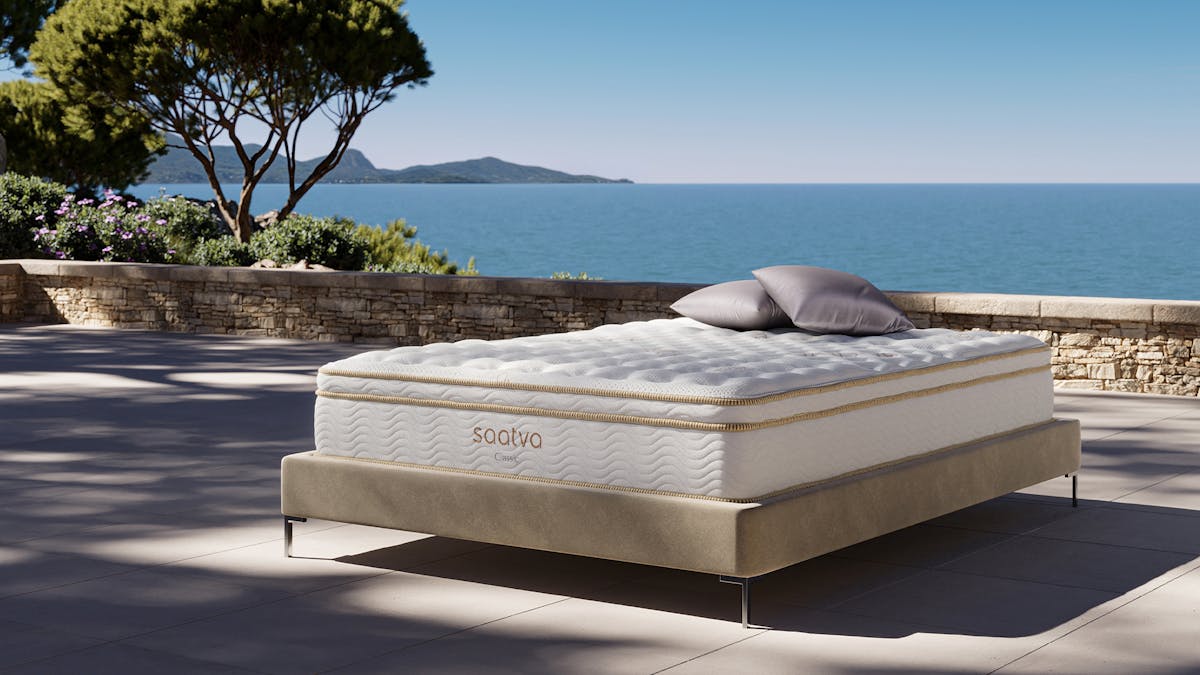
Saatva Classic
9.2/10
- Dual-coil construction with a reinforced lumbar zone pad keeps the L4-L5 region from sagging overnight
- Exceptional edge support (only 2.25" sitting sinkage) makes sit-to-stand transfers stable and safe
- Free white-glove delivery, in-room setup and old-mattress removal
- 365-night trial and lifetime warranty
- Outstanding airflow through open coil structure, runs cooler than most hybrids
- Moderate motion isolation, coil bounce transfers partner movement
- $99 return fee during the trial
- Heavy (~110 lb queen), hard to move or rotate without help
Sleep medicine specialists consistently point to medium-firm innerspring with zoned lumbar support as the standard of care for aging spines. The Saatva Classic delivers that construction plus the edge support that matters more and more as getting in and out of bed becomes a deliberate movement.
Why your spine's needs change with age
The relationship between your spine and your mattress shifts fundamentally after 50. Intervertebral discs lose 20 to 30 percent of their hydration between ages 20 and 70, reducing disc height and shock absorption. Facet joints develop arthritic changes that make certain positions painful. Spinal curvature often shifts: increased thoracic kyphosis and changes in lumbar lordosis alter how the spine needs to be supported horizontally.
These changes mean the medium-firm mattress that worked at 35 may create pressure points or fail to support the lumbar at 60. The needs of a 55-year-old differ from those of a 70-year-old, and the difference matters for choosing materials and firmness.
What an aging spine needs from a mattress
Neutral spinal alignment remains the primary goal, but what achieves it changes. With reduced disc height and more pronounced curvature, a mattress needs to contour enough to fill the lumbar gap without letting hips sink too far. The hammock effect of a soft mattress is more damaging to an aging spine than to a younger one.
Pressure relief at shoulders and hips becomes more critical as cartilage thins and joint sensitivity increases. Side sleepers especially need a mattress that lets shoulders and hips sink enough to maintain spinal alignment without creating pressure points.
Edge-to-edge support matters more as getting in and out of bed becomes deliberate. Strong edge support means sitting on the edge to dress without the mattress collapsing, and using the edge as a lever for transfers to standing.
Temperature regulation addresses the worsening thermoregulation common in the 60s and 70s. Innerspring and hybrid mattresses run considerably cooler than all-foam options because coil airflow carries heat away from the sleeping surface.
Quick comparison: top picks
| Mattress | Type | Firmness | Edge support | Trial | Queen price |
|---|---|---|---|---|---|
| Saatva Classic | Dual-coil innerspring | Lux Firm 6/10 | Excellent (10/10) | 365 nights | From $1,879 |
| Amerisleep AS3 | All-foam (Bio-Pur) | Medium 5/10 | Moderate | 100 nights | From $1,049 |
Amerisleep AS3
8.9/10
- HIVE 5-zone layer targets firmness by body region, specifically reinforcing under the lumbar
- Partially plant-based Bio-Pur foam runs cooler than standard memory foam
- CertiPUR-US certified, made in the USA
- 20-year warranty, 100-night trial
- Softer edges than any coil hybrid, less safe for sit-to-stand transfers
- Sleepers over 230 lb may need the firmer AS2 or an AS5 Hybrid
For aging-spine sleepers who prefer a quiet, motion-isolating foam feel over a traditional innerspring, the AS3 delivers the HIVE lumbar zoning and spinal alignment support without the coil bounce. The weaker edge support is the main trade-off compared to the Saatva.
Best mattress types for an aging spine
Innerspring with luxury pillow top (medium-firm): The standard recommendation from sleep medicine specialists for older adults with back pain. Individually wrapped coils provide zoned support, firmer under the lumbar and softer at the shoulder, and maintain strong edges. Airflow through coils addresses temperature regulation. The Saatva Classic is the benchmark in this category.
Hybrid (coil plus foam): Combines innerspring support with foam pressure relief. The strongest option for people who need both back support and significant pressure relief at hips and shoulders. Quality matters, cheap hybrids lose foam integrity quickly.
Medium-firm memory foam: Excellent pressure relief and contouring, but requires a quality base layer for adequate support. Traditional memory foam traps heat; partially plant-based or gel-infused versions perform better. Edge support is typically weaker than innerspring options. The AS3's HIVE zoning partially compensates.
Avoid: Very soft mattresses that let the lumbar sag, very firm mattresses that create pressure points at hips and shoulders, and mattresses with indentation greater than 1.5 inches (replace at that threshold regardless of age).
Firmness by age and sleeping position
- 50s, side sleeper: Medium (4 to 6 out of 10), enough give for shoulder and hip, enough support to prevent lumbar sag.
- 50s, back sleeper: Medium-firm (5 to 7 out of 10), lumbar support is the priority; slight contouring for pressure relief.
- 60s/70s, side sleeper: Medium to medium-soft (3 to 6 out of 10), increased joint sensitivity warrants more contouring at the hips and shoulders.
- 60s/70s, back sleeper: Medium-firm (5 to 7 out of 10), firmer lumbar support stays important; a pillow under the knees helps.
- Stomach sleeper: Firm, stomach sleeping strains the lumbar spine at any age; if position change isn't possible, maximum firmness reduces the damage.
Why edge support matters more at 60 than at 30
Weak edge support is one of the most overlooked specs for older adults. When the perimeter collapses, the usable sleeping surface shrinks and pushes you toward the center, increasing partner disturbance. More important: sitting on the edge of a collapsing mattress to put on shoes, or using the edge as a transfer point to standing, becomes genuinely unsafe. Innerspring mattresses with reinforced perimeter coils consistently test higher on edge support than all-foam options. The Saatva Classic measured 2.25 inches of sitting sinkage in NapLab testing, which places it among the best tested.
Mattress height and bed transfers
Total bed height (mattress plus box spring or platform plus frame) significantly affects ease of getting in and out. The target for most older adults is 20 to 23 inches from floor to top of mattress, roughly knee height when standing. That height allows the feet to reach the floor naturally when sitting on the edge and reduces the stand-up effort. Mattresses under 10 inches on a low platform often put the sleeping surface too close to the floor; mattresses over 14 inches on a standard frame may require stepping up.
When to replace your mattress for spine health
Aging spines warrant more frequent assessment of mattress condition. Replace when you see any of these: visible indentation or sagging, waking with back or hip pain that resolves within 30 minutes of getting up, consistently sleeping better at hotels than at home, or mattress age past 8 to 10 years for quality innerspring or past 7 years for standard foam. Quality foam hybrids last 8 to 12 years; low-quality foam closer to 5 to 7 years.
For an aging spine, choose a medium-firm coil hybrid with a reinforced lumbar zone and strong edge support. The Saatva Classic in Luxury Firm is our top pick, with a 365-night trial and free white-glove setup. The Amerisleep AS3 is the best foam alternative on a 100-night trial.
Frequently asked questions
Is a firm or soft mattress better for an aging spine?
Medium-firm (5 to 7 out of 10) consistently outperforms both extremes. Very soft beds let the lumbar sag into the hammock position, which strains the posterior ligaments and discs. Very firm beds prevent the pelvis from settling into its natural position, compressing the lumbar facet joints. The exception is stomach sleeping, where firmer support reduces lumbar hyperextension.
Can a mattress topper fix an aging spine problem?
A topper can add pressure relief to a mattress that's supportive but too firm. It cannot add structural support to a mattress that's already too soft or sagging. If your mattress has visible indentation, a topper makes the problem worse, not better. Replace the mattress first.
What mattress is best for spinal stenosis?
Spinal stenosis typically causes pain in extension and relief in slight flexion. Side sleeping with knees drawn slightly toward the chest is often most comfortable. A medium mattress that allows this position without creating hip pressure is usually best. An adjustable bed frame with head-and-knee elevation can reduce canal pressure significantly and pairs well with any of the zoned mattresses above.
How important is edge support for older adults?
Very, and it's one of the most consistently underrated specs. Weak edges shrink the usable sleeping surface and make sit-to-stand transfers unsafe. Innerspring and hybrid mattresses test higher on edge support than all-foam options in every independent lab comparison. If edge support is a priority, the Saatva Classic is the benchmark.
How long until a new mattress helps back pain?
Most people report improvement within 2 to 4 weeks, with full adaptation closer to 12 weeks. If pain persists past 4 to 6 weeks on an appropriate mattress, the cause may be positional or require medical evaluation. This is why a long trial window matters for older adults specifically.
This guide is part of our Best Mattress for Pain Relief hub, covering all the top picks across pain conditions.