
 by
by See live a recommended brand pricing →
Sleep Lab Pick · Current Sale
Saatva Crib Mattress
9.1/10
Our clean affiliate pick for standard crib-mattress intent. It is a mattress recommendation only, not a crib bed, crib frame, bedding set, or mini-crib recommendation.
Crib mattress safety note
For infants, the priority is a firm, flat, non-inclined sleep surface with a snug-fitting mattress and a fitted sheet only. The CPSC crib mattress rule is codified at 16 CFR part 1241, and the AAP safe-sleep guidance says not to add soft bedding, pillows, bumpers, or comfort layers in the crib.
CPSC crib mattress guidance · AAP 2022 safe sleep recommendations
| Rank | Mattress | Best for | Notes |
|---|---|---|---|
| #1 | Saatva Crib Mattress | Standard crib and toddler-bed mattress shoppers | Dual-sided baby/toddler design. Use only where the crib/toddler bed accepts a standard crib mattress. |
| Comparison | Newton Baby / Naturepedic / Avocado | Market context | Mention honestly, but no MattressNut buy button unless an affiliate relationship exists. |
| Safety first | Firm, flat, snug fit | Infant sleep setup | Follow the crib manufacturer's dimensions and CPSC/AAP safe-sleep guidance. |
Current Sale, Amerisleep's current sale runs sitewide. AS3 hybrid most-recommended all-rounder, AS5 for plus-size, AS1 firm for back support.
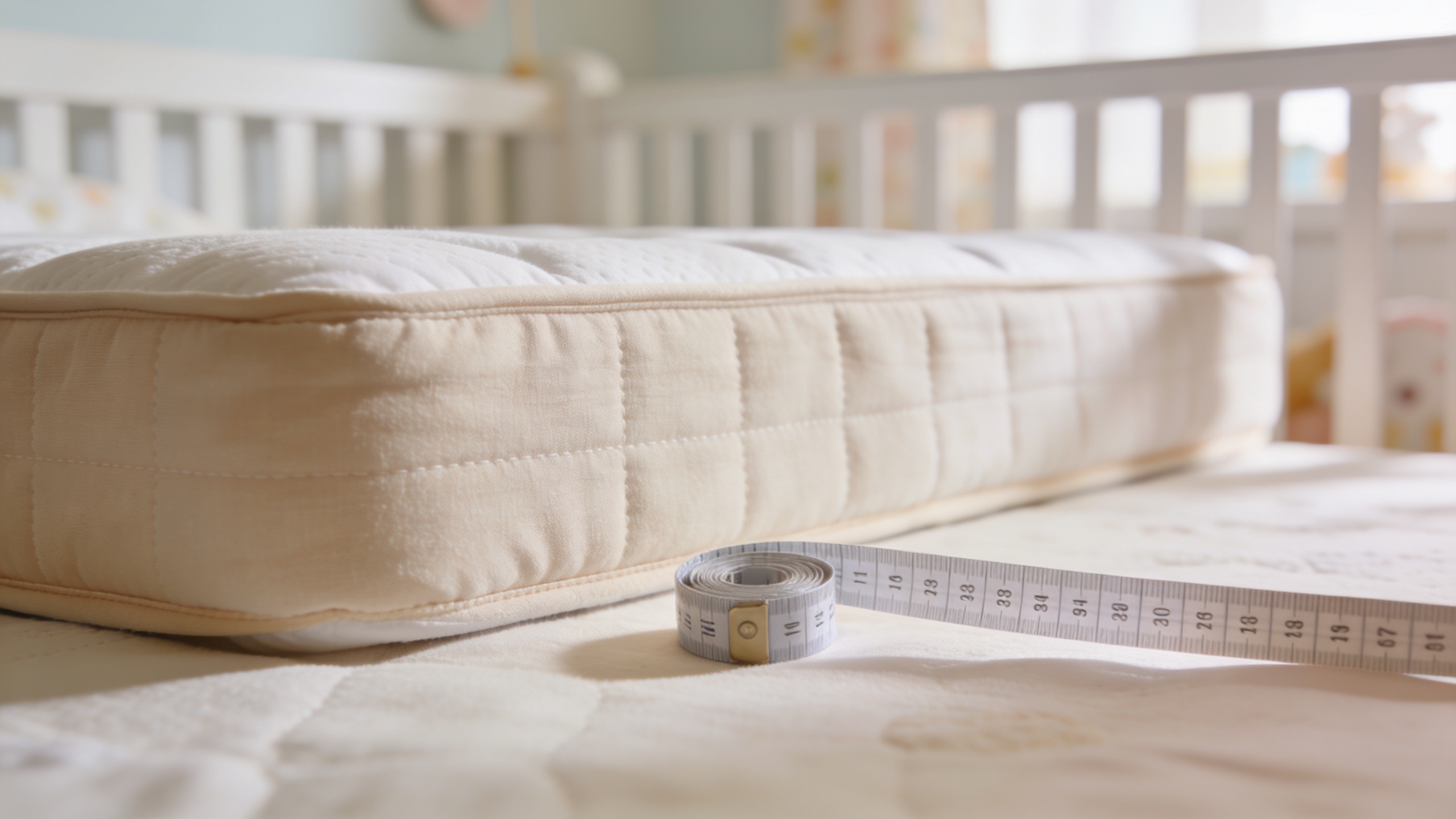
Crib Mattress Dimensions 2026: Standard, Mini & Safety Guide
- Standard US crib mattress dimensions: 27.25″ x 51.625″ (CPSC maximum 28″ x 52″)
- Maximum thickness: 6 inches per CPSC federal regulation 16 CFR 1220
- Mini crib mattress: 24″ x 38″, not interchangeable with standard
- Safety gap rule: the two-finger test, no more than two adult fingers between mattress edge and crib rail
- Certifications to look for: GREENGUARD Gold (chemical emissions) and OEKO-TEX STANDARD 100 (textile components)
Saatva Crib Mattress
Dual-firmness infant/toddler sides, GREENGUARD Gold certified, natural materials, fits standard 27.25″ x 51.625″ cribs. 365-night trial, lifetime warranty, free white-glove delivery + old mattress removal.
Check a CPSC-compliant crib mattress Price →
Quick Reference Dimensions
Federal law in the United States sets the dimensional envelope for full-size crib mattresses. The Consumer Product Safety Commission (CPSC) regulation 16 CFR Part 1220, which took effect in 2011 and was updated in 2014, establishes the following hard limits:
- Minimum length: 51.625 inches (131.125 cm)
- Maximum length: 52.125 inches (132.4 cm)
- Minimum width: 27.25 inches (69.2 cm)
- Maximum width: 28 inches (71.1 cm)
- Maximum thickness: 6 inches (15.2 cm)
The industry has converged on 27.25 inches x 51.625 inches as the de facto standard. Most name-brand cribs sold in the US are built to accept a mattress within this range. When a retailer or manufacturer states a mattress is "standard crib size," this is the number they mean.
| Type | Dimensions (inches) | Max Thickness | Typical Weight | Certifications to Look For | Price Range |
|---|---|---|---|---|---|
| Standard / Full-Size Crib | 27.25 x 51.625 | 6″ | 7-15 lb | GREENGUARD Gold, OEKO-TEX | $80-$400+ |
| Mini Crib | 24 x 38 | 4″-5″ | 3-7 lb | GREENGUARD Gold | $50-$200 |
| Portable / Play Yard | ~25.5 x 37.5 (varies) | 3″ | 2-4 lb | ASTM F406 | $30-$80 |
| Toddler Bed (reuse) | 27.25 x 51.625 (same as standard) | 6″ | 7-15 lb | GREENGUARD Gold | N/A (reuse existing) |
CPSC Safety Standards: Gap, Thickness & Firmness
The CPSC's crib mattress standard under 16 CFR Part 1220 covers more than just dimensions. It establishes structural performance requirements, surface firmness criteria, and testing protocols. Here is what matters when buying.
The Two-Finger Gap Rule
The most important field test for any crib mattress purchase: once the mattress is placed inside the crib, slide two adult fingers held together (not spread) between the mattress edge and the side rail. If both fingers fit with room to spare, the mattress is too small for that crib frame. A properly fitting mattress allows two fingers in snugly but should not accommodate a full adult hand. Any gap larger than approximately 1 inch creates an entrapment risk where an infant's head or torso could become wedged.
This rule applies across all four sides of the mattress and all four corners. Gaps are often uneven if the mattress is slightly off-center; always check corners first.
Maximum Thickness: 6 Inches
The 6-inch maximum thickness is not arbitrary. Crib drop-side regulations require a minimum rail height above the mattress surface when the mattress is at its lowest position. Exceeding 6 inches raises the sleeping surface, effectively reducing the rail clearance and increasing the risk of an older infant rolling or vaulting out of the crib. Most quality mattresses fall between 4 and 6 inches; there is no functional benefit to going thinner than 4 inches for full-term infants.
Firmness Requirements
The CPSC standard requires that a crib mattress pass a surface firmness test: the mattress must not deform more than a specified threshold under a 20-pound load applied to a defined contact area. The intent is to prevent soft sleep surfaces that can cause rebreathing (inhaling already-exhaled CO2), which is a known risk factor in sleep-related infant deaths.
A mattress that passes this test will feel noticeably firm to an adult. That firmness is intentional. Infants lack the neck strength to reposition their heads if their face partially contacts a soft surface; a firm substrate provides the resistance needed for them to push back. Do not add memory foam toppers or soft pads to a crib mattress for an infant under 12 months.
Flame Retardancy
The CPSC also requires crib mattresses to meet flammability standards under 16 CFR Part 1632 and 1633. Manufacturers meet these requirements through either chemical flame retardants or physical barriers such as a fire-resistant fabric layer over the foam. Parents concerned about chemical exposure should look for mattresses that use barrier systems rather than chemical treatments, or products with GREENGUARD Gold certification, which tests for a broad range of volatile organic compounds including common flame retardant chemicals.
Standard vs. Mini vs. Portable Cribs
Standard / Full-Size Crib (27.25″ x 51.625″)
The standard full-size crib is the most common configuration in the US market. Major brands including IKEA SUNDVIK, Delta Children, DaVinci, and Graco build their cribs to accept a 27.25 x 51.625-inch mattress. Convertible cribs that transition to toddler beds, daybeds, and full-size beds also begin at this standard mattress size, which is why a standard crib mattress can be reused when the crib converts, the mattress dimensions remain identical.
Key point: the mattress stays the same size through the crib-to-toddler-bed conversion. When a convertible crib manufacturer advertises that the product "converts to a toddler bed," they mean the frame configuration changes (typically one side rail is removed or replaced with a lower toddler guardrail), not that you need a new mattress.
Mini Crib (24″ x 38″)
Mini cribs are approximately 14 inches shorter and 3 inches narrower than standard cribs. They are designed for smaller bedrooms, nurseries in apartments, or use as a bedside co-sleeper unit. The mattress dimensions are not standardized to the same degree as full-size cribs, and different brands use slightly different specifications. Before purchasing a mini crib mattress, measure the interior sleeping area of the specific crib model, do not rely on the generic "24 x 38" figure.
Because mini crib mattress dimensions vary by brand, sheets and accessories are also less standardized. Budget for the possibility that fitted sheets sized for one brand's mini crib may not fit another's without bunching or leaving gaps.
Portable / Pack-and-Play Mattresses
Play yard mattresses (sold separately from the play yard itself, or used as replacements) are covered by a separate CPSC standard (16 CFR Part 1221) and typically measure approximately 25.5 x 37.5 inches with a maximum thickness of 3 inches. These are not interchangeable with mini crib or standard crib mattresses. A standard crib mattress will not fit inside a standard pack-and-play frame; the dimensions and the attachment method are incompatible.
If you need a firmer sleep surface for a pack-and-play, a dedicated portable crib mattress is the correct solution. Do not fold or roll a standard mattress to fit.
Bassinet Mattresses
Bassinets are regulated separately again (16 CFR Part 1218 for non-inclined bassinets) and use even smaller mattress dimensions, typically in the range of 13 x 27 inches or 15 x 30 inches depending on the bassinet model. Like portable cribs, bassinet mattresses are model-specific and not interchangeable with crib mattresses.
Materials: Foam vs. Innerspring vs. Organic
Foam Crib Mattresses
Foam crib mattresses are the most common entry-level option. They typically weigh 4 to 8 pounds, making them easier to maneuver when changing sheets. Quality varies substantially by density: a foam mattress for infants should have a density of at least 1.5 lb per cubic foot for basic safety compliance; 1.8 lb/ft3 or higher is preferred for firmer support over a longer use period. Low-density foam (below 1.5 lb/ft3) can begin to compress and deform within 12 months of use.
Foam crib mattresses start under $100 for basic models and top out around $250 for higher-density, organic foam versions. The primary trade-off versus innerspring is weight and surface conformance rather than safety, a properly firm foam mattress is equally safe to a properly firm innerspring.
Innerspring Crib Mattresses
Innerspring models use a coil system similar to adult mattresses, but scaled for infant support requirements. Coil count in crib mattresses typically ranges from 80 to 252; higher coil counts improve surface evenness but the correlation with infant safety is not linear. More meaningful than coil count is coil gauge: a lower gauge number means thicker, stiffer wire. 15.5 gauge is typical at the budget end; 13 gauge is firmer and more durable.
Innerspring crib mattresses are heavier (9 to 15 pounds is common) and more expensive ($150 to $400+). They tend to be more durable for extended use through the toddler years, and many dual-sided models use the innerspring structure to provide different surface feels on each side for the infant-to-toddler transition.
Organic and Natural Material Mattresses
The "organic" category in crib mattresses encompasses several different certifications and material types:
- GREENGUARD Gold: Tests finished products for chemical emissions including VOCs, formaldehyde, and phthalates. This is the most rigorous widely-used certification for crib mattresses. It applies to the finished product as manufactured, not individual components.
- OEKO-TEX STANDARD 100: Tests textile components (fabric covers, filling materials) for harmful substances. A cover certified to OEKO-TEX does not certify the foam or coil core inside.
- GOTS (Global Organic Textile Standard): Covers the organic certification of cotton and other natural textile fibers. Relevant for covers and padding layers made from cotton or wool.
- GOLS (Global Organic Latex Standard): Certifies natural latex as organic. Relevant for latex-core crib mattresses.
A mattress can carry one, several, or none of these certifications and still be compliant with CPSC safety standards. The certifications address chemical exposure concerns that are separate from the structural safety standards. For parents prioritizing low chemical exposure, GREENGUARD Gold is the single most meaningful certification to prioritize because it tests the whole product.
Saatva Crib Mattress Specs
The Saatva Crib Mattress ($295) is a dual-sided innerspring model built on a natural material platform. Here are the technical specifications relevant to this article:
- Dimensions: 27.25″ x 51.625″ (standard US crib size)
- Thickness: 5.5 inches (within the 6-inch CPSC maximum)
- Construction: Tempered steel coil innerspring core with natural fill layers
- Dual-sided: Firm infant side / slightly softer toddler side
- Cover: Organic cotton with natural thistle fire barrier (no chemical flame retardants)
- Certifications: GREENGUARD Gold
- Weight: Approximately 14 lbs
The dual-sided construction means the infant side uses a firmer surface profile to meet CPSC firmness requirements and AAP safe sleep recommendations. The toddler side provides a marginally softer feel appropriate for children 12 months and older who can change sleeping position independently. Saatva marks each side clearly; there is no ambiguity about which side faces up for each age stage.
The natural thistle fire barrier is Premium brands' alternative to chemical flame retardants. Wool and thistle fiber naturally resist ignition at temperatures encountered in residential fires, satisfying 16 CFR 1633 without adding chemical treatments. This is a meaningful differentiator for parents concerned about chemical exposure in a GREENGUARD Gold-certified product.
At $295, the recommended Crib Mattress occupies the premium end of the standard crib mattress market, comparable to Newton Wovenaire ($299) and above Naturepedic Organic Lightweight ($189) but below highest-end organic options ($400+). The GREENGUARD Gold certification, dual-sided design, and chemical-free fire barrier make it one of the stronger value propositions in the premium tier.
Check a CPSC-compliant crib mattress Price →
Sheet & Accessory Sizing
Standard Crib Fitted Sheets
Fitted sheets for a standard crib mattress (27.25 x 51.625 inches, up to 6 inches thick) should have a pocket depth of at least 4 inches to stay secure without bunching under the mattress. Most sheets marketed as "standard crib" or "full-size crib" sheets fit this envelope. However, fitted sheet sizing is not federally regulated to the same degree as mattress dimensions; pocket depths can vary from 4 to 9 inches by brand.
The AAP recommendation is that the fitted sheet stay taut against the mattress surface without excess fabric that could bunch near the infant's face. A sheet with too deep a pocket on a thinner mattress will bunch; a sheet with too shallow a pocket on a 6-inch mattress will pull off. Match the sheet pocket depth to your mattress thickness, not just the brand's "crib size" label.
Mini Crib Sheets
Mini crib sheets are sold to fit approximately 24 x 38-inch mattresses, but because mini crib dimensions vary by frame brand, verify actual mattress dimensions before buying sheets. A sheet that fits a DaVinci Kalani Mini Crib mattress may not fit an IKEA SNIGLAR mini crib because the frame interior dimensions differ.
Waterproof Mattress Pads and Protectors
Waterproof protectors are practical accessories for managing diaper leaks and spills without replacing the mattress. For a standard crib mattress, look for a waterproof protector with fitted corners and the same pocket-depth matching logic as sheets. Flat waterproof pads or non-fitted mats are not recommended for infant sleep surfaces because they can shift and create bunching.
Do not layer multiple pads between the fitted sheet and the mattress surface. Each added layer increases the distance between the baby and the firm mattress core, potentially creating a softer sleeping surface than the mattress was designed to provide.
Mattress Toppers: Not for Infants Under 12 Months
The American Academy of Pediatrics and CPSC advise against using any mattress topper or soft padding in a crib with an infant under 12 months. This applies regardless of how the topper is marketed (organic, cooling, pressure-relieving, etc.). The mattress itself is required to meet firmness standards; adding a topper undermines those standards.
Toddler Bed Transition Timing
The standard crib mattress dimensions (27.25 x 51.625 inches) are intentionally compatible with most US toddler bed frames. When a convertible crib transitions to a toddler bed configuration, the same mattress drops into the toddler frame without modification. This means parents typically do not need to purchase a new mattress at the crib-to-toddler-bed transition, a practical cost savings.
When to Transition
The American Academy of Pediatrics recommends transitioning out of the crib when:
- The child reaches 35 inches tall (the point at which most crib rail heights no longer provide meaningful containment)
- The child climbs out of the crib repeatedly, creating a fall hazard
- The child is approaching age 3 and the crib has become too small for comfortable sleep
There is no minimum age for transitioning to a toddler bed, but the AAP does not recommend rushing the transition for developmental reasons alone. A child who sleeps safely in a crib at 18 months does not need to move to a toddler bed at 18 months if they are not showing the indicators above.
From Toddler Bed to Twin
After the toddler bed phase, most children transition to a twin mattress (38 x 75 inches) between ages 3 and 5. The twin is a substantially different size than the crib/toddler mattress. This transition requires a full mattress replacement; the crib mattress cannot be adapted to fit a standard twin bed frame.
Dual-Sided Crib Mattresses and the Transition
Dual-sided mattresses like the recommended Crib Mattress are designed to serve both the infant and toddler phases. The firm infant side meets AAP and CPSC requirements for babies 0-12 months. The toddler side provides a surface appropriate for children 12 months and older. Flipping the mattress at the 12-month mark is a single step, remove the mattress, flip it, reinstall, and does not require any additional purchase until the eventual twin-bed transition.
Verdict
Crib mattress purchasing comes down to three measurable requirements: the mattress must fit the crib frame within the CPSC-specified gap tolerance (two-finger test), meet the 6-inch thickness maximum, and provide a firm, non-conforming sleep surface for infants under 12 months. Every other consideration, materials, certifications, dual-sided design, sits on top of those three requirements.
For parents who want to buy once and use through the toddler years, a dual-sided innerspring model with GREENGUARD Gold certification is the most defensible choice. The Saatva Crib Mattress meets all dimensional and safety requirements, uses a natural material fire barrier instead of chemical flame retardants, carries GREENGUARD Gold certification, and is built to last from infancy through the toddler bed phase on the same 27.25 x 51.625-inch footprint.
Saatva Crib Mattress, $295
GREENGUARD Gold · Dual-sided infant/toddler · Natural fire barrier · 365-night trial
Check a CPSC-compliant crib mattress Price →
Related Mattress Nut guides
Frequently Asked Questions
What is the two-finger test for crib mattress fit?
The two-finger test means no more than two adult fingers should fit between the mattress edge and the crib side rail. If more than two fingers slip in, the gap poses an entrapment hazard and the mattress is too small for that crib.
When should I flip a dual-sided crib mattress to the toddler side?
Flip to the toddler side once your child is 12 months old or has pulled themselves to standing in the crib, whichever comes first. Before 12 months, always use the firmer infant side per AAP safe sleep guidelines.
Can a mini crib mattress fit a standard crib?
No. A mini crib mattress (approximately 24 x 38 inches) is roughly 14 inches shorter and 3 inches narrower than a standard crib mattress (27.25 x 51.625 inches). The large gap created would be a serious entrapment hazard. Always match mattress size to crib size exactly.
Is an organic or GREENGUARD Gold crib mattress worth the extra cost?
For infants who spend 12-16 hours a day on a mattress, low-VOC materials are a legitimate health consideration. GREENGUARD Gold certification requires testing against more than 10,000 chemicals including formaldehyde and flame-retardant compounds. OEKO-TEX STANDARD 100 certifies individual textile components. Neither certification is legally required, but both provide independent verification beyond a manufacturer's own claims.
What thickness crib mattress is safe?
The CPSC requires crib mattresses sold in the US to be no thicker than 6 inches. Thicker mattresses raise the sleeping surface closer to the top rail, increasing the risk of a baby rolling or climbing out. Most quality mattresses fall in the 4-6 inch range; 5-6 inches is common and still compliant.
When should I transition my toddler from a crib to a toddler or twin bed?
The American Academy of Pediatrics recommends transitioning when a child reaches 35 inches tall, climbs out repeatedly, or is nearing age 3. The crib rail provides no meaningful containment once a child can clear it. Most standard crib mattresses (27.25 x 51.625 inches) fit toddler bed frames directly, so you may not need a new mattress for the first transition.