
 by
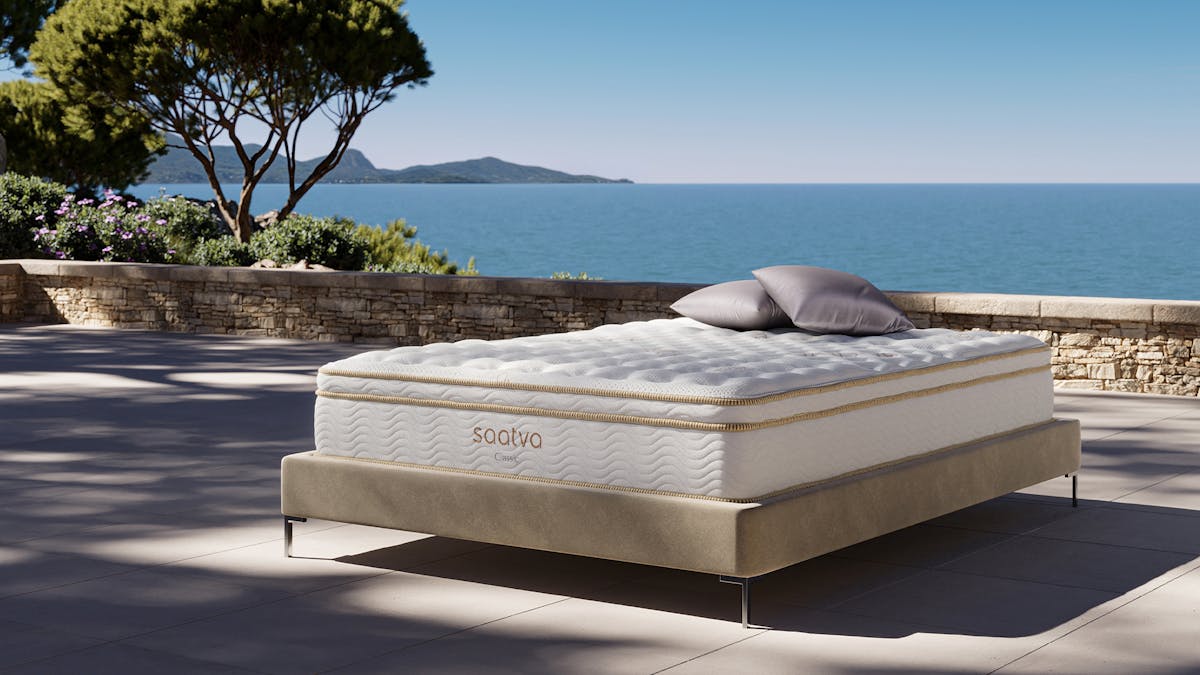
by Firm mattresses work best for stomach sleepers, heavy back sleepers, and anyone who needs a surface that resists deep sinkage. Our top pick is the Saatva Classic (Firm, 8/10): dual-coil innerspring construction, zoned lumbar reinforcement, white-glove delivery, 365-night trial, and lifetime warranty, the most complete firm mattress for most sleepers. The Amerisleep AS2 is the top all-foam firm option with a 100-night trial and 20-year warranty. For a natural-material firm feel, PlushBeds Botanical Bliss delivers configurable latex firmness with a 25-year warranty.
Saatva Classic
9.3/10
- Dual-coil system with zoned lumbar foam reinforcement, firm where it matters, supportive throughout
- Outstanding edge support: only 2.25" sitting sinkage in lab tests
- Free white-glove delivery with in-room setup and old-mattress removal
- 365-night trial and lifetime warranty; ships uncompressed with zero off-gassing
- Moderate motion isolation, coil construction transfers more movement than all-foam
- $99 return fee if you use the trial
For stomach sleepers, heavy back sleepers, or anyone who genuinely needs firm support, the Saatva Classic Firm option delivers coil-on-coil resistance with a zoned lumbar pad and the best edge support in its class, on a trial period that is more than twice the industry standard.
Who actually needs a firm mattress
Firmness is not a lifestyle preference, it is a biomechanical match. The wrong firmness causes or worsens pain; the right one keeps the spine neutral across the 7 to 8 hours you are in contact with the surface. Firm mattresses (7 to 8 out of 10) are genuinely appropriate for a specific group of sleepers:
- Stomach sleepers: The pelvis is the heaviest bony segment. On a soft mattress, it sinks lower than the thorax, forcing the lumbar spine into hyperextension and compressing the posterior discs. Firm resistance keeps the pelvis level and the lumbar neutral. This is the single strongest clinical case for a firm mattress.
- Heavy back sleepers (230+ lb): Heavier body weight generates more sinkage on any surface. What reads as medium-firm for a 150-lb sleeper may read as medium for a 250-lb sleeper. Firm beds provide the additional resistance needed to prevent lumbar drop.
- Combination sleepers who need ease of repositioning: Dense surfaces allow easier pivot and roll without the wrestling sensation of slow-response memory foam. If you change positions frequently, a firmer, more responsive surface reduces disruption.
- Sleepers who prefer sleeping on rather than in a mattress: Some people, particularly those who sleep hot or dislike deep contouring, simply feel more comfortable on a firm surface. Preference alone is a valid reason, provided the firmness does not create pressure points at the shoulders and hips.
Understanding the firmness scale
| Rating | Feel | Best for |
|---|---|---|
| 5-6/10 | Medium | Side/combo sleepers, average weight |
| 6-7/10 | Medium-firm | Back sleepers, most back pain sufferers |
| 7-8/10 | Firm | Stomach sleepers, 200+ lb back sleepers |
| 8-9/10 | Extra firm | Heavy stomach sleepers (250+ lb), strong firm preference |
Top picks: best firm mattresses
| Mattress | Type | Firmness | Trial | Price (queen) |
|---|---|---|---|---|
| Saatva Classic (Firm) | Dual-coil innerspring | Firm 8/10 | 365 nights | ~$1,395 |
| PlushBeds Botanical Bliss | Natural latex | Configurable 5-7/10 | 100 nights | ~$1,800 |
| Amerisleep AS2 | All-foam (Bio-Pur) | Medium-firm 7/10 | 100 nights | From $1,299 |
| Puffy Original | All-foam | Medium 6-7/10 | 101 nights | ~$1,499 |
| Sweetnight CoolNest | Hybrid | Medium-firm 6-7/10 | ~100 nights | Sub-$600 |
PlushBeds Botanical Bliss
8.8/10
- GOLS-certified organic latex layers, configurable at medium or medium-firm densities
- Dunlop latex sleeps cooler and more responsive than memory foam, with a buoyant rather than sinking feel
- Durable 25-year warranty, one of the longest in the category
- Good motion isolation without the slow-response feel of memory foam
- Heavy, not roll-packed, difficult to move alone
- Higher price point than most foam-in-a-box alternatives
- Buoyant latex feel is not for everyone who expects deep contouring
For sleepers who want a firm, natural-material surface that breathes better than any foam and outlasts most competitors, the Botanical Bliss in medium-firm configuration hits the firmness sweet spot for back and stomach sleepers without synthetic materials.
Amerisleep AS2
8.6/10
- HIVE 5-zone support with a medium-firm 7/10 feel, ideal for back and stomach sleepers who want contouring without deep sinkage
- Partially plant-based Bio-Pur open-cell foam runs cooler than traditional memory foam
- Excellent motion isolation and solid edge support for an all-foam build
- 100-night trial, 20-year split warranty (full replacement years 1-10), CertiPUR-US
- Not recommended for side sleepers, the firmer feel creates pressure at hips and shoulders
- All-foam version ships curbside, not white-glove like Saatva
For back and stomach sleepers who want firm-ish support without a coil feel, the AS2's medium-firm 7/10 rating sits at the ideal point: firm enough to prevent lumbar drop, soft enough to avoid pressure-point discomfort across the pelvic crest.
Puffy
8.2/10
- Lifetime warranty, one of the strongest coverage packages in the category
- Strong pressure relief and motion isolation for all-foam construction
- Comfortable medium-firm surface for back sleepers of average weight
- Runs slightly warm compared to coil or latex options
- Edge support softer than the Saatva or Amerisleep hybrids
The Puffy sits at the accessible end of medium-firm all-foam, with a lifetime warranty that matches more premium competitors and enough support for back sleepers who want contouring alongside firmness.
Sweetnight
7.8/10
- Hybrid coil-and-gel-foam construction under $600, well below most competing hybrids
- Better cooling than pure foam at this price tier thanks to the coil base
- Adequate medium-firm support for guest rooms or budget-conscious buyers
- Durability and edge support trail premium options significantly
- Not ideal for primary use by heavier sleepers (230+ lb) long-term
If the $1,000+ price of the Saatva or PlushBeds is not the right fit right now, the Sweetnight CoolNest hybrid delivers a functional medium-firm surface at a fraction of the cost, acceptable for guest rooms or lighter daily use.
The real benefits of a firm mattress
The word "benefits" often gets attached to firm mattresses uncritically. The actual evidence is more specific: firm mattresses offer clear advantages for particular sleepers in particular positions, and can cause harm when misapplied.
- Lumbar support in prone positions: Stomach sleeping on a firm surface prevents the anterior pelvic tilt that compresses lumbar discs. This is the primary documented benefit of firm mattresses, and it applies specifically to stomach sleepers, not all sleepers.
- Spinal alignment for heavy back sleepers: A 2003 Lancet study found medium-firm outperformed firm for general back pain. However, for sleepers over 200 lb, body weight creates additional downward force that shifts the optimal point toward the firmer end of medium-firm (6.5 to 8/10).
- Surface responsiveness: Firm surfaces rebound faster, making position changes easier and reducing the claustrophobic feeling common with deep memory foam.
- Durability: Firmer foams and coils tend to resist compression creep over time, though durability depends more on foam density (1.8 lb per cubic foot or higher) and coil gauge than on surface firmness alone.
Four myths about firm mattresses
- Myth: Firm is better for back pain. Not for most people. The Lancet (2003) and Sleep Health (Jacobson, 2015) both found medium-firm outperforms firm for non-specific lower back pain in average-weight sleepers. Firm is appropriate for stomach sleepers and heavy back sleepers, not as a general rule.
- Myth: Firm mattresses last longer. Durability depends on foam density and coil quality, not surface firmness rating. A low-density firm foam degrades faster than a high-density medium foam.
- Myth: You should buy firm and break it in. A mattress softens slightly with use, but you cannot break your way from firm to medium-firm. Buy what matches your position and body weight at purchase.
- Myth: Firm means no pressure relief. The best firm mattresses use zoned construction that differentiates firmness across body zones, firmer under the torso and hips, slightly less dense at the shoulders, so they provide pressure management without surrendering lumbar support.
What about side sleepers?
Firm mattresses are generally wrong for side sleepers. In a side position, the hip and shoulder must sink several inches into the sleep surface to allow the spine to remain straight. On a firm mattress, neither the hip nor the shoulder can adequately compress the surface, creating lateral spinal deflection and concentrated pressure at both contact points. Most side sleepers develop hip or shoulder pain within weeks on a firm mattress.
If you are a side sleeper who feels most comfortable on a firmer surface, the issue is usually motion: you are rolling toward your back during sleep. A medium or medium-firm mattress with good zoning resolves the side-position pressure while still providing adequate back-position support during position changes.
Frequently asked questions
Is a firm mattress better for back pain?
For most people, medium-firm (6 to 7 out of 10) outperforms firm for back pain. Firm (7 to 8/10) is specifically appropriate for stomach sleepers and heavy back sleepers whose weight requires more surface resistance to reach neutral spinal alignment.
Can a mattress be too firm?
Yes. Extra-firm mattresses create pressure points at the hip and shoulder in side and back sleepers, restricting circulation and causing pain. If you wake with hip or shoulder soreness, or with numbness or tingling, the surface is too firm for your sleep position.
How do I know if I need a firm mattress?
Two indicators: (1) you are primarily a stomach sleeper, or (2) you are over 200 lb and sleep primarily on your back. Both require more surface resistance than a medium mattress provides. If neither applies and you simply prefer the feel of firmness, test on a long trial before committing.
How do I make my mattress firmer?
Add a firm mattress topper with an ILD of 32 to 40 (high-density latex or poly foam). Check your foundation: slats spaced more than 3 inches allow the mattress to bow, creating a softer feel. A solid platform or bunkie board adds resistance without replacing the mattress.
For genuine firm-mattress needs, the Saatva Classic (Firm, 8/10) is the strongest option on a 365-night trial and lifetime warranty. For a natural-material firm feel, the PlushBeds Botanical Bliss is the top latex pick. For an all-foam firm option, the Amerisleep AS2 (7/10) covers back and stomach sleepers on a 100-night trial.
This guide is part of our Mattress Buying Guide hub, compare all the top picks and narrow down your choice there.