
 by
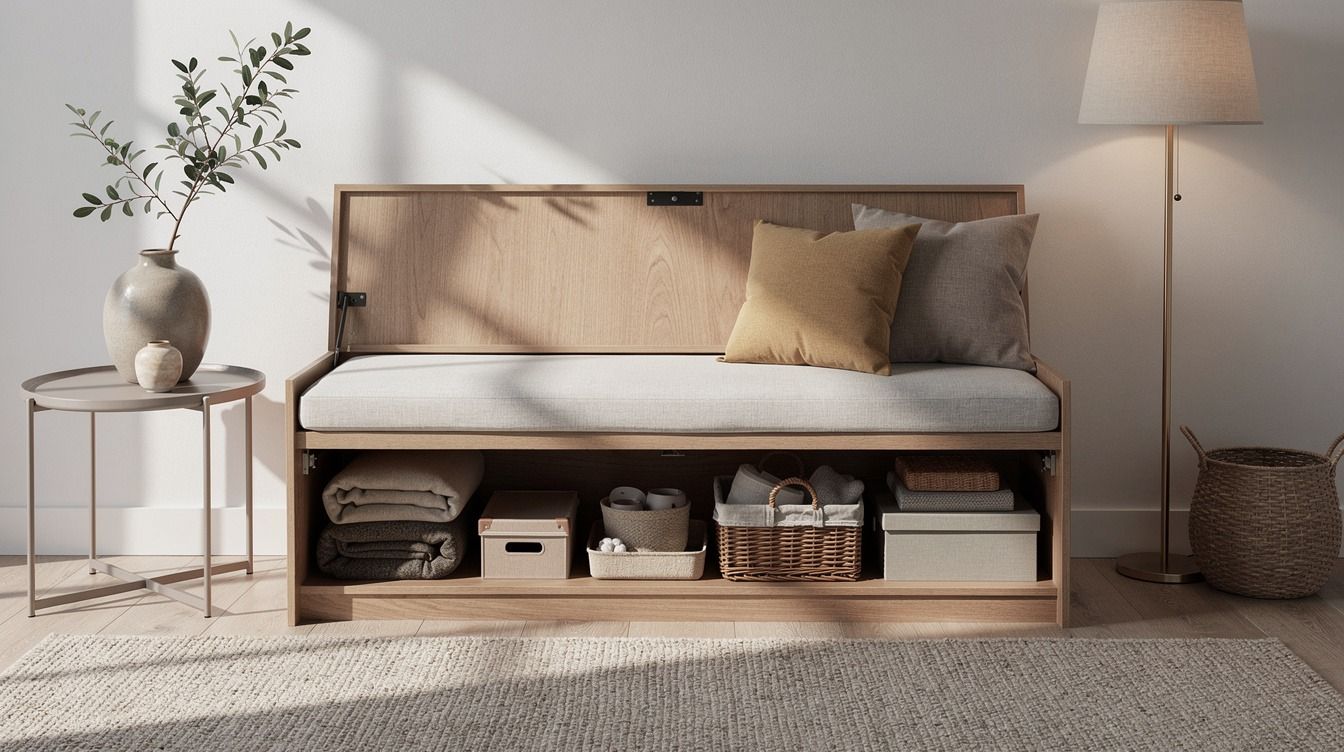
by Hidden storage ideas for small spaces work best when they borrow inches you already paid for. I learned that after cramming baskets into every visible corner and making one small room feel even tighter. The fix wasn't more stuff. It was quieter storage, built into the bench, the doorway, the toe-kick, and the ottoman you were going to use anyway. Most of these are weekend projects, and a few are zero carpentry at all, so you can start where your budget is honest.
- ✓ Build a bench with lift-up seat storage
- ✓ Frame the doorway with shallow hidden cubbies
- ✓ Slide toe-kick drawers under lower cabinets
![Storage idea inspiration]
- Build a bench with lift-up seat storage
- Frame the doorway with shallow hidden cubbies
- Slide toe-kick drawers under lower cabinets
- Can you mount a fold-down desk without it feeling like an office?
- Why bother hiding storage under a raised platform?
- Wrap the TV wall in push-latch panels
- Tuck rolling bins under a daybed
- Install stair drawers for tucked-away overflow
- Choose nesting tables with concealed compartments
- How do you hide pantry storage behind cabinet fronts?
- Use mirror doors to conceal narrow shelving
- Add a storage ottoman that anchors the room
1Build a bench with lift-up seat storage
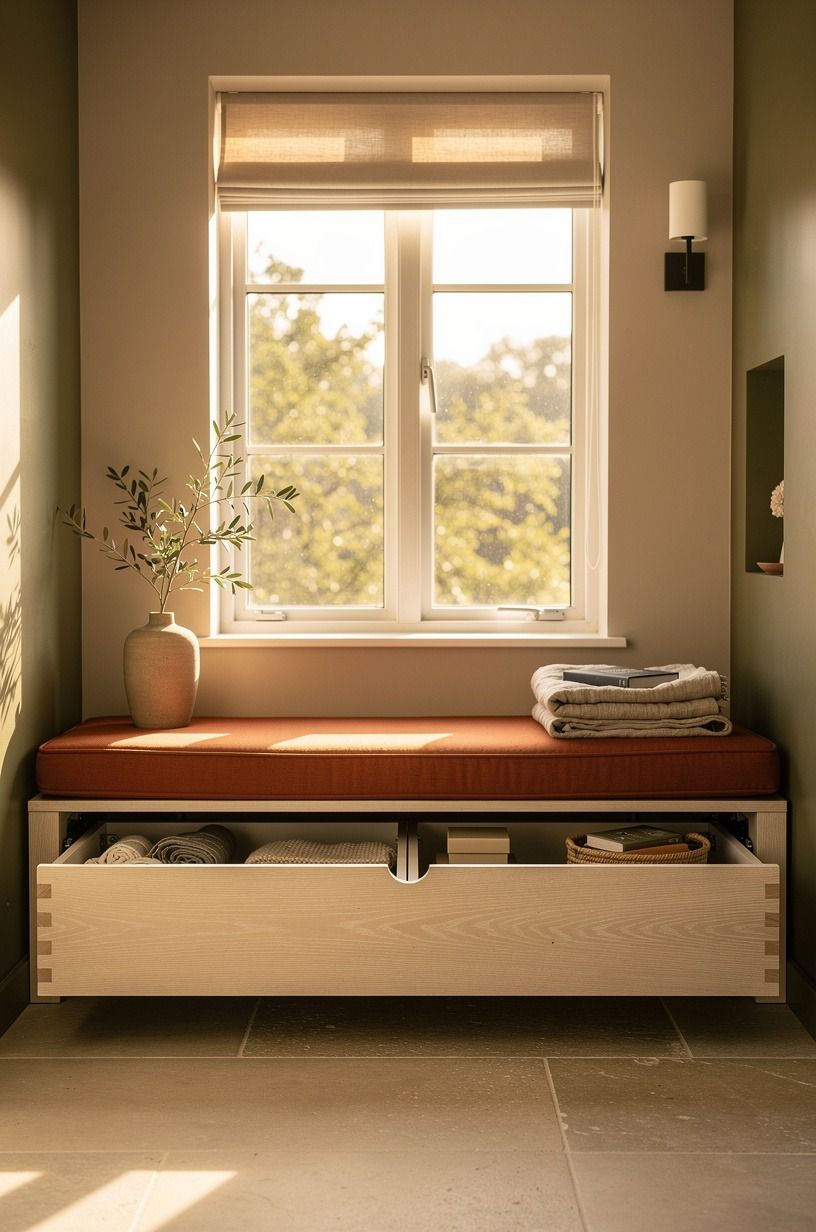
Build the bench where your room already pauses: under the compact window wall. With the seat tipped up just enough to show the compartments, you get the whole point in one glance, and you keep the clean line that makes a small room feel settled. I would make the box in 3/4-inch solid white oak if you're painting it, or in a cerused finish if you want the grain to echo the photo.
IKEA HEMNES in white stain is a worthy fallback if you want a faster read.
Inside, think in categories so you don't create a lid you hate opening. Guest throws. Board games.
Off-season pillow covers. A bench like this works especially well with terracotta cushions, olive accents, and a stone floor because the storage disappears into materials that already feel grounded.
If you're planning a whole seating wall, steal a few proportions from this breakfast nook with storage roundup before you size the lid.
The part that worked for me was keeping the seat in one clean slab instead of three fiddly tops. You lift once, you reach once, you're done. For a real budget check, a built-in like this runs about $250 to $600 in plywood and brass hinges, less if you're reclaiming a stock HEMNES.
Small thing, big difference!
![Window seat bench with cushion and warm wood tones]
2Frame the doorway with shallow hidden cubbies
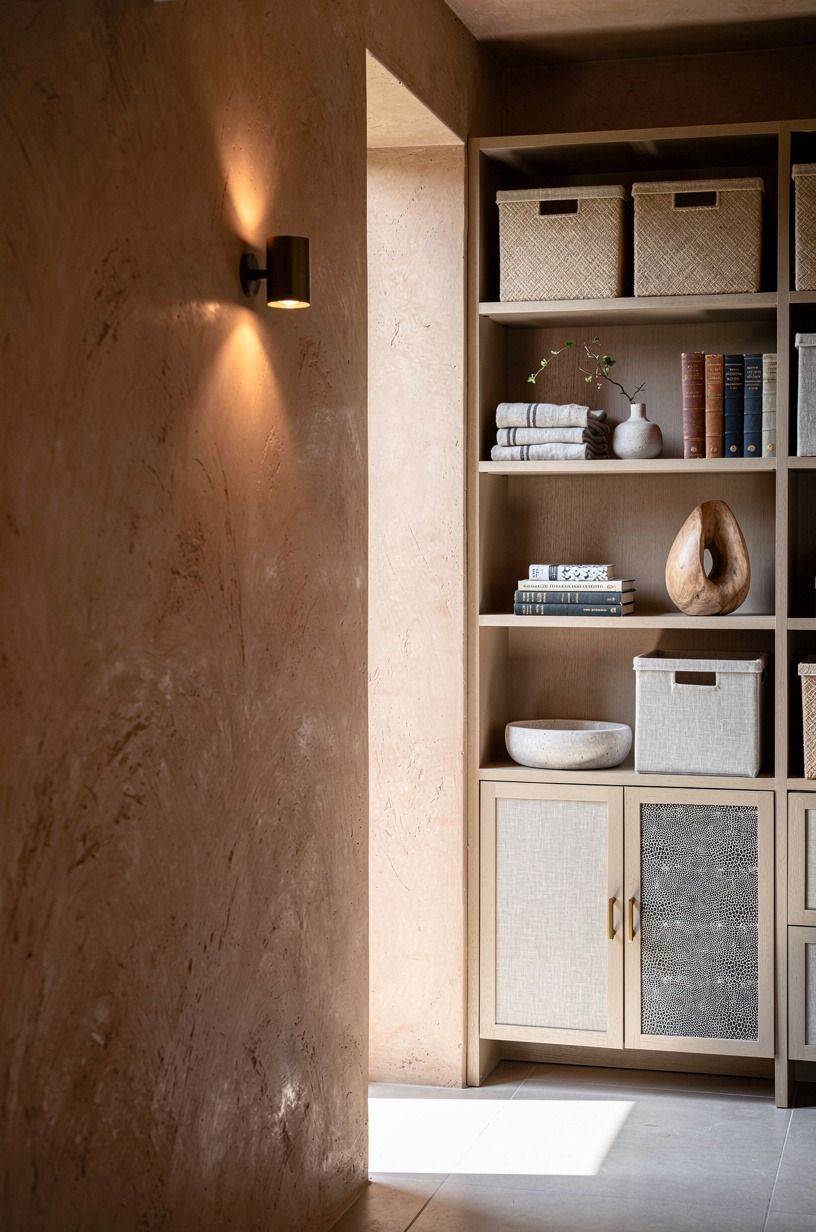
Frame the doorway with cubbies so shallow they read like trim first and storage second.
3Slide toe-kick drawers under lower cabinets
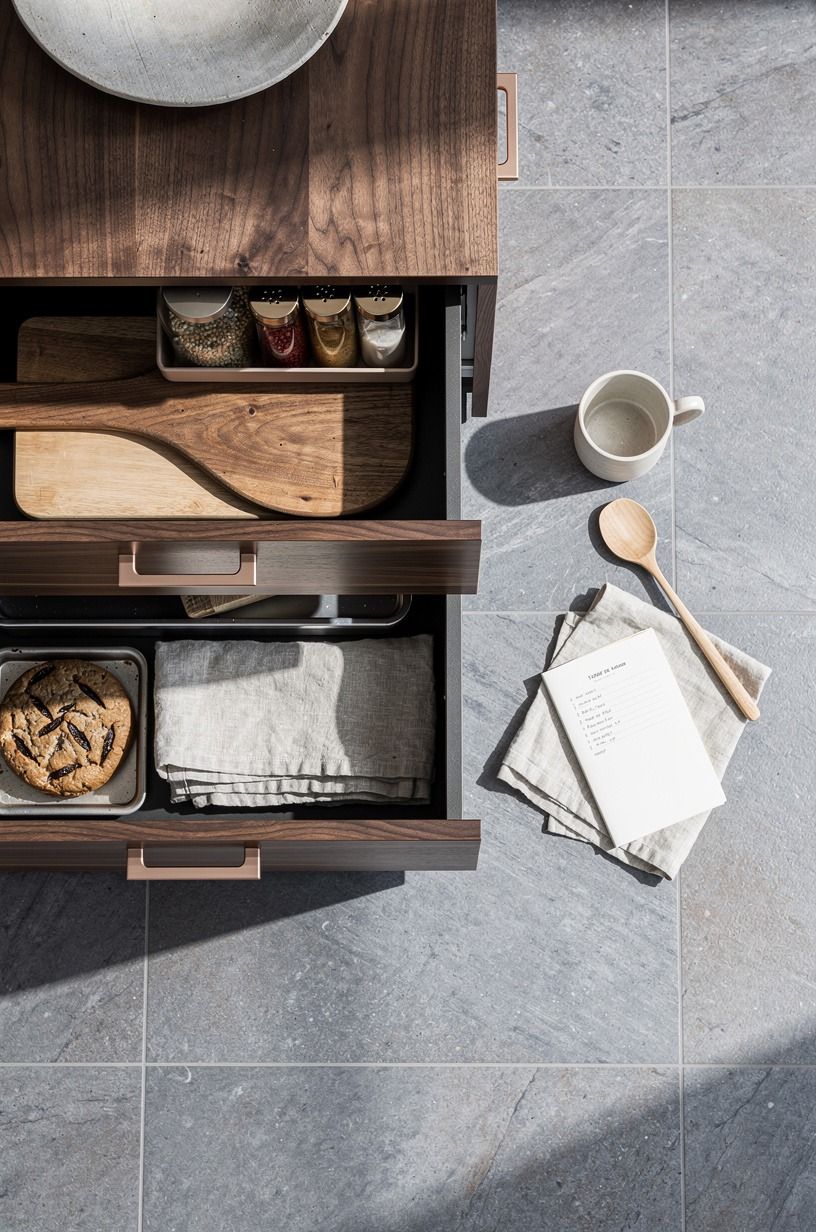
Slide toe-kick drawers under lower cabinets and you reclaim the strip most kitchens waste without a second thought. In a compact plan, that low band is prime real estate for flat items you don't need every day.
Baking sheets. Placemats.
Dog bowls. The overhead view in the photo makes it obvious how clean this looks once the drawer face closes back into the plinth.
I like this best under walnut bases with rose-gold hardware because the line between drawer and cabinet stays almost invisible against darker wood. If your kitchen runs small, pair this idea with small kitchen cabinet ideas that maximize storage so the hidden inches below and the usable inches above are solving the same problem.
But be picky about what goes here. Anything tall, fragile, or greasy turns the lowest drawer into a nuisance fast.
Keep it flat, wipeable, and boring. A good kit runs $120 to $300 with slides and a routed face, which makes it one of the better values per square inch in any kitchen.
That's why it lasts.
![Toe-kick drawer under cabinet with walnut plinth detail]
4Can you mount a fold-down desk without it feeling like an office?
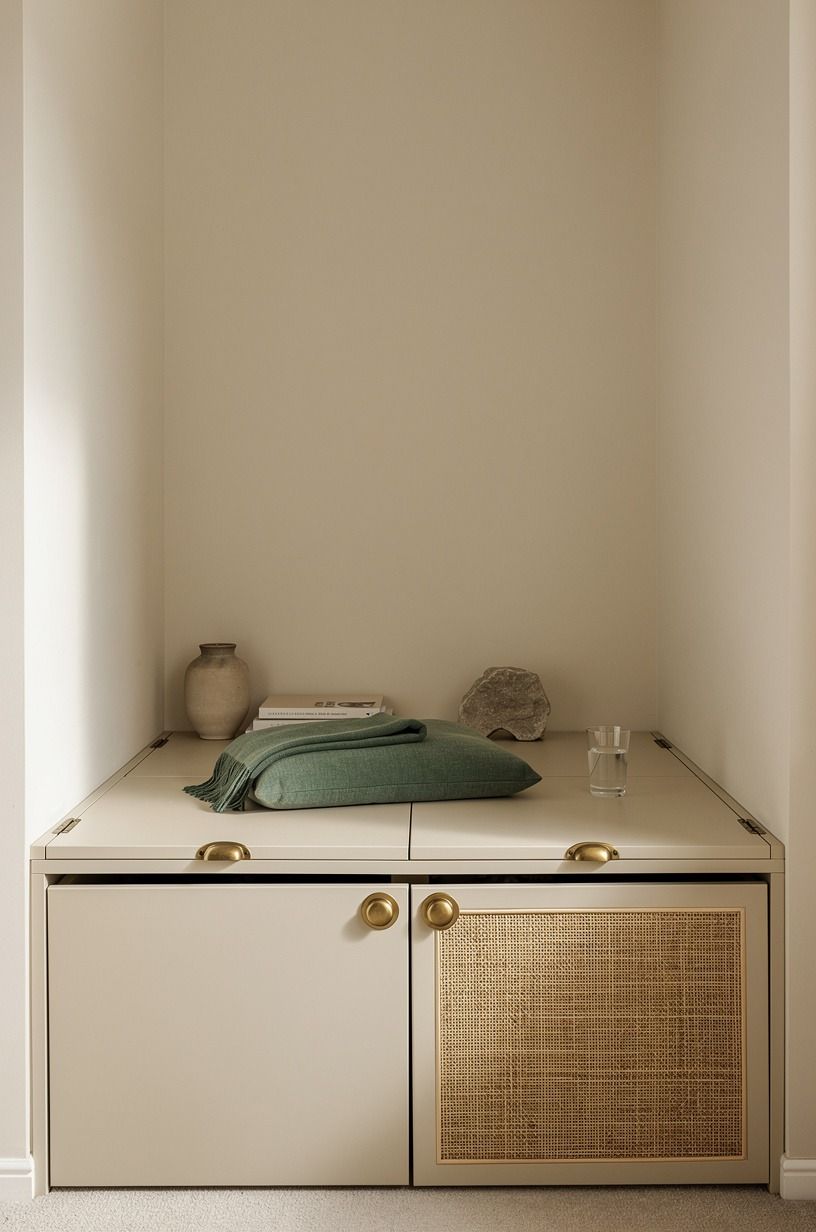
Mount the fold-down desk where you need work surface for two hours, not where you want to stare at work all night. Yes, even in a bedroom corner, as long as the panel closes flush against the wall. Once the panel lifts, you get a desk face, storage pockets, and a wall that goes quiet again when you're done.
For the look in the image, lean into walnut veneer against navy and white so the panel feels like furniture, not office equipment.
Inside the cabinet, keep the upper slots for chargers, a notebook, and one small task lamp. The lower section can hold paper trays, but I'd skip deep file boxes because they make the fold-down front heavier than you want. If you're trying to carve function out of a tight bedroom corner, this small-space bedroom roundup shows how much calmer a room feels when the work zone closes up at night.
I made the mistake of installing one too high once. You want the desk usable from a normal chair, not perched like a bar ledge.
Your shoulders will tell you right away if you got that wrong. Worth the splurge on soft-close hinges if you ask me, around $40 extra and the panel stops waking up the room every time you close it.
![Fold-down walnut desk mounted on navy wall in small room]
5Why bother hiding storage under a raised platform?
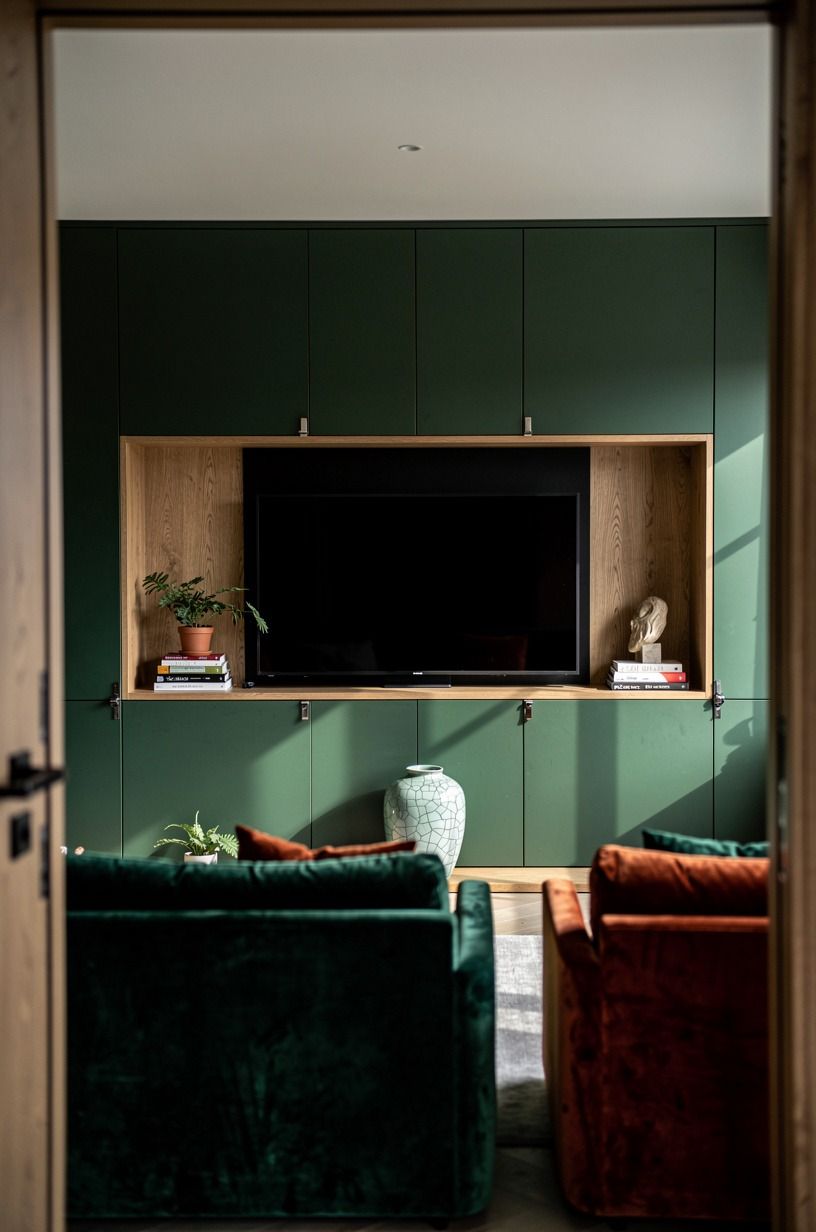
Hide floor storage beneath a raised platform when the room has one zone that already wants a stage.
6Wrap the TV wall in push-latch panels
Wrap the TV wall in push-latch panels so the screen stops being surrounded by little visual apologies. Cords, remotes, game controllers, routers, and speaker clutter all get absorbed into one plane, and your living area reads as architecture again. The layered doorway view in the photo is the giveaway: from a distance, you shouldn't immediately know where the storage starts.
This is one place where I'd spend for good hardware. Cheap push latches go sloppy fast, and a wall full of misaligned reveals will bother you every evening.
Use paint like Farrow & Ball Hague Blue No. 30 or Sherwin-Williams Evergreen Fog SW 9130 if you want the panels to feel integrated rather than tacked on. Then check your sofa placement against the usual TV guideline of about 1.5 to 2.5 times the screen diagonal, because hidden storage won't save a layout that still watches from too close.
For more ideas on making every wall earn its keep, this maximize-every-inch guide is oddly useful even outside the kitchen. Same principle. Dead surfaces are never really dead.
![TV wall wrapped in deep blue push-latch panels]
7Tuck rolling bins under a daybed
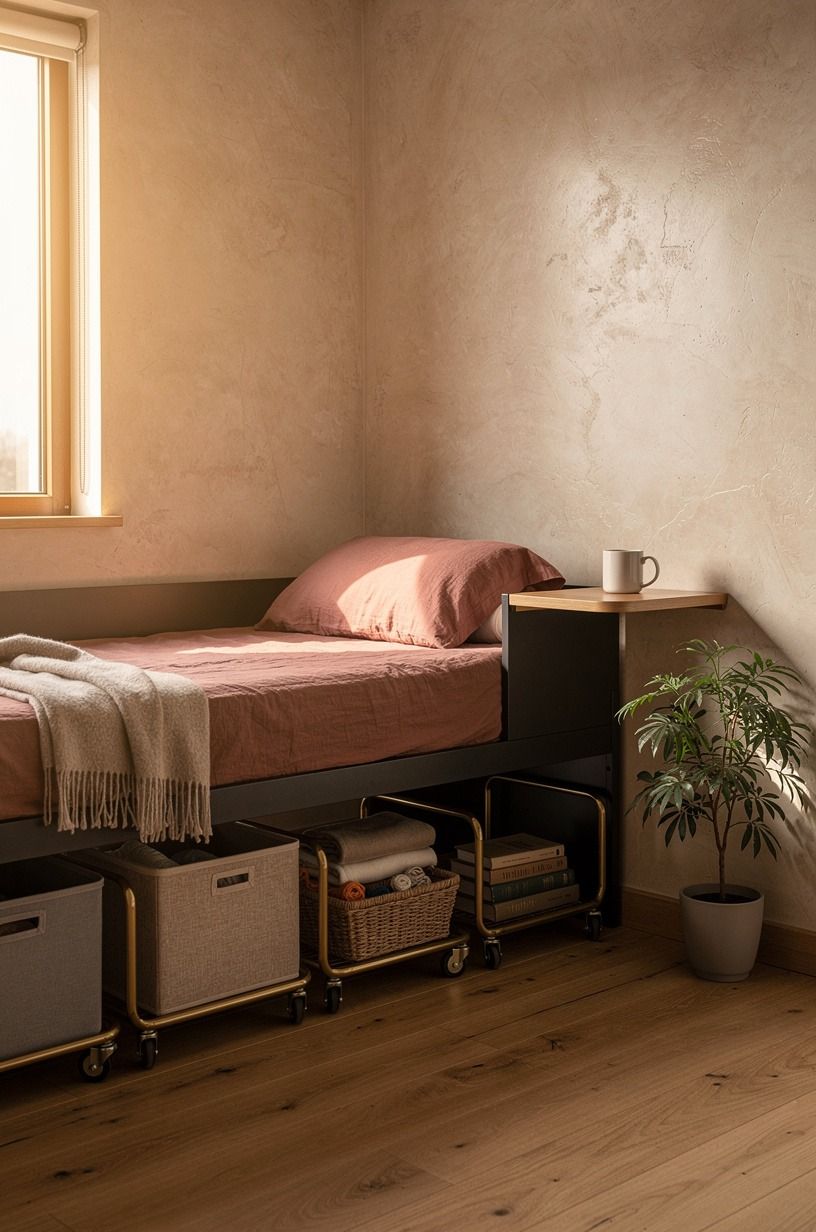
Tuck rolling bins under a daybed when one room has to be guest room, office, and lounge all in the same week. A fixed skirt would hide the mess, sure, but it also slows you down. I prefer bins you can roll out in one move, especially in a warm multi-use room with layered textiles and a wide corner-to-corner view like the one in the photo.
Go for bins that match the bed frame tone or disappear into shadow, then fill them by function instead of by person. Craft tools in one.
Extra bedding in another. Tech overflow in a third.
If you're planning around sleep and storage together, these moody small-space bedrooms are a good reminder that under-bed storage works better when the rest of the room stays visually soft. CB2 Primitivo bouclé baskets are worth a look if you want the bins to blend with the bed tone.
But don't stuff the cavity wall to wall. Leave breathing room at the edges so the bed still reads light. That negative space matters more than people think.
A tidy three-bin set runs $60 to $140 and saves you a real closet, which makes the value hard to argue with.
![Daybed with rolling storage bins tucked underneath]
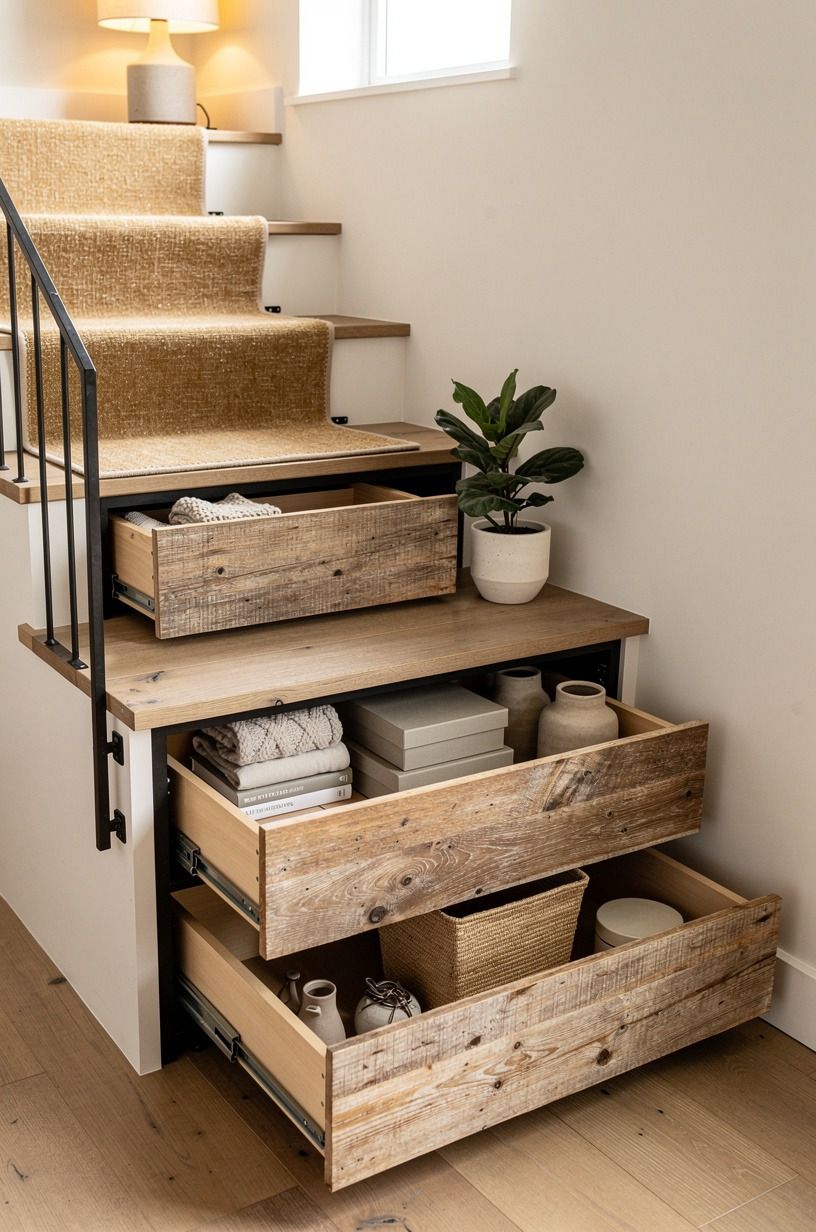
8Install stair drawers for tucked-away overflow
Install stair drawers when you need real capacity, not just a prettier basket. The relaxed three-quarter view in the image shows why they work so well: each riser or tread edge becomes a usable pocket, but the stair still reads as one piece of joinery.
You keep the circulation path. You gain a lot of invisible square inches.
I like this in white oak with slim aged-bronze pulls, or with push-cut finger grooves if you want the fronts extra quiet. Put heavier things in the lowest drawers so you aren't hauling weight at shoulder level. Off-season scarves, candles, guest linens, wrapping tools.
If your house already leans built-in, this breakfast nook storage article can help you repeat the same language elsewhere so the joinery doesn't feel random.
Would I DIY this on my first try? Probably not.
Drawer alignment on stairs is unforgiving, and the room notices every bad reveal. That said, a full set of three stair drawers starts near $1,200 in custom millwork and climbs with material cost, which is fair value for the square inches you reclaim.
![White oak staircase with hidden drawer fronts in treads]
9Choose nesting tables with concealed compartments
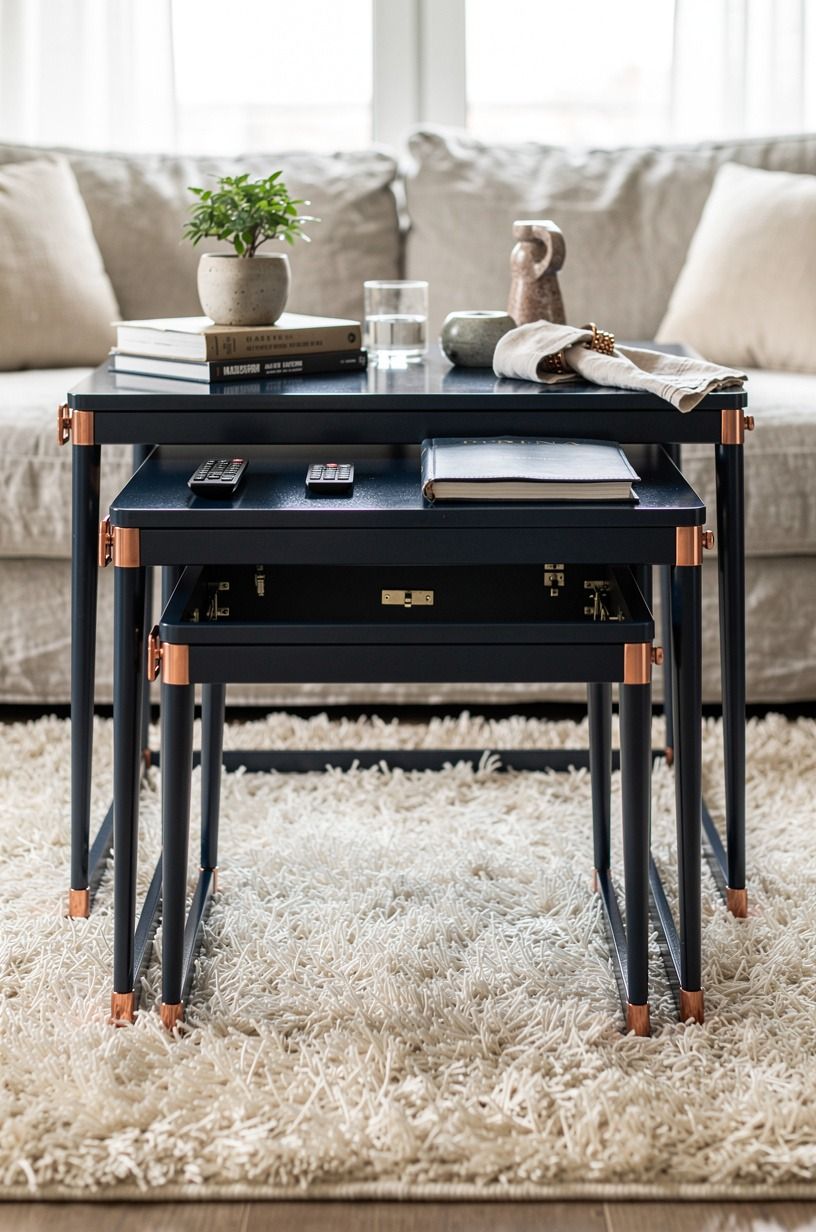
Choose nesting tables with concealed compartments when you want storage in the center of the room without the room looking storage-driven. From that low floor-level perspective, the tables feel sculptural first.
That's the win. I'd rather have one good cluster hiding remotes, chargers, and coasters than a coffee table with open shelves broadcasting every stray object.
Look for a warm wood top, a hollow interior, and proportions that still leave you walking room around the seating area. Coffee tables usually land best at 16 to 18 inches tall and around two-thirds the sofa length, and the same logic helps nesting tables feel anchored instead of floaty. Article Sven tan leather tops are a fair reference for the look.
If your seating zone is tiny, this small-space maximize-every-inch article is worth skimming for layout discipline alone.
The concealed compartment should hold the ugly little things your room uses daily. Power banks.
The remote pile. Reading glasses.
The items that multiply when nobody gives them a home. A quality nesting set with hidden bins lands around $450 to $900, which feels fair for the daily rhythm it gives back.
![Warm wood nesting tables with concealed storage compartments]
10How do you hide pantry storage behind cabinet fronts?
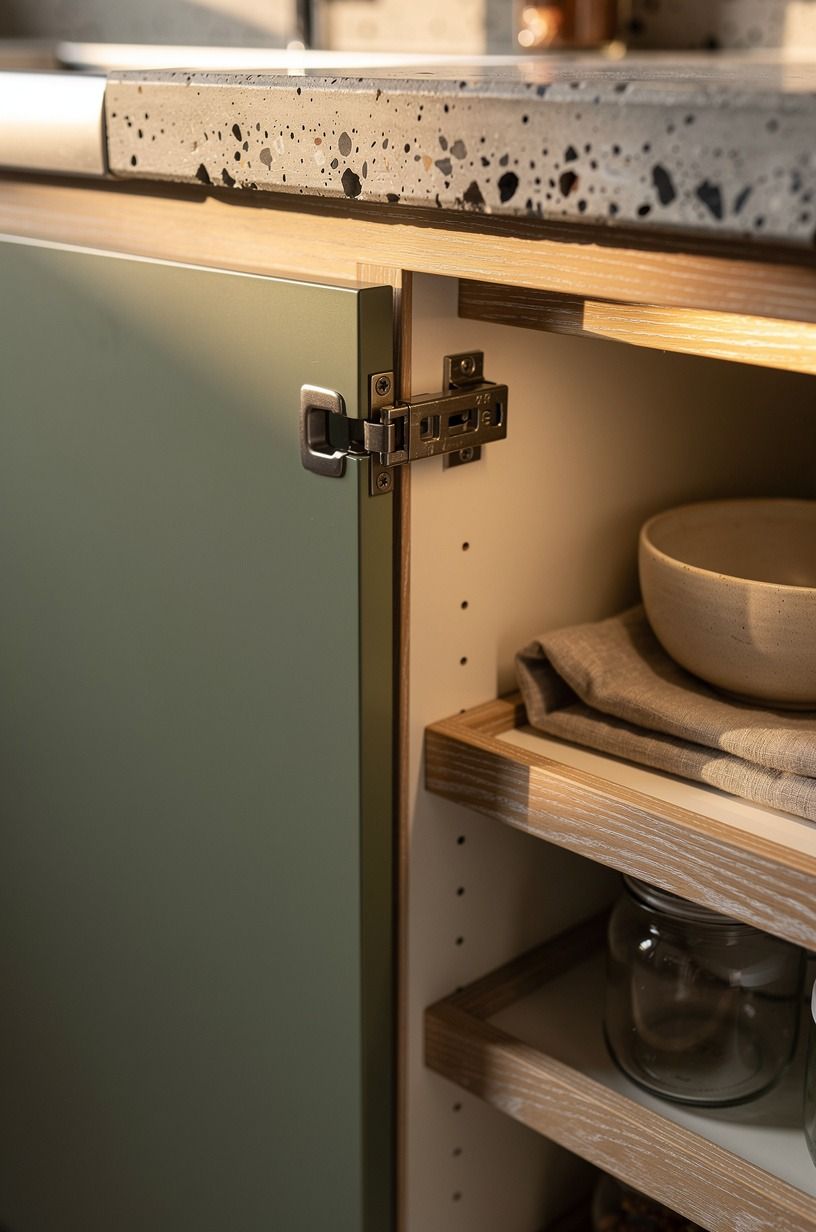
Camouflage pantry storage behind cabinet fronts when the kitchen is open to everything else and you can't afford one messy zone.
11Use mirror doors to conceal narrow shelving
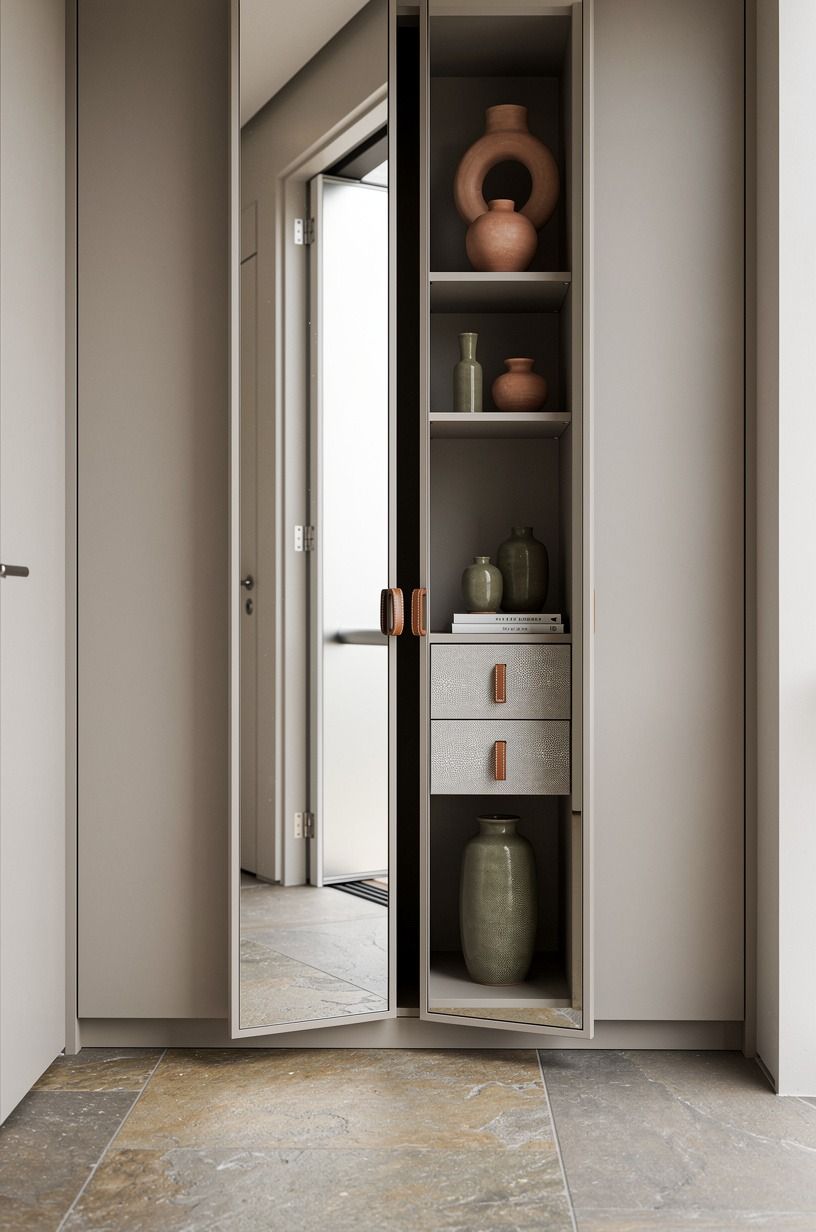
Use mirror doors to conceal narrow shelving when the entry is too slim for bulky cabinetry but too hardworking to stay empty. A mirror gives you reflection, borrowed light, and a door face all at once, which is why this move punches above its weight in a tight hall. From the low ground-level angle in the image, you can feel how much cleaner the floor plane stays when the storage rises vertically.
Behind the doors, keep the shelves shallow enough for shoe spray, dog leads, gloves, and the paper clutter that always sneaks into the entrance. I like a frame painted in Sherwin-Williams Evergreen Fog SW 9130 or a soft neutral near Benjamin Moore Revere Pewter HC-172 so the mirror doesn't feel too sharp against the wall. For more renter-minded ideas that hide real life without drilling everywhere, these apartment breakfast nook ideas are more relevant than the title suggests.
The mistake is going too deep. Your body feels a protruding entry cabinet every single day, even when your eye stops seeing it. A slim mirrored unit runs $200 to $500 and is the rare small-space storage that pays you back in light, not just clutter control.
![Mirror-front cabinet concealing narrow entry shelving]
12Add a storage ottoman that anchors the room
Add a storage ottoman that anchors the room when you need one piece to do three jobs at once. Footrest. Coffee-table substitute.
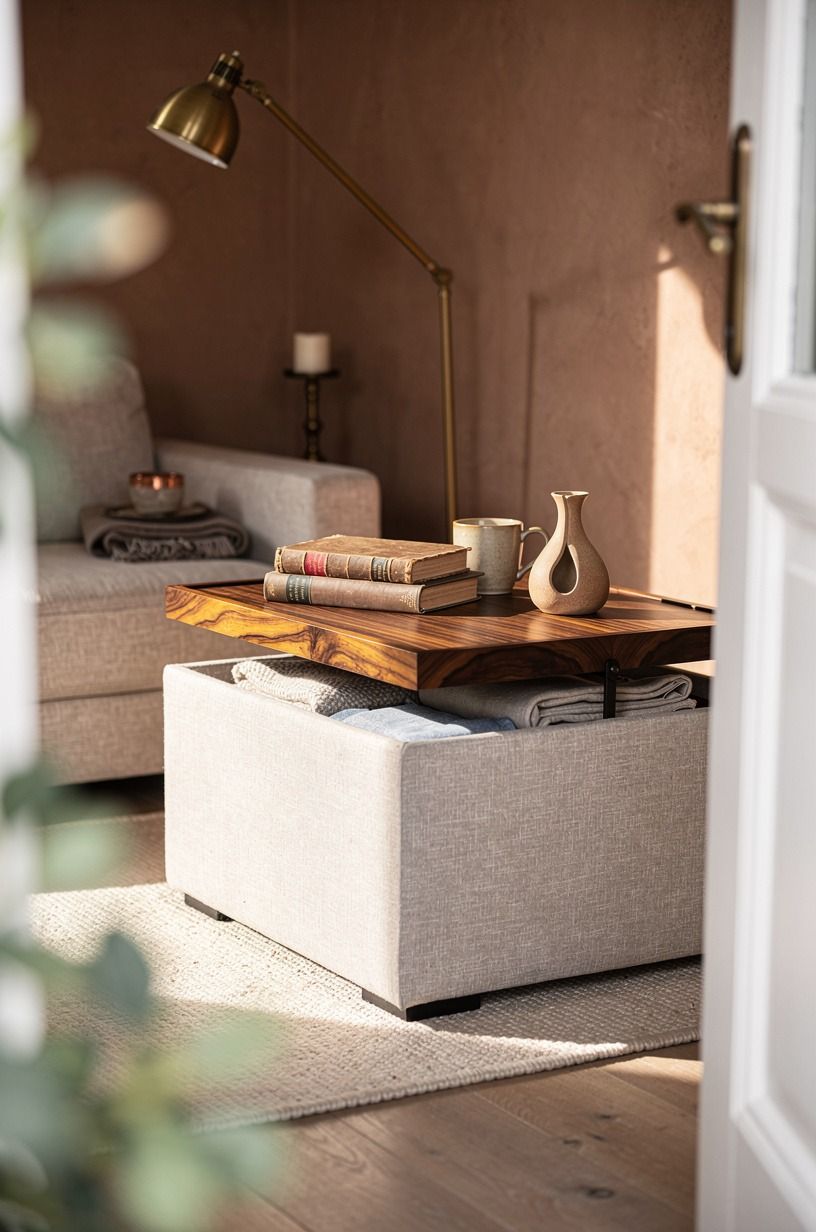
Blanket vault. Framed through foliage and an open doorway, the ottoman in the photo feels like part of the room's architecture, and that's why this idea keeps winning in small spaces.
I'd pick a piece in performance linen or a tight bouclé so it can take feet, trays, and daily use without looking tired by month three. IKEA STOCKSUND in grey-beige is the affordable reference, while West Elm Brooks ottoman shows the direction if your budget allows a real splurge. If your sofa is standard depth, around 35 to 40 inches, an ottoman scaled a little lower and visually lighter will keep the center from feeling blocked.
Layer it with a tray, one candle, and a folded throw, then borrow balance ideas from these small rooms that still feel like a refuge.
I love this one for renters because you get hidden storage with zero carpentry. A solid ottoman runs $150 to $450, which is excellent value for the daily function it adds. Less than a weekend, and the room works harder already!
![Bouclé storage ottoman anchoring small living room seating]
What does hidden storage in a small space usually cost?
The short answer: the price swings less by room than by how custom you go. Buy-in pieces like storage ottomans and rolling bins stay in the lower lane, while millwork, stair drawers, and panel-wrapped TV walls climb because labor is the real bill. For most readers, the moveable pieces will return about 80% of the calm at about 20% of the cost of custom millwork.
If you're deciding where your money should land, I'd spend first on the built-ins you can't fake later and save on the movable pieces you can upgrade over time. That means the stair drawer hardware, the fold-down desk support, or the TV wall latch system matter more than whether your ottoman is designer or not. Get the bones right first, and the room compounds its value for years.
You can style around them for years!
The Disappearing-Furniture Rule
Here's the rule I keep coming back to: in a small room, the best storage is the storage that lets the furniture keep pretending it's just furniture. Once a bench starts looking like a chest, or a doorway starts reading like shelving, you lose the calm that made the idea smart in the first place. I learned that the annoying way, by overbuilding a tiny entry cabinet years ago and feeling it with my hip every single morning.
What changed my mind wasn't some big renovation. It was seeing how hard a room can work when the storage hides inside a shape you already need.
A bench under a window still earns the seat. A daybed still gives you somewhere to land with a book.
A mirrored door still throws light back into the hall. The room doesn't feel more efficient in a sterile way.
It feels easier.
That's why I'm usually against open storage in a truly small space unless you're disciplined to the point of sainthood. Open shelves ask you to style and maintain them every day, and most of us aren't doing that before coffee.
Closed storage with good access is kinder. Lift-top benches.
Rolling under-bed bins. Push-latch TV panels.
Mirror-front cabinets. You open them, use them, close them, move on.
And this part matters more than people admit: hidden storage changes how you behave in the room. When the home for the blanket, laptop, spare tray, or game controller is one motion away, you reset the space faster.
That means the room returns to itself faster too. The honest cost of a calm room isn't the millwork, it's the speed of reset, and that rhythm is everything.
Not bigger. Just better.
What People Always Want to Know
What is the best hidden storage idea for a really small room?
The best pick is usually the one that replaces a piece you'd buy anyway. A lift-top bench or a storage ottoman gives you daily function without adding another footprint, and IKEA STOCKSUND ottomans or a simple IKEA HEMNES window bench make that payoff easy to feel at any budget.
Where can I buy hidden storage pieces on a budget?
Start with IKEA, Target Threshold, and Wayfair for the basics, then check Facebook Marketplace for the heavier pieces. You're looking for clean lines and decent hinges, not a fancy label. These renter-friendly small-space ideas can help you sort what is worth buying new.
How much does a hidden storage makeover cost?
A small-space hidden storage refresh usually lands anywhere from about $100 to $300 for movable pieces and paint, then rises fast when custom carpentry enters the room. Most readers see real value between $500 and $2,500, which covers moveable pieces plus one built-in project.
Free moves count too. Editing what stays out, regrouping categories, and reclaiming dead space under furniture still matter.
Can I create hidden storage on a tight budget?
Yes, and I'd start with the low-drama moves first. Rolling bins, lidded baskets, and a bench that lifts will get you farther than buying six decorative boxes you don't enjoy opening. The smartest budget move I know is the under-bed rolling bin, under $40 each and lifeworth.
Small kitchen storage ideas carry the same discipline.
Is hidden storage worth it in a small space?
Yes, more than in a big one, because every visible object steals proportion from the room. Hidden storage gives you clear surfaces and faster resets, which makes the room feel calmer right away. If you only do one layout move, keep the walking path open and let storage hug the perimeter.
The value compounds the more you reset the room daily.
Is hidden storage a good idea for a rental?
Yes, if you lean on no-damage versions. Think storage ottomans, under-bed bins, mirror-front cabinets, and removable organizers inside existing cupboards.
Every move here keeps your deposit intact and still adds real value to daily life. If you need more small-footprint inspiration before you buy, this small-space refuge roundup is worth a look.
Start With the Doorway Frame
If I had to pick one, I'd start with the doorway cubbies. They borrow inches your room already owns, and they don't ask you to give up floor space to get them. For under $100 in materials, you get one of the few hidden storage upgrades that actually feels worth it the moment you walk through the door.
Pin that idea for later, then compare it with this breakfast nook storage approach before you build.