
 by
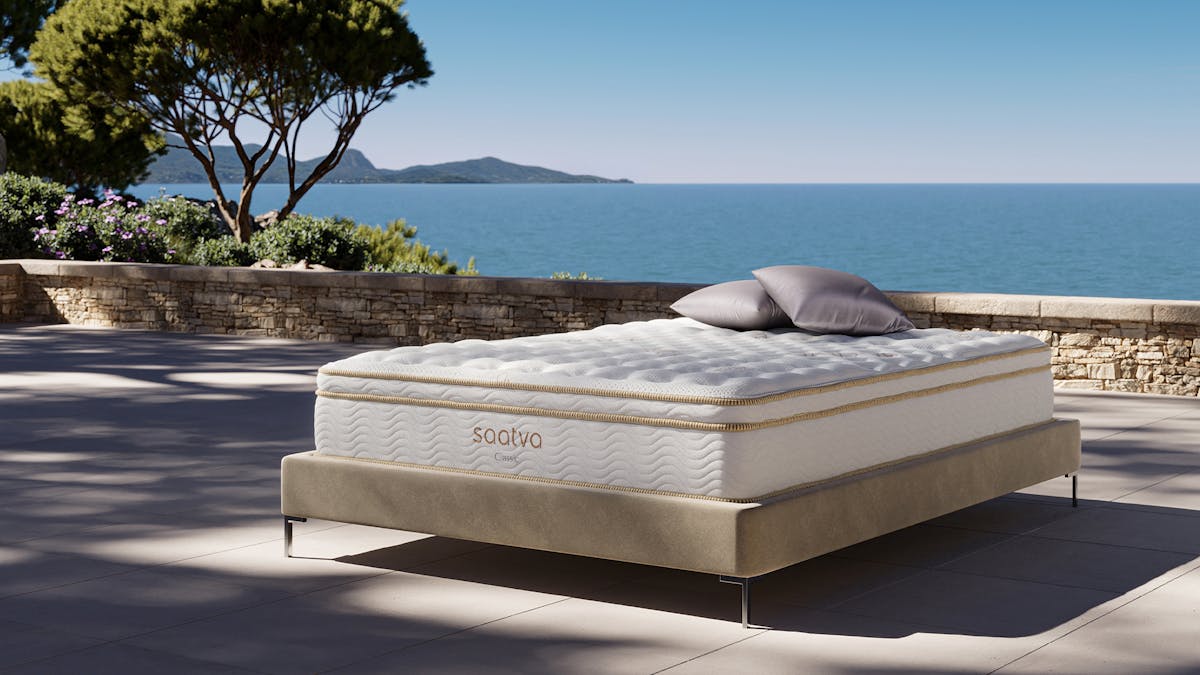
by The best mattress for latex sleepers is the Saatva Latex Hybrid: 3 inches of zoned natural Talalay latex over pocketed coils, GOTS-certified organic wool and cotton, white-glove delivery, and a lifetime warranty. For a fully certified all-latex mattress with GOLS, GOTS, and GREENGUARD Gold, the PlushBeds Botanical Bliss is the benchmark. Both outperform memory foam on durability, temperature regulation, and eco credentials.
Saatva Latex Hybrid
9.2/10
- 3" zoned natural Talalay latex over pocketed coils, the responsive latex feel with coil support structure
- GOTS-certified organic wool and organic cotton cover, real material credentials
- Excellent temperature regulation (8.5/10 Sleep Foundation): open-cell latex plus coil airflow
- Free white-glove delivery: in-room setup and old mattress removal included, no assembly hassle
- Strong edge support from reinforced perimeter coils, 365-night trial and lifetime warranty
- Below-average motion isolation (6/10): bouncy latex and coils transfer more movement than foam
- Only one firmness option (Medium Firm), not ideal if you prefer soft or extra-firm
- $99 return fee if returned during trial
For sleepers who want a true latex feel with the spinal support of pocketed coils, the Saatva Latex Hybrid is the most complete option in the category. White-glove delivery, GOTS-certified materials, and a lifetime warranty put it above most latex hybrids at this price point.
PlushBeds Botanical Bliss
9.0/10
- GOLS-certified organic latex, GOTS organic wool and cotton, GREENGUARD Gold: four certifications stacked
- Excellent cooling (9.0/10 NapLab): max surface temp 89.9°F, matching a coil hybrid
- Very low motion transfer (9.8/10): 37% below the all-latex average, unusual for this material
- Lifetime warranty and 365-night trial, the strongest ownership terms in the all-latex segment
- Weak edge support (7.4/10), not ideal for edge sleepers or those who need perimeter firmness
- Strong rubber odor for the first 10 days after unboxing
- Premium price: 77% above the all-latex average
If you want a genuinely certified organic latex mattress, not just "natural" marketing language, the Botanical Bliss is the benchmark. Four independent certifications, an all-Dunlop build, and the most generous trial-and-warranty combo in the segment.
Amerisleep AS3
8.6/10
- Partially plant-based Bio-Pur foam runs cooler than standard memory foam
- HIVE 5-zone support firms under the lumbar specifically
- CertiPUR-US certified, made in the USA
- Significantly more affordable entry point than full latex or a latex hybrid
- Not latex: no GOLS certification, shorter lifespan than natural rubber
- Softer edges than a coil hybrid; 230 lb+ sleepers may prefer the AS5 Hybrid
If a certified latex mattress is outside your budget, the AS3 is the closest foam match: plant-based foam, zoned support, and CertiPUR-US certification at roughly half the price. Not a substitute for latex durability, but the strongest foam pick at this price point.
Latex mattress benefits: what the data shows
Latex outperforms memory foam and polyfoam on four measurable dimensions. The claims below are drawn from independent lab testing and material science, not manufacturer copy.
| Benefit | Saatva Latex Hybrid | PlushBeds Botanical Bliss | Memory foam comparison |
|---|---|---|---|
| Durability | Lifetime warranty, Talalay latex + coil core | 15-20 years all-Dunlop, lifetime warranty | 6-10 years before sagging |
| Temperature | Excellent (8.5/10): coil airflow + open-cell latex | Excellent (9.0/10 NapLab, 89.9°F surface) | Heat-trapping closed-cell; runs 2-5°F warmer |
| Responsiveness | Sub-0.2-second latex response, coil bounce | Sub-0.2-second response, all-latex feel | 5-10 second response; repositioning can feel effortful |
| Certifications | GOTS organic wool and cotton | GOLS, GOTS, GREENGUARD Gold | CertiPUR-US (foam only, no organic standard) |
Natural vs synthetic vs blended latex
Not every mattress labeled "latex" uses the same material. The distinction matters for both durability and health claims.
Natural latex
Harvested from the sap of Hevea brasiliensis rubber trees without cutting the tree, a tapping process that makes natural latex one of the few mattress materials with a genuinely renewable supply chain. Natural latex mattresses are inherently resistant to mold and dust mites, and the material carries no petroleum-derived chemical load. The longevity advantage over foam is real: natural rubber retains its elastic structure for 15-20 years versus 6-10 for polyurethane foam. Both the Saatva Latex Hybrid (natural Talalay) and PlushBeds Botanical Bliss (natural Dunlop) use natural latex at their core.
Synthetic latex (SBR)
Styrene-butadiene rubber mimics the feel of natural latex but is derived from petrochemicals. It has a shorter lifespan, typically 6-8 years, and lacks the hypoallergenic and biodegradable properties of natural rubber. If the mattress label says "latex" without specifying natural or a certification, it is likely synthetic or blended.
Blended latex
A mix, typically 30% natural and 70% synthetic, that lands between the two on price and durability. Blended latex outperforms pure SBR but falls short of the lifespan and certification credentials of natural latex. If you want GOLS certification, you need a mattress using predominantly natural latex from certified sources.
Dunlop vs Talalay: which process matters
Two manufacturing methods produce natural latex foam, and they produce meaningfully different results.
- Dunlop process: latex sap is poured directly into molds and baked. The result is a denser, heavier foam with slightly more variance in consistency (sediment settles toward the bottom). Dunlop is the preferred construction for GOLS-certified organic builds because no synthetic fillers are added. PlushBeds Botanical Bliss uses Dunlop latex throughout.
- Talalay process: liquid latex is vacuum-sealed and flash-frozen before baking, producing a more consistent, airier foam. Talalay is lighter and more breathable than Dunlop at the same firmness level. The tradeoff is that some Talalay formulations include polyurethane fillers, making full GOLS certification harder to achieve. The Saatva Latex Hybrid uses natural Talalay certified under GOTS.
For a comfort layer, Talalay's consistency and breathability is an advantage. For a support core, Dunlop's density holds up better over time.
Latex certifications: what they actually verify
The word "natural" on a mattress label is unregulated. Third-party certifications are the only verifiable standard.
- GOLS (Global Organic Latex Standard): certifies the latex content is at least 95% certified organic raw material, sourced from sustainably managed rubber tree plantations. The only independent organic certification specifically for latex.
- GOTS (Global Organic Textile Standard): certifies organic cotton and wool in the cover and comfort layers. Requires no harmful dyes or processing chemicals at any stage. Both the Saatva Latex Hybrid and PlushBeds Botanical Bliss carry GOTS certification.
- GREENGUARD Gold: certifies low chemical emissions (VOCs), important for indoor air quality. A GREENGUARD Gold mattress has been tested for over 10,000 chemicals.
- OEKO-TEX Standard 100: certifies the finished product contains no harmful substances above regulatory limits. Covers the full mattress, not just the latex component.
The PlushBeds Botanical Bliss carries GOLS, GOTS, and GREENGUARD Gold simultaneously, the most comprehensive certification stack among all-latex mattresses. The Saatva Latex Hybrid holds GOTS for its organic cover materials. For a wider look at certified mattresses, see our best organic mattresses guide.
Who benefits most from a latex mattress
Latex is not the right choice for every sleeper. The material is most valuable when specific needs align with what latex actually delivers.
- Hot sleepers: the open-cell structure of natural latex, combined with perforated construction and coil airflow in a hybrid, produces consistent temperature regulation that foam cannot match without active cooling technology. The Saatva Latex Hybrid rated 8.5/10 for temperature, and PlushBeds measured 89.9°F surface temperature (NapLab).
- Allergy sufferers: natural latex is inherently resistant to dust mites, mold, and mildew without chemical treatments. If you react to the chemical treatments that make foam mattresses hypoallergenic, natural latex avoids the problem entirely.
- Long-term buyers: a quality latex mattress lasts 15-20 years. Over a 20-year period, a $2,649 latex mattress that holds up costs less per year than two consecutive foam mattresses at $1,200 each.
- Eco-conscious sleepers: natural latex is biodegradable and renewable. Combined with organic cotton and wool, a GOTS or GOLS-certified mattress has a lower environmental load than any foam alternative.
- Sleepers who dislike foam sink: latex has a sub-0.2-second response time versus 5-10 seconds for memory foam. If foam mattresses make repositioning feel effortful, latex eliminates that friction entirely.
When latex is not the best fit
- Tight budget: quality natural latex starts at roughly $1,500 queen for a hybrid. If the budget ceiling is under $1,000, a CertiPUR-US foam with zoned support is the more practical choice. The Amerisleep AS3 covers that gap well.
- Deep pressure relief: latex does not contour as deeply as memory foam. Side sleepers with significant shoulder or hip pressure needs may find a soft memory foam layer more effective.
- Latex allergy: affects approximately 1% of the population. If you have a confirmed latex sensitivity, synthetic or foam mattresses are the appropriate alternative.
For a latex hybrid with white-glove delivery and lifetime warranty, the Saatva Latex Hybrid is our top pick. For the most comprehensive certified organic credentials (GOLS, GOTS, GREENGUARD Gold), the PlushBeds Botanical Bliss sets the standard. Budget shoppers who want the cleaner foam alternative should look at the Amerisleep AS3.
Frequently asked questions
Is a latex mattress better than memory foam?
For durability and temperature regulation, yes. Natural latex lasts 15-20 years versus 6-10 for memory foam, and sleeps several degrees cooler on average. For deep body-contouring pressure relief, memory foam has an edge, it hugs the body more completely than latex. The right answer depends on whether durability and cooling or deep pressure relief is the priority.
What is GOLS certification for latex?
GOLS (Global Organic Latex Standard) certifies that at least 95% of the latex content is from certified organic raw material sources. It is the only independent third-party organic certification specifically for latex foam and the most reliable way to verify that a mattress contains genuinely natural, sustainably sourced latex.
How long does a latex mattress last?
A well-built natural latex mattress lasts 15-20 years. The elastic cell structure of natural rubber resists the permanent compression (sagging) that shortens foam mattress lifespans. Synthetic and blended latex mattresses last 6-10 years, closer to foam than to natural latex. The Saatva Latex Hybrid and PlushBeds Botanical Bliss both carry lifetime warranties.
Is latex mattress good for back pain?
Latex mattresses provide firm, responsive support that maintains spinal alignment well, particularly in medium-firm options. The responsiveness means the mattress adjusts to position changes without the lag of memory foam. For back pain specifically, see our best mattresses for back pain guide, which covers foam and hybrid options alongside latex.
This guide is part of our Mattress Buying Guide hub, compare all the top picks and narrow down your choice there.