
 by
by Our first mattress recommendation for parents is the Amerisleep AS3, a medium-feel foam option with Bio-Pur memory foam and HIVE support. Choose it for the adults' sleeping positions and comfort needs, and check how easily each person can turn or get out of bed. An adult mattress is not a substitute for a baby's separate safe sleep surface.
Amerisleep AS3
9.3/10
- 10/10 motion isolation (NapLab), partner getting up at 2 a.m. won't wake you
- Bio-Pur open-cell foam runs cooler than traditional memory foam, reducing heat-related arousals
- HIVE 5-zone support keeps the spine aligned even on short, fragmented sleep cycles
- 20-year warranty, twice the industry standard, covering years of parenting
- CertiPUR-US certified, made in the USA
- Average edge support on the all-foam version, hybrid adds reinforced perimeter coils
- 30-night mandatory break-in before returns are accepted
If motion isolation is the single most important factor, one partner gets up two or three times a night and the other cannot afford to lose any more sleep, the AS3's all-foam construction is the most proven answer. Its NapLab score of 2.11 m/s² compares to an 8.80 m/s² category average, a 76% reduction in transferred movement.
Why parents need a different mattress
Sleep deprivation research is unambiguous: parents of newborns lose an average of 750 hours of sleep in the first year. Cognitive function, immune response, and emotional regulation all degrade under sustained interruption. And unlike single-episode deprivation, parental sleep disruption compounds over years, not days.
A mattress cannot fix the biology. But a mattress that eliminates preventable micro-arousals, partner motion, pressure discomfort, heat, can realistically add 5 to 15 minutes of sleep per interruption event. Over years, that margin matters.
Four properties drive every pick on this page.
What parents should prioritize
Edge support
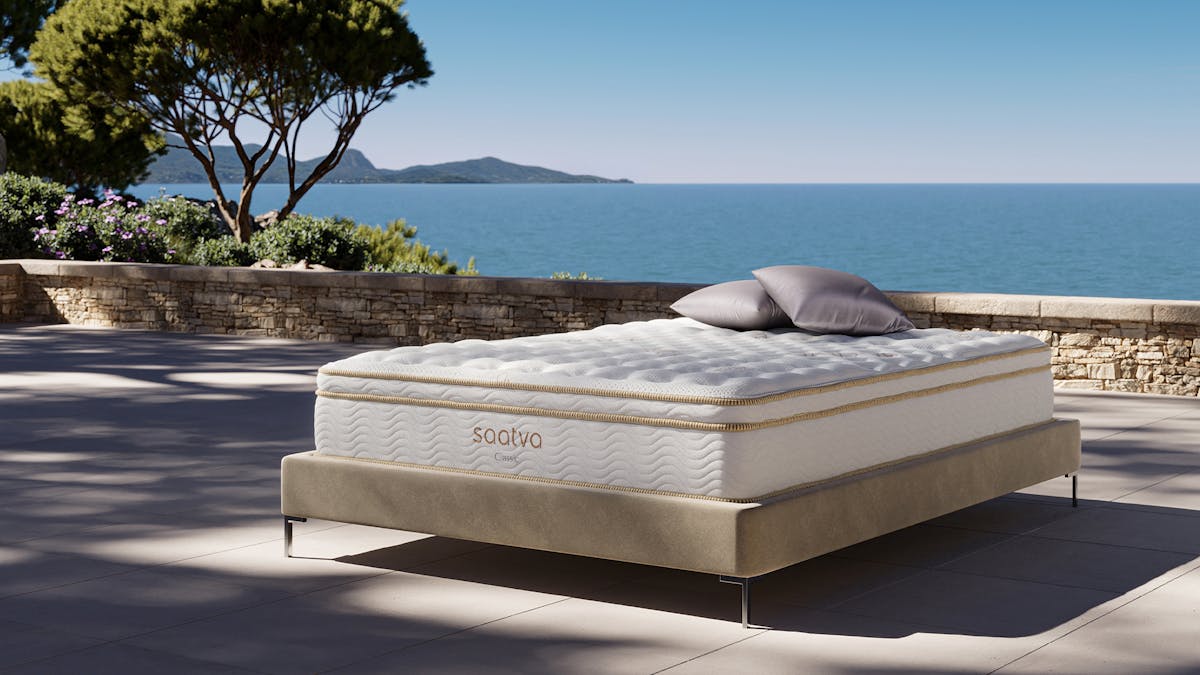
Strong edge support lets you sit up and leave quickly without a deep sink you have to push out of while half-asleep. It also means the returning parent can slide back in at the edge without disturbing the center of the bed. The Saatva Classic's reinforced perimeter coils and lumbar foam edge score 10/10 on NapLab's sitting compression test, the top result in our database for parents.
Motion isolation
When one parent leaves the bed to attend to a child, the other should not be woken by the movement. Individually wrapped foam layers or pocketed coils absorb motion. Traditional interconnected innerspring coils broadcast it across the whole surface. For couples where absolute silence matters most, an all-foam option like the AS3 leads this category.
Fast sleep onset after interruption
Every factor that adds friction to falling back asleep, pressure points, heat retention, body impression, costs time from the next sleep cycle. A mattress that contours without trapping heat minimizes time-to-sleep after a 3 a.m. interruption.
Long-term durability
Parents often buy during the most financially demanding period of life. A mattress that holds its support properties for 8 to 10 years is a better investment than a cheaper one that sags in 3 to 4, creating lumbar discomfort that adds to an already disrupted sleep load. Both top picks below carry warranties well above the industry standard.
Comparison: top picks for parents
| Mattress | Type | Firmness | Edge support | Trial | Queen price |
|---|---|---|---|---|---|
| Amerisleep AS3 | All-foam Bio-Pur | Medium 5/10 | Average, foam perimeter | 100 nights | From $1,049 |
| Saatva Classic | Dual-coil innerspring | Lux Firm 6/10 | Outstanding, 10/10 NapLab | 365 nights | ~$1,395 |
| Puffy Lux | All-foam in-a-box | Medium 5-6/10 | Good, reinforced edges | 101 nights | ~$1,799 |
| PlushBeds Botanical Bliss | Natural latex hybrid | Medium or Medium-Firm | Good, latex responsive | 100 nights | From $1,999 |
Saatva Classic
9/10
- 10/10 edge support (NapLab), sit up and exit the bed cleanly without waking your partner
- Free white-glove delivery: setup, old-mattress removal, zero lifting for exhausted parents
- Breathable dual-coil construction runs cooler than all-foam, reducing heat-related arousals
- Three firmness options (Plush Soft, Luxury Firm, Firm) accommodate both partners
- 365-night trial and lifetime warranty, the lowest-risk purchase in this price range
- Motion isolation is moderate, foam alternatives absorb partner movement more completely
- $99 return fee applies during the trial period
- Heavy (~110 lb queen), white-glove delivery handles setup, but self-rotating is difficult
For parents managing years of interrupted sleep, the Saatva Classic delivers on the metrics that matter most: a surface you can leave and re-enter without waking anyone, outstanding long-term durability, and a service experience (white-glove delivery, lifetime warranty) that removes friction at exactly the wrong time of life to deal with logistics.
Puffy Lux
8.7/10
- Strong pressure relief across shoulders and hips, good for side-sleeping parents
- Good motion isolation, foam layers absorb partner movement
- Lifetime warranty, covers the full multi-year parenting window
- Ships compressed in a box, easy delivery into any room
- Runs warmer than hybrid or latex alternatives
- Softer feel may not suit back-sleeping parents who prefer firmer support
For side-sleeping parents who need pressure relief at the shoulder and hip to stay comfortable through fragmented sleep cycles, the Puffy Lux delivers solid contouring at a price point below the Saatva and with the convenience of box delivery.
Does firmness matter for parents?
Medium-firm (5 to 6.5 out of 10) suits most adult sleepers, and it suits parents specifically for two reasons. First, it allows fast repositioning, a surface that is too soft creates a stuck sensation when you need to get up quickly in the night. Second, it maintains lumbar alignment across short fragmented sleep periods, preventing the lower back stiffness that builds up when support fails across repeated incomplete cycles.
If both partners have different weight or position preferences, the Saatva Classic's three firmness options let each sleeper choose independently, or you can build a split-king configuration with two twin XL units.
Motion isolation: what the data shows
NapLab's accelerometer protocol measures how much vibration transfers from one side of the mattress to the other during a standardized movement event. The Amerisleep AS3 recorded 2.11 m/s² compared to the 8.80 m/s² category average, a 76% reduction in transmitted movement.
Foam mattresses dominate motion isolation tests because foam dissipates kinetic energy locally rather than propagating it. The Saatva Classic, as a dual-coil hybrid, transfers more movement than all-foam alternatives but compensates with superior edge support and a significantly more responsive feel for couples who find foam too slow.
For a couple where one parent leaves two to three times per night and the other must stay asleep to function the next day, the right choice depends on which failure mode you are trying to solve: if the disturbance is the problem, choose foam; if the difficult exit and re-entry is the problem, choose the Saatva.
Our first recommendation in this guide is the Amerisleep AS3. Bio-Pur memory foam and HIVE support give the AS3 a medium foam feel. Choose it if that balance of cushioning and support suits your sleeping position; it is not a coil-on-coil mattress.
Frequently asked questions
What mattress feature matters most for new parents?
It depends on which problem bothers you most. If the non-rising partner is being woken by movement, prioritize motion isolation and choose an all-foam option. If both partners are finding it physically difficult to get out and back into bed cleanly at night, prioritize edge support and choose a coil hybrid like the Saatva Classic.
Is a firm or soft mattress better for parents?
Medium-firm (5 to 6.5 out of 10) is optimal. Firm enough for quick repositioning and lumbar support across fragmented sleep; soft enough to eliminate pressure friction that keeps exhausted sleepers awake when they return to bed.
How long does sleep disruption last for parents?
Most parents experience significant disruption for the first 6 to 12 months. Moderate disruption, early wake-ups, occasional nighttime calls, commonly continues until age 3 to 5. Investing in durable, high-quality sleep infrastructure has a multi-year payoff window.
Does an adjustable base help parents?
Yes, for specific situations. Zero-gravity positioning reduces lumbar disc pressure for parents who carry back tension from lifting. An adjustable bed frame also lets partners set individual head and foot elevation. The Amerisleep AS3 is compatible with adjustable bases; the Saatva Classic 14.5-inch model is not, though the 11.5-inch low-profile version is.
Can a mattress really help with sleep deprivation?
It cannot eliminate deprivation, but it removes compounding factors. Every minute saved on sleep onset after an interruption, every prevented micro-arousal from partner motion, and every hour without pressure-point waking adds marginally back to total sleep time. Over years, those margins compound into real recovery.
Amerisleep AS3
Bio-Pur memory foam and HIVE support give the AS3 a medium foam feel. Choose it if that balance of cushioning and support suits your sleeping position; it is not a coil-on-coil mattress.
This guide is part of our Best Mattress by Age & Life Stage hub, compare all the top picks and narrow down your choice there.