
 by
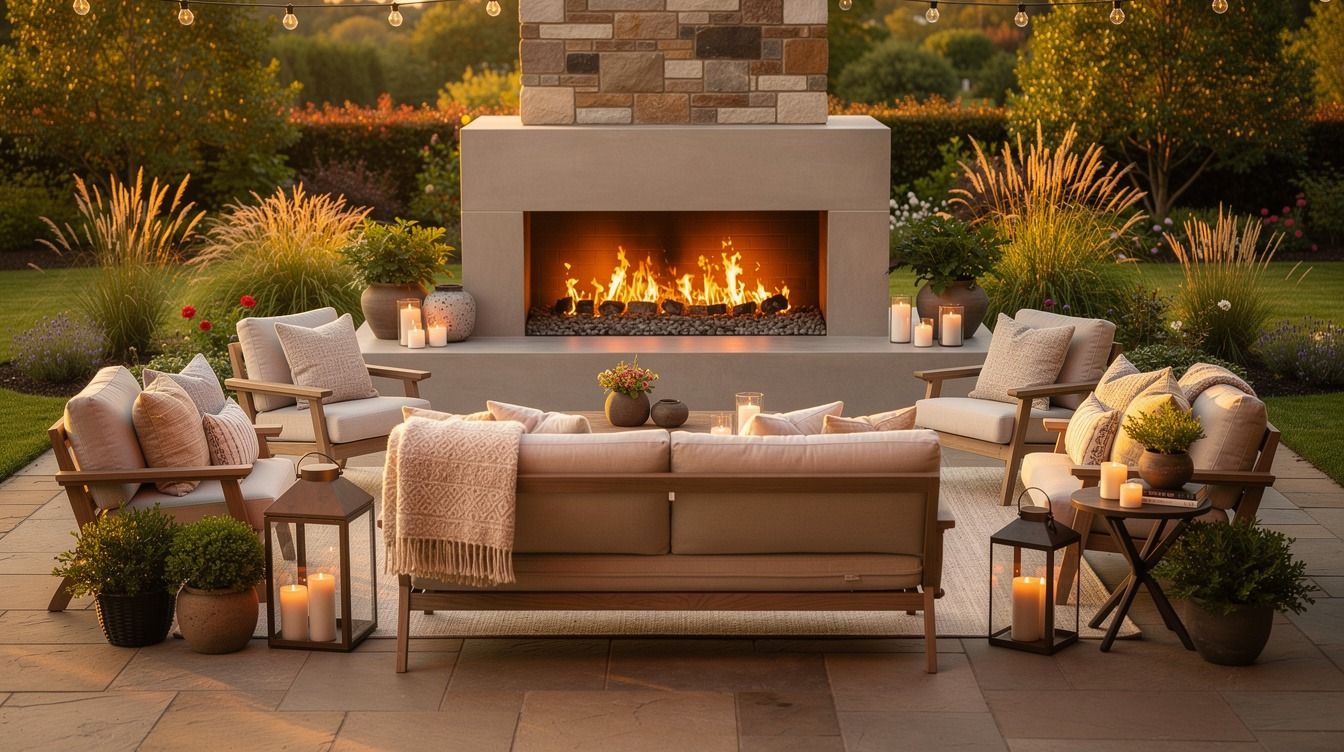
by I added an outdoor patio fireplace at 34 weeks pregnant, mostly because the brick wall at the back of the garage had been empty for six years and I'd run out of excuses. Eight months later, the yard pulls more evenings than the living room does! Here's every move that earned its place, and the two I'd skip if I started over.
Here's what it looked like before
Six years of nothing. That was the patio.
The slab was poured concrete with that thin gray builder paint, half of it peeling back in long strips near the side door. Two plastic Adirondack chairs sat in the far corner next to a sad little propane tank. The back wall was just the garage's exposed brick with no mantel, no hearth, no anchor.
The yard itself was fine: six mature trees, decent grass, a cedar privacy fence that did its job. But nothing pointed anywhere.
Nothing said stay. The first weekend, I swept the slab and sat there for an hour, and that's when I knew the fireplace had to live on the back wall.
The garage would just have to share it. If you're working with a yard that feels emptier than it should, my guide to making a large backyard feel cozy covers the same problem from the opposite angle.
- Anchor the seating around the fireplace
- Pick stone that ages well
- Layer the glow with the Three-Height Light Stack
- Add a chunky wood mantel even if it's just decorative
- Instead of string lights, run café bulbs on a real wire
- Frame the hearth with a pair of olive trees
- What if you went stucco instead of stacked stone?
- The Log Stack Effect: firewood wall as art
- Run a rug sized for outdoor living
- Skip the gas insert for real flame
- Hang a single pendant over the seating zone
- The Two-Wood Rule: pair teak with cedar
1Anchor the seating around the fireplace
Before the fireplace went in, I'd been pushing the chairs to the far corner, away from everything. After, I dragged the outdoor sofa within six feet of where the hearth would land, and the whole room reorganized itself around it. That's the part I didn't expect: the fireplace isn't a feature you add, it's the gravity of the yard. People drift toward it without being told.
If your seating floats in the middle of the slab with no anchor, no conversation will last past twenty minutes. Put the heaviest piece of furniture within arm's reach of where the fire will be, and let the rest fall into place.
Why does fire do that? I think it's because fire asks for nothing and gives back warmth, and most furniture asks for attention and gives back a place to sit.
If you're weighing fireplace versus fire pit, my fire pit vs fireplace breakdown covers that decision honestly.
2Pick stone that ages well
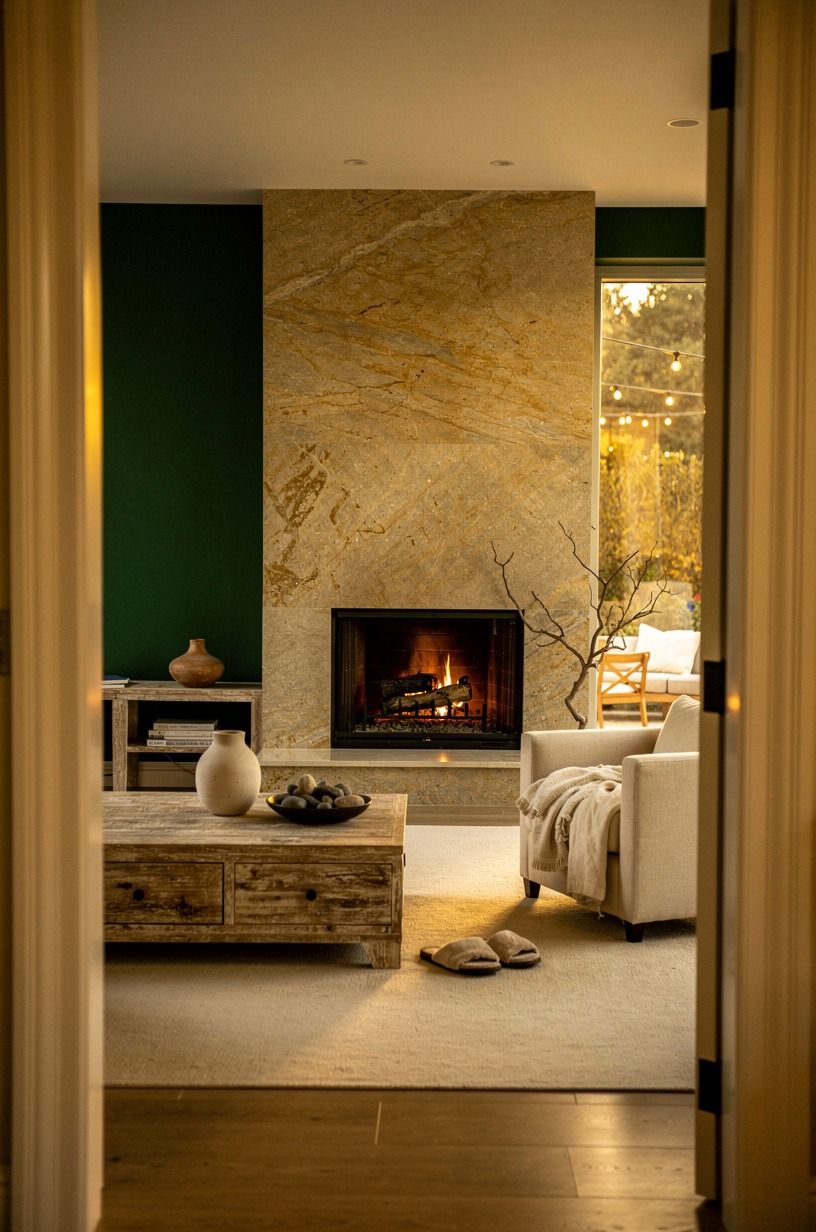
I went with reclaimed weathered teak for the surround, and I'm glad I did. The weathered grain isn't perfect, so it doesn't show the soot or the rain streaks the way a polished finish would.
Two years in, it just looks like it's been there forever, which is the whole point of an outdoor fireplace. Skip anything with a heavy texture if your patio faces south; dust collects in the grooves and you'll be out there with a brush every weekend!
If you want a low-maintenance look that doesn't demand attention, reclaimed weathered teak or a limestone veneer is your friend. Real stone runs about $15 to $30 a square foot installed, and a thin veneer on a wood frame cuts that in half.
And if your plan is to extend the season with a roof over the hearth, my covered patio with fireplace guide goes deeper on that combo.
3Layer the glow with the Three-Height Light Stack
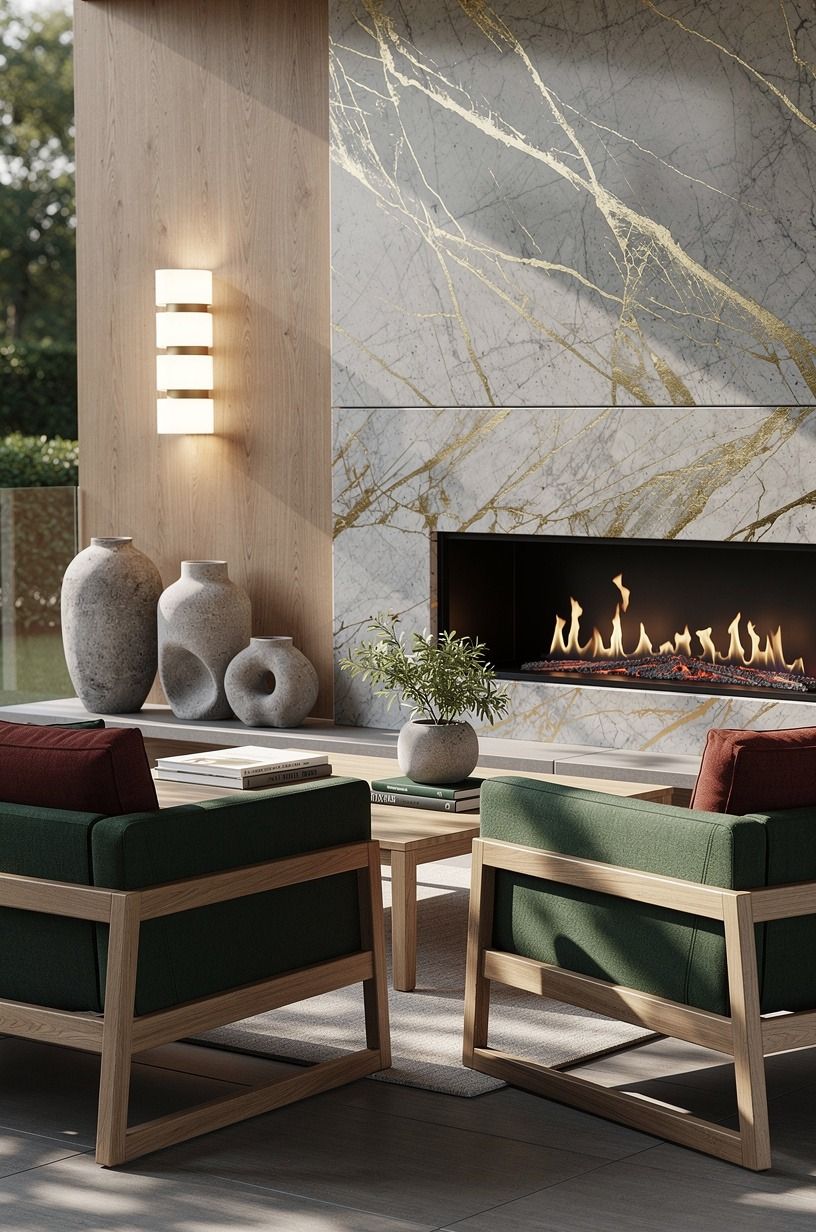
This is the move that nobody talks about and that changed the patio most. The Three-Height Light Stack means you light at three different heights: low (lanterns on the ground), mid (sconces on the back wall), and high (café bulbs strung overhead). One source of light makes a yard feel like a parking lot.
Three sources layered make it feel like a garden at dusk. I used LED café bulbs on a black wire overhead, two outdoor sconces with natural oak accents flanking the fireplace, and three tall lanterns set into the planting beds. The forest-green and rust accents warm up the natural oak and the Calacatta marble surround, whose gold veining keeps the light from feeling flat. The whole thing cost about $180 and turned the patio from a lit surface into a place.
Worth every dollar, and it was the best $180 I spent on the whole project. If you're dreaming bigger than a fireplace into the full outdoor room, my resort-style yard guide shows the next level!
4Add a chunky wood mantel even if it's just decorative
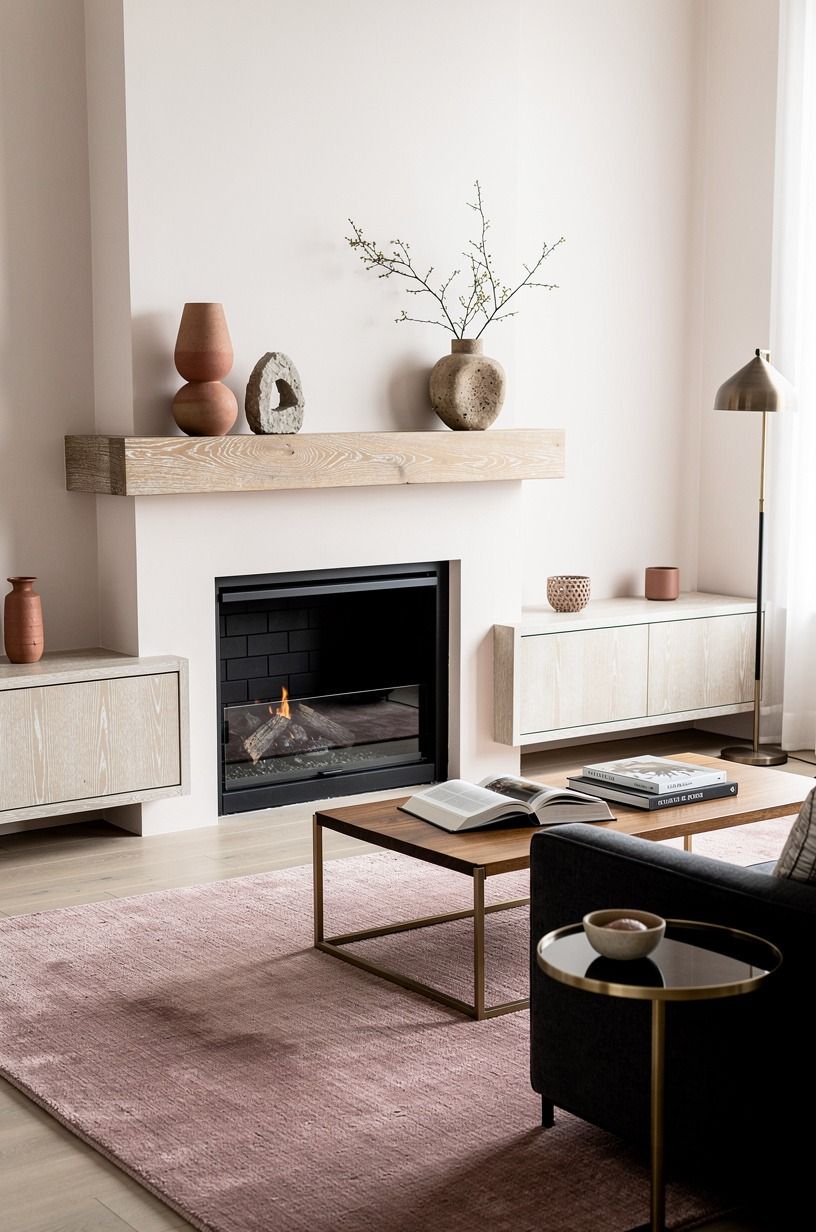
A real cerused white oak beam across the top of the fireplace does more than you think. It's where the candles go, where the small terra-cotta pots go, where the vase of eucalyptus lands in summer and the pumpkins land in October. It also visually finishes the surround and makes the whole structure feel built, not stuck on.
I bought a 6-foot cerused white oak mantel beam with the brushed grain still showing, and it cost about $220. Mount it at 54 inches from the floor if your surround is standard height. Anything higher and you can't reach to style it.
Anything lower and the candles block the fire. If you're also rethinking the whole backyard layout, my guide to making a large yard feel cozy is a good place to start.
5Instead of string lights, run café bulbs on a real wire
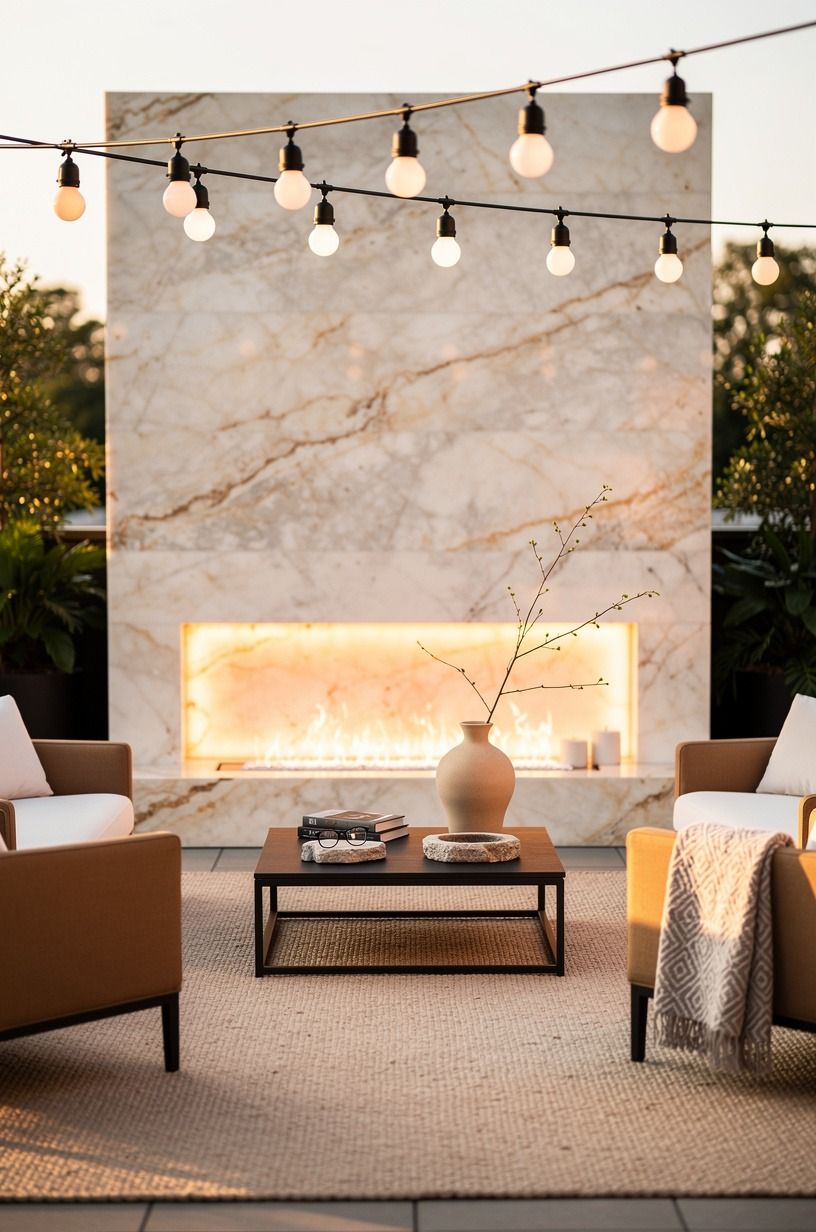
I tried string lights first because everyone does, and they looked like a college dorm by week two. The wire is too thin, the bulbs are too small, and the whole thing sags.
So I ripped them out and ran a real 18-gauge outdoor wire between two points on the back fence and the house eave, hung café bulbs in warm white (2700K, not the blue 5000K), and let them wash across the backlit translucent onyx surround. The wire holds, the bulbs throw actual light, and the whole thing reads as intentional instead of decorative.
Cost was about $90 for 50 feet and ten bulbs. You can find the wire at any hardware store and the bulbs at West Elm or CB2.
If you only do one lighting upgrade on the patio, do this one. And if you're planning a roof over the whole zone to use it year-round, my covered patio fireplace guide is worth a look before you commit.
6Frame the hearth with a pair of olive trees
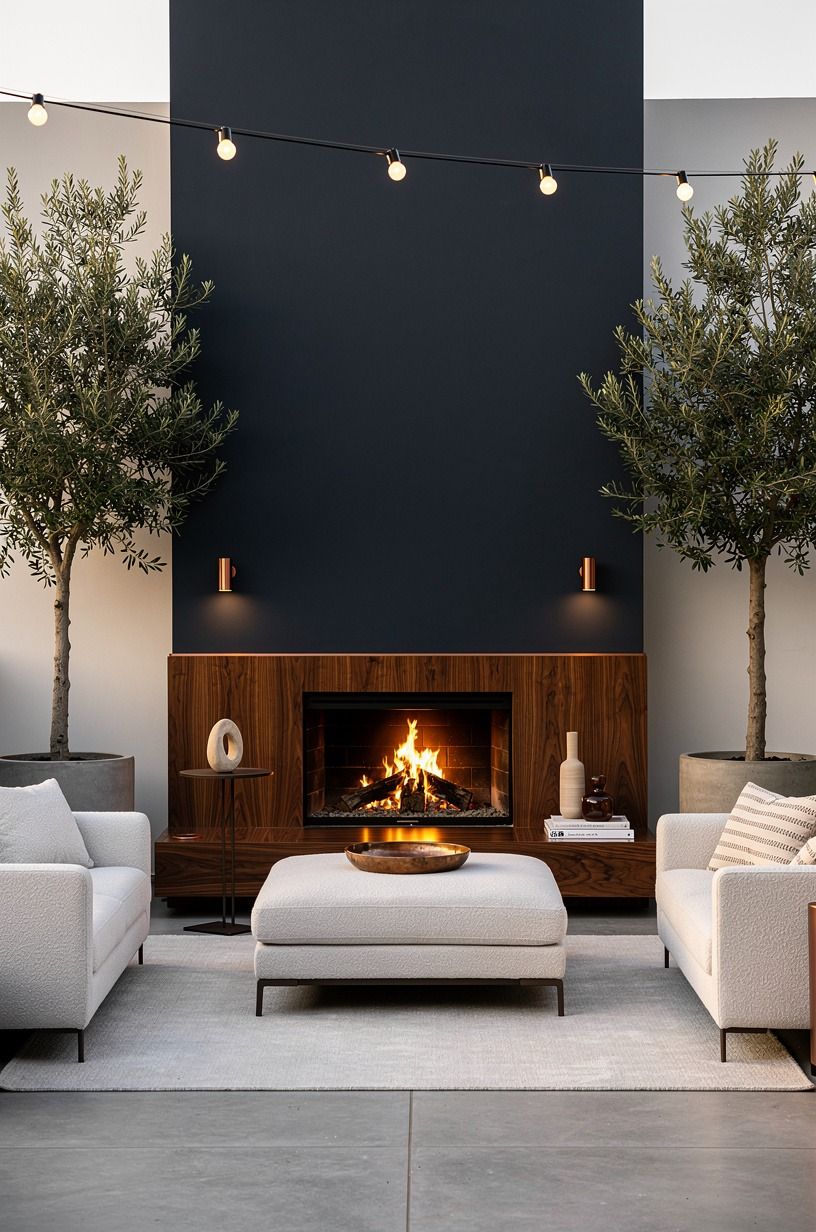
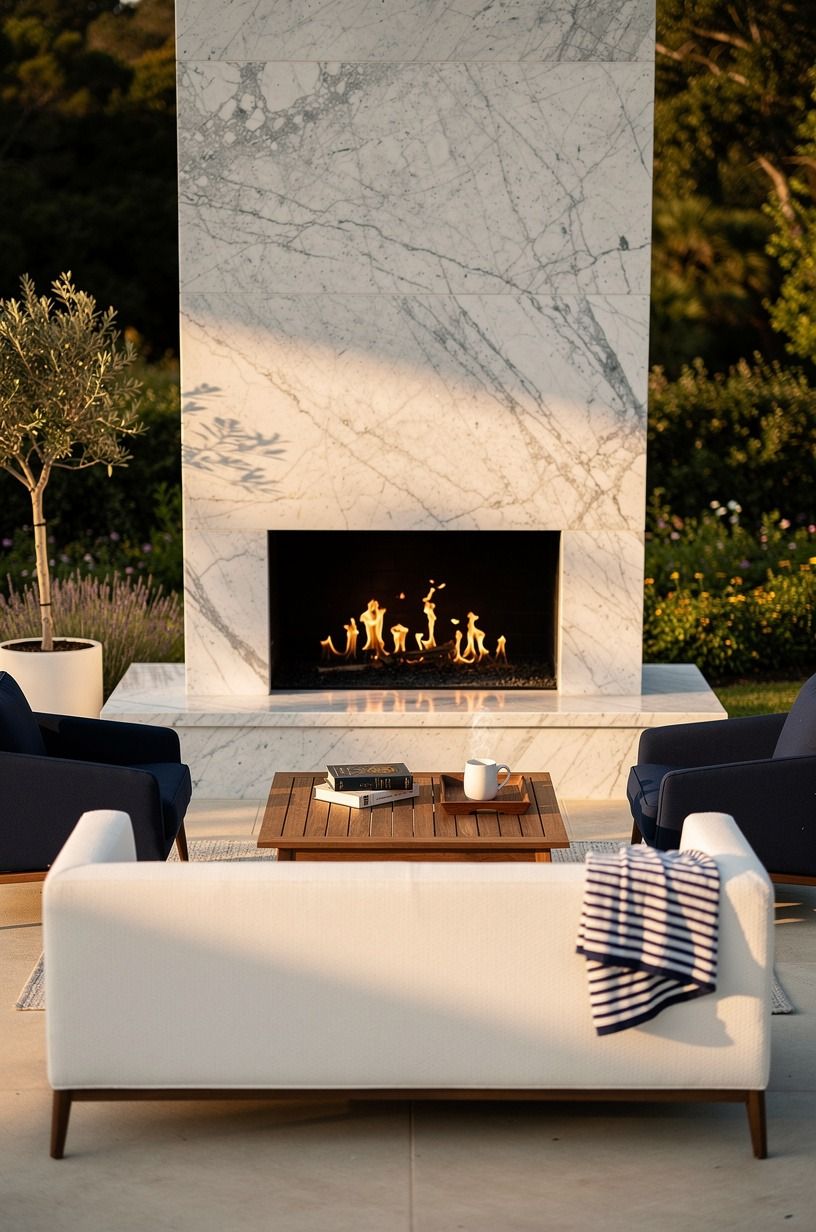
I planted two olive trees in ivory planters on either side of a book-matched walnut surround, and the patio immediately felt Mediterranean instead of suburban. Olive trees are hardy in zones 8 to 10, they handle being root-bound (so the pot is fine), and their muted leaves sit beautifully with midnight blue, copper, and ivory.
Each planter is a 24-inch ivory planter from a local nursery, about $80 each, with the trees around $120 apiece. If you're in a colder zone, swap to bay laurel for the same shape and a similar leaf color.
The point is the vertical line on either side of the hearth; the plant itself is secondary. Without them, the fireplace looked stranded.
With them, it looked framed. And if you're going bigger than the fireplace into a full outdoor kitchen and dining zone, my resort-style yard guide has the layout.
7What if you went stucco instead of stacked stone?
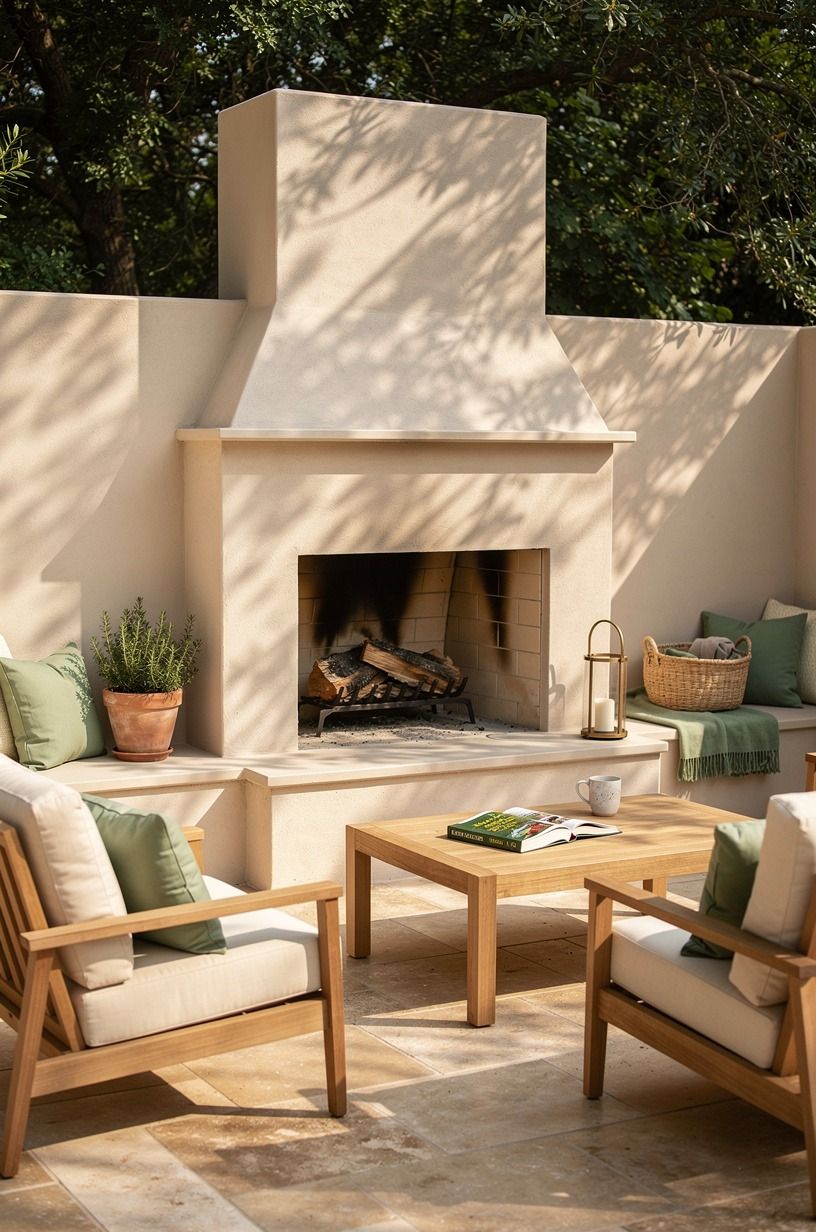
I almost did. Stucco over a framed surround is faster, cheaper, and reads cleaner in modern yards.
The reason I didn't was the soot. Real wood fires throw smoke and tar onto whatever sits behind them, and a dark stucco surround will show every streak in two weekends. A textured warm travertine surround hides it. So if you're running gas, go stucco.
If you're burning real wood, go stone. That's the only honest rule. Stucco runs $8 to $15 a square foot installed for a smooth modern finish; warm travertine is $15 to $30.
The price gap is real, but the maintenance gap matters more. If you're still deciding between an open patio and a covered one, my covered patio fireplace guide walks through both.
8The Log Stack Effect: firewood wall as art
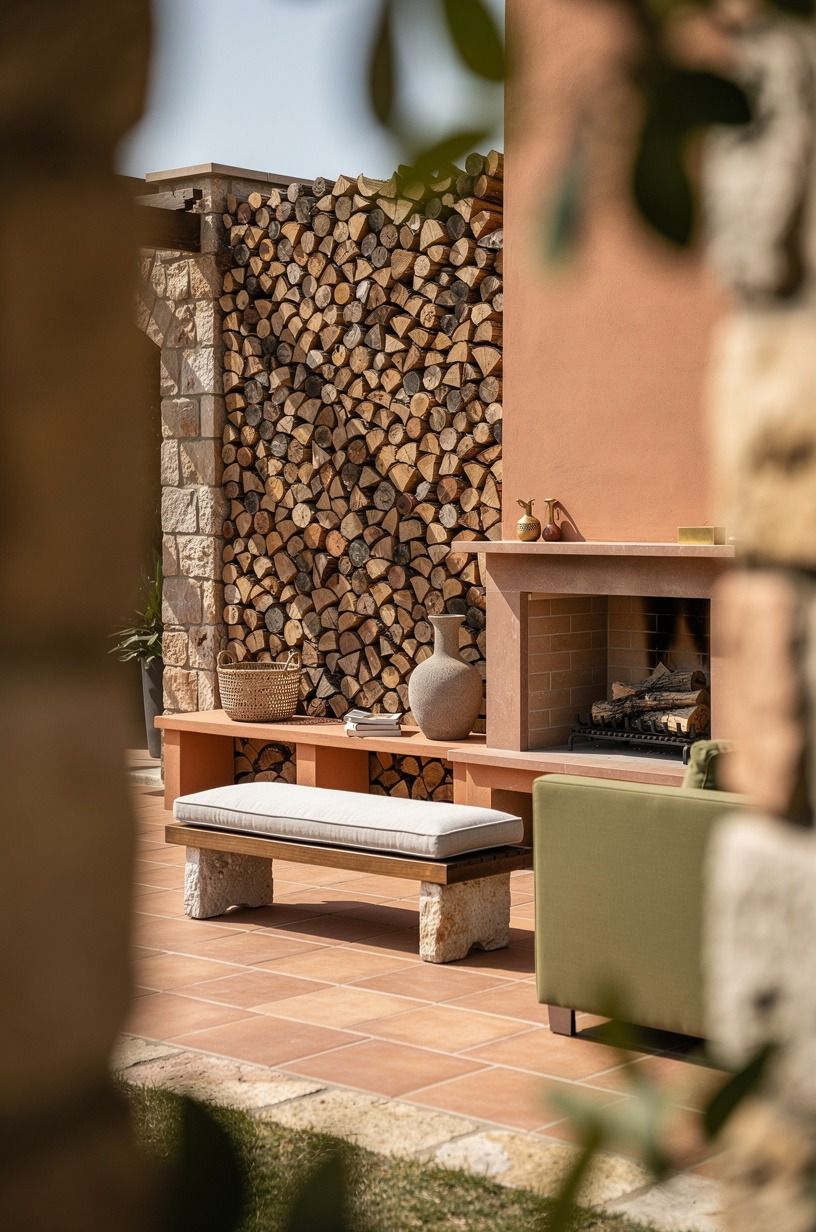
This one's stolen from a hotel in Sonoma. Build a single firewood cubby with an unlacquered brass surround about 4 feet tall and 6 feet wide, fill it with seasoned firewood, and let the rounds become the texture.
It costs almost nothing if you have a chainsaw and a weekend, and it does two jobs at once: stores the wood, and gives the yard a warm focal point that the fireplace can't reach on its own. Let the brass develop its patina beside terracotta, stone, and olive tones.
Mine sits about 12 feet to the left of the hearth, and people look at it as much as the fire. Use kiln-dried hardwood so the bark doesn't shed, and stack it rounds-out for the cleanest look.
If your patio is small, even a 2x3-foot stack against the back fence changes the energy of the whole space. And if you're working with a yard that feels larger than it should, my guide to making a large backyard feel cozy is the right companion read.
9Run a rug sized for outdoor living
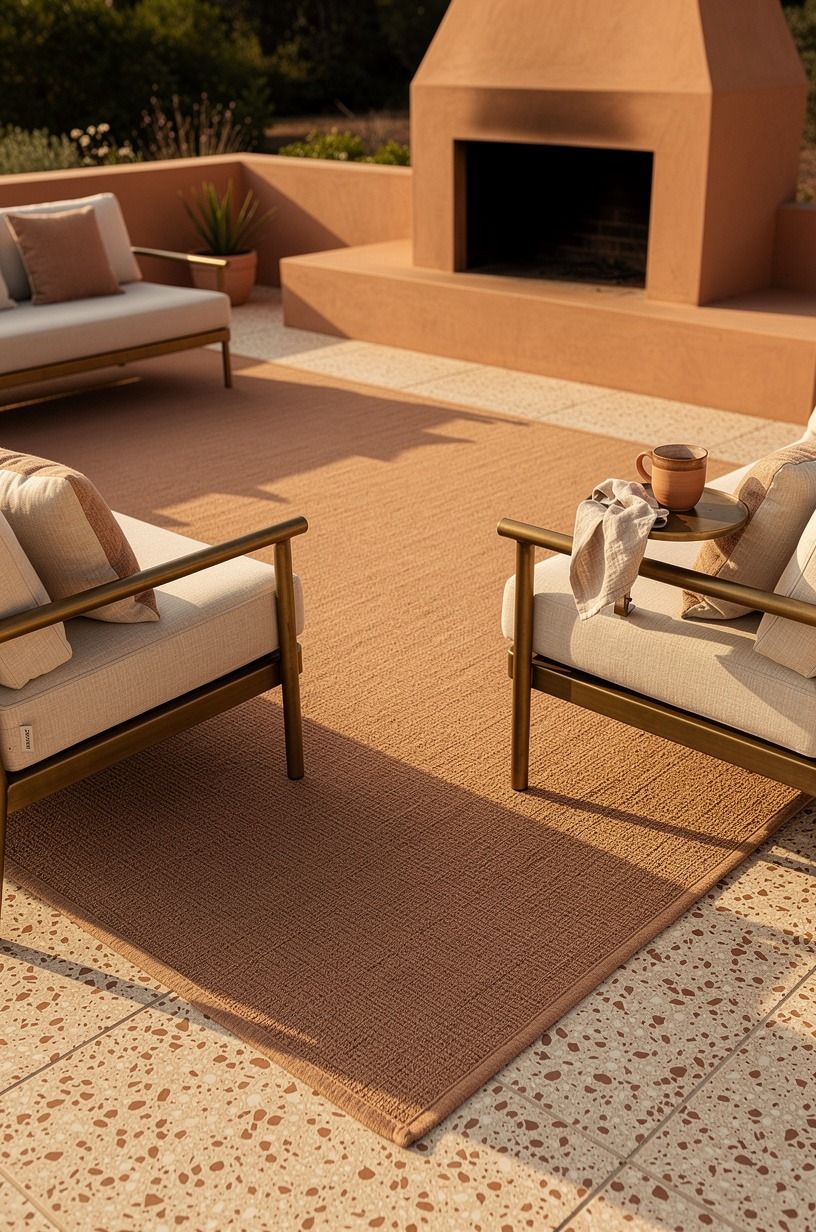
An outdoor rug in clay and linen tones, laid over oversized-chip terrazzo, does for a patio what a rug does indoors: it tells people where the room is.
10Skip the gas insert for real flame
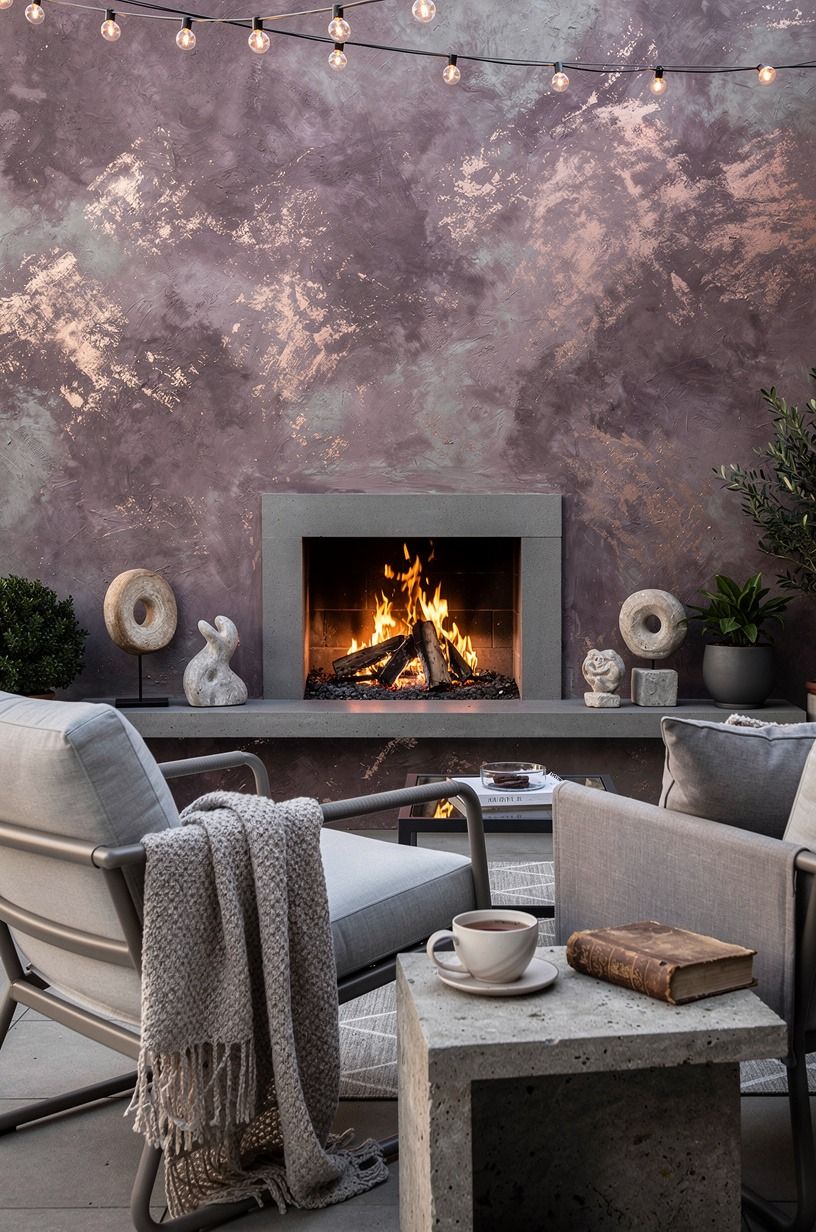
Everyone I know put in a gas insert because it's easier, and everyone I know has told me they regret it. The flame is too controlled, too even, too quiet.
A real wood fire moves, throws sparks, and smells like a Saturday night! It's the whole reason to have an outdoor fireplace in the first place.
A gas insert is fine if you live somewhere with fire restrictions, but if you can burn wood, burn wood. We added a small wood-burning firebox rated for outdoor use, set into hand-applied Venetian plaster, and it cost about $1,400 installed.
The plum, gray, and rose-gold accents keep the surround from feeling cold. The first fire took two hours to get right, and the second fire took twenty minutes. Now it's the easiest part of the week. Worth every penny and every ash cleanup.
If you're weighing fire pit instead, my fire pit vs fireplace breakdown covers both honestly.
11Hang a single pendant over the seating zone
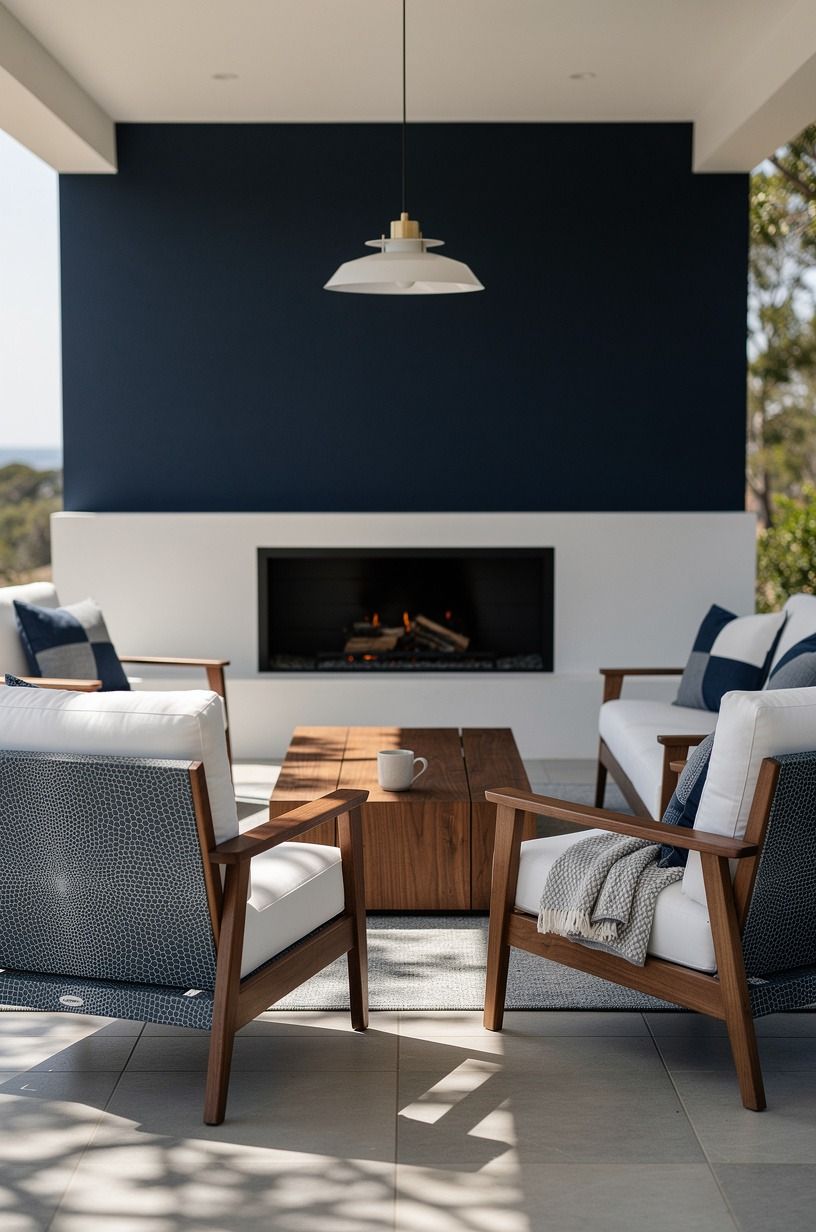
A large outdoor pendant hung over a navy-and-white seating zone with walnut and shagreen accents does something string lights never can: it gives the eye one place to land.
12The Two-Wood Rule: pair teak with cedar
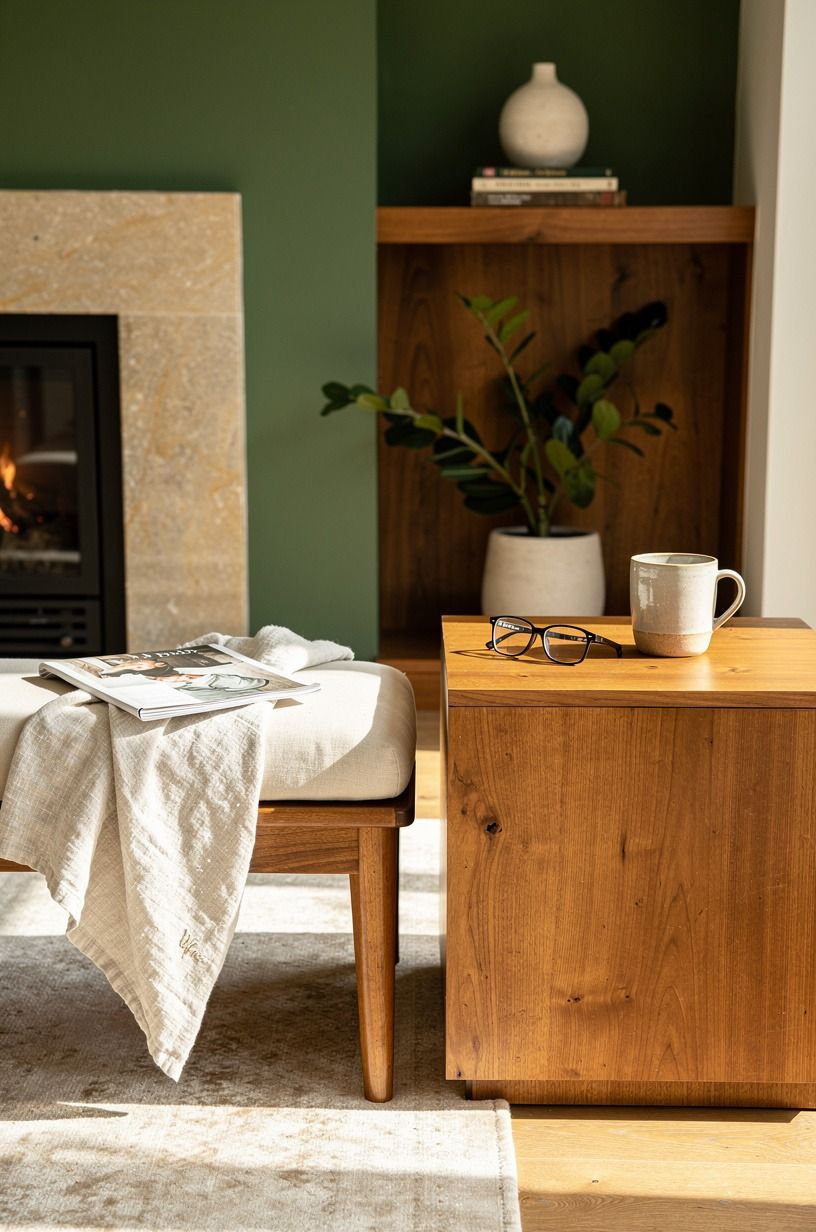
This is the move that ties the whole patio together. Teak for the furniture, cedar for the structure and the accents, then washed Belgian linen for the soft layer. Both woods weather to a soft silver-gray if you leave them unfinished, and they weather at almost the same rate, so the whole yard reads as one material story instead of a collection of pieces.
The emerald, gold, and cream palette keeps the linen from feeling too formal. My teak outdoor dining set was the big splurge, about $2,800 for a six-person set, and the cedar pergola was the second big splurge at $1,500 in materials.
If teak is out of budget, acacia does the same job for about a third of the price, just with a slightly warmer tone. The rule is two woods, both natural, both allowed to gray.
Anything else fights the fireplace. If you're planning the bigger outdoor room, my resort-style yard guide pairs well with this.
How much it cost
Here's the honest breakdown, line by line. I kept receipts for most of it because I wanted to know if the fireplace paid for itself in evenings. It did.
Could you do this for less? Absolutely. Skip the teak and go acacia, drop the pergola for a shade sail, and you're under $6,000 with the same fireplace.
Skip the wood-burning firebox for gas and you save another $600. The stone and the mantel are the parts I'd never cut, because they're the parts you see every single day for the next decade.
A note from the patio, eight months in
Eight months in, here's what I know for sure. The fireplace was the right call, but not for the reason I thought.
I thought I'd use it on cool evenings, maybe twice a week through fall and once a week in winter. Instead, it's been every single Friday and most Saturdays from late September through May, plus a random Wednesday when someone needs to talk.
The wood smoke carries farther than I expected, and the neighbors have stopped by twice because of it. That's the part nobody tells you when you're budgeting: the fireplace pulls the neighborhood closer, not just your family. If you're worried about losing the rest of the yard to weather, my covered patio guide is the natural next read.
The other thing I know is that not every yard needs a fireplace. If your patio is small (under 100 square feet), a fire pit does the same job for a tenth of the cost and a tenth of the footprint.
If your climate is dry and you're under fire restrictions for half the year, an electric heater on a timer is the smarter move. The fireplace earns its space when you have a real back wall, a real seating zone, and at least eight fire-friendly weekends a year.
Anything less, and you're lighting money on fire (which is its own kind of warmth, but not the kind you want).
I also learned that the styling matters more than the structure. The first weekend, I lit the fire and stood there with nothing around it: no chairs pulled close, no lights layered, no rug underfoot.
It felt like a campfire in a parking lot. The weekend I added the mantel styling, the rug, and the olive trees, the same fireplace became a different room.
If you take one thing from this: build the surround first, then spend a month living with it before you style the rest. You'll know what the space wants.
I went back and forth on the mantel height twice before landing on the right number, and the second attempt is the one that finally felt like the room was holding the fireplace instead of the other way around.
What People Always Want to Know
What is the best outdoor patio fireplace setup for a small backyard?
A wood-burning fire pit in a steel bowl does more for a small yard than a built-in fireplace, mostly because you can move it and it costs about a tenth as much. Pair it with two Adirondack chairs, one polypropylene outdoor rug, and a single strand of café bulbs, and you've got the same cozy effect in 60 square feet. Skip the stone and the mantel on a small patio; they'll eat the room.
Where can I buy outdoor patio fireplace pieces on a budget?
IKEA for the basic teak-style chairs and side tables, Target's Threshold line for outdoor rugs and cushions, and Wayfair for the bigger furniture pieces if you can wait for a sale. For second-hand, Facebook Marketplace is where I found my original fire pit bowl for $40; thrift stores are hit or miss but worth a Saturday morning. If you're also rethinking the bedroom side, my bed designs guide might spark something.
How much does an outdoor patio fireplace makeover cost?
The fireplace itself runs about $1,400 to $5,000 installed, depending on whether you go stone or stucco and wood-burning or gas. The full patio makeover, including furniture and lighting, typically lands between $6,000 and $12,000.
The free part is the styling: pulling chairs closer, layering candles, planting the olive trees. You can do most of that with what you already own.
Can I create an outdoor patio fireplace setup on a $500 budget?
Yes, and the cheapest version is just a steel fire pit bowl on a cleared corner of the slab, two chairs, and a string of café bulbs. Total cost is closer to $200 than $2,000, and it does the same job for a small yard.
The big-ticket pieces (stone surround, mantel, teak set) come later if you want them. If you're working with a bigger yard on a tighter budget, my guide to making a large backyard feel cozy helps prioritize.
Is an outdoor patio fireplace worth it in a small space?
It's worth it if the small space has a real back wall for the surround and you can seat at least three people around it. If the yard is tiny (under 80 square feet) and there's no wall to anchor to, the fireplace will eat the space and you'll use it twice a year.
Go fire pit instead, save the money, and put the rest toward better lighting and seating. If you're redoing the bedroom too, my bed frame guide is a good pairing read.
Is an outdoor patio fireplace a good idea for a rental?
Yes, with two swaps. Use a freestanding steel fireplace (no construction, no permanent change) and a rolling wood cart for the firewood.
Skip the built-in stone, skip the mantel, and put your budget into seating and lighting instead. The whole setup moves with you when the lease is up.
If you're also doing the bedroom side, my grey bed frame ideas and vaulted ceiling bedrooms are good complements.
Where I'd Start First
If I had to pick one, I'd start with the stone surround. You can't layer warmth on top of a cold wall, and the rug, the seating, the lighting will all fight it.
Get the fireplace right first. Everything else lands.