
 by
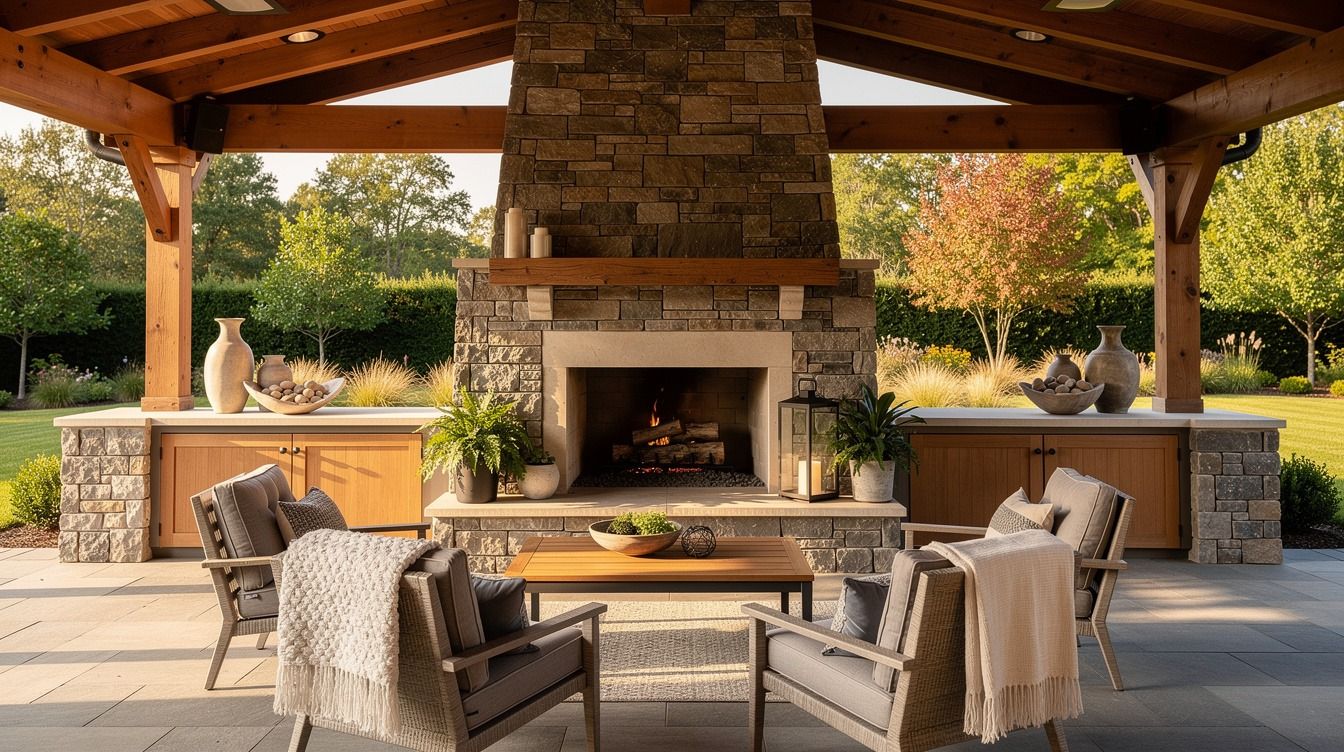
by A covered patio with a fireplace extends your outdoor living into every season, but most homeowners miss the small details that make it work. I've built three now, and the ones that get used year-round share one thing: the cover does the heavy lifting, not the fire.
- The Stone Chimney Anchor
- Frame the hearth in built-in cedar benches
- Stack cut logs under the mantel as decor
- Why two iron lanterns beat every other mantel pairing
- Lay a weather-treated rug in front of the hearth
- The Continuous Stone Sentence
- Style the mantel low with greenery and ceramics
- Run cedar beams across the covered patio ceiling
- A TV over no-TV for movie nights
- Hang a woven rattan pendant over the seating zone
- Open one wall with Nanawall sliding glass panels
- What about a ceiling fan for the summer months?
- How much a covered patio fireplace actually costs
- The honest truth about outdoor fireplaces in 2026
- Should you screen in the open wall?
- Can a small backyard pull this off?
1The Stone Chimney Anchor
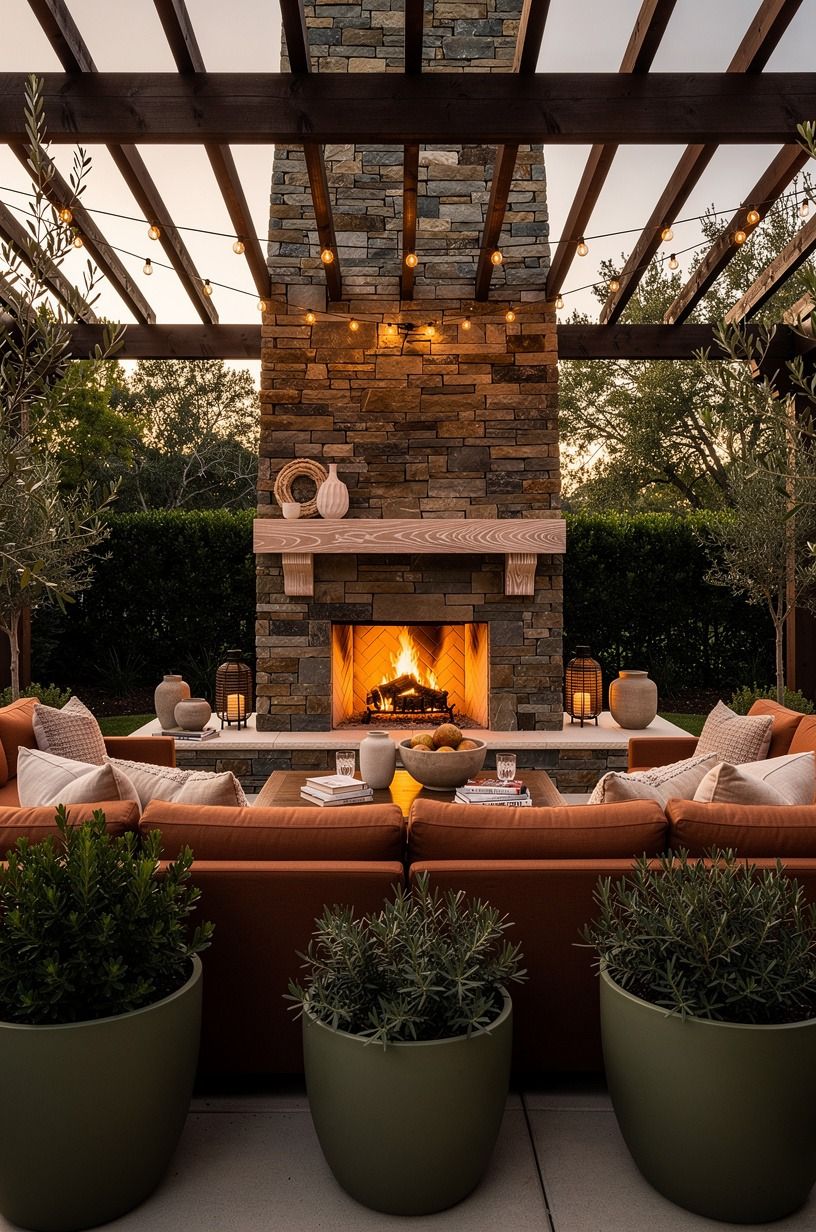
The chimney is the gravity of the room, and most DIY builds treat it like an afterthought. A full-height stacked stone wall going floor to ceiling changes everything: the fire has a body, the mantel has something to land on, and the rest of the patio gets to relax around it.
Go with limestone in a split-face stack or sandstone in a coursed pattern if you want it to read rugged and rooted. Skip the cultured stone if you can afford the real thing, because the weight, the cool touch, the way it catches firelight at night, none of that fakes well. The chimney mass also acts as a thermal sink, holding radiant heat long after the fire dies down, which is what lets you sit out there in a hoodie at 45°F and not feel the chill.
Mantel it with a cerused white oak beam, four to six inches tall and eight inches deep, with an exposed dovetail where it joins the stone. That joinery shows the craft and ages beautifully.
You'll spend around $4,000 to $8,000 on a real stone chimney plus beam, but you can hit the same effect with stone veneer over a framed chase for closer to $1,500 to $2,500. The chase version reads slightly thinner at the wall, but at seating distance nobody notices the difference.
If you're weighing stone options for an outdoor build, our stone outdoor kitchen guide covers the same material logic for a different zone. And if your backyard runs small, our small outdoor kitchen ideas apply the same bench-and-fire footprint math.
2Frame the hearth in built-in cedar benches
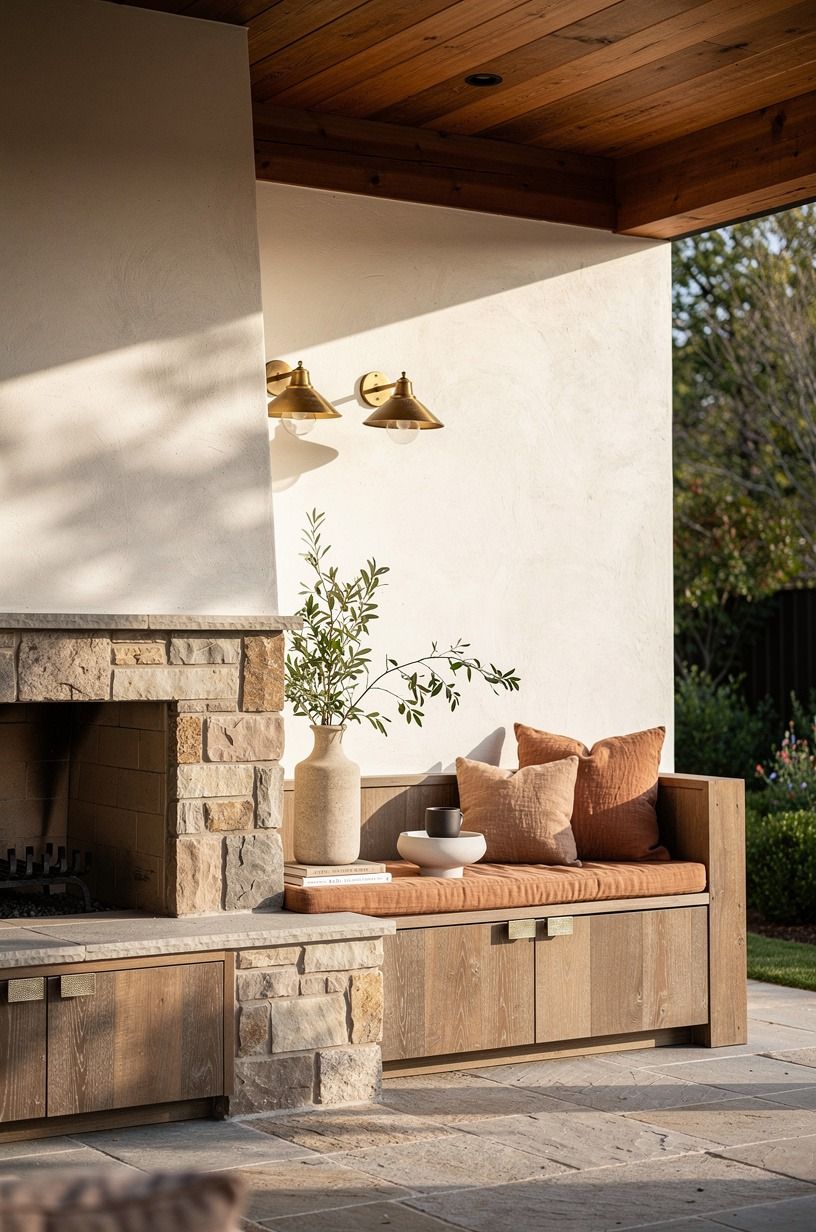
Two cedar benches flanking the fireplace pull the seating toward the fire and frame the view beyond, which is the whole point of a covered patio.
3Stack cut logs under the mantel as decor
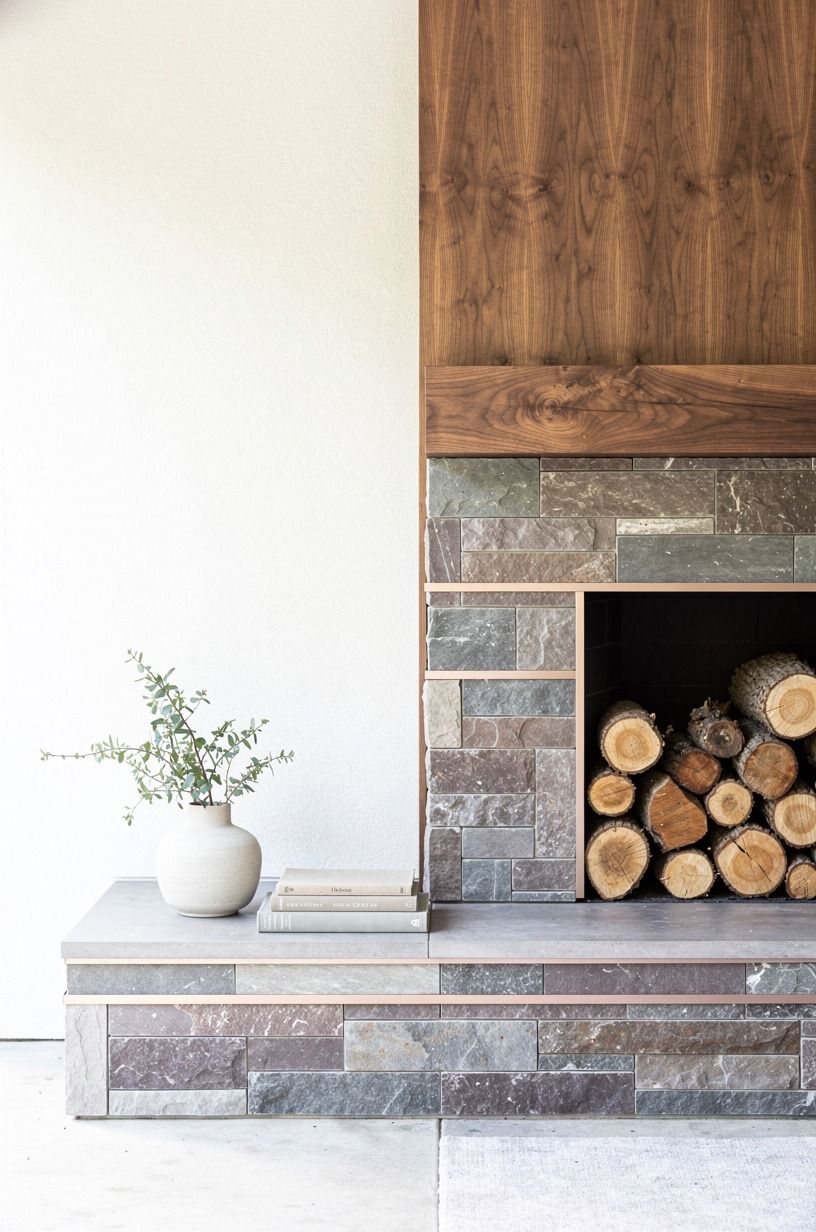
Cut logs as decor only works if you burn them. A fake stack looks like a yard-sale moment, but a real seasoned oak stack tucked beneath the mantel reads as resource and warmth at the same time.
The move here is species. White oak splits clean, burns long, and the bark holds for two seasons if you stack it with airflow.
Cherry is prettier but it punishes you with sparking in the fire, so skip it for decor you plan to burn. Stack in alternating courses, bark-out and bark-in, so the wall looks intentional and the pile doesn't collapse when you pull a log.
A single row of four to six logs against the stone gives you the silhouette without the fire hazard.
Above the mantel, book-matched walnut in a 10-inch-deep slab gives you a wood moment that contrasts the rough log stack below. Walnut darkens with age and oil, so don't panic if it shifts from cocoa to espresso over a year, because that's the patina you want. Pair with a blackened iron log holder so the tool blends in when it's empty.
If you're leaning more fire-pit than fireplace for the backyard, our cozy fire pit guide breaks down the same wood-stacking logic in a more casual setup. For the keep-or-replace decision, the fire pit vs fireplace comparison is honest about which one you end up using more.
4Why two iron lanterns beat every other mantel pairing
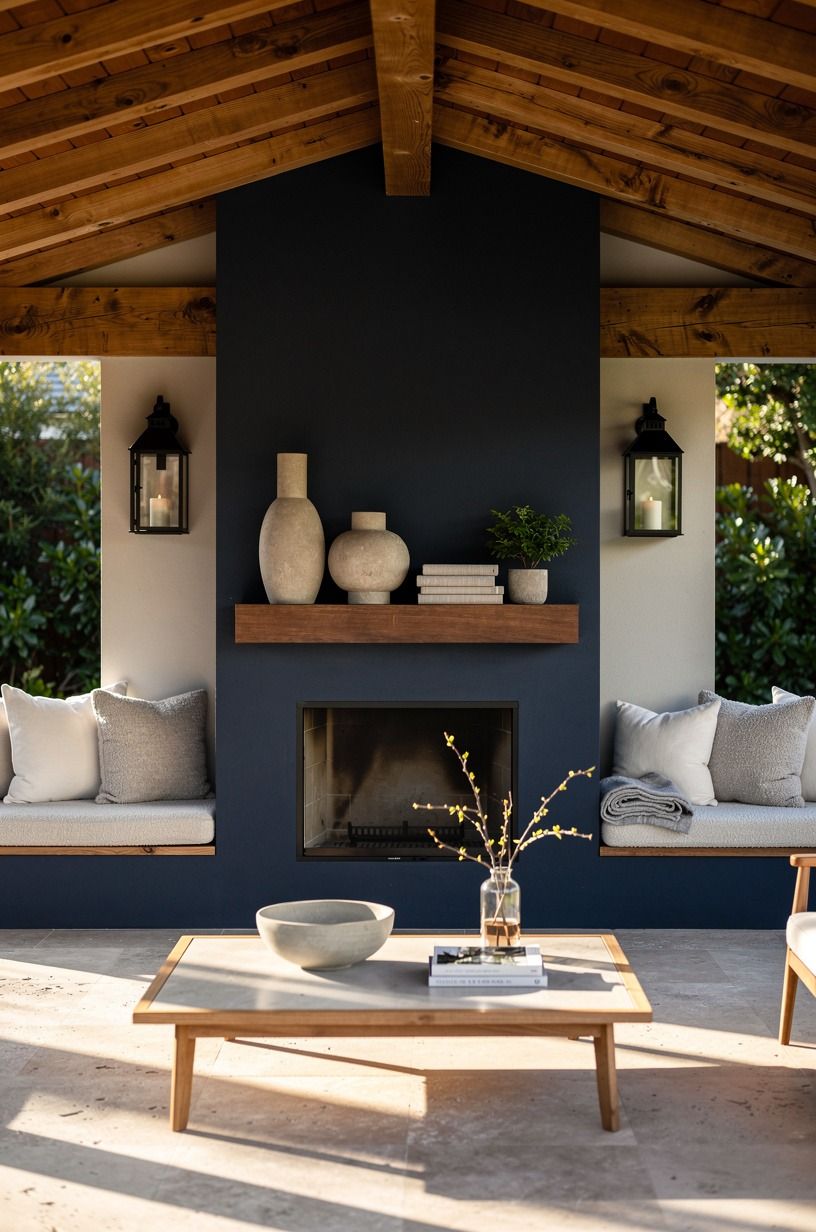
Two lanterns always beat a candle collection, and the scale is what makes it work. A taper candle looks lonely up there, and a row of three reads like a restaurant. Two blackened iron lanterns, one on each end of the mantel, frame the fire the way a couple of bookends frame a shelf.
Go oversized, not delicate. Lanterns in the 14 to 18-inch-tall range hold a pillar candle or a faux LED pillar, and the iron weight grounds the mantel visually.
Faux beeswax pillars with a slow-flicker bulb last through a full season without you touching them. Real candles are romantic for one dinner and a smoke stain for the next three years, so pick your trade-off.
The iron should be hot-rolled, not powder-coated. Hot-rolled iron develops a soft orange patina in the weather, which is the lived-in finish you want on a covered patio. If you're going more polished, unlacquered brass lanterns catch the firelight beautifully but ask for monthly wiping to keep the shine.
For a true set-and-forget setup, I'd skip both and go with marine-grade aged bronze, which patinas evenly and asks for nothing.
5Lay a weather-treated rug in front of the hearth
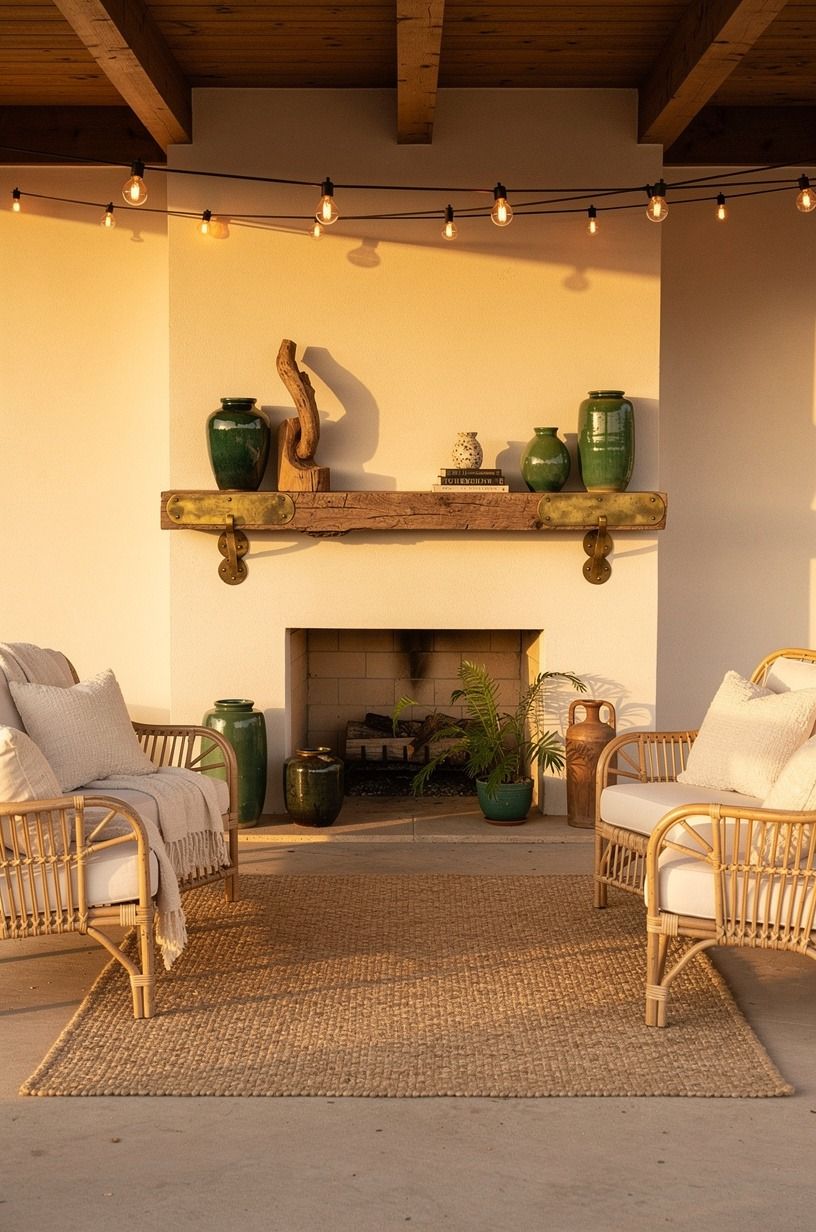
A rug pulls the seating zone together and softens the stone underfoot, but outdoor rugs fail in three predictable ways: they fade, they mildew at the backing, and the edges curl after a season.
6The Continuous Stone Sentence
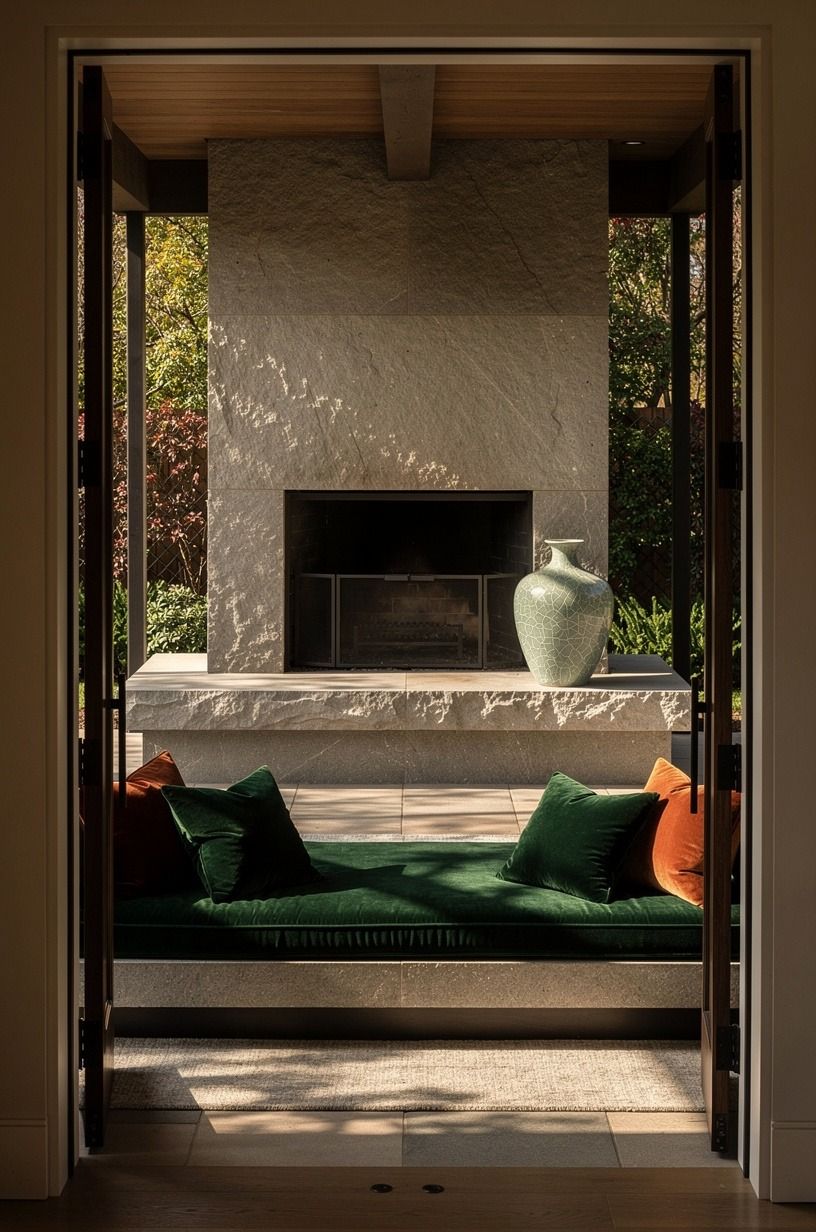
Here's the move most homeowners miss: the stone doesn't stop at the fire. Run the same honed travertine from the hearth out into the bench platform or the raised seating deck, and the whole patio reads as one continuous gesture instead of a fireplace parked in the middle of a deck.
You'll need a continuous slab pour or a tightly fitted tile system to avoid the cold joint that cracks at year three. Travertine is the easy choice because it cuts clean and the natural pitting forgives small settling.
Bluestone is colder underfoot but reads more architectural if your patio leans modern. Avoid marble outdoors; it etches from rain and wine and looks tired in two seasons.
The visual payoff is real: your eye reads the stone as a path, and the fireplace becomes the destination. It's the same logic designers use indoors when they run a single wood floor from the entry through every room. Continuous material, continuous sight line, one calm space.
And it's the cheapest upgrade per square foot you'll ever make on the patio.
For more on choosing the right outdoor stone, our stone outdoor kitchen guide applies the same logic to the cooking zone, and our outdoor kitchen countertop breakdown ranks the materials by climate performance.
7Style the mantel low with greenery and ceramics
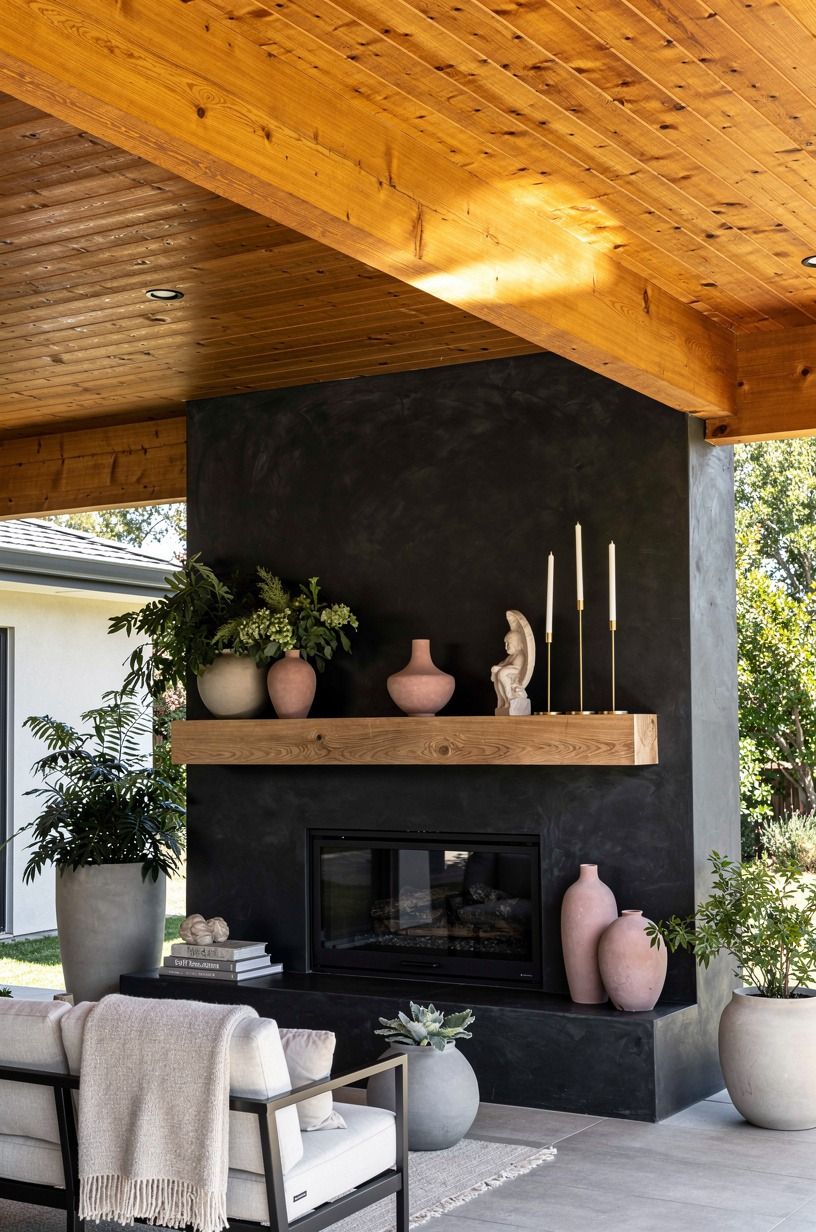
A low mantel beats a tall one every time, because a low mantel says decorate me instead of admire me from a distance. Aim for 54 to 60 inches off the finished hearth, so your styling sits at eye level when you're standing in front of the fire.
Start with one large object on one side, not the middle. A dusty rose ceramic vessel with three olive branches works because the asymmetry reads intentional and the height catches the eye without blocking the fire.
On the other end, a low stack of well-loved books and a small brass bud vase with a single stem. The rule is one tall moment, one low moment, and empty space in between.
The fireplace wall behind the mantel is your chance to pull a real color into the room. Farrow & Ball Hague Blue in a matte finish turns the whole wall into a mood, especially under firelight.
Benjamin Moore Revere Pewter HC-172 is the safer pick if you want the stone and the wood to keep stealing the show. I'd skip the bold paint and let the materials lead, because a charcoal wall reads beautiful in photos and oppressive in person by November.
8Run cedar beams across the covered patio ceiling
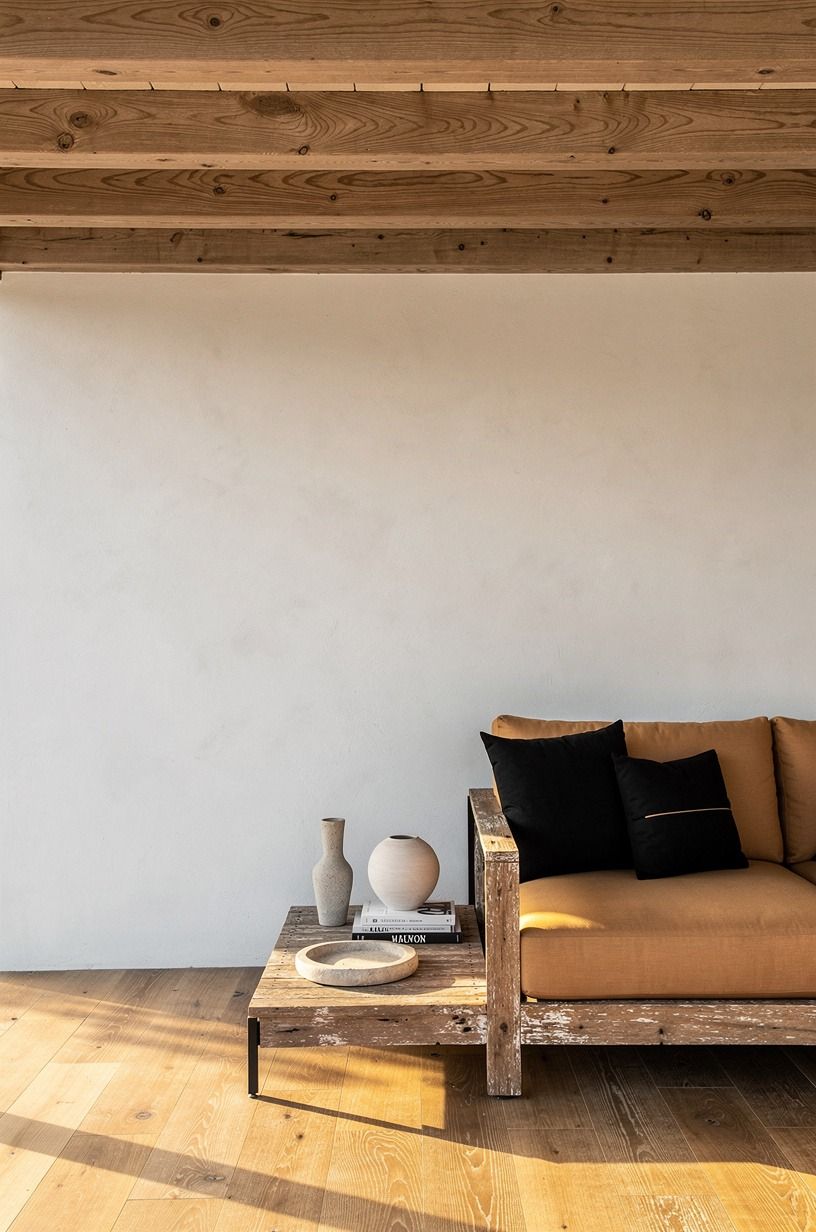
The ceiling is the part most people forget to detail, and a flat plywood soffit kills the whole covered patio fantasy. Cedar beams running across, even faux ones wrapped in cedar trim, give the room its sense of enclosure and weight.
For real structural beams, Douglas fir in a 6x8 or 8x10 cross-section spans 12 to 16 feet without intermediate support, which is the typical patio depth. If your span is wider, you'll need an intermediate post or a flush steel flitch plate, which is fine but reads more engineered. Cedar in a 4x6 works for smaller patios and ages to a soft driftwood gray.
The rule to follow is rhythm. Beams should land at 24 to 32 inches on center, never random spacing, and they should line up over windows or door openings when possible so the eye reads them as structural. Skip the decorative truss work unless your roof needs bracing, because fake trusses look like a wedding venue and undercut the rugged material story you've built downstairs.
For the cover decision itself, our covered vs uncovered outdoor kitchen breakdown walks the same climate logic for the cooking zone, and the pergola vs gazebo guide covers the structure-above-your-head decision honestly.
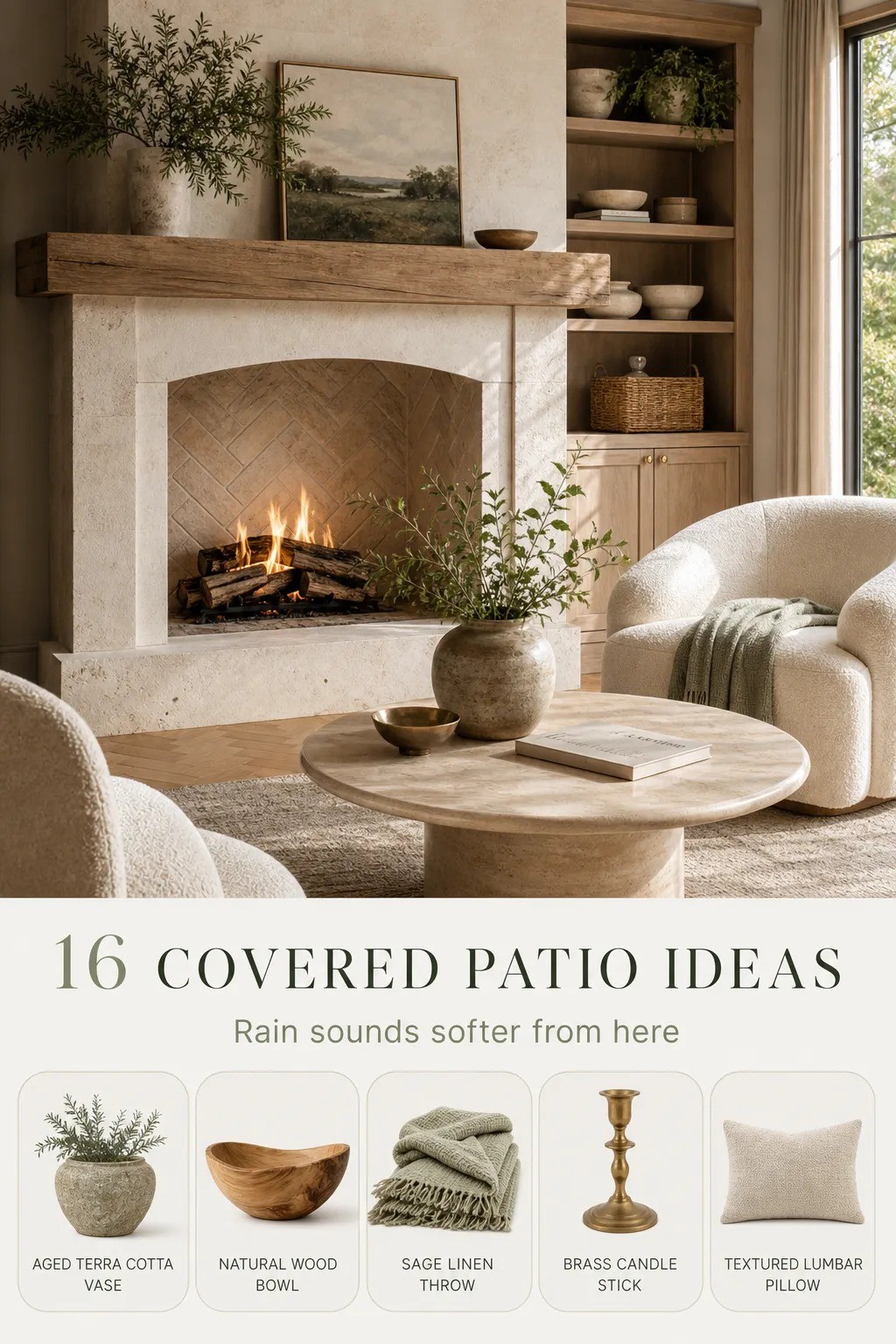
9A TV over no-TV for movie nights
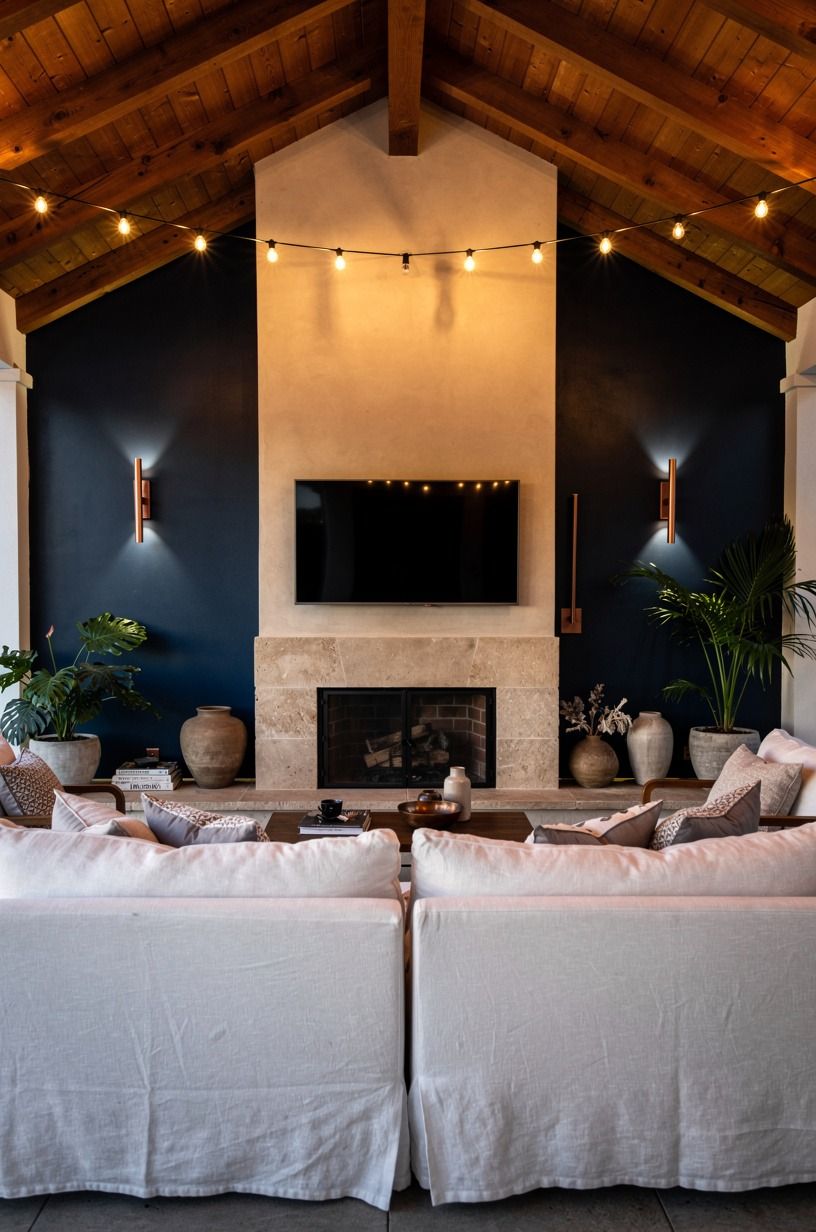
The hot take: a covered patio with a fireplace is the only place a TV belongs outside. Indoors you've got the couch; outside, the fire and the screen do different jobs and don't compete.
Mount the TV on the wall beside the chimney, not above it. Heat and soot will kill a TV above a working fireplace inside two seasons.
A side mount at 60 to 65 inches off the finished hearth keeps the screen at seated eye level and clear of the mantel heat plume. Use a full-motion mount so you can angle it toward the seating zone on movie nights and back toward the bar for sports.
Enclose it in a weather-rated outdoor TV cabinet or step up to a true SunBrite or Samsung Terrace model rated for covered outdoor use. Standard indoor TVs will fail at the first humidity spike, no matter what the box says. Run the cable through the chimney chase during the build so you don't have an ugly conduit stapled to the stone afterward.
Cushion your seating in ivory Belgian linen so the screen glare doesn't fight a busy pattern.
For more on screen + seating layouts that hold up under real use, our backyard gathering guide covers the movie-night zone math.
10Hang a woven rattan pendant over the seating zone
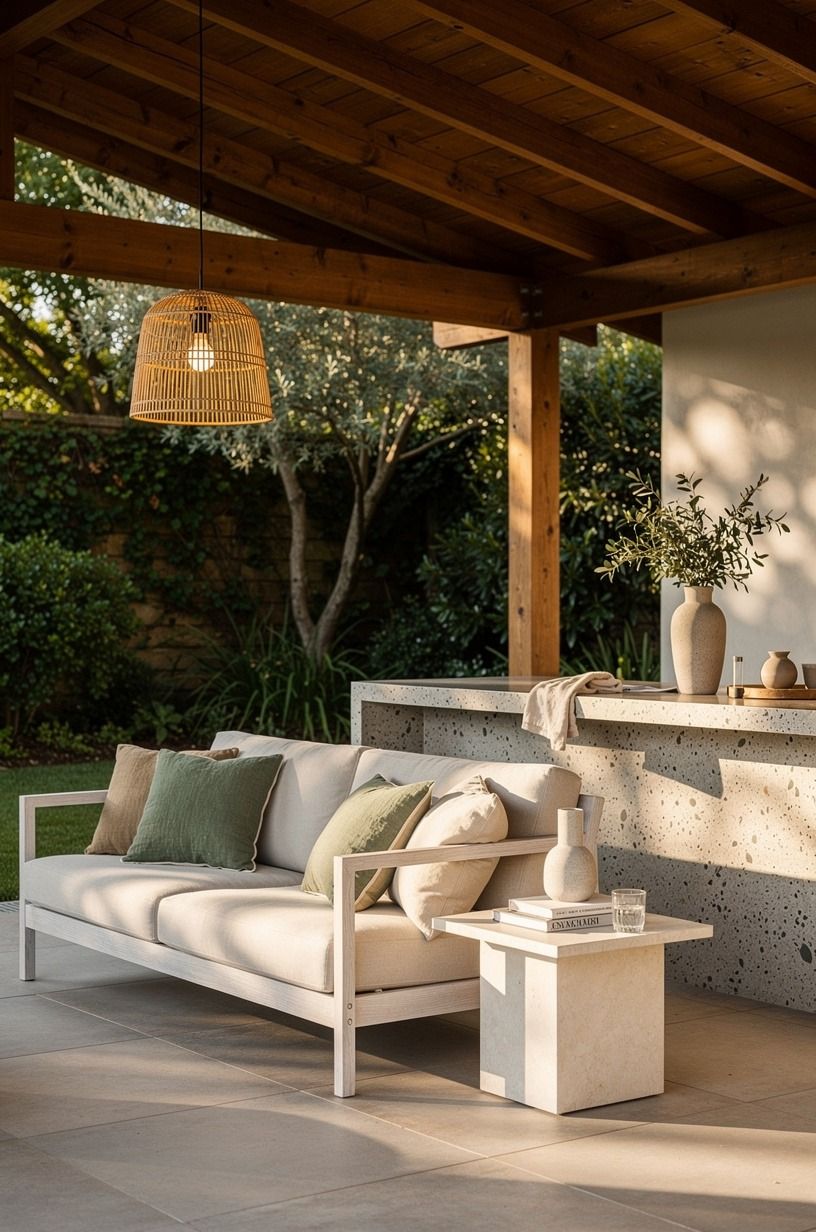
Overhead lighting on a covered patio is where most builds go wrong, and a flush-mount LED disc is the single saddest choice you can make up there.
11Open one wall with Nanawall sliding glass panels
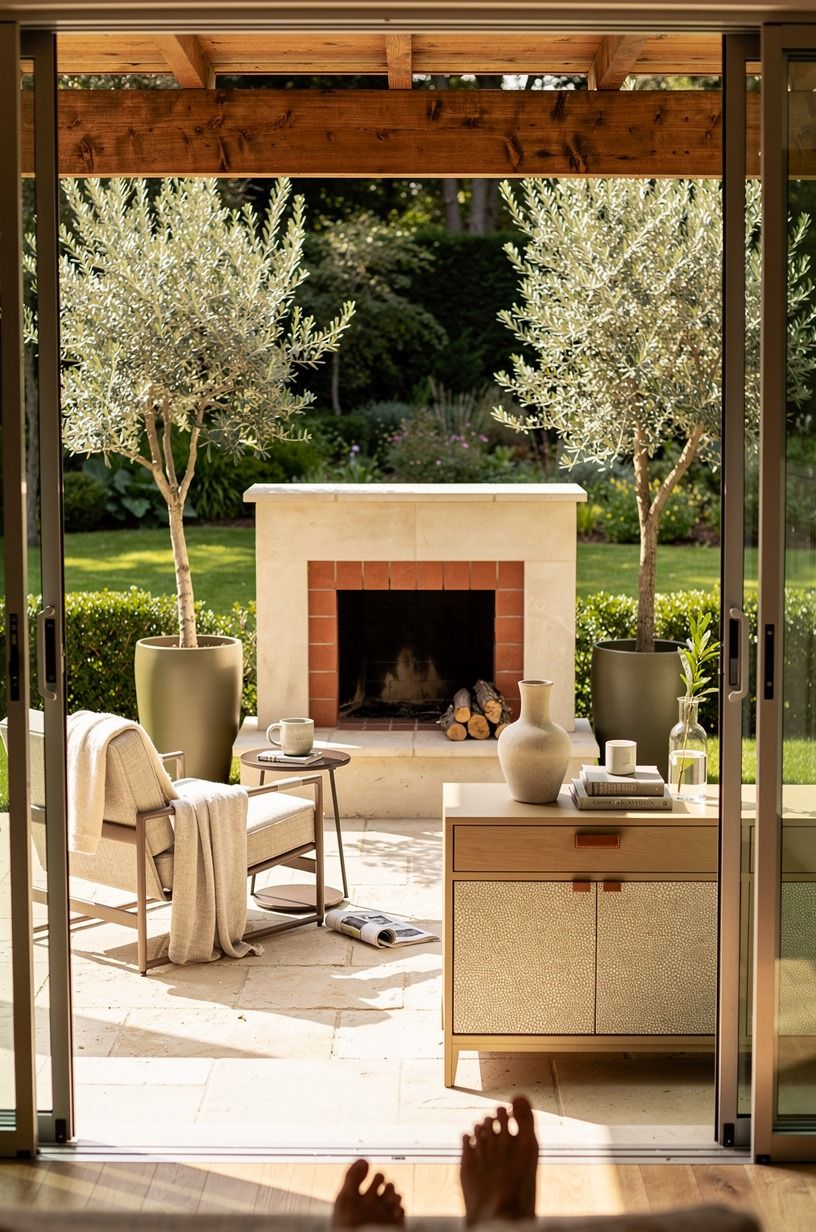
Here's the move that turns a covered patio into a year-round room: take out one wall with full sliding glass panels that stack into a pocket when the weather's good. You keep the cover, lose the screen, and your patio becomes a true extension of the living room.
The panels should be tempered low-iron glass in a thermally broken aluminum frame, because standard single-pane glass will fog and sweat through temperature swings. The panels need a flush sill into the finished floor so your rug runs continuous from inside to out, which is the move that makes the space read as one room instead of two. A header beam above the opening carries the roof load when the wall is open, and your contractor needs to spec it during the structural phase, not after.
For climates with real winters, swap one panel section for a folding aluminum-and-glass door system like Nanawall or Western Window Systems. They seal tight enough to hold heat from the fireplace inside a 40°F evening, and they stack to a four-inch panel when you want the full opening in July. The cost is steep: $25,000 to $60,000 installed for a 12-foot opening, but you regain the patio for nine months instead of five, which is the whole point!
For the broader indoor-outdoor flow, our indoor-outdoor kitchen guide covers the same opening-the-wall logic for the cooking zone.
12What about a ceiling fan for the summer months?
Here's the part that gets left out of the Pinterest fantasy: a covered patio with a fireplace is gorgeous in November and miserable in July without a fan. Stagnant air under a roof sits at 95°F while your shaded lawn is 82, and you stop going out there by the second weekend of August.
Install a 52-inch outdoor-rated ceiling fan with a DC motor, mounted to a fan-rated electrical box between two beams. The DC motor is worth the upcharge: it is silent at low speed and pulls a third of the electricity of the old AC motors. Run it on low most evenings and you will reclaim three more months of patio use per year.
Skip the fan if your ceiling is under 9 feet, because the blade clearance gets sketchy and the unit ends up feeling like a helicopter overhead.
13How much a covered patio fireplace actually costs
Real numbers, because the Pinterest fantasy skips this part. Here's what a typical US homeowner spends, depending on how far they want to take it.
The budget tier is mostly what you put on top of an existing structure: a $200 wool-blend rug, $150 in lanterns, $400 in cushions and throws. The mid tier is where most homeowners land, because stone veneer and cedar benches deliver the look without the full masonry price tag. The high tier is a real project with permits, a structural beam, and a moving glass wall, and it's worth it if you use the space nine months a year.
A few extras worth budgeting for: $200 to $400 for a gas line if you go with a gas insert, $300 to $600 for a hearth extension if you want the stone to run continuous, and $500 to $1,200 for a ceiling fan if your patio runs hot in summer. For tighter budgets, our cozy backyard ideas on a budget breaks down the $50-and-under swaps that buy you the same look for a fraction.
14The honest truth about outdoor fireplaces in 2026
I've watched the outdoor fireplace trend cycle hard in the last six years.
15Should you screen in the open wall?
Here's the question every homeowner asks me by the third visit: what about screens? The romantic answer is no, leave it open. The honest answer is that a single motorized Phantom Screens pull-down on the open wall buys you back the patio for mosquito season and the August heat, without costing you the view the rest of the year.
The system runs $1,800 to $3,500 installed for a 14-foot opening, retracts into a header box you can trim to match the ceiling beam, and disappears when you don't need it. The mesh is fine enough to keep out no-see-ums in coastal climates, which is the difference between using the patio in May and abandoning it by Memorial Day.
Skip the cheaper retractable screen doors. The mesh stretches in two seasons, the tracks collect debris, and the whole unit starts rattling in the wind. Spend the money once on a through-wall system and your patio gains back the four months a year you'd otherwise lose.
16Can a small backyard pull this off?
Yes, and you don't need the 800-square-foot version to make it work.
The Questions I Get Asked Most
What is the best covered patio fireplace for a small backyard?
A vertical gas insert on a stone-veneer chimney chase is your friend, because it heats a 12x12 patio without dominating it. Pair it with a 6-foot cedar bench on one side and a single lounge chair, and you've got seating for four in 80 square feet. For tighter footprints, our outdoor kitchen ideas for small backyards cover the layout math that makes a tiny footprint feel generous.
Where can I buy covered patio fireplace pieces on a budget?
IKEA carries outdoor-rated lanterns and rugs that punch above their price. Target's Threshold line has the woven pendants at half the designer price.
For real stone, check local architectural salvage yards for reclaimed limestone, which costs less than new and comes with patina already earned. And for second-hand fireplace inserts, Facebook Marketplace in warmer climates is a goldmine between October and March, because that's when people rip out perfectly good units during a remodel.
How much does a covered patio fireplace makeover cost?
A cosmetic refresh, paint, lanterns, cushions, a rug, lands around $300 to $1,200. A mid-range redo with stone veneer and built-in benches runs $2,500 to $8,000.
A full masonry build with a sliding glass wall starts at $12,000 and climbs. For tighter budgets, our diy backyard projects guide breaks down the swaps that buy you the look under $100 a pop.
Can I create a covered patio fireplace on a tight budget?
Yes, and the fire itself doesn't have to be the spend. A freestanding wood stove on a stone pad under an existing pergola runs $800 to $2,000 installed, including the chimney pipe.
Add a $200 outdoor rug, $150 in lanterns, and you've got the look for under $3,000. The real move is to skip the masonry chimney and use a black stovepipe instead.
Is a covered patio fireplace worth it in a small space?
Yes, because the cover makes the small footprint usable. An uncovered 10x10 patio sits empty eight months a year; a covered 10x10 with a fireplace becomes your morning coffee spot through most of winter. The cost-per-use math is brutal in favor of building the cover.
For the full small-footprint playbook, our backyard ideas on a budget guide covers the dense-layout logic.
Is a covered patio fireplace a good idea for a rental?
Yes, with two no-damage swaps. Use a freestanding wood stove on a stone pad instead of a built-in chimney, and hang curtains on a tension rod for the fourth wall. Both come down without a trace when you move, and your landlord never sees a drill hole.
Where I'd Start First
If I had to pick one, I'd start with the chimney. A real stone anchor changes how every other decision on the patio feels, because everything else gets to relax around it. You can't fake the weight!