
 by
by Sleep On Latex makes GOLS + GOTS certified natural Dunlop latex mattresses at roughly half the price of premium organic brands. The Pure Green Queen runs $799 to $999 with three firmness options, a GOTS organic cotton cover, and a straightforward 10-year warranty. It is the strongest value in certified organic latex at this price point. If you want a Talalay latex hybrid with pocketed-coil support and white-glove delivery, the Saatva Zenhaven is the top-tier alternative.
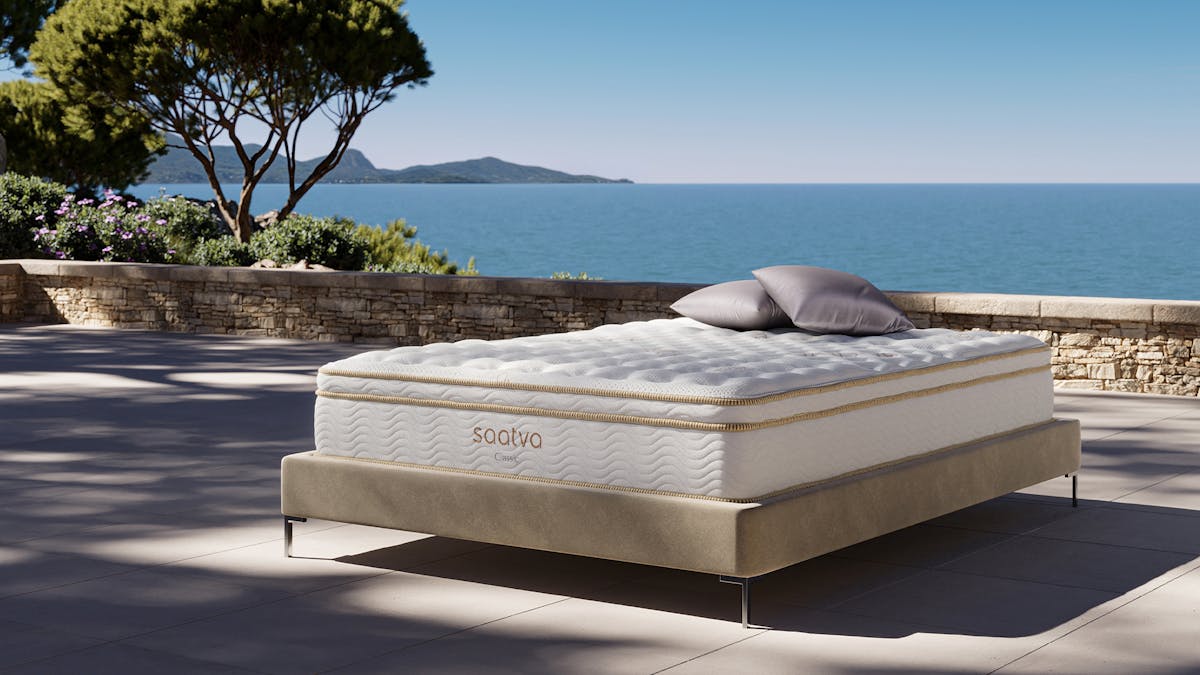
Saatva Zenhaven
9.2/10
- 100% American Talalay natural latex, GREENGUARD Gold certified
- Flippable design: Luxury Plush (4/10) on one side, Gentle Firm (6/10) on the other
- Naturally breathable, antimicrobial, and hypoallergenic construction
- Free white-glove delivery, setup, and old-mattress removal
- 365-night home trial and a lifetime warranty
- Premium price point compared to direct-to-consumer latex brands
- Latex has more bounce than memory foam, which some sleepers dislike
For shoppers comparing certified organic latex options, the Zenhaven sits above Sleep On Latex on build complexity, trial length, and warranty, at a higher price. Its flippable design gives two firmness options in one mattress, which is especially useful if you are unsure which latex feel suits you.
Check Zenhaven Price at Saatva
PlushBeds Botanical Bliss
8.9/10
- GOLS-certified Dunlop latex, GOTS-certified organic cotton and wool cover
- Thicker profile (10-12") with more customization options than Sleep On Latex
- 25-year warranty, one of the longest in the latex category
- Multiple firmness and height configurations
- Significantly pricier than Sleep On Latex for similar core certifications
- 100-night trial is shorter than Saatva's 365 nights
PlushBeds sits in the middle ground between Sleep On Latex and Zenhaven: same certification tier as SOL but with thicker build, better warranty, and more firmness choices. Worth the premium over SOL if you want a thicker latex profile or greater customization.
Sleep On Latex: brand overview
Sleep On Latex was founded around a single mission: make natural latex mattresses accessible without the marketing markup of premium brands. The brand sells primarily through its own website and Amazon, publishes detailed information about its Dunlop latex sourcing and certifications, and has earned a loyal following among latex enthusiasts who prioritize organic credentials over brand prestige. Customer service is well-regarded, and the brand's transparency about materials stands out in a category often full of vague sourcing claims.
Sleep On Latex occupies a specific niche: GOLS and GOTS certified natural Dunlop latex at prices significantly below brands like PlushBeds or Avocado, without sacrificing material quality. For buyers who want legitimate certified organic latex but find premium latex brands out of budget, Sleep On Latex is worth serious consideration.
Construction and specs
Sleep On Latex mattresses use natural Dunlop latex throughout. Dunlop is the traditional processing method, poured and baked in a single pass, producing a denser and more uniform material than Talalay latex. The result is a firmer feel at equivalent ILD ratings, which buyers should factor into firmness selection.
- Latex type: 100% natural Dunlop latex, GOLS certified
- Cover: Organic cotton, GOTS certified
- Layers: 3" comfort layer + 6" support layer (9" total, standard model)
- Firmness options: Soft, Medium, Firm (each layer available separately for split customization)
- Height: 9" total, thinner than many competitors in this category
- Warranty: 10 years
- Trial: 100 nights
- Price (queen): approximately $799 to $999 depending on firmness and sale timing
Certifications
Sleep On Latex carries the full trifecta of organic and safety certifications for a latex mattress:
- GOLS (Global Organic Latex Standard), the latex core meets organic sourcing and processing standards
- GOTS (Global Organic Textile Standard), the organic cotton cover meets textile organic standards
- OEKO-TEX Standard 100, the finished mattress is tested for harmful substances
Very few mattresses at Sleep On Latex's price point achieve all three certifications. Brands charging twice as much for comparable organic construction do not always offer a meaningfully better certified product, the certifications themselves are identical. See our organic mattress certification guide for a full breakdown of what each certification covers and what it does not.
Feel and performance
Pressure relief
Dunlop latex provides excellent pressure relief through what is called progressive resistance: it compresses and pushes back proportionally, reducing hip and shoulder pressure without the full sinkage of slow-response memory foam. Side sleepers do well on Medium or Soft; back sleepers on Medium or Firm. The feel is distinctly different from foam, with a buoyant responsiveness rather than an enveloping cradling sensation.
Temperature regulation
Natural latex sleeps significantly cooler than any foam. GOLS-certified Dunlop latex has a naturally open cell structure with integrated air channels that resist heat buildup. Hot sleepers who want a foam-adjacent feel with better temperature regulation consistently prefer latex over memory foam. Sleep On Latex performs comparably to more expensive latex brands in this dimension, as cooling is a function of the material itself, not the price tier.
Motion isolation
Latex has good but not exceptional motion isolation. It performs better than innerspring but not as well as memory foam. Couples where motion isolation is the top priority should lean toward memory foam or a pocketed-coil hybrid rather than all-latex. For most couples, the difference is acceptable.
Edge support
Sleep On Latex's 9" profile means less mattress depth overall, and the edges compress more noticeably than on a thicker hybrid. This is a minor limitation for sleepers who use the full mattress surface, including sitting on the edge. It is not a disqualifying issue but worth noting for buyers who share a smaller mattress.
Price vs the competition
The value case for Sleep On Latex rests on its certification-to-price ratio:
- Sleep On Latex Pure Green (queen): ~$799 to $999
- PlushBeds Botanical Bliss (queen): ~$1,699 to $2,099
- Avocado Green (queen): ~$1,699 and up
- Saatva Zenhaven (queen): from $1,995
Sleep On Latex offers GOLS and GOTS certified construction at roughly half the price of comparable competitors. For buyers who prioritize certifications over brand prestige, additional features like a pillow top or Talalay comfort layers, or extended trial periods, Sleep On Latex's value is difficult to beat at this certification level.
Limitations
- 9" total height is thinner than most competitors, may feel less substantial, and edge support is correspondingly less robust
- No pillow top option, pure latex only, without the quilted comfort layer that brands like PlushBeds or Zenhaven include
- Limited firmness customization compared to brands offering zoned or dual-sided models; layers can be swapped but the mattress is not designed as a hybrid with coil support
- Dunlop runs firmer than Talalay at equivalent ILD ratings, size down one level if a softer Talalay feel is your reference point
- 10-year warranty is shorter than PlushBeds (25 years) or Saatva (lifetime)
- 100-night trial is adequate but shorter than the 365-night trials Saatva offers
Who Sleep On Latex is best for
- Buyers who want GOLS and GOTS certified natural Dunlop latex at the most accessible price in the category
- Environmentally conscious shoppers who prioritize organic credentials without paying premium-brand premiums
- Hot sleepers who want the natural cooling of latex without moving to a full hybrid
- Back and side sleepers looking for buoyant pressure relief rather than deep foam sinkage
- Buyers comparing to PlushBeds who want the same organic certifications at a significantly lower price
Sleep On Latex is not the best fit for: couples who need top-tier motion isolation, sleepers who want a thick pillow-top feel, buyers who need a long warranty as part of the value equation, or anyone who wants the extended trial window that brands like Saatva provide.
Sleep On Latex is the strongest value in GOLS and GOTS certified natural latex at its price point. The primary tradeoffs are a thinner profile (9"), a 10-year warranty, and a bouncy Dunlop feel that not everyone prefers. If budget is the main constraint and organic certification is the priority, it earns its reputation. If budget allows, the PlushBeds Botanical Bliss offers more thickness and a 25-year warranty, and the Saatva Zenhaven adds Talalay latex, a flippable design, and a 365-night trial.
Frequently asked questions
Is Sleep On Latex a good mattress?
Yes, for buyers whose priority is organic certification at an accessible price. Sleep On Latex uses GOLS-certified natural Dunlop latex and a GOTS-certified organic cotton cover, achieving the same certification level as brands costing twice as much. The main tradeoffs are a thinner 9" profile, no Talalay option, and a 10-year warranty rather than the 25-year or lifetime warranties premium brands offer.
How does Sleep On Latex compare to PlushBeds Botanical Bliss?
Both use GOLS-certified Dunlop latex and GOTS-certified covers. PlushBeds offers thicker profiles (10 to 12"), Talalay comfort layer options, more firmness customization, and a 25-year warranty. Sleep On Latex costs roughly half as much for comparable certification levels. For buyers primarily motivated by organic credentials rather than build complexity, Sleep On Latex is the stronger value. For buyers who want a thicker, more customizable latex mattress and can stretch the budget, PlushBeds justifies its premium.
How does Zenhaven compare to Sleep On Latex?
Zenhaven uses American Talalay latex rather than Dunlop, which produces a lighter, more consistently aerated cell structure and a softer response at the same firmness rating. It is also flippable (two firmness options in one mattress), comes with a 365-night trial, and a lifetime warranty. It costs significantly more than Sleep On Latex, so the comparison comes down to budget and how much the trial length and warranty matter relative to price.
What firmness should I choose from Sleep On Latex?
Dunlop latex sleeps slightly firmer than Talalay at equivalent ILD ratings. Side sleepers should start with Soft or Medium. Back sleepers should start with Medium. Stomach sleepers should choose Firm. If you are choosing between two levels, Dunlop's tendency toward firmness suggests sizing down: choose Medium rather than Firm if a medium-firm feel is your target.
Is Sleep On Latex safe for people with latex allergies?
Natural latex protein levels are reduced through washing during the Dunlop process, and reactions to finished latex mattresses are rare in the general population. However, anyone with a confirmed latex allergy should consult their doctor before purchasing any latex mattress, regardless of processing method. People with general rubber sensitivities rather than a true latex allergy typically tolerate natural Dunlop latex without issues.
Is organic latex worth paying extra for?
For chemically sensitive sleepers and those with specific health concerns, GOLS certification rules out pesticide residues and processing chemicals in the latex core. For the broader population, the performance difference between natural non-organic latex and GOLS-certified organic latex is marginal, both are naturally hypoallergenic and durable. The certification has more environmental and ethical value than it does performance value for the average sleeper.