
 by
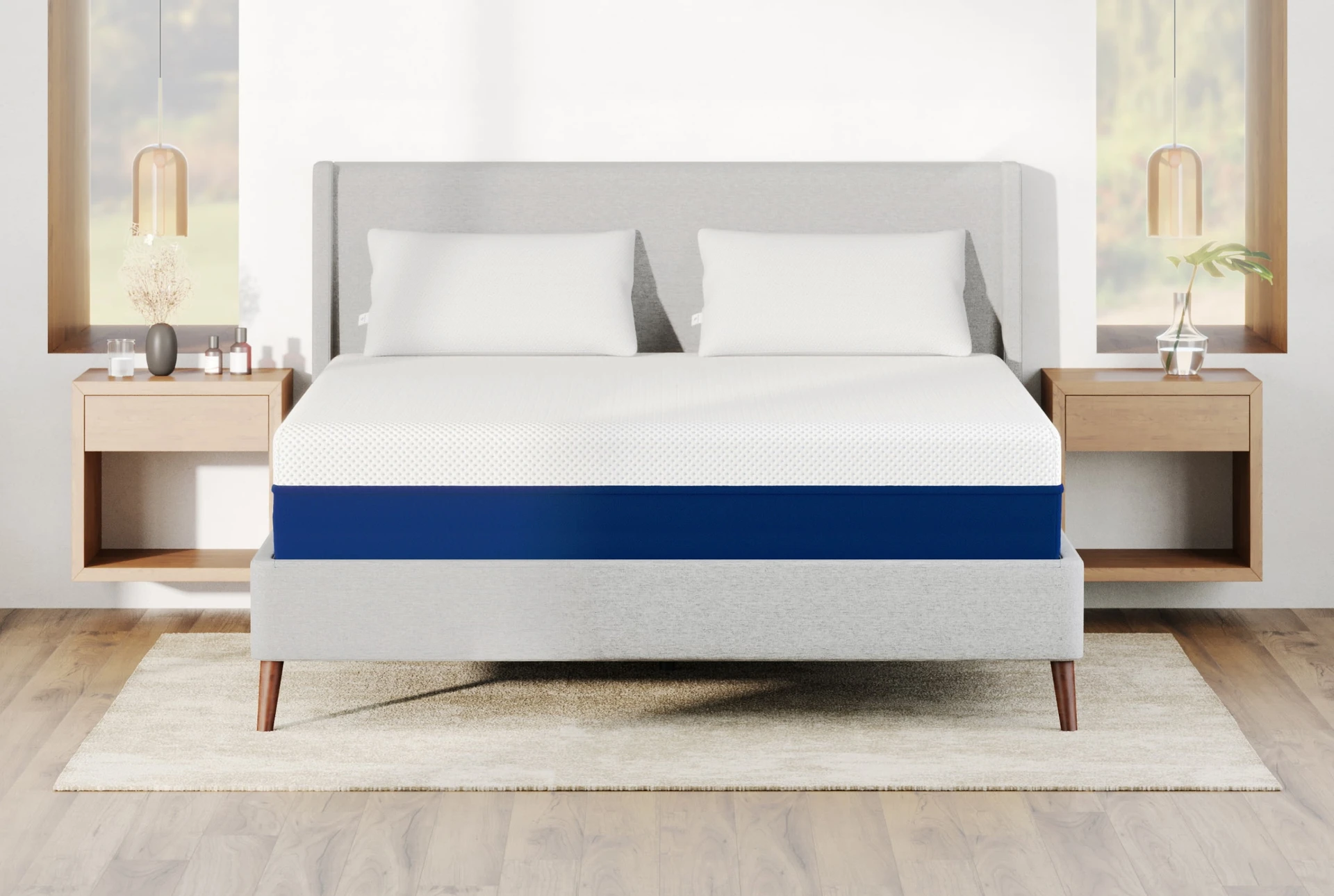
by Our first recommendation for a medium-firm foam option for heavier sleepers with back pain is the Amerisleep AS2. Amerisleep publishes no weight limit per side. Ask about suitability for your body weight and foundation before ordering.
Amerisleep AS2

The AS2 is a 12-inch all-foam mattress with a medium-firm feel.
Check how the edge and center feel under your weight, rather than relying on the firmness label alone. A mattress does not treat back pain.
Why heavy sleepers experience more back pain
Body weight is the single biggest variable in how a mattress performs. A 150-pound sleeper and a 280-pound sleeper lying on the same mattress have completely different experiences. The heavier sleeper compresses comfort layers more rapidly, reaching the support core faster, and if that core is not built to handle the load, the sleeper sinks past the point where the spine stays neutral.
The lumbar spine is especially vulnerable. When the hips sink deeper than the shoulders, the lumbar curves out of alignment. Over six to eight hours, that misalignment creates muscle strain, disc compression, and the kind of dull morning stiffness that heavier sleepers know well. A mattress that provides adequate support for a 160-pound person can actively cause back pain for someone 100 pounds heavier on the same model.
There is also the durability factor. Cheap mattresses sag at the center within 12 to 18 months under higher body weight. A sagging mattress is arguably worse than a too-firm one for back pain, because the sag creates a hammock effect that locks the spine into flexion all night.
Why all-foam mattresses often fail heavy sleepers with back pain
Memory foam and polyfoam mattresses have real structural limits for heavier bodies. Even high-density foam compresses significantly under 230 or more pounds of sustained pressure, and heavy sleepers often sink too far into the foam, losing the spinal support the mattress was supposed to provide.
All-foam mattresses also trap heat more than hybrids, and heavy sleepers already tend to sleep warm. Add the fact that foam edges compress quickly under higher loads, and the case becomes clear: for heavy sleepers with back pain, a well-engineered hybrid or innerspring is almost always the better structural choice.
What to look for in a mattress for heavy sleepers with back pain
Coil gauge and count. Thicker coils (12 to 13 gauge) resist compression better than the thinner 15 to 16 gauge coils found in budget mattresses. More coils per square inch means more granular support and less dipping around the lumbar region.
Verified weight rating. Most standard mattresses are rated to 250 to 300 lbs per side. If you weigh more than that, look for mattresses with explicit higher ratings. The Saatva HD is rated to 500 lbs per side, which means the support system is engineered for your load, not just tolerating it.
Firmness in the 6.5 to 7.5 range. Medium-soft options let heavier sleepers sink past the neutral-spine zone. A firm to medium-firm feel provides enough resistance to keep the lumbar in alignment. Side sleepers on the heavier end may want to stay closer to 6.5; back and stomach sleepers should consider 7 to 7.5.
Zoned lumbar support. Some mattresses use different coil tensions or foam densities across zones, firmer under the hips and lower back, slightly softer under the shoulders. For back pain sufferers, this zoning is one of the most valuable structural features available.
Edge support. Strong, reinforced perimeter coils keep the usable sleep surface consistent across the full mattress width. For heavier couples especially, weak edge support effectively shrinks the bed.
Top picks compared
| Mattress | Type | Weight rating | Firmness | Trial | Why it works |
|---|---|---|---|---|---|
| Amerisleep AS2 | All-foam, 12 in | No published limit per side | Medium-firm | 100 nights | Medium-firm foam feel |
| Saatva HD | Hybrid (dual coil) | 500 lbs/side | Medium-firm 6.5 | 365 nights | Dual tempered coils, lumbar zone, micro-coil comfort layer |
| Puffy Lux Hybrid | Hybrid (foam + pocketed coils) | Standard | Medium 5-6 | 101 nights | Pressure relief + coil support, lifetime warranty |
Saatva HD
8.7/10
- Engineered specifically for heavy sleepers, not a "plus" retrofit of a standard model
- Lumbar zone enhancement targets the center third for targeted lower-back support
- Micro-coil comfort layer relieves shoulder and hip pressure without creating sinkage at the lumbar
- Best-in-class edge support for heavy sleepers, full usable surface to the perimeter
- Free white-glove delivery, setup, and old mattress removal
- Heavier and ships flat (not roll-packed), requires white-glove delivery coordination
- $99 return fee if returned during the 365-night trial
The Saatva HD is our runner-up for heavy sleepers with back pain who want a mattress with a published weight rating. The dual coil system handles loads that standard hybrids cannot, while the lumbar zone pad addresses the specific failure mode that causes morning pain in heavier bodies.
Firmness by sleep position for heavy sleepers
Back sleepers at 230 or more pounds generally do best in the 7 to 7.5 range. The goal is to keep the lower back from sinking while allowing the natural lumbar curve to be supported rather than flattened. A too-soft mattress lets the pelvis tilt backward, flattening the lumbar curve and creating strain on the posterior ligaments.
Side sleepers at 230 or more pounds need slightly more give at the shoulder and hip to prevent pressure buildup, but still need enough resistance to prevent the hip from sinking so far that the spine curves sideways. A 6.5 medium-firm is generally the right zone. The Saatva HD's micro-coil layer handles this well, while the Puffy Lux Hybrid offers a softer alternative for those who prioritize contouring.
Stomach sleepers who are heavy and have back pain face the most challenging setup. Stomach sleeping puts the lumbar spine into extension, and if the midsection sinks below the chest and legs, that extension becomes hyperextension. A firm 7 to 7.5 mattress with a strong lumbar zone is the minimum requirement.
For a complete breakdown, our firm vs. medium-firm mattress guide covers the differences in detail.
Puffy Lux Hybrid
8.7/10
- Pocketed coil core provides better airflow and edge support than all-foam builds
- Adaptive cloud foam comfort layer contours under heavier shoulders and hips without full sinkage
- Lifetime warranty covers the mattress for as long as you own it
- Motion isolation strong enough for couples with different sleep schedules
- Not purpose-built for sleepers over 300 lbs as the Saatva HD is
- Medium feel may be too plush for strict stomach sleepers on the heavier end
The Puffy Lux Hybrid is the best middle-ground option for heavy sleepers who want the contouring feel of foam with the structural support of a pocketed coil system. Its lifetime warranty and 101-night trial make it a low-risk upgrade from an underperforming all-foam mattress.
How long will a heavy-duty mattress last?
A well-built heavy-duty hybrid like the Saatva HD should maintain its support characteristics for 8 to 10 years under higher weight loads. Standard mattresses often sag noticeably within 3 to 5 years for heavy sleepers, especially in the center sleep zone where most body weight concentrates.
Durability is directly tied to material quality: tempered steel coils hold their shape better than non-tempered ones; high-density foam resists compression better than low-density. A mattress that maintains its profile over time is one that continues to support the lumbar correctly, which matters for back pain more than almost any other feature.
For more options across body types, see our guides to the best mattresses for heavy people and the best mattress for back pain. If budget is a factor, our best mattress deals page tracks current promotions.
Frequently asked questions
What firmness mattress is best for a heavy person with back pain?
For most heavy sleepers with back pain, a medium-firm to firm range, roughly 6.5 to 7.5 on a 10-point scale, provides the right balance of support and pressure relief. Back and stomach sleepers tend to need the higher end of that range; side sleepers generally do better toward 6.5. The goal is to keep the lumbar spine neutral without letting the hips sink past the shoulders.
Is a hybrid or foam mattress better for a heavy person with back pain?
Hybrids are almost always better for heavy sleepers with back pain. All-foam mattresses compress more under higher weight loads over time, reducing support. Coil-based systems provide more durable support, allow for better airflow (important since heavy sleepers tend to sleep warmer), and maintain edge support better than foam perimeters. Latex hybrids are a solid middle-ground option since natural latex resists compression well and does not trap heat the way memory foam does.
What weight rating should a mattress have for a 300-pound person?
Look for a per-side rating of at least 300 to 350 lbs if sleeping alone, and ideally higher. For couples where one partner weighs 300 lbs or more, a per-side rating of 400 to 500 lbs provides a real safety margin. The Saatva HD's 500 lbs per side rating is one of the highest available and is specifically designed for this use case.
How do I know if my mattress is causing my back pain?
Several signs point to the mattress as a contributing factor: you wake with stiffness that improves after 20 to 30 minutes of moving around; the center of your mattress has a visible sag or body impression; you sleep better in other beds; or your mattress is more than 7 to 8 years old and you have gained significant weight since purchasing it. Heavy sleepers accelerate mattress wear, so a mattress that was fine three years ago may no longer be providing adequate support today.
Can a heavy person use the Amerisleep AS3?
Amerisleep publishes no weight limit per side for the AS3. Assess support, ease of movement and edge comfort during the trial, and ask about suitability for your weight and foundation. The AS5 Hybrid is a soft option, so switching to it does not mean choosing a firmer bed.
Our first choice is the Amerisleep AS2. The AS2 remains our first medium-firm foam option. Compare support and ease of movement during the trial.
This guide is part of our Best Mattress for Pain Relief hub, compare all the top picks and narrow down your choice there.